

WRPRO Review: Account Tiers, Trading Costs and Withdrawal Conditions
WRPRO sells a tiered CFD trading experience. Its menu ranges from Classic through Bronze, Silver, Gold and Diamond, with account managers, research access and increasingly favorable advertised spreads. That looks familiar at first glance. The useful story, however, begins once a trader asks what each tier costs in practice, how its benefits are measured, and which entity is responsible for withdrawals. Trading a leveraged contract is complicated enough without adding ambiguity about deposit thresholds, overnight charges or where profits are sent. This review examines the terms that materially affect those decisions, including the difference between the broker’s ‘no withdrawal fee’ claim and the wider payment process.
The company markets more than 500 CFD instruments across forex, metals, indices, commodities, stocks and cryptocurrencies, as well as charting and educational tools. It has a Mauritius-based regulated operator and presents Cyprus-based company information elsewhere in its legal disclosures. Those facts deserve a precise reading. A Cyprus address, representative or paying agent is not the same as a Cyprus-regulated broker relationship. A five-tier account table is not a price guarantee on every instrument. And a swap-free option does not always mean cost-free overnight positions for an unlimited period. These are the questions that determine whether WRPRO is suitable for a specific trader.
Who WRPRO is built for
The platform’s feature list is aimed at people who want a guided path into trading rather than a bare-bones, low-cost terminal. Account-manager access, daily market analysis, an education center and trading signals feature heavily in its public account comparisons. That can be useful to someone who is still developing a repeatable decision process. A more experienced trader might care much less about these services and much more about price, fill quality, spreads across the instruments traded and the exact amount charged for holding a position overnight. WRPRO therefore needs to be assessed from two angles: the service value of a tier and its measurable trading economics.
The tier system also creates a potential behavioral issue. Traders may feel pressure to move up solely because a higher level appears to promise a smaller spread and more personal attention. Higher status is not itself evidence that account economics improve. A trader who enters just a few small positions per month may not recover any meaningful savings from a tier that requires a materially larger balance. A high-volume user could have a different experience. Without a complete, instrument-specific pricing schedule and clear eligibility requirements, the promotional ladder remains a useful starting point, not a final purchasing decision.
Five account tiers: what is publicly specified
WRPRO’s account page lists Classic, Bronze, Silver, Gold and Diamond. The Classic level uses default spreads as shown on the platform and advertises leverage up to 1:100. Bronze says spreads are 20% lower than Classic and leverage up to 1:200. Silver advertises 40% lower spreads and leverage up to 1:300. Gold advertises 60% lower spreads, leverage up to 1:400 and additional signals. Diamond advertises spreads as low as 0.6 pips, leverage up to 1:500 and unlimited trading signals. The list also emphasizes differing service access, including analysis and contact with trading staff at higher levels.
What it does not provide in the headline table is a universal minimum deposit for every tier, a guaranteed spread at every moment or a complete statement of all costs for each instrument. That is an important distinction. ‘60% less than Classic’ is a relative claim. If a spread on a particular instrument is 2.5 pips at one time, a 60% discount would suggest 1.0 pip under comparable conditions; it does not tell you that this figure will prevail through news, overnight sessions or volatile markets. Similarly, ‘as low as 0.6 pips’ is a floor-style advertisement, not an all-day average or binding maximum.
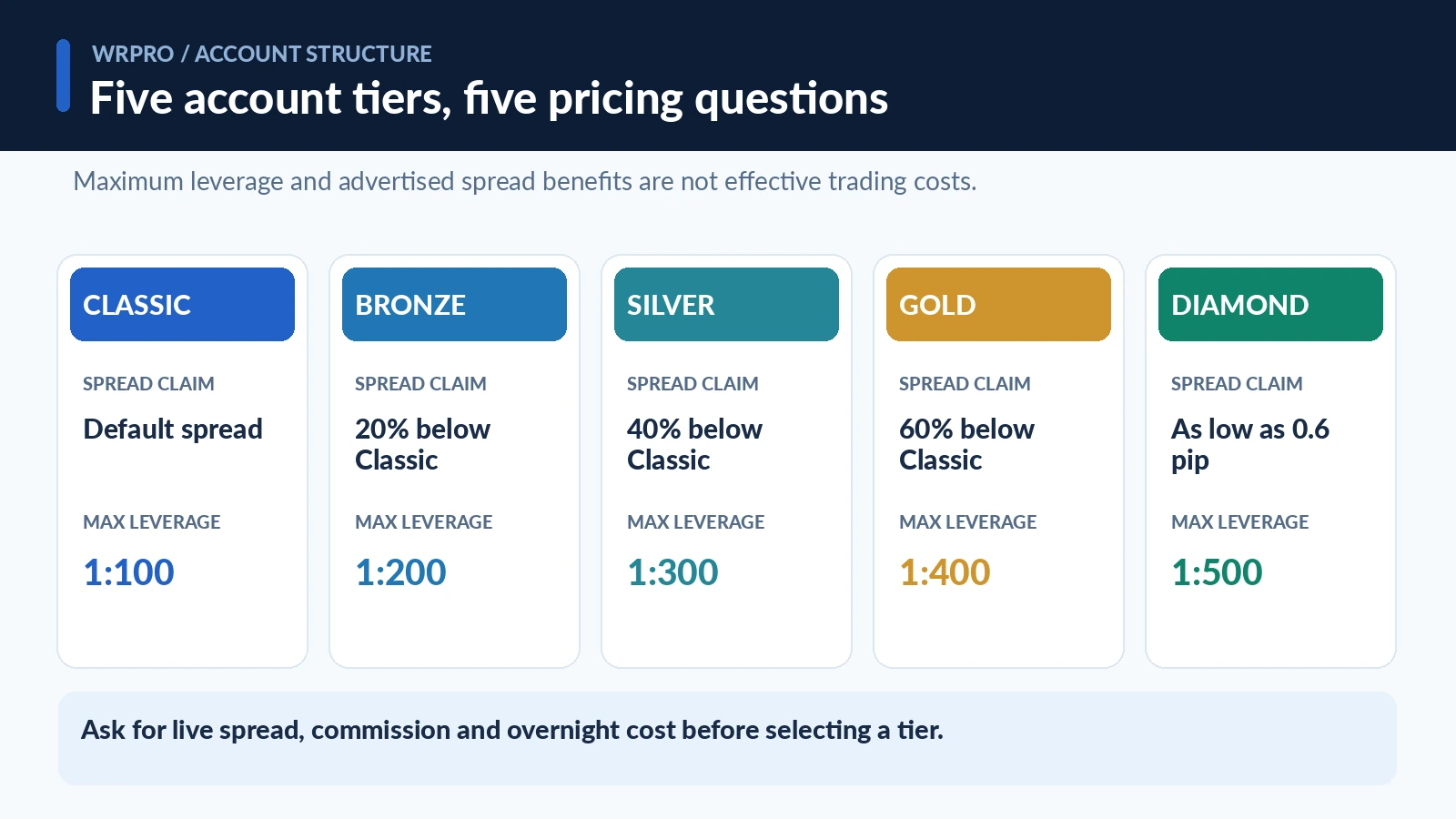
Before choosing a tier, request three documents: the live contract specifications for the instruments you intend to trade, the tier’s eligibility conditions and a fee schedule explaining every commission and non-trading charge. If the representative quotes a minimum deposit, ask whether it is a requirement to open the account, a condition to retain the tier or a threshold for a promotional package. These questions are more useful than simply asking whether the Diamond tier is ‘best’. The account table explains relative positioning; it cannot replace a personalized cost assessment.
Calculating the actual cost of a CFD order
A CFD’s trading cost typically includes the spread, any separate commission and overnight financing where relevant. Additional costs can arise from currency conversion or payments. The first calculation should be straightforward. Assume an illustrative 100,000-unit EUR/USD transaction in a USD-denominated account, where one pip is approximately $10. A 2.0-pip spread represents about $20 of immediate spread cost. If the comparable spread were 1.2 pips, the calculation becomes about $12. The difference is $8 per round trip under the same market and position assumptions. The calculation shows why spreads matter, but it does not establish WRPRO’s actual live pricing for those orders.
The more important question is whether a trader’s typical method is sensitive to that $8 difference. A strategy targeting 10–15 pips will feel spread friction much more than one targeting a very large move. Repeated transactions magnify it as well. Twenty identical round trips at a $20 entry-exit spread cost are roughly $400 of transaction friction before other charges; the $12 scenario is roughly $240. If spreads widen at the hours when the strategy trades, a back-of-the-envelope comparison using the broker’s minimum advertisement can substantially understate the realized cost.
For anyone trading metals, crypto CFDs or stock CFDs, a forex pip model may be inappropriate. Contract sizes, price units and commission formulas differ. Ask for a worked example using the precise instrument, lot size, account base currency and position duration. A reliable quote should make clear whether commission is charged per side or as a round turn and whether swap applies once per day or has special rollover conventions. Comparing different instruments as if they all use the same lot economics is one of the easiest ways to underestimate CFD costs.
Overnight charges and the ‘swap-free’ question
WRPRO promotes an Islamic swap-free account option. That can be useful for eligible clients, but the published terms contain an important operational qualification. The firm’s terms state that qualifying Islamic accounts are free of overnight fees during the first five days a position is open; from the sixth day a $10 per lot per night storage fee can apply, with a threefold weekend treatment described. The document also limits eligibility to Muslim clients providing the required evidence. A person opening a regular account should not interpret the existence of this option as a general waiver of overnight financing.
This is a substantial issue for strategies that retain positions for weeks. Imagine, strictly as an example, a single full-lot position held long enough to incur four nights of a $10 storage charge after the initial period. That is $40 before considering special weekend multipliers, changes in the terms or other instrument-specific effects. A trader could save a small amount on the advertised spread and still incur materially higher financing costs over the life of the trade. The proper comparison is spread plus commission plus holding cost, not spread alone.
A second complication is that ordinary swap rates may differ for long and short positions. They can change as market rates and broker parameters change. Some instruments have a triple rollover day or other calendar conventions. Clients should inspect the actual trading terminal’s current specifications and ask how fees are posted in the account statement. The fact that a promotional page calls a category ‘swap free’ is less useful than knowing exactly when, why and how an administrative fee begins.
Leverage: tier perk or risk multiplier?
The public ladder raises advertised maximum leverage from 1:100 at Classic to as much as 1:500 at Diamond. Higher leverage allows the same nominal exposure with a smaller margin deposit, but it does not improve the price of an underlying asset or lower the risk of the position itself. If a $10,000 position moves against a trader by 2%, the mark-to-market loss is $200 before fees regardless of whether the initial margin requirement was $100, $200 or $1,000. Lower margin simply makes it easier to accumulate more exposure relative to account equity.
That is why traders should separate available leverage from chosen leverage. A higher tier could provide flexibility that a disciplined trader never fully uses. That can be beneficial if margin requirements are dynamic, but it should not become an excuse for oversized positions. The risks of slippage, gap moves and liquidation also become more urgent as free equity falls. Retail CFD safeguards in Europe cannot simply be assumed to govern an account issued by a Mauritius-regulated company. Users must examine the actual margin-closeout and negative-balance terms for their agreement, not import expectations from a different jurisdiction.
The legal entity behind the trading account
WRPRO identifies its operator as GMBB Investment Ltd, a Mauritius company registered under number 195321. Its legal and regulation pages state that the firm holds an FSC Mauritius Investment Dealer licence GB22201139, described as a full-service dealer authorization excluding underwriting. That is the legal claim to verify. The website also names GMBB Investments CY Ltd, a company incorporated in Cyprus under number HE 445963, in the capacity of representative or paying agent. WRPRO’s regulation page specifically distinguishes that representative from the company providing regulated investment services.
This structure matters because readers sometimes equate a Cyprus company appearing in paperwork with a European investment-firm authorization. The two are not equivalent. The operator’s Mauritius licence is the relevant published investment-dealer reference. The Cyprus representative may assist with specified operational or payment functions, but it should not be described as the counterparty to every CFD or as the source of EU retail protections. Users should record the legal name in their agreement, the governing law and the complaints procedure associated with their account. The broker’s website also lists numerous restricted markets, including the United States, Canada, several EU countries and others.
A reasonable review credits WRPRO for placing entity names and regulatory references in public view, while also acknowledging that cross-border structures create extra work for prospective clients. Registration and licences are factual references, not guarantees of trading performance or refund outcomes. A trader who cannot obtain an understandable answer about where funds are held, who handles client complaints and who issues the CFD contract should not let an attractive marketing tier override those unresolved questions.
Deposits, withdrawals and the $50 minimum
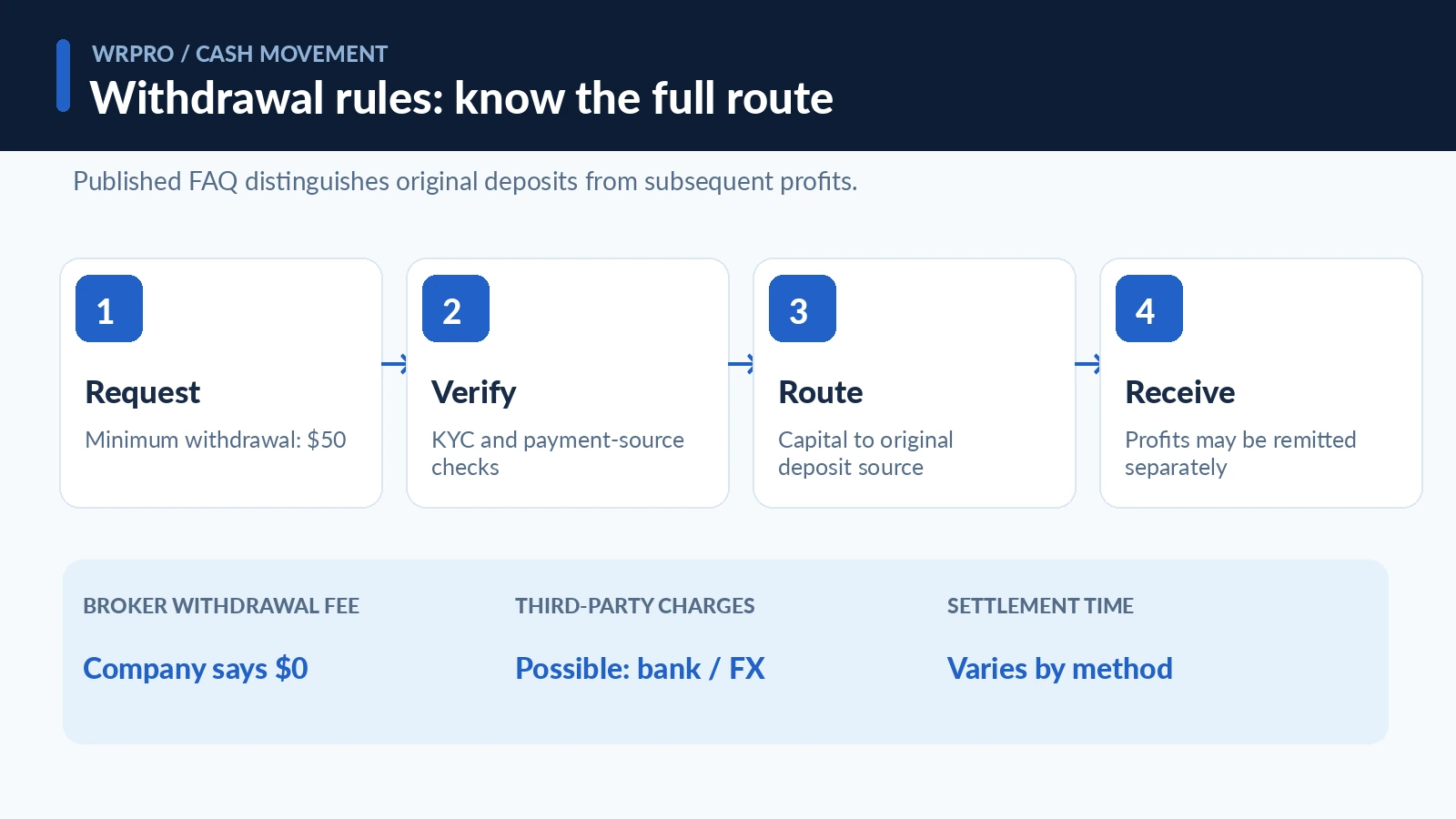
The WRPRO FAQ states that the minimum withdrawal is $50 and that the company does not charge deposit or withdrawal fees. This is useful information but not a promise that every funding path will be entirely costless. Banks and payment intermediaries may apply their own fees, conversion costs or card-related adjustments. A clear withdrawal budget distinguishes the broker’s stated fee from charges imposed elsewhere. Traders should also check whether the selected funding method is available in their country and whether the receiving bank accepts the transaction currency.
The FAQ makes another point that deserves more attention: capital and profits may be returned through different routes. It says capital is sent back to the deposit source, up to the amount deposited, while profits are sent separately. Where multiple deposit sources were used, the broker describes allocation according to the order and amounts of the original deposits. This can surprise a trader expecting all proceeds to arrive through one new bank account. It is consistent with the kind of source-of-funds controls often found in financial services, but it creates practical questions. What if a deposit card has expired? Which documents prove ownership of the replacement destination? How are profits handled where certain payment channels cannot receive them?
Before funding, users should verify identity and address documentation, method-specific minimums, the withdrawal review process and realistic arrival times. WRPRO’s public FAQ confirms KYC requirements; it does not establish a universal guaranteed bank settlement date for every market. A pending withdrawal is not necessarily evidence of misconduct, but prolonged opacity over an eligible request deserves escalation through the documented complaints process. Keep confirmations, statements and messages so the issue can be reviewed on facts rather than recollection.
What traders should ask before choosing a higher tier
The economic case for an upgrade should be measurable. Ask the broker for average spreads during your trading hours, not only the smallest spread the platform has displayed. Request an estimate for the same instruments at your current and proposed tier. If a higher tier advertises more signals, ask how third-party signals are selected, whether they carry any additional charge and whether they represent independent research or a marketing service. WRPRO’s own account page notes that signals are supplied by specialist third parties and should not be treated as personalized advice.
Account-manager access raises a related issue. Support is valuable when helping explain a platform setting or solve a transfer problem. It should not be confused with a guarantee that a representative’s trading suggestions will be suitable, unbiased or profitable. If a representative emphasizes adding funds to unlock a better tier, request the conditions in writing and calculate how much cost reduction would actually result. Avoid choosing a larger deposit purely to secure a more impressive-sounding service package.
Pros and cons that materially change the verdict
WRPRO’s strengths include a broad CFD catalog, a straightforward five-level ladder of research and service features, clear publication of its Mauritius operating company and a relatively direct FAQ on minimum withdrawals and broker-level payment fees. It also provides material suitable for beginners who want education and structured market coverage rather than a purely technical interface. Those are genuine reasons a potential client might consider the platform, subject to regional eligibility.
The drawbacks are not cosmetic. The account table omits enough all-in pricing detail that a direct like-for-like cost comparison remains harder than it should be. A minimum spread does not describe spread quality through a volatile day. Leverage increases sharply across tiers, creating a temptation to increase position size. Islamic ‘swap-free’ accounts can incur a storage fee after an initial period. And the distinction between a Mauritius broker and a Cyprus representative must be understood clearly. These issues do not prove the platform is unsuitable for everyone; they do mean a careful client has more homework than the marketing page suggests.
A practical scenario: the same trader, two tiers
Imagine a trader using one standard EUR/USD lot for ten monthly round trips, holding positions intraday and assuming no commissions for the purpose of the example. If the effective spread were 2.0 pips, spread friction would be about $200 for the month. At an effective 1.0 pip, it would be about $100. The difference is $100 over the same number of transactions. Now imagine the trader rarely exceeds two round trips per month. The potential saving falls to around $20. A tier with higher funding requirements could therefore be economically useful for one person and irrelevant for another. These are arithmetic examples; WRPRO’s actual conditions must be taken from the appropriate account specifications.
Change only one variable and the answer may reverse. If trades remain open across several rollover periods, overnight financing may outweigh spread savings. If execution slippage worsens during the trader’s chosen news releases, minimum advertised spreads may have little bearing on results. And if a currency-conversion step is required to withdraw profits, payment economics can reduce the net outcome further. The core lesson is simple: model your real workflow, not an idealized one-lot example selected by a sales page.
Final assessment
WRPRO is a service-oriented CFD brand with an identifiable Mauritius investment-dealer operator and a tier menu that may suit clients seeking education and account support. Its public withdrawal FAQ contains useful operational detail, especially the $50 minimum and split treatment of deposited capital and profits. But the strongest recommendation is conditional rather than promotional: select the account only after confirming effective spreads, holding charges, leverage terms, eligibility and funding rules for your jurisdiction. The platform has meaningful features, yet it leaves enough pricing questions open that cost-sensitive or long-horizon traders should be particularly careful before committing larger balances.
Frequently asked questions
Is WRPRO regulated in Cyprus?
WRPRO states that its investment-services operator is GMBB Investment Ltd, licensed by the Mauritius FSC under GB22201139. Its Cyprus company is described as a representative or paying agent, not the operator of a CySEC-regulated CFD account.
Which account advertises the tightest spreads?
The Diamond tier advertises spreads as low as 0.6 pips. That should not be read as a guaranteed all-day spread across all markets. Compare live specifications and total costs.
What is the minimum withdrawal on WRPRO?
The published FAQ states $50. It also says the company does not charge its own deposit or withdrawal fees, though third-party and conversion charges may still matter.
Does WRPRO offer genuinely unlimited swap-free holding?
Its Islamic-account terms describe an initial fee-free period and subsequent storage charges. Eligibility and exact conditions need to be verified before relying on that feature.
Why might capital and profits reach different destinations?
The broker’s FAQ explains that initial capital can be returned to the original deposit source while profits are sent separately, reflecting the account’s funding history and payment controls.
Sources and further reading

Croom Raymond is an ecommerce writer and digital business researcher at Ecom Reality. He covers online selling platforms, SaaS tools, pricing structures, platform features, and practical strategies for building digital businesses. His articles focus on clear, evidence-based analysis that helps readers understand how different services work, compare their advantages and limitations, and make more informed business decisions.
Comments
Related Articles



Leave a Reply