
VCG Markets combines a familiar trading terminal with a less familiar proposition: a tool that evaluates how a trader makes decisions, not only whether the latest trade was profitable. The broker offers access to multi-asset CFD markets and MetaTrader 5, while its VCG ONE feature analyzes trading history for behavioral patterns involving discipline, position sizing and risk control. The platform also publishes a relatively direct Terms and Fees page, saying trading commission and custody fees are free in the stated conditions while spreads are variable and overnight funding can apply. That makes the brand more interesting than a brokerage review built around one minimum-spread claim.
The answers determine whether VCG Markets is genuinely suitable for a particular trader. This review focuses on those practical distinctions and the costs and limitations that deserve attention before funding.
What VCG Markets offers and how the business is structured
The public VCG Markets site describes trading access through mobile, desktop and web, together with broker-account tools for monitoring positions, instruments and funding. Its marketing includes currency pairs and other leveraged CFD categories. The legal section identifies two regulated trading businesses: VCG Markets Ltd, incorporated in Mauritius and regulated by the Financial Services Commission, license GB22200388, and VCG Markets (Seychelles) Ltd, regulated by the Financial Services Authority of Seychelles, license SD243. The site also names VCG Tech Limited in Cyprus as the website operator and merchant company handling payment processing.
These facts should be interpreted carefully. A payments company located in Cyprus is not automatically the investor’s CySEC-regulated CFD counterparty. Likewise, a broker website that lists Mauritius and Seychelles entities does not mean one client necessarily has a contract with both. The company delivering trading services and the company processing a deposit can perform different roles. The appropriate documents should specify which trading entity is responsible for the position and which rules govern custody, margin and client complaints.
For someone comparing offshore-regulated brokers, the transparency of naming these entities is a positive. The trade-off is that consumer protections can differ from those associated with a UK or EU investment firm. It is not enough to see a license number in a footer; an applicant should match the company name, license and product permissions, then read the client agreement relevant to the account being opened.
MetaTrader 5: why a mainstream terminal matters
MetaTrader 5 is one of the most familiar retail trading environments. Its appeal is practical: price charts, technical indicators, multi-asset watchlists, order tickets and position-management functions live inside a widely understood software ecosystem. For experienced traders, familiarity reduces unnecessary friction. Established chart routines and account monitoring habits do not have to be abandoned when comparing another broker. MT5 also has a substantial community of education and automated-trading tools, although actual availability depends on broker settings and the trader’s own software.
At VCG Markets, the important consideration is whether the desired instrument list and execution conditions are enabled on the live account. The existence of MT5 does not guarantee a specific CFD is offered, the same contract size as a competitor or unrestricted algorithmic trading. An index with a proprietary contract value may require very different position sizing from an FX pair. Traders should inspect symbol specifications, trading sessions, swaps, stop distance and margin before copying an old strategy to a new account.
A demo or small controlled test can be useful for understanding the interface, but the actual live cost model remains central. The MetaTrader ticket displays current prices and gives access to orders; it does not decide whether the spread is competitive or whether a particular offshore legal agreement is appropriate. Platform quality and broker obligations belong in separate columns of the decision.
What VCG ONE actually is
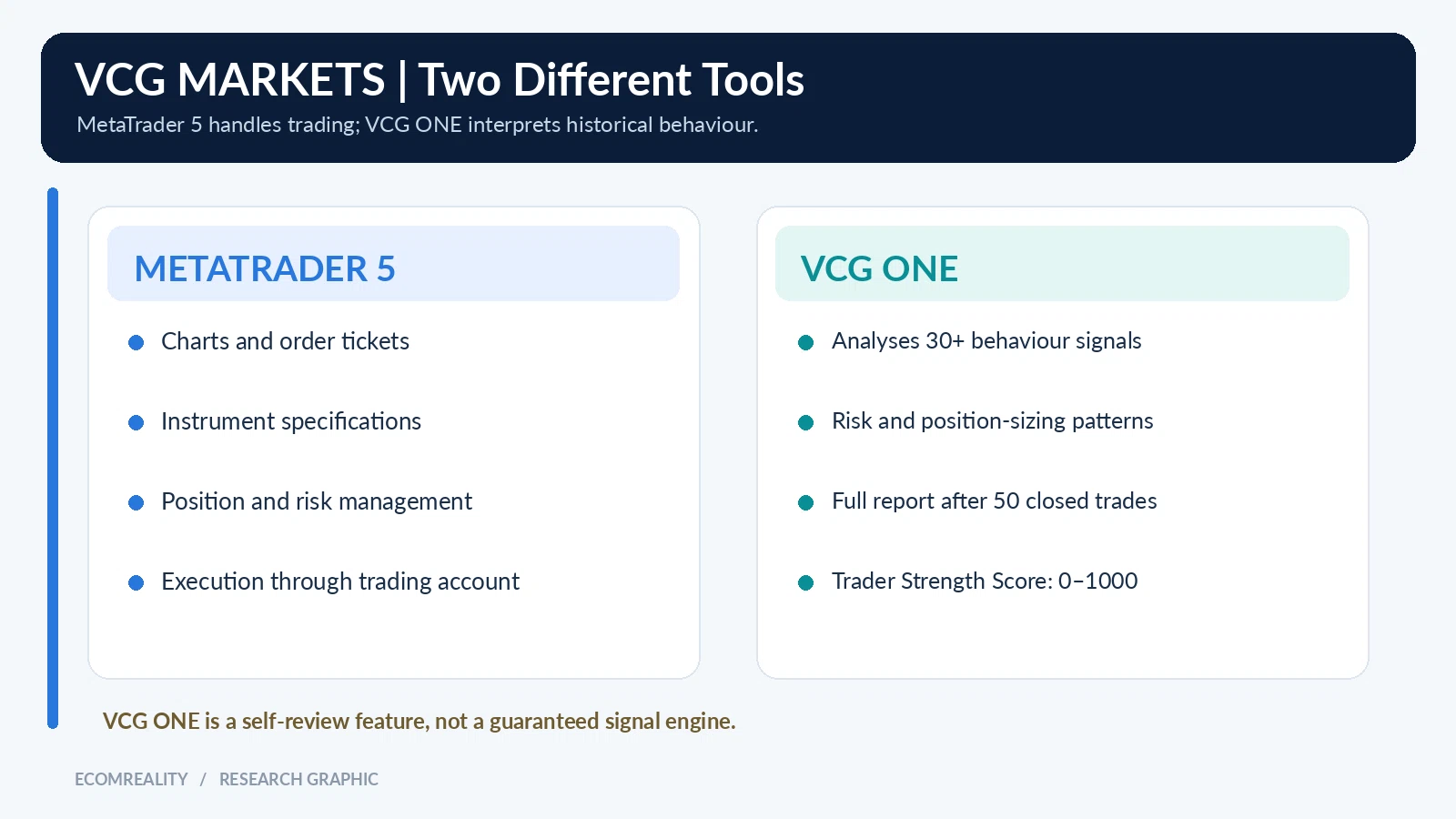
VCG ONE is presented as an AI-assisted trading-behavior analysis feature, not as a guarantee of profitable signals. In the company’s official January 2026 introduction, the tool analyzes 30-plus behavioral and performance signals across trade timing, risk sizing, entry and exit decisions, consistency and reactions after gains or losses. After 50 completed trades, a personal report becomes available. It includes a Trader Strength Score on a scale of 0 to 1,000 and personalized observations drawn from the trader’s history.
This is an interesting product distinction. Most retail platforms show profit-and-loss charts, position history and account equity. Those numbers reveal outcomes, but they can obscure decision quality. A trader can make money from an undisciplined trade or lose money on a reasonable setup that did not work. A behavioral report attempts to examine repeated choices such as oversizing positions after a loss, moving stops, changing holding periods or trading impulsively. Used thoughtfully, those insights can support reflection and process improvement.
The risk is treating the score as an oracle. A high score is not proof of a profitable trading strategy, and a low score does not identify a certain future loss. The score is an interpretation of observed behavior under a particular methodology, not an independent audit of every market condition. The company presents it as informational guidance. Readers should use it alongside actual trading records, with an understanding that model outputs can simplify complex decisions.
The 50-trade threshold: who benefits and who may not
The requirement for 50 completed trades creates a meaningful divide among users. Someone who trades frequently may accumulate enough observations relatively quickly. A position trader who opens only a few trades per month may need a long period before unlocking the detailed report. There is no sensible reason to trade more frequently just to reach the threshold. Forcing activity changes the dataset and potentially exposes the account to additional spread and financing costs.
A more useful approach is to let the feature develop alongside an established trading process. Maintain a simple trading journal that records setup, position size, intended stop, actual execution and reason for exit. When VCG ONE becomes available, compare its patterns with the journal. If the tool flags inconsistent sizing, look for actual examples. If it highlights entries after losses, determine whether those trades were planned or emotional. Behavioral technology adds value when it triggers precise review rather than vague confidence.
An unanswered practical question is whether a user will find the feature valuable enough if their trading is very infrequent. A casual investor who checks markets monthly may gain less from a behavior-focused service than an active CFD trader with a repeatable process. That is a genuine limitation, not a flaw in the underlying idea. VCG ONE is most relevant when there is enough consistent activity to make recurring patterns worth studying.
Spreads, commission and what “free” really means
VCG Markets’ official Terms and Fees page lists trading commission: free, custody fee: free and FX fee: free in the specified conditions. This is welcome clarity, but it does not mean transactions have no economic cost. The same page states that spreads are dynamic and depend on market conditions; customers should view each instrument’s specific dealing spread. Every CFD trade still faces the economic effect of the bid/ask difference, even without a separate commission line on the statement.
Consider a simple illustrative EUR/USD calculation. One standard lot of 100,000 EUR typically represents about $10 per pip for a USD-denominated account. At a hypothetical 1.0-pip spread, the immediate dealing cost is approximately $10. At 1.5 pips, it becomes about $15. The commission remains zero in both illustrations, but the cost still changed by 50%. For a strategy trading many lots each month, that difference can become substantial. These are mathematical examples, not claimed live spreads on VCG Markets.
This matters because zero-commission messaging can make a broker sound cheaper than a commission-charging competitor without proving it. An alternative broker might charge an explicit ticket commission but quote a tighter spread. To compare fairly, translate both structures into dollars at the same position size and time. A trader should also review slippage and any applicable conversion rules instead of assuming that the absence of a visible commission eliminates all operational costs.
Overnight holding fees: the hidden variable for slower strategies
VCG Markets’ Terms and Fees page states that positions carried past 22:00 GMT incur an overnight holding adjustment that can be positive or negative depending on the product and trade direction. The rate appears on the relevant instrument page. For intraday traders who consistently close before rollover, this may be less important. For people who hold trades for several nights, it can materially change net results even when the initial spread is attractive.
The right cost question is not simply whether the broker charges swaps. It is how those swaps accumulate on the actual instruments and holding periods used. A trader planning to hold a gold position for two weeks should examine the long and short holding rates, any weekend-related multipliers and the effect of changing financing conditions. A separate profit target should then be large enough to justify both market risk and expected carrying cost. A short-term movement that looks profitable on a chart may be uninteresting after several days of financing.
Another point often omitted from reviews is that receiving a positive swap under some circumstances does not make a position risk free. Underlying asset losses can dwarf the financing adjustment, and swap rates can change. The user’s strategy and position size remain the dominant drivers of risk. VCG’s relatively clear disclosure of the rollover time is helpful, but the numbers must still be checked on the instrument the trader actually intends to hold.
Trading costs beyond the spread: a complete worksheet
A practical worksheet should contain six fields: instrument, position size, current spread, overnight long or short adjustment, expected holding duration and cash movement. If trading commission is zero under the applicable terms, put zero in the commission column rather than deleting the column entirely. That makes comparisons with other brokers easier and prevents a later pricing change from being missed. Include expected slippage as a risk allowance when the strategy trades around major announcements or thin sessions.
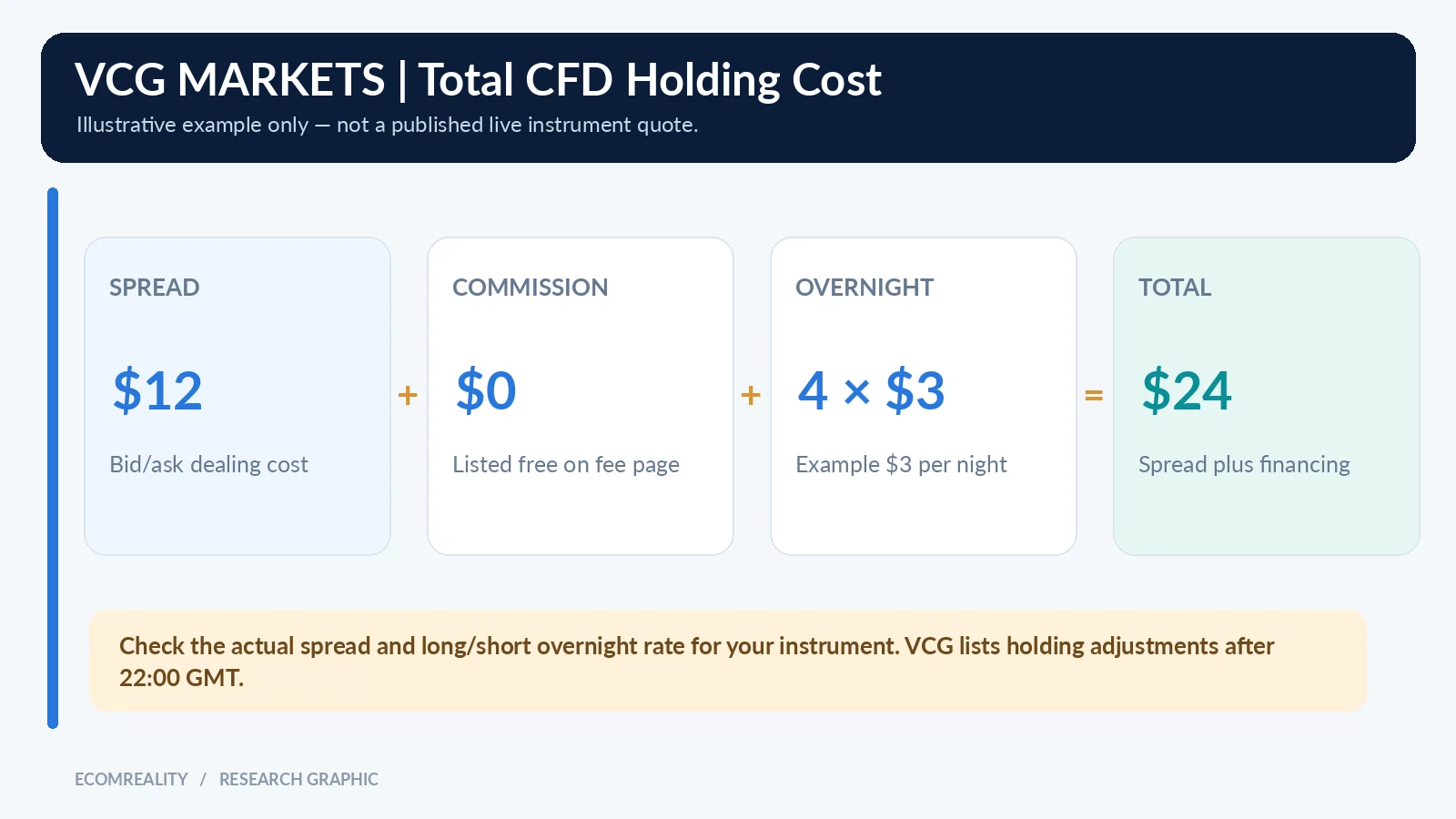
Suppose a hypothetical position has a $12 initial spread cost and the relevant holding fee equals $3 per night. Holding it for four nights could bring that illustrative dealing-and-carry total to about $24 before other factors. A competing setup with a $16 initial dealing cost and $1 per night could cost $20 over the same period. The cheaper entry was not the cheaper complete trade. Real contract specifications may differ, but the arithmetic demonstrates exactly why all-in comparisons are more useful than promotional minimums.
A trader evaluating VCG Markets should repeat the calculation for typical forex and non-forex instruments. Contract sizes and price increments vary, so a generic EUR/USD pip value cannot be applied indiscriminately to oil, indices or stocks. The broker’s instrument-specific pricing page is the right source for live conditions. This deliberate method may be less exciting than choosing a platform based on a screenshot, but it produces a defensible comparison.
Deposits, withdrawals and the two-company payment structure
VCG Markets’ website lists cards, bank transfers, Neteller and Apple Pay among payment channels, with availability depending on country. Its Terms and Fees page states deposits: free and withdrawals: free under published platform charges. A client should still distinguish broker-side fees from charges that may be imposed by card providers, banks or currency intermediaries. The timing and allowed return route may vary by payment method, verification status and jurisdiction.
The merchant-company arrangement deserves attention. VCG Tech Limited is identified as a Cyprus-based operator that handles processing of client deposits and withdrawals, while trading services are attributed to the Mauritius and Seychelles licensed entities. That is not inherently unusual in international financial services, but it requires clear documentation. The name on a payment statement need not match the exact name of the CFD issuer; clients should be able to trace the relationship through the published terms and account documents.
Before transferring money, users should verify supported methods, account ownership requirements, the settlement currency and any documentation that might delay a payout. They should also understand the complaint route if a payment problem concerns the merchant company versus the trading business.
Regulation and the client-protection distinction
Two licenses are central to VCG Markets’ public regulatory positioning. VCG Markets Ltd is described as an investment dealer regulated by the Mauritius FSC, license GB22200388. VCG Markets (Seychelles) Ltd is described as a securities dealer licensed by the Seychelles FSA, license SD243. The website also gives company registration and office details. Such specificity allows prospective customers to identify the relevant business and look for an agreement matching that name.
A regulated offshore entity is not interchangeable with an FCA- or CySEC-regulated retail investment firm. Margin rules, restrictions on leverage, investor compensation arrangements and dispute mechanisms may differ. The correct framework is determined by the entity and its actual legal obligations, not by a generic assertion that the broker is globally licensed. VCG Markets should therefore be evaluated with the same entity-level rigor applied to other international CFD providers.
The warning on the site is also worth reading closely: leveraged forex and CFD products can generate rapid losses, and the legal materials discuss the possibility of losses exceeding deposited funds. This emphasizes why account-level protections must be verified and not inferred. A user should understand margin closeout, negative-balance treatment and the firm’s actual contractual position before selecting leverage.
What VCG Markets gets right
The strongest distinguishing feature is VCG ONE’s attempt to make trading behavior measurable. The company gives a concrete description of what it analyzes and the threshold needed to unlock the report. That is more informative than vague promises that an AI assistant will find profitable entries. The feature is most compelling for traders who already keep records and want an additional method of spotting repeated risk-management errors.
VCG Markets also publishes a relatively easy-to-read fee overview. Explicit statements about trading commissions, custody charges, deposits and withdrawals make initial cost classification straightforward, while the instrument-level approach to dynamic spreads and overnight adjustments is conceptually sound. MT5 offers a mature platform foundation. Together, these elements give the brand a coherent proposition: a recognizable terminal, transparent fee categories and a specialized behavioral-review layer.
The attractiveness depends on whether the trader uses those capabilities properly. An account that offers detailed analytics is not inherently a good fit for someone who wants long-only unleveraged investing, and a zero-commission CFD model may not be optimal for a strategy that incurs expensive overnight financing. VCG Markets is interesting when the workflow matches the user’s trading behavior.
The weaknesses and unresolved questions
The most important reservation concerns entity-specific protections. The public materials identify offshore licensed companies, and the payment-processing company has a separate role. That is a structure a customer must understand before relying on statements about security or regulation. It does not justify accusing the broker of wrongdoing, but it does mean that licensing should be checked at the contract level rather than treated as a simple trust badge.
A second limitation is the ease with which a zero-commission label can obscure the real cost of a position. Spreads vary, and overnight financing can become significant. Without a standardized published live-cost sample for a user’s preferred instruments, a broad claim that VCG Markets is cheaper than competitors would be unsupportable. Third, VCG ONE’s behavioral score may be interpreted too confidently by inexperienced traders, particularly if they believe the model can replace a risk plan or validate a strategy’s future performance.
Finally, the 50-trade threshold means less active users may not experience the marquee analytical feature for a considerable period. It would be a mistake to increase trading frequency merely to unlock a report. That tension between the product’s most interesting feature and prudent trading behavior is one of the review’s most important practical findings.
Final verdict
VCG Markets offers a distinctive combination of MetaTrader 5, a published zero-trading-commission fee structure and VCG ONE, a behavioral-analysis feature that begins its fuller reporting after 50 completed trades. The latter is genuinely more interesting than another generic trading-dashboard claim, because it invites users to examine their own sizing and discipline. The benefit is strongest when the trader verifies the model’s observations against an actual trading journal.
The caution points are equally concrete: dynamic spreads and overnight fees mean total trading costs are not zero, while the Mauritius and Seychelles trading entities have distinct legal frameworks from the Cyprus merchant company. VCG Markets can be a useful comparison for disciplined active traders, but a sound decision depends on instrument-level price checks and the actual client agreement. Neither AI-derived scores nor platform branding can substitute for those fundamentals.
Frequently asked questions
Is VCG ONE a signal bot? Its official description presents it as a behavioral-analysis and personal-reporting tool, not a guaranteed trade-prediction service.
When does the VCG ONE report unlock? The company states that the detailed report becomes available after 50 completed trades.
Does VCG Markets charge trading commission? Its published Terms and Fees page lists trading commission as free for the described conditions. Dynamic spreads and overnight adjustments can still apply.
When does an overnight holding fee apply? The published terms refer to positions held beyond 22:00 GMT, with instrument-specific positive or negative amounts.
Is VCG Markets a CySEC broker? The site lists Mauritius FSC and Seychelles FSA trading entities. The separate Cyprus company is described as a merchant/payment operator, not the CFD execution licensee.
Official reference links

Jo Carter is an editor and ecommerce researcher at Ecom Reality, where she covers ecommerce platforms, digital selling tools, online business software, pricing models, and emerging industry trends. She focuses on turning complex platform features and costs into clear, practical information for entrepreneurs and digital sellers. Her work combines detailed research with a balanced editorial approach, helping readers compare services, understand potential limitations, and choose tools that fit their business goals.
Comments
Related Articles


Leave a Reply