

Taurex review of Standard, Pro and VIP commission models, MT4/MT5, swap rules, withdrawal timing and distinct international legal entities.
The main finding: Taurex is a multi-entity CFD brand whose practical value depends on the account, trading platform and jurisdiction offered to the customer. Its retail menu includes commission-free Standard and Pro accounts and a VIP account with a quoted commission of up to $3 per side. The platform offering includes the MetaTrader ecosystem and supporting tools. The central risk is assuming that the existence of a UK-regulated group company means a customer using the international website receives UK-regulated trading services. The relevant account agreement and the Seychelles entity disclosures deserve more attention than a logo or headline spread.
An account-level review is more useful than a brand-level score
Broker comparisons often begin with a numerical rating, a few maximum-leverage figures and a statement that a platform is "regulated." That is not enough for Taurex. The company operates through affiliated entities in multiple countries, while its main international product pages can lead customers to a Seychelles entity. The brand also references a UK-regulated company and a UAE organization with a narrower category of authorization. Each has its own function. A customer should identify which entity actually issues the CFD before drawing conclusions about client protections.
There is another reason to focus on account structure: trading style changes the economics. Someone who opens two trades a week may prefer a straightforward spread-only account. A frequent short-term trader may find a tighter-spread plan more attractive despite paying commission. Someone who carries positions overnight needs to care about swap treatment and any administrative fees. These are different questions, even when the dashboard looks similar. This review addresses them individually rather than declaring one account or platform best for everyone.
Taurex's corporate and regulatory structure
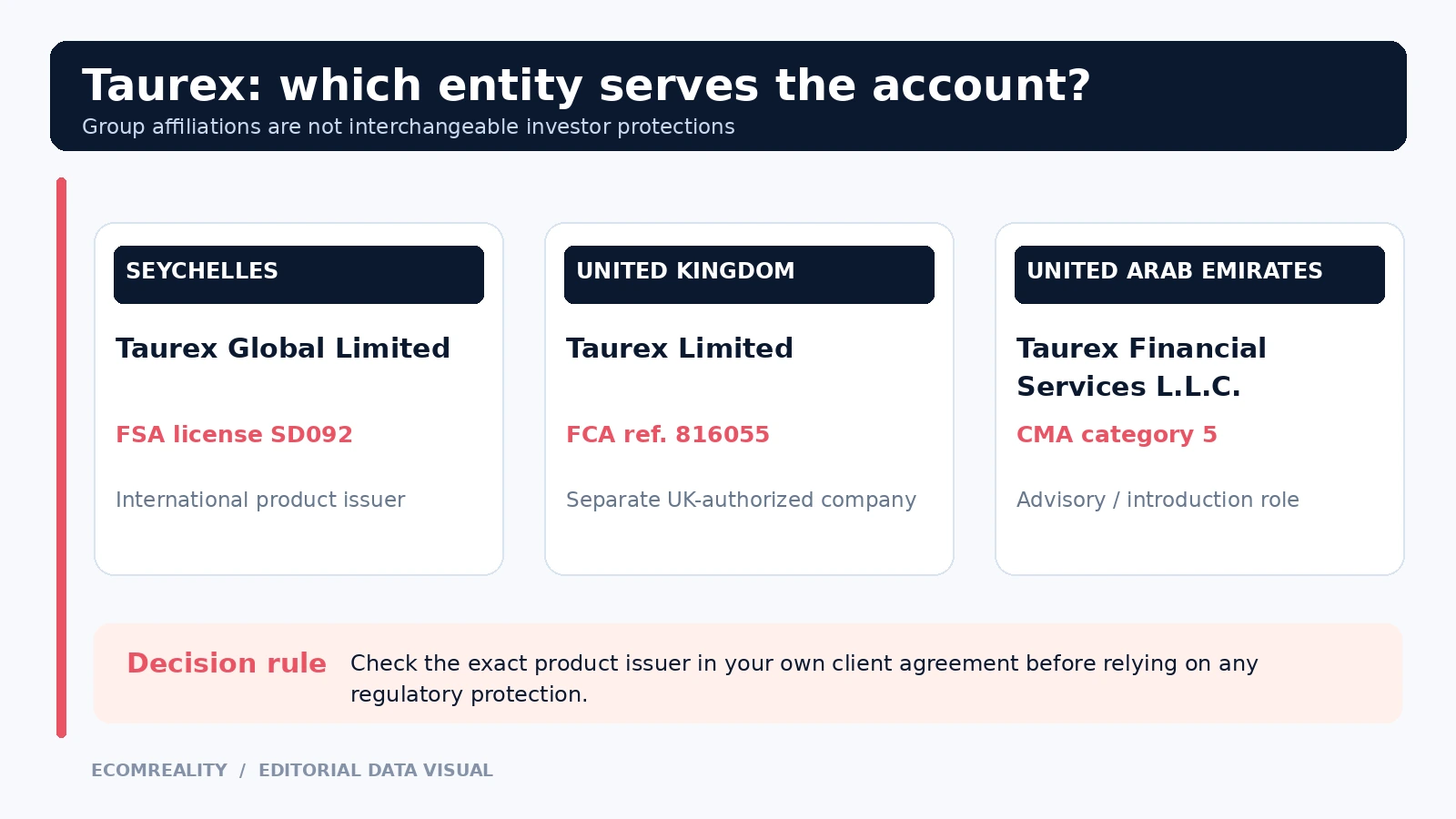
The international Taurex website identifies Taurex Global Limited as the product issuer and trading name holder for its Seychelles offering. It states that this company is regulated by the Seychelles Financial Services Authority under license SD092. The same public disclosure describes Taurex Limited in the United Kingdom as authorized by the Financial Conduct Authority under reference 816055. It additionally names Taurex Financial Services L.L.C. in the United Arab Emirates, licensed for a category of ranking and advice that does not authorize it to hold client assets or money. A Cyprus payment agent is also referenced for receiving and processing client funds on behalf of the international entity.
Those details are not interchangeable badges. An FCA-authorized affiliate does not automatically turn a Seychelles-issued CFD into an FCA-covered investment. Likewise, an entity that facilitates introducing customers under an advisory authorization is not necessarily the principal counterparty to the trading transaction. The client agreement should give a specific legal name. That name, not the prominence of a regulator's logo in a group footer, is the starting point for identifying applicable rights.
This distinction also affects customer eligibility. The international site lists a number of restricted jurisdictions and notes that its information is not directed at residents of several major markets. A trader who sees a published promotion online cannot assume it is available to them. If they are redirected to a different regional entity or denied service, that result can be consistent with the legal structure rather than an unexplained technical problem.
Standard, Pro and VIP: what the fee structure tells us
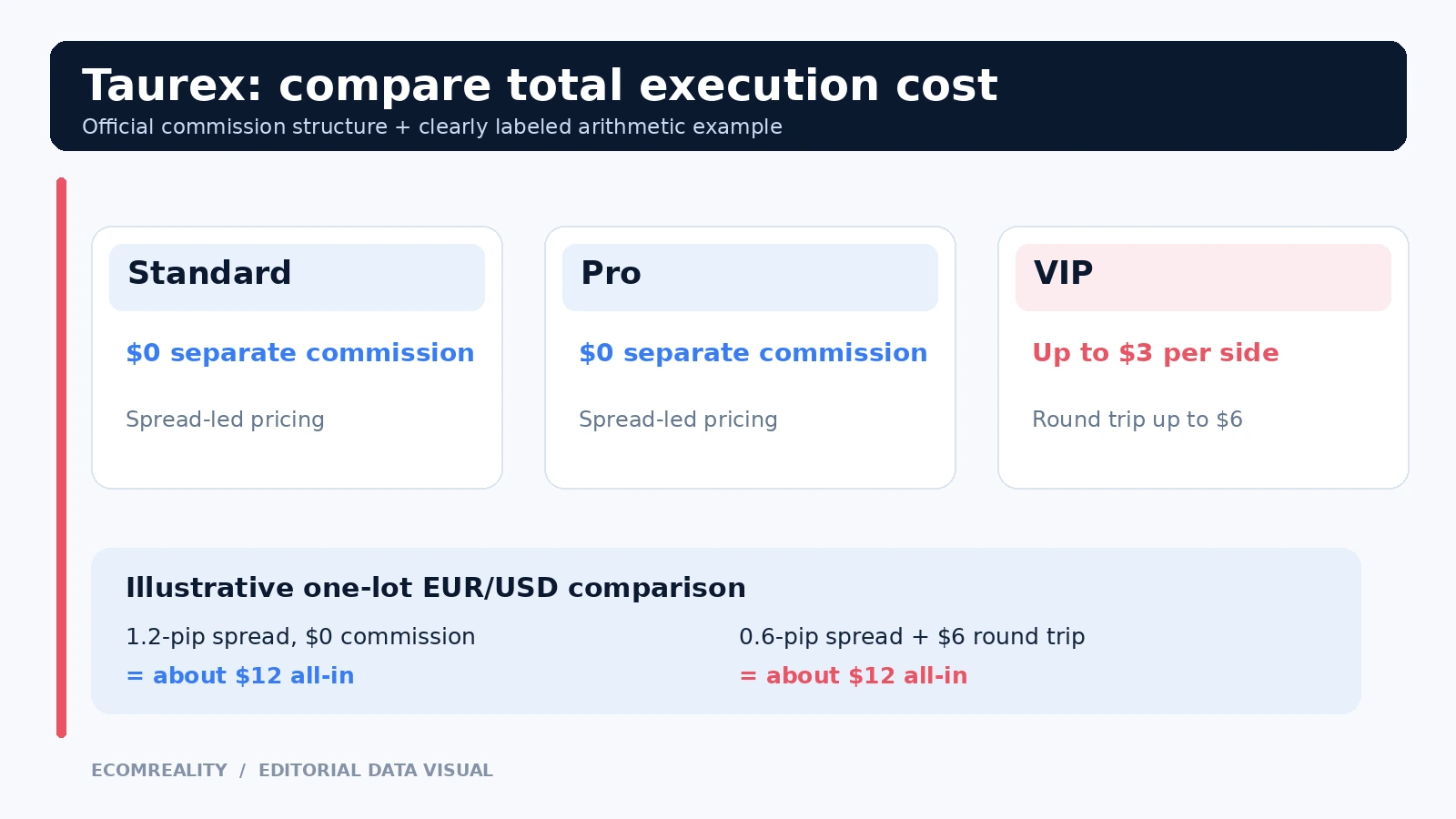
Taurex's public FAQ states that Standard and Pro accounts do not carry a separate trading commission, while VIP may charge up to $3 per side. That creates a useful three-tier logic but does not, by itself, reveal the total cost of each account. The spread still matters, as do instrument-specific contract sizes, financing and any conversion. A VIP account showing a tighter quoted spread is not necessarily cheaper for every trading volume once both sides of commission are included.
Consider a simplified EUR/USD example for one standard lot, with an illustrative pip value of $10. If a commission-free account has a spread of 1.2 pips at execution, the spread cost is about $12. If a VIP account at the same moment quotes a 0.6-pip spread and applies a $3 commission to both opening and closing, the total would also be about $12: $6 spread plus $6 round-trip commission. The numbers are teaching assumptions rather than asserted Taurex live quotes. The example shows why comparing only a spread table or only a commission field can produce the wrong decision.
A trader should collect current prices for the intended instruments during the hours they really trade, not just the lowest advertised conditions. Gold, stock indices and less-liquid currency pairs may have different tick values and spreads. The transaction-cost calculation must reflect the actual contract specification rather than borrow the EUR/USD pip model indiscriminately. What makes an account economical depends on the traded instruments and the frequency of opening and closing positions.
The full trading-cost equation
For a short-term CFD trader, the obvious costs are dealing spread and any separate commission. For a medium-term trader, overnight financing or swaps may be just as important. If money enters the account in one currency and the trading balance is maintained in another, conversion costs may also be material. A businesslike comparison combines all applicable elements and compares the result with the amount the strategy reasonably expects to earn before costs.
A useful account worksheet includes five fields: instrument, average executed spread, opening commission, closing commission and expected daily financing. An optional sixth field records conversion or account-related charges. When these are entered consistently, the trader can compare Standard, Pro and VIP on the same basis. Without that discipline, a "commission-free" label can become misleading, as can a dramatic headline about the lowest raw spread.
The formula is not complicated: total direct trade cost equals spread expense plus round-trip commission plus any overnight charges, with conversion and external charges considered where relevant. What is difficult is ensuring the inputs are real. A price quoted at 10 a.m. London time may not reflect liquidity during an overnight session, while a swap value displayed today may change later in the week.
Swaps, swap-free arrangements and administrative fees
Taurex publishes unusually detailed help-center guidance on swap-free arrangements. It describes an ordinary default swap-free period of 10 days in eligible contexts, with up to 30 days in certain regions such as Malaysia and Thailand. After the eligible period, a fixed daily fee may become applicable until the position closes, and some excluded instruments can incur charges from the first day. Eligibility, specific symbols, rates and durations may change, so a trader should review the current platform specification before treating the term "swap-free" as a universal promise.
The company also acknowledges that administrative fees may apply and can differ by country of residence. This is easy to overlook when reviewing account tables because it is not always part of the familiar spread-versus-commission headline. It matters particularly for traders whose strategies involve holding CFDs for weeks, maintaining accounts with limited activity or repeatedly funding across different currencies. The cost of a long-held trade may be driven more by financing and policy exceptions than by its initial spread.
For example, imagine a position carrying a hypothetical $4 daily holding charge after its permitted swap-free period. An additional 15 holding days would add $60, before considering other costs or price changes. That amount is not a claim about the current Taurex charge on any named instrument. It demonstrates why a position described as having "no swap" should be evaluated together with the detailed exception schedule and the planned holding period.
Platforms: why MT4 and MT5 still matter
For traders who already use MetaTrader, platform familiarity is a meaningful advantage. MT4 remains popular for established forex strategies and automated expert advisers built specifically for its architecture. MT5 adds a broader framework for multi-asset trading, more analytical options and differences in order management and execution features. Taurex's availability across the MetaTrader ecosystem can therefore support both established workflows and traders seeking a more modern terminal.
However, platform support is not the same as unlimited features on every account. A particular symbol, leverage setting or trading condition can vary by entity, account and region. Users moving an existing expert adviser should verify symbol naming conventions, minimum lot size, allowed order types, server time and execution policy. Even a small difference in contract specification can affect an automated strategy far more than the appearance of the chart.
The mobile experience is a separate decision. A trader checking positions on a phone needs reliable order controls, visible margin information and clear risk indicators. That is different from the requirements of a trader doing detailed analysis on multiple monitors. A useful workflow may involve desktop analysis with mobile monitoring rather than forcing every task into one screen size.
Execution, spreads and fast-market conditions
The quality of a CFD account is tested most severely during volatile periods. Even when the account table lists an attractive minimum spread, the actual market quote can widen around news releases, market opens and low-liquidity periods. Pending orders can be executed at unexpected prices when the market gaps. The broker's platform may show the requested stop level, but the exact execution depends on the terms, available liquidity and market conditions.
Users should therefore distinguish a stop-loss instruction from a guaranteed maximum loss. On a leveraged product, a market gap can make the realized loss larger than the intended stop distance. Proper position sizing remains necessary even when the interface makes it easy to attach protective orders. Traders should understand the stop-out threshold and the margin-notification rules that apply to their account and legal entity.
A credible comparison with rival brokers should include spread consistency at the time of execution, not just the minimum published value. A scalper concerned about a fraction of a pip may care about that more than a swing trader who trades infrequently. Taurex's multiple account options provide choices, but only real account-specific conditions establish which one offers better value for a particular strategy.
Deposits and withdrawals: separating broker time from bank time
Taurex advertises several payment routes, including cards, bank wires, e-wallets, mobile payments and selected digital-asset methods where available. The options depend on location. The firm's official funding page shows different timing estimates for different methods, while the help center explains that most withdrawal requests are internally reviewed within hours but may sometimes take up to 24 hours before release. Arrival at the destination can take longer. Bank transfers may require up to five working days, and cards often take three to five working days after the broker-side processing stage.
This distinction should shape expectations. A request submitted on Friday night may involve a different customer experience than one submitted on a normal banking day. Verification of a wallet address, additional compliance questions or third-party payment-provider processing can add time. A customer should not interpret an "instant" e-wallet listing as a promise that every request, every weekend and every country has the same end-to-end timing.
The company says it does not charge a deposit fee, but bank or exchange-related charges may still arise externally. A practical withdrawal plan confirms the available method, currency, minimum and destination ownership requirements before committing significant funds. It is particularly important for customers who expect to receive withdrawals in a different currency from the trading account.
Regional entity risk: what protections follow the customer?
A common analytical error is to assume every brand in a group offers one regulatory standard. Taurex makes that mistake especially easy because its public disclosures name multiple regulators. A customer of the Seychelles product issuer should not rely solely on protections associated with the company's FCA-regulated affiliate. They need to determine the exact issuer, any client-money arrangements applicable to it, dispute route and governing law.
Likewise, the UAE affiliate's disclosed category is for ranking and advice and is explicitly not authorization to hold client funds. That does not negate the firm's role within the broader group, but it should be described accurately. A serious review cannot treat all affiliations as identical evidence of a deposit-protection or compensation scheme. The nature of the authorization matters as much as its existence.
For a prospective customer, the sensible task is straightforward: request the relevant contract, identify the product issuer by full legal name, check that name on the appropriate official register, and verify what is promised concerning negative balances, segregation, complaints and leverage. If an advertised feature is described globally but excluded for the actual account, the account agreement takes priority.
Strengths of the Taurex model
Taurex offers a useful range of account-pricing approaches: commission-free options for simplicity and a commission-based tier that may fit more active users. The availability of widely used trading terminals reduces the learning curve for people with existing MetaTrader workflows. Its public help center also addresses practical questions about swaps, eligible swap-free periods, funding costs and withdrawal timing instead of relying exclusively on promotional slogans.
For a trader who knows their instrument mix and holding period, those published details make comparison easier. They can ask relevant questions before funding, estimate a realistic cost range and decide whether they value fewer visible commissions or potentially tighter execution quotes. That flexibility is a legitimate benefit compared with platforms that offer only one generic account structure.
Weaknesses and reasons for caution
The main weakness is the risk of interpreting group-wide regulation too broadly. The international product issuer, UK affiliate, UAE entity and payment agent do not all perform the same function. Prospective clients should verify the counterparty serving them before relying on an investor-protection assumption. A second weakness is the complexity of true all-in costs. Headline commission-free accounts can still incur spreads and financing, while swap-free arrangements have eligibility windows and exclusions. Regional administrative fees create another variable.
The third concern is the nature of leveraged CFDs themselves. Flexible leverage can encourage larger exposures than a retail client can comfortably withstand. The trading platform can provide useful tools, but no interface guarantees profits or eliminates slippage. Traders who prize predictable long-term costs should be especially careful to calculate their expected holding charges rather than deciding solely on advertised starting spreads.
Who Taurex fits best
Taurex may make sense for an experienced CFD trader who knows how to compare contract specifications, can identify the correct legal entity, and wants a choice of MetaTrader-based accounts. It may be less suitable for someone who assumes that a familiar UK regulatory logo covers every international account or who intends to leave leveraged positions untouched without monitoring financing. The product offering requires engagement with the details rather than a superficial reading of a promotional table.
New traders should decide on account size and maximum tolerable loss before selecting a platform. They should then compare the same instruments on the same trading session, check actual costs and use conservative position sizing. The existence of several account plans is an opportunity to choose appropriately, not a reason to upgrade merely because one plan is labeled VIP.
Final verdict
Taurex has a plausible offering for users who want established trading platforms, differentiated pricing tiers and access to multiple CFD markets. Its Standard and Pro commission-free structure and VIP commission schedule give traders a basis for comparison, while the help-center guidance is useful for understanding withdrawal and swap details. The decisive questions, however, concern the exact account entity, live spreads, holding costs and whether the chosen platform supports the trader's strategy. Taurex is not a one-size-fits-all broker; it is a service to evaluate at the account and jurisdiction level.
Frequently asked questions
Is Taurex regulated by the FCA for all clients?
No. The international website identifies a Seychelles product issuer and separately refers to an FCA-regulated UK group company. The applicable legal entity must be checked in the individual client agreement.
Does Taurex charge trading commission?
Its public FAQ lists Standard and Pro as commission-free and VIP as potentially charging up to $3 per side. Spreads and any overnight or administrative charges also affect the total cost.
Is a swap-free account free of all holding costs forever?
Not necessarily. Eligible swap-free periods and exclusions are described in the company's help materials, and a daily fee can apply after the relevant period or earlier on excluded instruments.
Are Taurex withdrawals instant?
Internal review often takes hours, but delivery through a bank or card can take several working days. Region, verification and payment method affect the timeline.
Which platform should I choose?
Choose according to the tools, instruments and order controls you actually need. Existing MT4 automated strategies may favor MT4, while users wanting newer multi-asset features may prefer MT5 where available.
Official sources
- Taurex, official funding disclosures and legal-entity footer: https://www.tradetaurex.com/fees-deposits-and-withdrawals/
- Taurex, frequently asked questions on account commissions and swaps: https://www.tradetaurex.com/faq/
- Taurex, withdrawal processing and delivery: https://help.tradetaurex.com/en/articles/11388566-how-long-does-the-withdrawal-process-take
- Taurex, deposit charges: https://help.tradetaurex.com/en/articles/12690444-do-you-charge-any-fees-for-deposits

Croom Raymond is an ecommerce writer and digital business researcher at Ecom Reality. He covers online selling platforms, SaaS tools, pricing structures, platform features, and practical strategies for building digital businesses. His articles focus on clear, evidence-based analysis that helps readers understand how different services work, compare their advantages and limitations, and make more informed business decisions.
Comments
Related Articles



Leave a Reply