

A broker can offer several account names, a familiar terminal and a long list of licenses while still leaving prospective clients with a basic question: what will a trade actually cost under the agreement that applies to my location? STARTRADER is a good example of why that question matters. Its published account lineup includes Standard, ECN and Prime ECN, supported by MetaTrader 4, MetaTrader 5, WebTrader and mobile access. The difference is not cosmetic: a commission-free account, a tight-spread account and a zero-spread-style account can produce different results for exactly the same strategy. Regulation adds another dimension, because the STARTRADER group includes separate licensed companies in Australia, South Africa, Seychelles and Mauritius, while its UAE permission concerns introduction and promotion rather than ordinary execution.
This review examines the actual decisions facing an applicant: which account structure is worth comparing, how to estimate spread and commission, why swaps and cash movement can matter more than a minimum-spread headline, and how to identify the legal counterparty. It also explains where STARTRADER’s platform range is convenient and where marketing language needs more careful reading. The objective is an actionable broker assessment, not a list of decorative features.
A broker with more than one product and more than one rulebook
STARTRADER describes a multi-asset trading business covering forex, indices, metals, commodities and shares through trading platforms familiar to retail CFD users. The group’s materials emphasize access across desktop, web and mobile, plus trading infrastructure designed around fast execution and varied account needs. That approach has an obvious practical appeal. A trader who already uses MetaTrader can move into the broker’s account environment without learning a completely new charting system. A trader who prefers simpler browser access can use WebTrader, while someone still developing a process can open a demo account to explore order placement and risk settings.
The important qualifier is the legal entity. STARTRADER’s global site explains that customers are assigned to an appropriate group company according to location. An Australian license cannot simply be assumed to cover every account opened through a global marketing page. Equally, a Mauritius or Seychelles company should not be described as though it offers the identical investor protections available to clients of an Australian financial-services licensee. In broker comparisons, entity mapping is not a compliance footnote: it changes the meaning of leverage limits, dispute routes and the client agreement itself.
For STARTRADER, this review therefore treats the platform brand and the contracting business as two related but distinct subjects. The group structure may be useful for reaching different markets, but it places a responsibility on the applicant to verify exactly which company will accept deposits and execute positions. A sophisticated website cannot answer that question on its own; the answer belongs in the account-opening documents.
Standard, ECN and Prime ECN: the practical differences
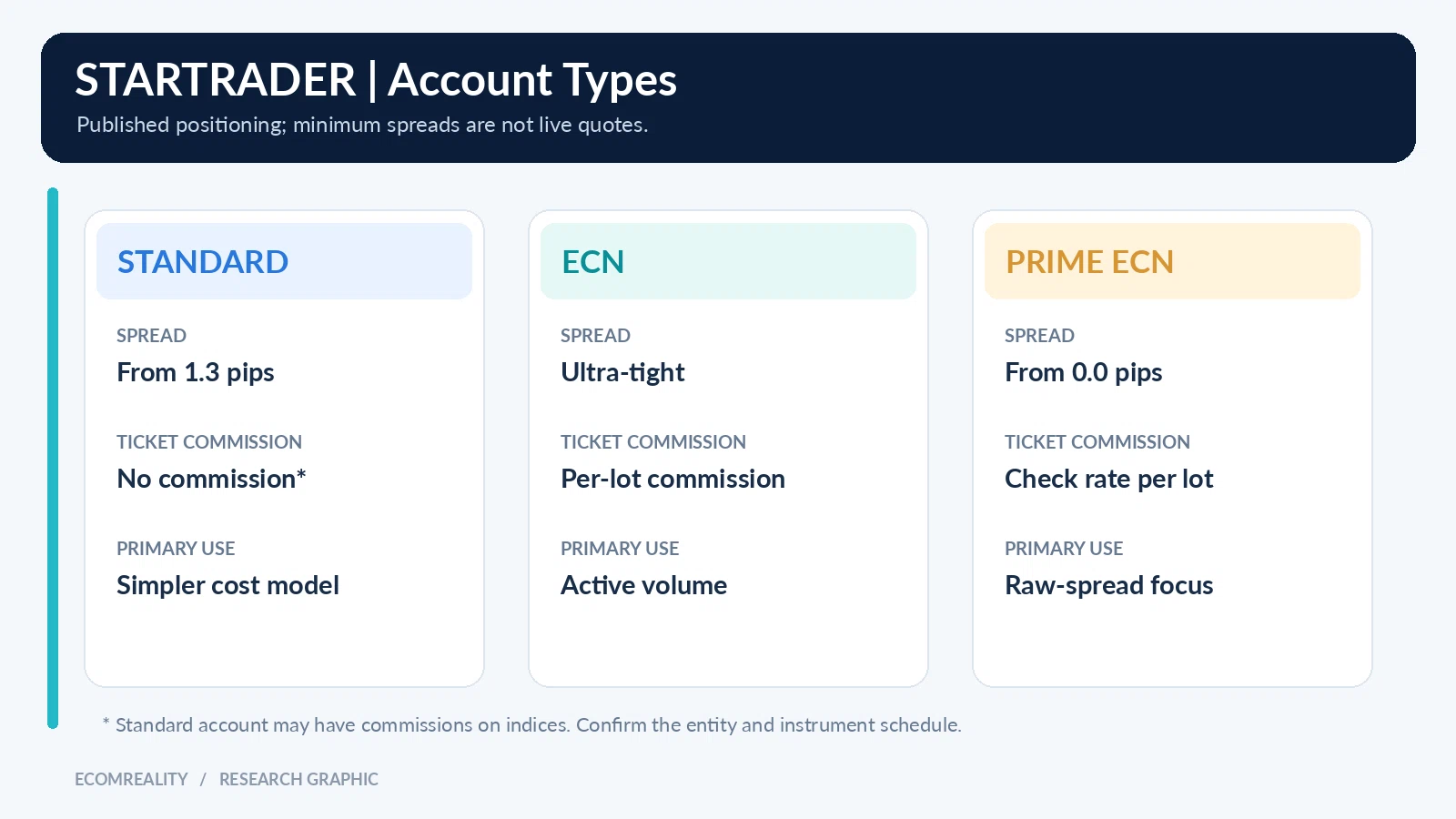
The current global account page lists three live categories. Standard is positioned for smaller-volume users and publishes spreads as low as 1.3 pips. The company describes this as a no-commission account for ordinary trading, while noting an exception for indices. ECN is pitched to higher-volume users and account managers, with tighter spread language and a separate per-lot commission. Prime ECN targets experienced traders and advertises spreads starting from 0.0 pips, together with a competitive commission structure. A free demo option is also available for practicing with trading tools without live-money risk.
Those labels should not be read as a ranking from worst to best. Standard can be economically sensible when trade frequency is low, account size is modest or simplicity is valuable. ECN can be more compelling when small spread improvements repeat across many trades. Prime ECN may deserve attention from active traders but only after confirming the actual commission applied to their jurisdiction, instrument and volume. A 0.0-pip advertised minimum is a starting condition under favorable circumstances, not a promise that every position will open at zero spread.
The published table also lists a minimum volume of 0.01 lots and market execution across the three categories, together with account currencies such as USD, EUR and GBP and several others. Platform access includes MT4, MT5, WebTrader and the STARTRADER app. These common features reduce switching friction between account types, but execution quality and the resulting total trading cost still require individual assessment.
Turning spread and commission into an actual trade cost
The distinction between a spread and a commission is easy to understand in isolation and frequently misunderstood in combination. The spread is the difference between the ask and bid quote. For an illustrative standard EUR/USD lot of 100,000 units, one pip commonly corresponds to about $10 when the account is denominated in USD. At a hypothetical 1.3-pip spread, the initial spread cost would be approximately $13 for that lot. At a hypothetical 0.2-pip spread it would be about $2, before commission and financing. The examples are calculations, not sampled live quotes or guarantees.
A commission account requires an extra line on the worksheet. If a broker charges, for illustration, $3 per side on a standard lot, the round-trip ticket commission is $6. At a 0.2-pip spread, the combined illustrative round-trip dealing cost becomes approximately $8. Compare that with about $13 on the 1.3-pip spread-only case. The apparent saving is $5 before slippage, holding costs, taxes or any other conditions. If the commission were higher or the spread gap narrower, the ranking could reverse. That is why the actual commission schedule, not the generic ECN label, decides which account is cheaper.
The same reasoning must be applied across instruments. A pip-based example for EUR/USD should not be copied blindly to gold, indices or share CFDs, where contract size, tick value and commission rules may differ. STARTRADER explicitly directs users to product specifications for current conditions. Someone comparing accounts should select three or four instruments they truly trade and compute the cost of a realistic position on each. A one-number comparison of headline EUR/USD spreads is useful editorial context but a weak substitute for a strategy-level calculation.
Overnight positions: how swaps change the result
Spread and commission dominate attention during account selection because they are visible at entry. Financing can have a larger effect on positions that remain open overnight. A CFD swap or holding adjustment may vary by instrument, long versus short direction, account entity and current market rates. It may be applied on trading-day rollover and can include a larger adjustment on a designated day to account for weekends. The exact mechanics belong to the contract specification, not to a general statement that a broker has low trading fees.
Imagine two traders opening the same EUR/USD position. One closes after twenty minutes; the other holds for eight nights. Even if their entry prices and spread are identical, the second trader can face several financing entries. The direction of the swap can matter too. A positive adjustment on one side of a currency pair does not imply that all long positions earn financing, nor that the rate will remain unchanged throughout the holding period. A sensible comparison therefore records the projected holding duration and the live swap long and swap short values alongside dealing costs.
This is especially important for copy-trading or discretionary swing strategies. If an account is evaluated only by the spread, an apparently inexpensive position can gradually accumulate costs. STARTRADER’s public materials also discuss swap-free options in some contexts, but these should be checked against eligibility and instrument-specific exceptions. A zero-swap marketing message is not a substitute for the complete contract terms governing the particular account.
What the regulated-entity list really means
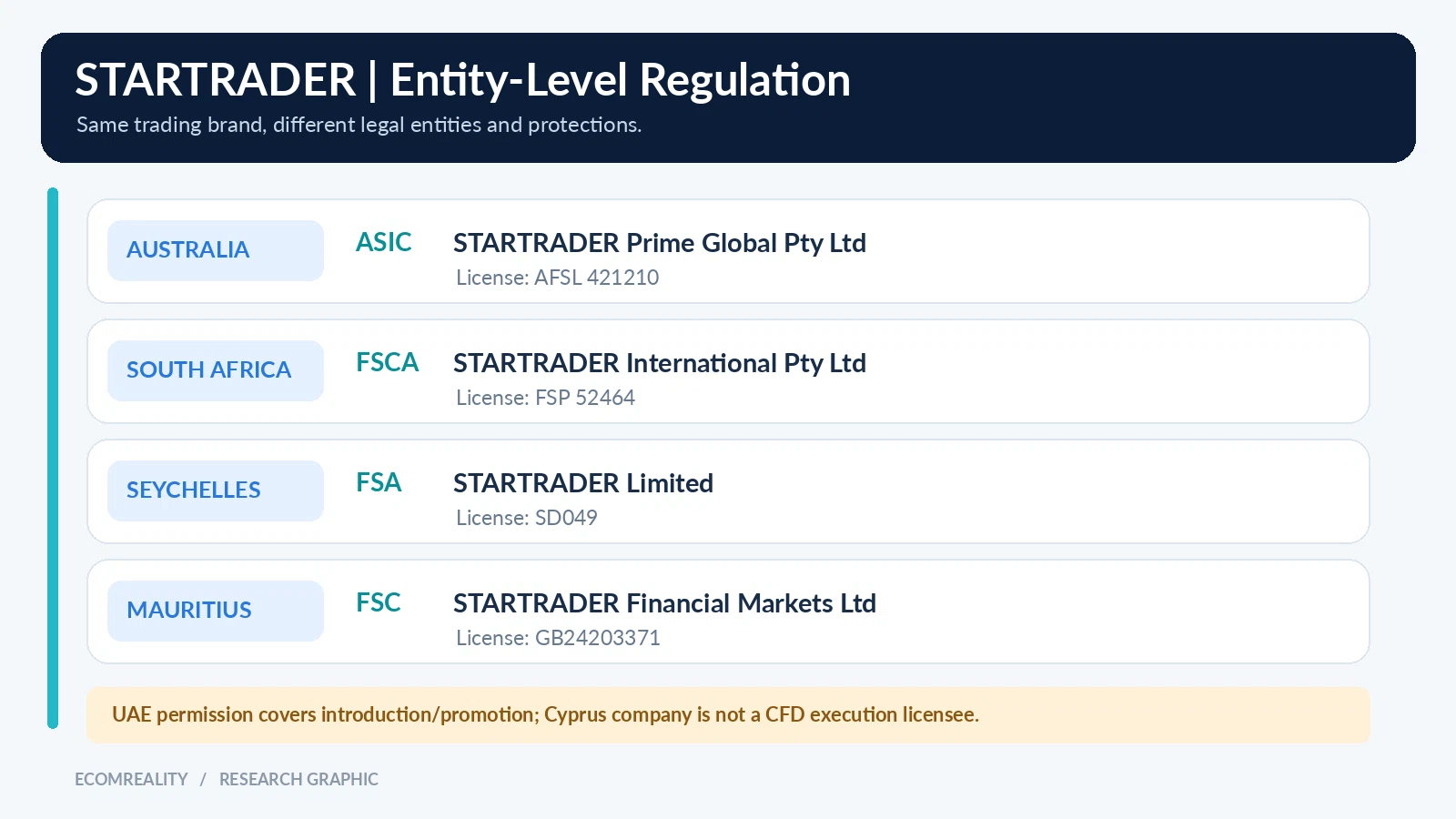
STARTRADER’s regulation page identifies STARTRADER Prime Global Pty Ltd as an Australian licensee supervised by ASIC, AFSL 421210. It lists STARTRADER International Pty Ltd under South Africa’s FSCA, FSP 52464; STARTRADER Limited under the Seychelles FSA, license SD049; and STARTRADER Financial Markets Limited under the Mauritius FSC, license GB24203371. The published UAE entry concerns a Category 5 authorization for introduction and promotion. The brand also references a Cyprus-registered company, while clarifying that this company does not provide regulated trading products.
There are useful positives here: the site identifies concrete legal names and numbers instead of referring vaguely to being “internationally regulated.” But group-level disclosure and client-level protection are separate. An Australian investor-protection framework does not automatically accompany a client onboarded by the Seychelles dealer. The nature of segregation, negative-balance treatment, eligible products and complaints handling must be checked in the agreement supplied during registration. The regulator’s public register can then be used to verify the license and the associated entity.
The sharper question is not how many regulators can be placed in a marketing banner. It is whether the particular customer knows the entity, its legal address, its role as execution counterparty and the rulebook governing disputes. If the account agreement does not clearly explain these points, that uncertainty should be resolved before funding. Multiplicity of licenses is a potential advantage only when it creates genuine clarity for the client rather than a misleading impression that every account enjoys every possible protection.
MetaTrader, WebTrader and mobile app: strong breadth, different purposes
Platform breadth is one of STARTRADER’s more obvious strengths. MT4 remains useful to forex traders who have established indicators, custom scripts or expert advisors. MT5 supports a broader multi-asset framework and a different set of platform capabilities, including extended order and analysis functions. Browser access reduces installation friction for occasional monitoring, while mobile interfaces are convenient for checking positions, alerts and account balances. Offering these options under the same broker family is helpful because it lets users preserve workflows they already understand.
The limitation is that the presence of a platform logo does not confirm feature parity. A custom MT4 indicator is not automatically compatible with MT5. A mobile app may support order management but not every desktop customization. Product lists can also differ by account, region or terminal. A trader planning to use automated strategies should test the necessary instruments, order types, stop settings and historical data in the actual terminal offered to that account, not simply assume all capabilities are interchangeable.
Execution claims need similar discipline. Marketing expressions such as ultra-fast execution or deep liquidity can describe a target service level, but the trader’s actual experience depends on network conditions, market volatility, position size and available liquidity. Keeping sample records of quoted spread and execution price is a sensible way to understand the difference between theoretical conditions and results. The platform lineup makes STARTRADER accessible; careful instrument-level verification is what makes the access useful.
Funding and withdrawals: the cost outside the trading ticket
STARTRADER’s global funding page lists bank transfers, cards and selected electronic payment options. It says deposits normally carry no broker-side charge and that withdrawals are free in most countries. The same page warns that international telegraphic-transfer fees imposed by banking institutions may be passed on, with a typical amount around $20 for many international transfers. A bank-wire deposit or withdrawal can also involve several working days. These distinctions are important because a “free withdrawal” headline can coexist with intermediary banking expenses.
The official withdrawal notes set cutoffs for request processing and require payout to an account in the same name, or a permitted joint account. Those are standard anti-fraud controls, but they affect timing. The user should distinguish between submitting a request, the broker reviewing it, the broker releasing funds, and the money arriving with the recipient institution. A three-to-five-working-day bank route is not necessarily evidence of a dispute; it can be the expected settlement channel. Equally, a processing acknowledgement is not the same as completed receipt.
A useful pre-deposit exercise is to write down the intended currency, deposit method and likely withdrawal destination. Check whether the path involves currency conversion, whether a third-party fee applies and whether the account has any verification requirements outstanding. Trading costs may dominate a high-frequency strategy, but a small account with frequent international transfers can be disproportionately affected by transaction expenses. The operational details belong in the broker comparison alongside spreads and swaps.
What STARTRADER does well
The broker makes sense for people who want a familiar trading terminal, several account-pricing choices and a reasonable range of asset classes in one environment. Standard, ECN and Prime ECN provide a comprehensible structure for comparing spread-only and spread-plus-commission economics. The group also supplies detailed entity information and a funding overview, which improves the starting point for due diligence. These are real operational strengths, especially when compared with brands that reveal little about their legal or dealing arrangements.
STARTRADER is also relatively approachable from a workflow perspective. Demo access allows strategy rehearsal, MT4 and MT5 offer established communities and tooling, and mobile or browser access supports ordinary position monitoring. Active traders may appreciate the availability of tighter-spread tiers, provided those tiers remain competitively priced once commissions are included. This flexibility is more useful than a one-account offering that forces every trader into the same cost model.
The main attraction should be viewed as choice, not guaranteed superior pricing. A cost-sensitive trader can compare the account structures; a platform-driven trader can check terminal compatibility; and a risk-sensitive trader can identify the exact licensed company. STARTRADER exposes enough categories to support those decisions without requiring the reader to assume that every account is identical.
The shortcomings a potential customer should not ignore
The biggest weakness of the proposition is its dependence on conditions that can vary by entity and instrument. It is possible to read the brand’s broad regulatory summary and believe the same safeguards apply across jurisdictions, which would be a mistake. It is also possible to overvalue a 0.0-pip advertised minimum without seeing the complete commission schedule for Prime ECN. These are not abstract objections. They can affect financial expectations from the first live trade.
Another limitation is the distinction between published “from” conditions and observed prices in volatile markets. The best advertised spread may not describe the price at the time a user actually trades. Swaps can materially change longer positions; a withdrawal may be free from the broker while still attracting a bank charge; and execution speed may change as liquidity deteriorates. None of these issues makes the broker automatically unsuitable. They simply mean that total cost and contractual protection must be evaluated together.
Finally, a wide range of markets and platforms can encourage users to trade instruments they understand poorly. Being able to reach share CFDs or commodities from an MT5 ticket is not evidence that their contract values, financing and session gaps resemble a familiar currency pair. STARTRADER provides access; it does not remove the responsibility to understand the product specifications.
How to compare STARTRADER with another CFD broker fairly
Use a repeatable five-part comparison. Identify the exact legal company and license on both sides. Select the instrument and position size you actually trade, not a generic minimum-spread headline. Compute spread cost plus round-trip commission, then add expected swap for the intended holding period. Consider realistic funding and withdrawal costs if you move cash frequently. Finally, test the critical platform features in a demo environment before relying on them in live execution.
The comparison should be documented at a single point in time because spreads, commissions and financing may change. A useful worksheet records date, entity, account type, instrument, contract size, spread, commission, financing and settlement method. With those fields, a reader can answer the question that matters: what would using this broker cost for my strategy, and which legal protections cover the relationship? That is a much stronger conclusion than a universal numerical score.
Final verdict
STARTRADER is a credible candidate for traders who value multiple pricing models and MetaTrader-based workflows, but its appeal is conditional. Standard looks simple and accessible, while ECN and Prime ECN require careful commission arithmetic. The group publishes meaningful licensing details, yet client protections depend on the contracting entity rather than the brand as a whole. The most important weakness is the gap that can exist between an advertised minimum spread and an account’s actual total cost after commissions, financing and cash movement.
For anyone considering STARTRADER, the strongest next step is not to choose the lowest-looking spread immediately. It is to verify the precise client agreement, calculate the all-in cost of a familiar trade and confirm that the needed platform features work under the offered entity. Taken that way, the account lineup is a useful choice set rather than a source of false certainty.
Frequently asked questions
Is STARTRADER Standard commission-free? STARTRADER advertises Standard as no commission on ordinary trades, with a published exception concerning indices. The specific product schedule should still be checked.
Does Prime ECN guarantee a zero spread? No. The page says spreads start at 0.0 pips; market spreads can vary and commission also needs to be included.
Which regulator protects a STARTRADER client? It depends on the licensed legal entity named in that customer’s agreement. The group publicly lists Australian, South African, Seychelles and Mauritius entities, with distinct permissions.
Can I use MT4 and MT5? Both platforms appear on the account comparison, alongside WebTrader and an app. Instrument and account availability should be verified.
Are bank withdrawals free? STARTRADER says withdrawals are free in most countries, but international bank-transfer charges may still be passed through.
Official reference links

Croom Raymond is an ecommerce writer and digital business researcher at Ecom Reality. He covers online selling platforms, SaaS tools, pricing structures, platform features, and practical strategies for building digital businesses. His articles focus on clear, evidence-based analysis that helps readers understand how different services work, compare their advantages and limitations, and make more informed business decisions.
Comments
Related Articles



Leave a Reply