

The short answer: Sellvia Mall offers both downloadable digital resources and AI-assisted products, but those are not interchangeable. A conventional guide gives you a finished reference, template, checklist, or course to read and reuse. An AI-enabled tool can create a customized result from information you enter, and generation uses a separate token balance. The Infinity Pass currently advertises a seven-day trial followed by $9.99 per month, with unlimited eligible downloads after the trial. Certain premium purchase-only products are excluded, and the AI token allowance is not unlimited. Understanding those boundaries is the key to deciding whether a particular item is worth opening.
Most marketplaces put digital content into one large category and leave customers to guess what they receive. Sellvia Mall is more interesting because its catalog spans familiar learning materials—ebooks, guides, planners, templates, checklists, and courses—and products that use AI to generate customized outputs. Those formats address different problems. A travel-planning checklist is a reusable reference; an AI-assisted travel planner might produce a personalized itinerary after asking for dates, interests, and constraints. Both could be useful, but their cost, effort, and expectations should not be judged in the same way.
The distinction becomes especially important when the catalog is accessed through a membership. A subscription can make exploration economical, yet it does not erase the need to check product type, licensing, usage limits, or whether a listing is actually included in the membership. This review focuses on those questions rather than promising that every product will be valuable for everyone. It draws on the current Sellvia Mall product pages, Infinity Pass page, and terms of service. We did not purchase and independently test every item in the catalog, so product-specific claims are treated as descriptions rather than verified performance outcomes.
The first distinction: a file versus a generated result
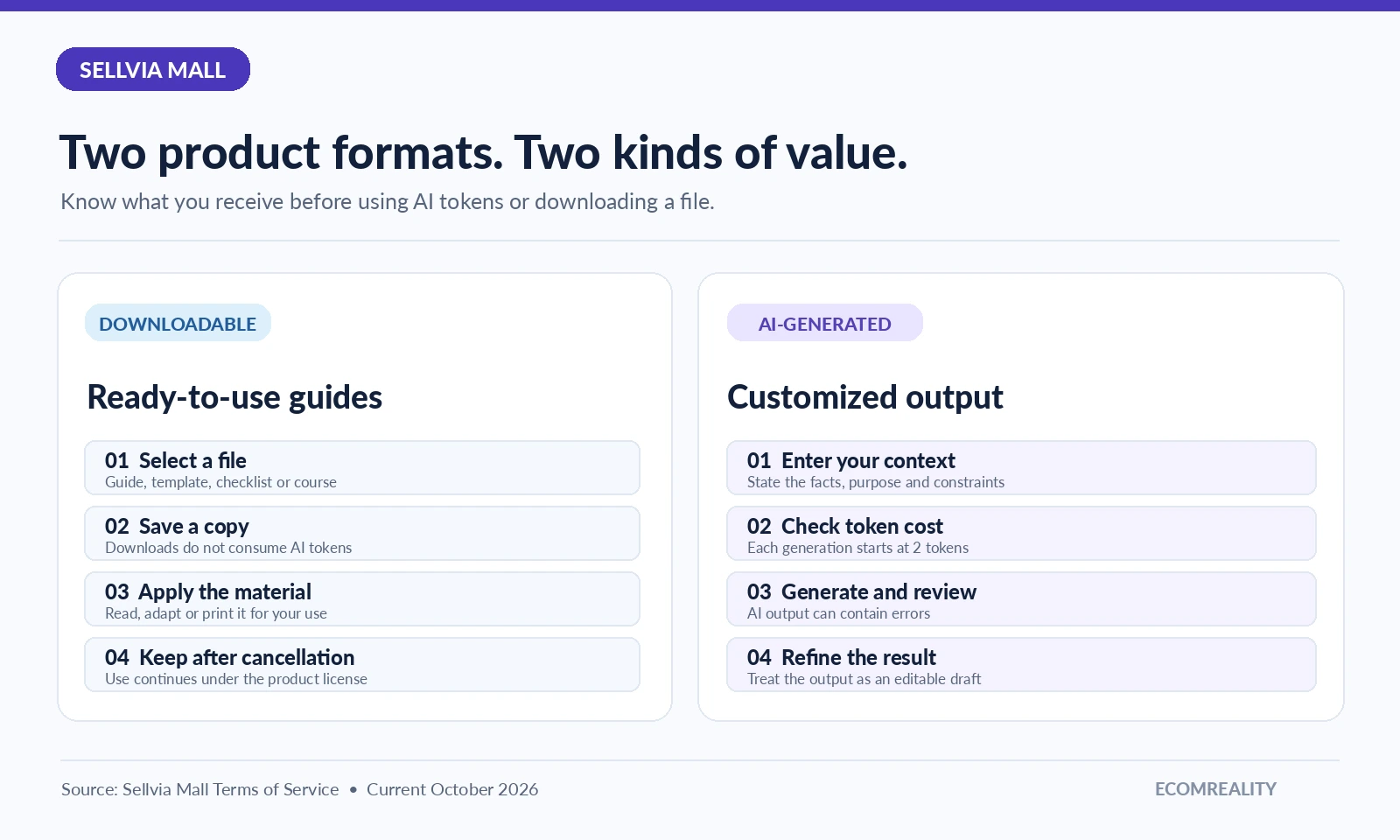
A downloadable guide is usually the more predictable purchase. Its content already exists. You can inspect the product description, determine whether the chapters cover your problem, and use the resource as a reference. A budgeting workbook might contain categories, prompts, worksheets, and example calculations. A career guide might include interview checklists or practical scripts. A course may combine lesson material with exercises. The quality depends on how thoroughly the resource was written, how well it matches your situation, and how clearly it explains its limitations. Its chief advantage is consistency: the same file is available to read again tomorrow.
An AI-enabled product has a different value proposition. Instead of merely presenting generic instructions, it accepts inputs and returns content adapted to what the user says. A buyer preparing for a job interview may give their role, experience, and goals; a planning tool may then return a tailored practice plan. That output can save drafting time, but it also requires judgment. Personalization does not make a result automatically accurate, suitable, or complete. The user still needs to examine names, facts, assumptions, tone, and any high-stakes advice before acting on it.
Sellvia Mall’s terms explicitly acknowledge that some digital products produce output such as a letter, script, plan, image, or persona. They warn that generated results can contain errors and are the customer’s responsibility to review. This is a meaningful disclosure. It positions AI as a productivity tool, not as a substitute for professional judgment, and it gives buyers a sensible way to decide when to choose a fixed guide instead.
What happens when you select a downloadable guide?
The starting point is the product listing, not the membership slogan. Read the format information carefully. Is the product an ebook, a structured template, a printable checklist, an audio course, or a multi-part bundle? An ebook and a template can both be labeled digital products while serving completely different needs. An ebook helps someone learn; a spreadsheet or checklist helps them act. For a specific task, an actionable file may be more valuable than a lengthy explanation. For a new subject, a well-organized guide may be more useful than a tool with too little context.
It is also important to notice that many catalog listings are educational. That helps set expectations for sensitive topics. A financial-planning guide can explain budgeting concepts without becoming personalized financial advice. A wellness planner can organize habits without diagnosing a medical problem. Buyers should assess whether the resource teaches an approach or actually performs a service. If it is a reference product, the safest expectation is that it will give you structured information and a framework to apply yourself.
After download, the terms say buyers retain the file even if they later cancel the Infinity Pass. The usage license is limited, non-exclusive, and non-transferable: it allows personal and internal business use and adaptation for one’s own projects, but prohibits reselling, redistributing, or republishing the source files as standalone products. That is a practical distinction between keeping a download and owning intellectual-property rights. A buyer can continue to use a template; the buyer cannot simply repackage the same template as a new product for resale.
What happens when you use an AI-enabled item?
For an AI-assisted item, the buyer should expect at least two steps: choosing the tool and giving it enough useful context to produce a meaningful result. The quantity and quality of that input matters. A vague question may generate a generic answer; a carefully described task can produce something closer to a usable first draft. If the output is a letter, check for accuracy and a natural tone. If it is a plan, verify its constraints and timing. If it is a research outline, independently confirm any facts. Generated material is best treated as a draft that can accelerate work, not as a finished authority.
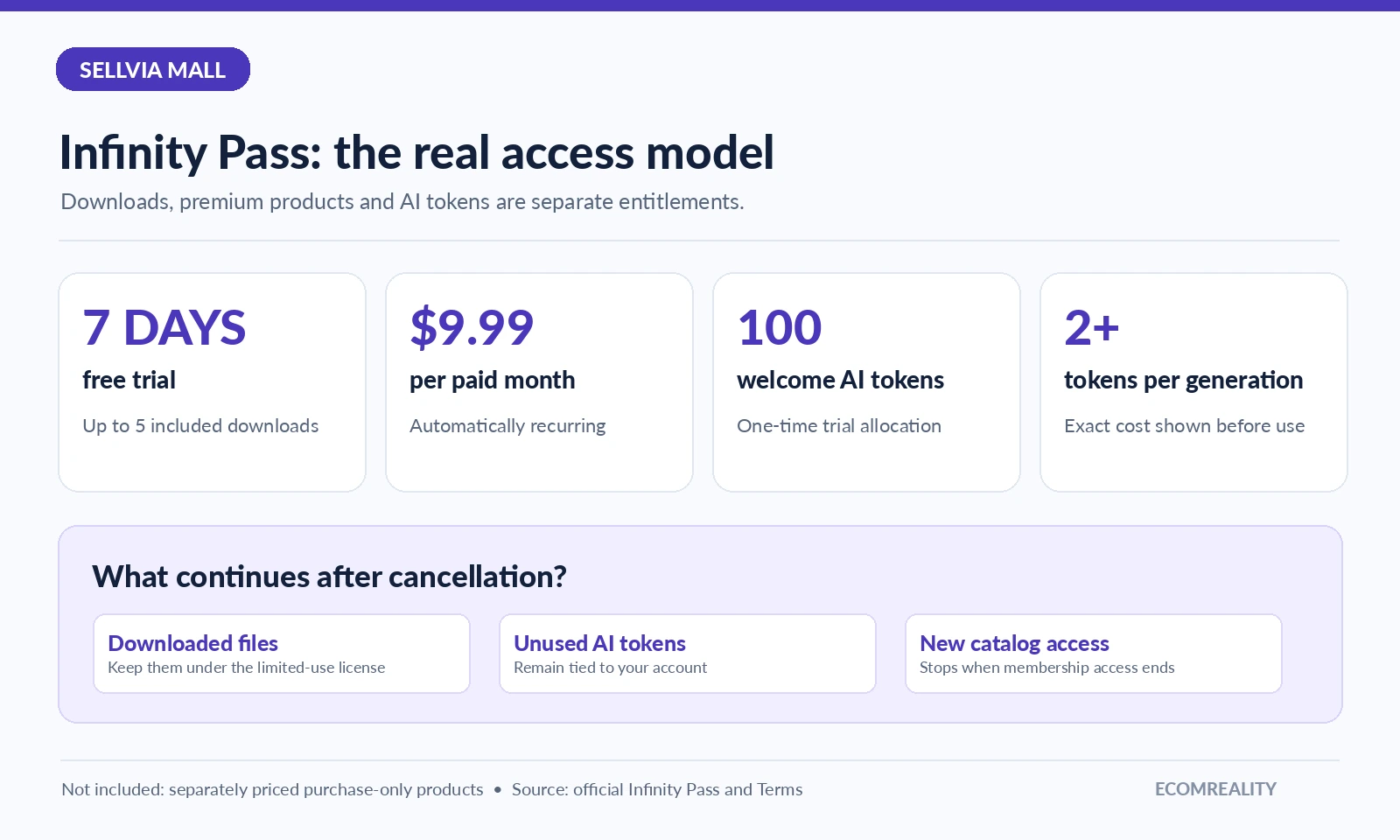
The second step is understanding tokens. Sellvia Mall’s Infinity Pass terms say a free trial begins with 100 AI tokens, and that individual generations start at two tokens, with the actual amount shown before a generation is run. Tokens do not renew automatically each billing cycle; unused balances remain available, including after cancellation. Extra tokens may be purchased. A buyer who thinks “unlimited downloads” means unlimited AI runs could misunderstand the product economics. Downloads and generation tokens are separate entitlements.
This difference changes the way to compare products. If you expect to use a guide ten times, it may cost no additional generation tokens after you save it. If you expect to regenerate a tailored output repeatedly, the marginal token requirement matters. The right way to estimate value is to ask how many customized results you realistically need, not simply how many tools the catalog advertises.
Infinity Pass pricing: what the $9.99 figure includes
As checked for this review, the Infinity Pass landing page promotes seven days free, then $9.99 per month, with cancellation available at any time. During the trial, Sellvia Mall says users can download up to five products and receive the one-time 100-token AI welcome bonus. The trial requires a payment method and converts automatically to paid membership on day eight unless cancelled before the end of the trial. The site says a reminder is sent before the initial charge. All prices are in US dollars unless otherwise stated, and applicable taxes may appear at checkout.
Once the paid membership is active, the terms provide for unlimited downloads of products included in the membership catalog, with newly added eligible products becoming available while the membership remains active. The important caveat is the word included. Sellvia Mall also sells some premium purchase-only products separately, outside Infinity Pass. A member may receive a special member price for those items, but unlimited membership downloads do not make them free. The product detail page, not the category headline, should settle the question of inclusion.
Cancellation stops future recurring charges, while membership access generally continues through the end of the already-paid period. Downloads made during an active period remain usable afterward under the product license. Likewise, unused AI tokens remain in the account, according to the published terms, although continued access to particular tools may depend on the product and account status. This distinction is easy to miss: retaining token balance does not necessarily guarantee identical access to every tool without an active membership.
A practical buyer’s decision tree
Rather than beginning with the largest bundle, start with the task you need to complete. If the answer is mostly reference material—“How should I organize a checklist?”—a guide is likely enough. If the answer needs your specifics—“Build a weekly plan from these ten constraints”—an AI product may save more time. If you need both, use a guide to understand the framework and a generator to produce the first customized draft. Then review that draft against the guidance you have learned.
Here is a useful example. Imagine preparing for a salary negotiation. A downloadable guide can teach the structure of a compensation discussion, common preparation mistakes, and how to document your achievements. A generator might help draft a personalized email from your stated facts. Those are complementary outputs rather than competing products. The guide provides reusable principles; the AI tool provides an editable artifact. Buyers who understand that relationship are more likely to benefit from the catalog and less likely to feel that two similar-sounding listings are redundant.
For recurring tasks, evaluate repetition. An annual budget checklist might need only one or two updates a year; a personalized weekly scheduling tool might be used often. If each AI execution consumes tokens, estimate usage before assuming the monthly pass fully covers it. For occasional tasks, the included trial allowance could be sufficient to learn whether a generator improves your workflow. For high-volume use, the additional token economics may become more important than the membership fee itself.
What does a $9.99 subscription actually buy you?
The clearest way to value an all-you-can-download catalog is to compare the membership with your intended use. A person who saves five useful guides during the trial has already acquired reference files they may continue to use. A person who joins for one month to build a library of relevant templates may see substantial practical value even if they cancel afterward. In contrast, someone who signs up without a specific project may accumulate dozens of files without using them. In that case, the catalog’s size becomes a distraction rather than a benefit.
For a simple illustrative calculation, the annual equivalent of a $9.99 monthly membership is $119.88, assuming twelve paid months at that unchanged price before taxes. That does not mean a user must subscribe for a year, and it does not mean every product is worth an arbitrary share of $119.88. It is simply a budgeting baseline. Compare the likely usefulness of the actual downloads and AI runs with what you would otherwise spend on similar tools, books, or software.
The distinction between unlimited included downloads and finite token consumption is the central financial insight. A buyer who mainly reads guides can estimate membership value around access and retention. A buyer who mainly generates customized outputs should treat token requirements as a separate variable and check prices at the point of use. Do not use a generic “cost per tool” calculation unless you know the share of tools that are included, the number of generations you need, and whether a purchase-only product is involved.
What is actually included in the catalog?
Sellvia Mall currently advertises 10,000+ digital products spanning subjects such as money management, work, learning, everyday life, career development, relationships, planning, and practical skills. On live category pages, products appear in a broad mix of formats: guides, toolkits, planners, courses, checklists, and AI-focused bundles. The breadth is genuine as a catalog design choice, but the number of listings alone is not a guarantee of uniform depth. A short printable checklist and a long multi-part training resource can both count as one product.
A useful search technique is to approach the catalog with several versions of a task. Search first for the problem, then for the format, and finally for the output: for example, “interview preparation,” “interview checklist,” and “interview email.” This reduces the risk of opening a generic item when a more targeted product is available. It also reveals whether the catalog offers alternatives at different levels of complexity. The best selection is usually the one that most directly matches the desired output and the amount of effort the buyer is prepared to invest.
Do not confuse positive product-card ratings or prominently promoted listings with independently audited results. A rating may reflect users’ impressions, while a paid placement can affect visibility without changing the product’s contents. Sellvia Mall’s terms say promoted products are marked and do not receive altered pricing simply because they are promoted. The right response is not to disregard popular items, but to judge them against your personal requirements instead of assuming their position in the interface predicts usefulness.
Five questions to ask before using a product
First: What do I actually receive? Look for the exact format and deliverable. “AI productivity system” can mean a bundle of instructions, an interactive generator, or a collection of downloadable files. Those are very different experiences.
Second: Is the item included in my pass? Purchase-only items exist. Check whether the price shown is a separate purchase, a discounted member price, or an included membership item.
Third: Does this operation cost tokens? Downloads never consume AI tokens, according to the current terms; generation actions can. Review the per-generation charge before confirming a run.
Fourth: Can I use the result commercially? The source digital product itself cannot be resold or republished. The terms allow certain outputs to be used for personal, household, and business projects, subject to compliance. Buyers who intend public publication should also consider accuracy, confidentiality, licensing, and virtual-persona disclosure rules.
Fifth: What happens after cancellation? Downloaded files stay with you. New catalog downloads stop when paid access ends. Remaining tokens stay associated with the account, but current tool access should be verified. These distinctions are more useful than a vague promise of permanent ownership.
The main strengths and limitations
The biggest strength is convenience. Sellvia Mall lets buyers explore digital learning resources, practical templates, and AI-assisted products in one place rather than maintaining separate subscriptions for every small task. A low monthly entry price and the ability to keep downloads make short, project-based use attractive. The catalog’s breadth also creates opportunities to combine a learning resource with an action-oriented template or generator. For customers who repeatedly need everyday business and productivity materials, that combination can save research time.
The limitation is that membership breadth can create unrealistic expectations. Not every listing will be equally valuable, not every larger product is included in the pass, and unlimited downloads are not unlimited AI output. AI generations can be inaccurate or unsuitable until reviewed. Purchased or downloaded materials carry a limited-use license rather than unrestricted redistribution rights. None of those drawbacks makes the service inherently unattractive; they simply mean the best buyer is someone who chooses deliberately and treats outputs as tools to work with.
Final verdict: choose the format before judging the deal
Sellvia Mall’s AI tools and downloadable guides should be evaluated as complementary categories. Guides, workbooks, and templates are best when you need reliable reference material, repeatable steps, or a file you can retain. AI-powered tools can be useful when the task benefits from personalization and you are willing to review the output. The Infinity Pass makes exploring both categories relatively affordable, but purchase-only exclusions and token accounting are material details, not fine print to ignore.
For a practical purchase decision, start with a concrete task, inspect the product type, check whether membership covers it, and estimate token usage if generation is involved. Then apply your own quality control. That is a more reliable path to value than collecting the highest number of downloads or assuming a generated answer is finished just because it arrived quickly.
Frequently asked questions
Are all Sellvia Mall products AI tools?
No. The catalog includes guides, checklists, templates, planners, courses, and other digital resources alongside AI-enabled products. A downloadable guide and an AI generator serve different purposes.
Is unlimited AI generation included in Infinity Pass?
No. The membership offers unlimited downloads of eligible catalog products during paid access, while AI generation uses a separate token balance. The trial includes 100 welcome tokens, and generation costs start at two tokens per run.
Do downloads disappear after canceling?
The current terms say files downloaded during membership remain yours to keep under the limited-use license. Cancellation ends future billing and eventually access to new downloads, not the right to retain existing copies.
Can I resell a guide I downloaded?
No. The product license prohibits resale, redistribution, sublicensing, or republishing the downloaded source files as standalone products. Rules for using your own AI-generated output differ and require compliance with the terms.
Are the AI tools suitable for legal or medical decisions?
They may assist with planning or drafting, but Sellvia Mall’s terms say its products are educational and not a substitute for legal, medical, financial, or other professional advice. Review factual accuracy and seek qualified advice when needed.
Sources and editorial method
This article uses the official Sellvia Mall catalog, Infinity Pass page, and Terms of Service, accessed in October 2026. Product listings and availability change. The review is based on documented public features and calculations, not a claim of independent purchase or outcome testing.

Jo Carter is an editor and ecommerce researcher at Ecom Reality, where she covers ecommerce platforms, digital selling tools, online business software, pricing models, and emerging industry trends. She focuses on turning complex platform features and costs into clear, practical information for entrepreneurs and digital sellers. Her work combines detailed research with a balanced editorial approach, helping readers compare services, understand potential limitations, and choose tools that fit their business goals.
Comments
Related Articles

Leave a Reply