
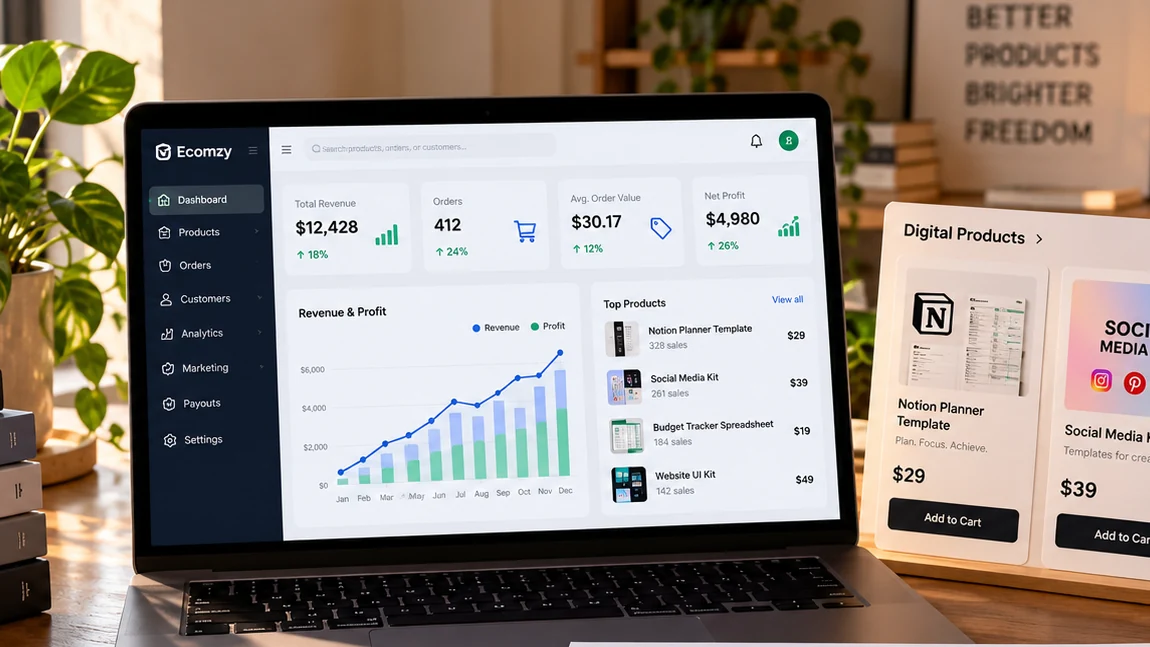
The most useful question about Ecomzy margins is not simply how much someone could earn from a digital product. It is which transaction flow created the order. Ecomzy’s public pages market turnkey stores, a large digital-product catalog, hosting and managed platform infrastructure. The pricing page promotes a 14-day trial followed by a $39 monthly plan. These can be useful foundations for a new online business. However, the current Terms of Service describe a payment and order-processing structure that is more detailed than a short marketing headline. A serious earnings model needs to capture that structure rather than treating every checkout as identical.
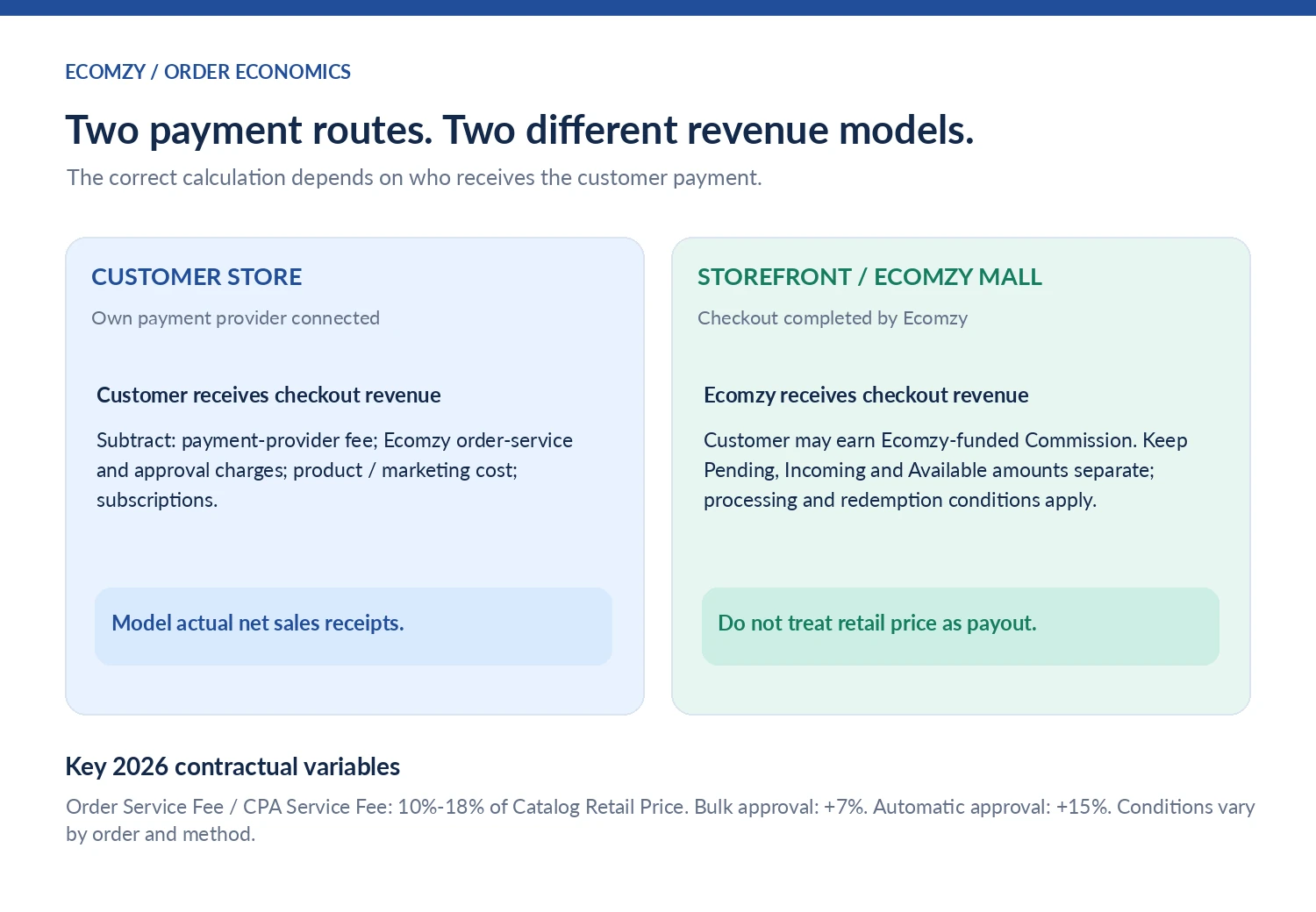
The first distinction is between a Customer Store using the customer’s own payment system and a Storefront configuration without its own checkout. In the first case, the customer receives the end-customer payment and pays Ecomzy separately for catalog order-processing services. In the second, the shopper completes checkout with Ecomzy, and the Storefront operator never receives or owns the end-customer payment. Instead, Commission can be allocated as an Ecomzy-funded promotional incentive after the required order-processing and validation steps. The phrase “product margin” means different things for those two flows. Both can be modeled, but they must never be combined into one generic net-profit figure.
The basic economics of an Ecomzy store
The official pricing page promotes a 14-day free trial and $39/month for Ecomzy PRO. The October 2026 Terms of Service also describe PRO Basic at $39/month, Advanced at $99/month and Ultimate at $299/month, alongside separate optional Performance Tiers. The terms explain that each additional turnkey store is associated with a separate subscription. A store’s recurring plan therefore belongs in its fixed-cost model, whether sales volume is high or low. Paid marketing tools, upgrades and optional services should be included only when actually purchased, never silently treated as included in the $39 plan.
In the own-checkout model, revenue arrives directly to the store operator’s payment provider. Variable costs may include the provider’s payment processing, content creation, acquisition spending and the Order Service Fee owed to Ecomzy on an approved Customer Store Order. In a Storefront or Ecomzy Ecosystem flow, by contrast, Ecomzy is the seller of record; the customer’s relevant inflow is potential Commission rather than the customer’s retail checkout amount. The separate order-processing and promotional fees are costs of operating that channel. This distinction is essential before considering any percentage margin.
Accordingly, begin with three inputs: which type of order it is, what the Catalog Retail Price is, and how order approval will occur. Then look at likely Commission or directly collected revenue, subscriptions, fees, marketing and refunds. Two products with the same visible listing price can have different effective economics when one is sold through a self-managed payment route and another is an attributed Ecomzy Mall order.
The margin formula that actually matters
For a Customer Store using its own payment system, a practical contribution estimate is:
Customer Store contribution per sale = Checkout revenue received – payment-provider charges – product-creation cost – Ecomzy order-related fees – attributed marketing cost – allocated recurring costs. The checkout revenue assumption must be replaced with actual amounts collected; the Ecomzy fee must use the Catalog Retail Price basis stated in the order terms.
The calculation is deliberately more specific than a generic “selling price minus processing fees” shortcut. Under the current terms, applicable CPA Service Fee or Order Service Fee is 10%-18% of Catalog Retail Price. When applicable, bulk order approval adds 7% and automatic approval adds 15%, rather than both fees applying together. A promoted order can carry a separate CPA Fee, while late approval can create another charge. The relevant rates and amounts should be taken from the actual Ecomzy catalog and dashboard for each order, not inferred from a marketing claim about platform commissions.
Fixed costs matter as well. Suppose a customer pays $39 for Ecomzy PRO and $30 for supporting software. At 10 completed orders, these $69 of monthly costs average $6.90 per order; at 100 orders, they average $0.69. But allocation does not replace the order-level charges. Those must be calculated separately, using the exact transaction flow and approval option. The result is a more decision-useful forecast than a single advertised margin percentage.
What official Ecomzy materials imply for margins
Ecomzy’s homepage advertises 0% platform commission on the store, while its October 2026 contract specifies separate order-related service fees and other conditions. Readers should not interpret the promotional headline as meaning that every Ecomzy-related order is free to process. The most important contract distinction is economic ownership of the checkout payment. With a customer’s own payment system, the customer receives the sale proceeds and separately owes applicable platform service charges. With a Storefront redirecting to Ecomzy Mall, Ecomzy collects the payment and the store operator can receive Ecomzy-funded promotional Commission if eligibility requirements are met. Each model can support a business, but the revenue line in the worksheet must reflect the correct one.
Fees also vary by operating choice. The October 2026 terms specify a 28% Promotion Service fee calculated on Ads Credits applied to daily delivery, alongside the underlying credits used; a 10%-18% Order Service Fee or CPA Service Fee for applicable orders; and additional approval-method charges. In Commission-funded flows, cash redemption is a separate process with its own thresholds, verification and fees. It is important to keep three kinds of numbers separate: checkout revenue paid directly to the customer where applicable, Commission recorded by Ecomzy but not yet approved for redemption, and the operational costs the customer pays to Ecomzy.
- Product margin: What do I keep after product cost and payment processing?
- Contribution margin: What do I keep after product cost, payment processing and variable marketing spend?
- Business margin: What do I keep after contribution margin plus my share of monthly subscription and tool costs?
This separation is useful even for small businesses. It shows which expenses are truly variable, which are subscriptions, and which amounts are potential promotional incentives rather than settled cash. It also avoids treating pending Commission as money available to spend. A seller deciding whether to increase ad spend should look at approved-order economics and actual eligible payouts, not a single optimistic dashboard total.
Three realistic margin scenarios
Digital products avoid physical inventory and shipping, but that does not make every order inexpensive. A paid product could involve content creation, catalog charges, per-order service fees, payment-provider costs, advertising, subscriptions and possibly Commission redemption costs. The illustrations below therefore model order economics under stated assumptions. They are not screenshots of real Ecomzy profit, not guaranteed rates and not forecasts of what a reader will earn.
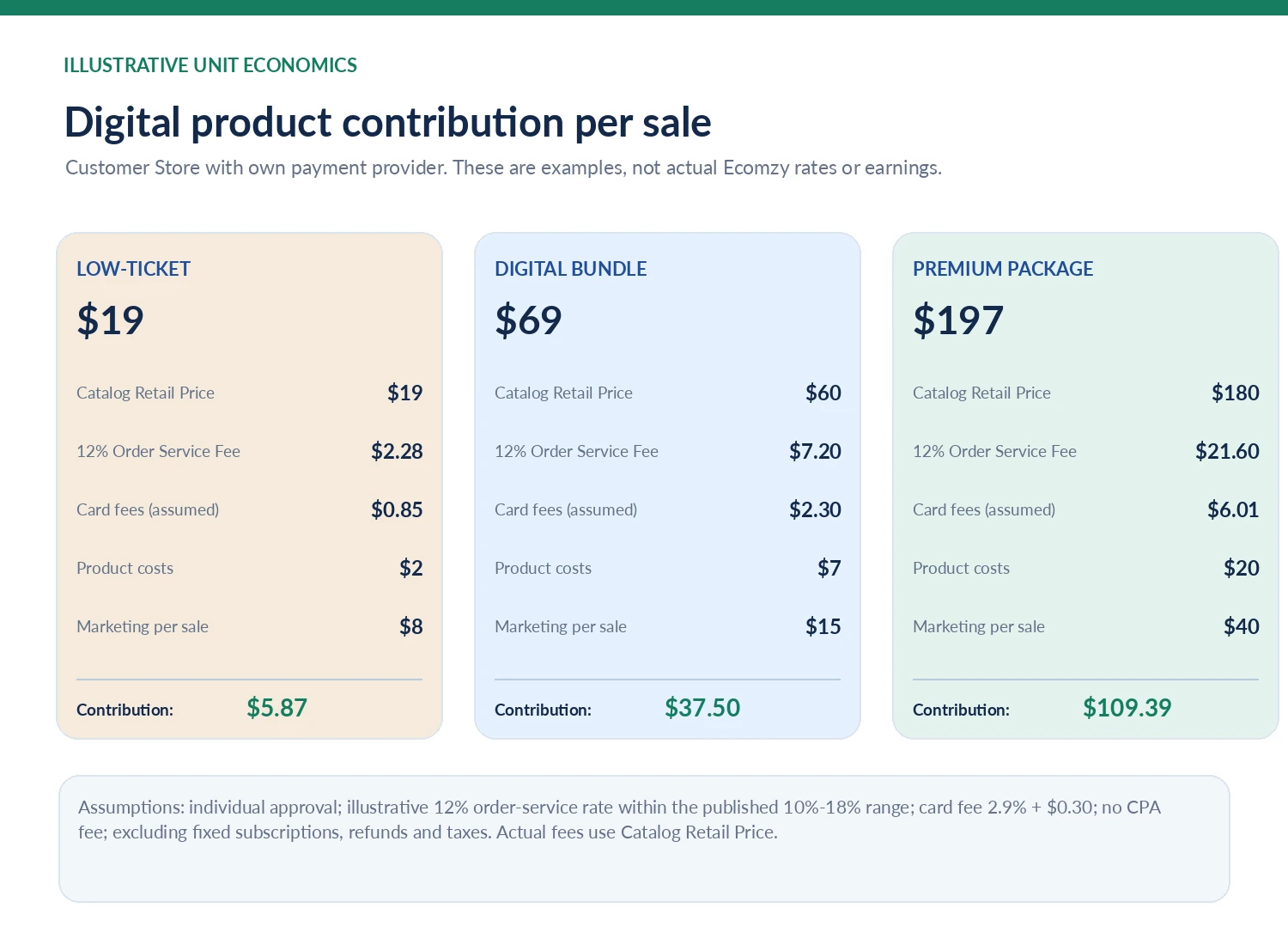
| Illustrative Customer Store sale | Low ticket | Bundle | Premium |
|---|---|---|---|
| Checkout revenue received | $19.00 | $69.00 | $197.00 |
| Assumed Catalog Retail Price | $19.00 | $60.00 | $180.00 |
| Illustrative Order Service Fee at 12% of Catalog Retail Price | $2.28 | $7.20 | $21.60 |
| Illustrative card fee at 2.9% + $0.30 | $0.85 | $2.30 | $6.01 |
| Illustrative product creation allocation | $2.00 | $7.00 | $20.00 |
| Illustrative marketing per conversion | $8.00 | $15.00 | $40.00 |
| Contribution before fixed subscriptions | $5.87 | $37.50 | $109.39 |
All figures are illustrative, not a quotation from Ecomzy. Assumes the customer’s own payment checkout, individual approval (0% extra approval fee), an assumed 12% Order Service Fee within the contractual 10%-18% range, no separate CPA Fee, no refunds, and the illustrative card-processing rate shown. Catalog Retail Price may differ from customer checkout price. Fixed costs, taxes and additional services are excluded from these row totals.
How to allocate subscription and tool costs the right way
Because Ecomzy has a monthly subscription, fixed costs need to be allocated to realistic completed orders. On a $39 monthly plan with 20 completed orders, the subscription alone contributes $1.95 to each order. Add $25 of design software and $20 of marketing tools and the fixed monthly total becomes $84, or $4.20 per completed order at that volume. At 80 completed orders, the same pool contributes $1.05 per order. This calculation should be made after applying the actual order-service charges in the individual transactions, not in place of them.
Optional upsells, such as higher subscription tiers or performance-tier style add-ons described in the terms, should be handled the same way. Do not treat them as vague “business costs.” Spread them across the sales they are helping generate. If a higher plan or marketing add-on is expected to help you scale, your margin worksheet should make that assumption visible. That way, you can see whether the extra cost is actually being justified by extra revenue.
Common margin mistakes on Ecomzy
- Using the wrong revenue line: a Storefront redirect to Ecomzy Mall does not receive end-customer checkout proceeds; potential Commission is distinct from retail receipts.
- Assuming 0% platform commission means no operational fees: order service, approval, CPA and promotion fees may apply under the current terms.
- Using store price as the fee base by default: the order-service percentages are calculated against Catalog Retail Price.
- Counting pending Commission as cash: allocation, validation, redemption conditions and additional fees must be considered.
- Ignoring subscriptions, marketing and refunds: these can materially change contribution margin, even for digital products.
What a strong Ecomzy margin profile looks like
A healthy Ecomzy store usually shows four signs. First, pricing is deliberate rather than emotional. Sellers know why a product is priced at $19, $69 or $197. Second, margins are tracked per product, not only at the store level. Third, fixed costs are allocated monthly so the owner knows which products are carrying the business. Fourth, marketing spend is monitored separately from product quality, which prevents good products from being misjudged because traffic was bought inefficiently. When those four habits are in place, Ecomzy’s basic economics become much easier to manage.
What helps with planning
- The $39/month starting subscription provides a known fixed cost.
- The terms identify order categories and approval methods, enabling more realistic per-order modeling.
- Digital delivery removes physical stock and shipment assumptions from the worksheet.
- Separate account records make it possible to distinguish Commission from direct customer checkout receipts.
What reduces the result
- Order Service Fee or CPA Service Fee at 10%-18% of Catalog Retail Price, where applicable.
- Bulk, automatic or late approval fees when triggered by the chosen process.
- Payment processing when using an independent payment provider.
- Marketing, subscriptions, creation costs, refunds and applicable Commission redemption fees.
Build a monthly margin worksheet, not just a one-product estimate
Use a monthly worksheet with distinct tabs for direct Customer Store sales, Storefront or Ecosystem orders and subscription costs. For direct sales, start with the amount collected through the customer’s own payment provider, then subtract provider fees and the appropriate Ecomzy order costs. For Storefront and Ecosystem flows, use recorded and ultimately approved promotional Commission as a separate potential inflow, subtract eligible operational costs and redemption charges, and distinguish pending or incoming amounts from available, approved payouts. This is more work than a single generic formula, but it prevents a fundamentally wrong revenue model.
That approach highlights where the store’s economics come from. A $19 digital download can be profitable in one channel and weak in another, because processing and acquisition differ. A $69 bundle may tolerate more ad spend, but only if the actual Catalog Retail Price and order fee are included. And a premium $197 package may carry enough contribution to cover fixed costs, yet still fail to justify expensive customer acquisition. The math is useful precisely because it exposes those differences rather than promising a universal margin.
When optional services should enter your margin model
Ecomzy’s terms describe optional services beyond the basic subscription, including higher PRO tiers and separate Performance Tiers. Their price and functionality should be included when actually used. A customer on the $39 plan who adds a $19 weekly Performance Tier is not spending just $39 a month. The weekly payment creates another recurring cost, and its exact monthly equivalent changes with the calendar. Similarly, customers using paid advertising should include the applicable promotional service charge. For budgeting, list each recurring or usage-based charge in a separate row instead of labeling everything “platform fees.”
A practical budget allocates a campaign cost to the products or order sources it supports. If Ecomzy’s Promotion Service is used, the terms state that the 28% service fee applies to Ads Credits consumed in delivery, in addition to those credits; this is not a fee on every store sale. For example, $100 of credits applied to delivery would correspond to $28 of service charge under that stated formula, for $128 total credit consumption before unrelated charges. In contrast, advertising purchased outside Ecomzy would follow the external platform’s own billing. Both belong in the acquisition-cost worksheet, not in the order-processing line.
This is why margin tracking matters. It is not just bookkeeping after an order is paid. It is a way to decide which customer acquisition channels are worth funding, when paid automation makes economic sense, and how much fixed subscription expense is supportable. In a system with multiple payment routes and Commission stages, careful categorization is a competitive advantage rather than unnecessary complexity.
Final verdict
Ecomzy’s appeal is its integrated digital-product infrastructure: ready storefronts, product access, hosting and a workflow for marketing and managing orders. Those features can simplify setup and give new operators a clearer starting point. But actual earnings still depend on the payment arrangement and the rates in the current customer agreement. A Customer Store with its own checkout should model direct receipts less the applicable order fees, payment processing, creation, advertising and subscriptions. A Storefront redirecting buyers to Ecomzy Mall should model qualifying Ecomzy-funded Commission and redemption conditions instead of treating checkout revenue as the customer’s income. Either way, the most useful Ecomzy margin estimate is an explicit worksheet with verified order type and fee base, not a headline percentage. That approach gives the business owner a realistic basis for pricing, promoting and scaling digital products.
FAQ
No. The public homepage’s marketing shorthand should be read alongside the current Terms. Section 3.3 identifies an Order Service Fee or CPA Service Fee of 10%-18% of Catalog Retail Price on applicable approved orders, plus additional approval-method charges when relevant.
Under Ecomzy’s Storefront Configuration, checkout occurs on Ecomzy Mall and Ecomzy receives the end-customer payment. The Storefront customer may qualify for Ecomzy-funded promotional Commission, but does not receive the retail checkout funds.
Ecomzy’s public pricing page promotes $39 per month after a 14-day trial. Its October 2026 terms also list higher monthly PRO plans and optional Performance Tiers.
Yes. Start with actual checkout revenue, subtract processor charges and appropriate Ecomzy service fees based on Catalog Retail Price, then subtract creation, customer acquisition and allocated subscription costs. The illustrative figures in this article are not actual Ecomzy quotes.
Sources and methodology
Official references: Ecomzy product overview, Ecomzy PRO pricing, and October 2026 Terms of Service, especially Sections 1.2, 1.3, 1.4, 3.1, 3.3 and 3.5. Examples are hypothetical and are not customer-account screenshots, real payout tests or earnings forecasts. Use the live dashboard’s current order details and fees for an actual business decision.

Sylvia Pierce is an editor and ecommerce researcher at Ecom Reality. She specializes in reviewing ecommerce platforms, digital selling tools, pricing models, and online business software. Her work focuses on providing clear, practical, and balanced information that helps entrepreneurs make informed decisions.
Comments
Related Articles



Leave a Reply