
Sellvia Ads Budgeting: How Advertising Spend Affects Store Profit

The number that matters before you touch a budget
Start with the amount a completed digital-product order contributes after the relevant platform and order-processing charges, but before advertising. Call it net order contribution before ads. That number is not automatically the customer's checkout payment, the catalog price, or the gross commission displayed when an order first appears. Order terms, approval method, payment channel and subsequent adjustments can change the final result. Your own dashboard and the current order terms should determine the real per-order figure. The model in this article deliberately assumes a net contribution of $18 per completed order when illustrating advertising choices. It is a hypothetical input, not an average for Sellvia stores.
With that distinction in place, the core question becomes simple: how many additional completed orders must an increase in advertising produce? If the added cost is larger than the contribution from those extra orders, the increase does not pay for itself during the measurement period. This does not necessarily mean advertising had no long-term benefit; some buyers may return, and future organic demand can be influenced by earlier exposure. It does mean the operator should not declare the decision profitable solely because traffic or gross sales increased. Keep immediate campaign contribution and potential longer-term effects in separate columns.
Sellvia's 28% advertising charge changes the calculation
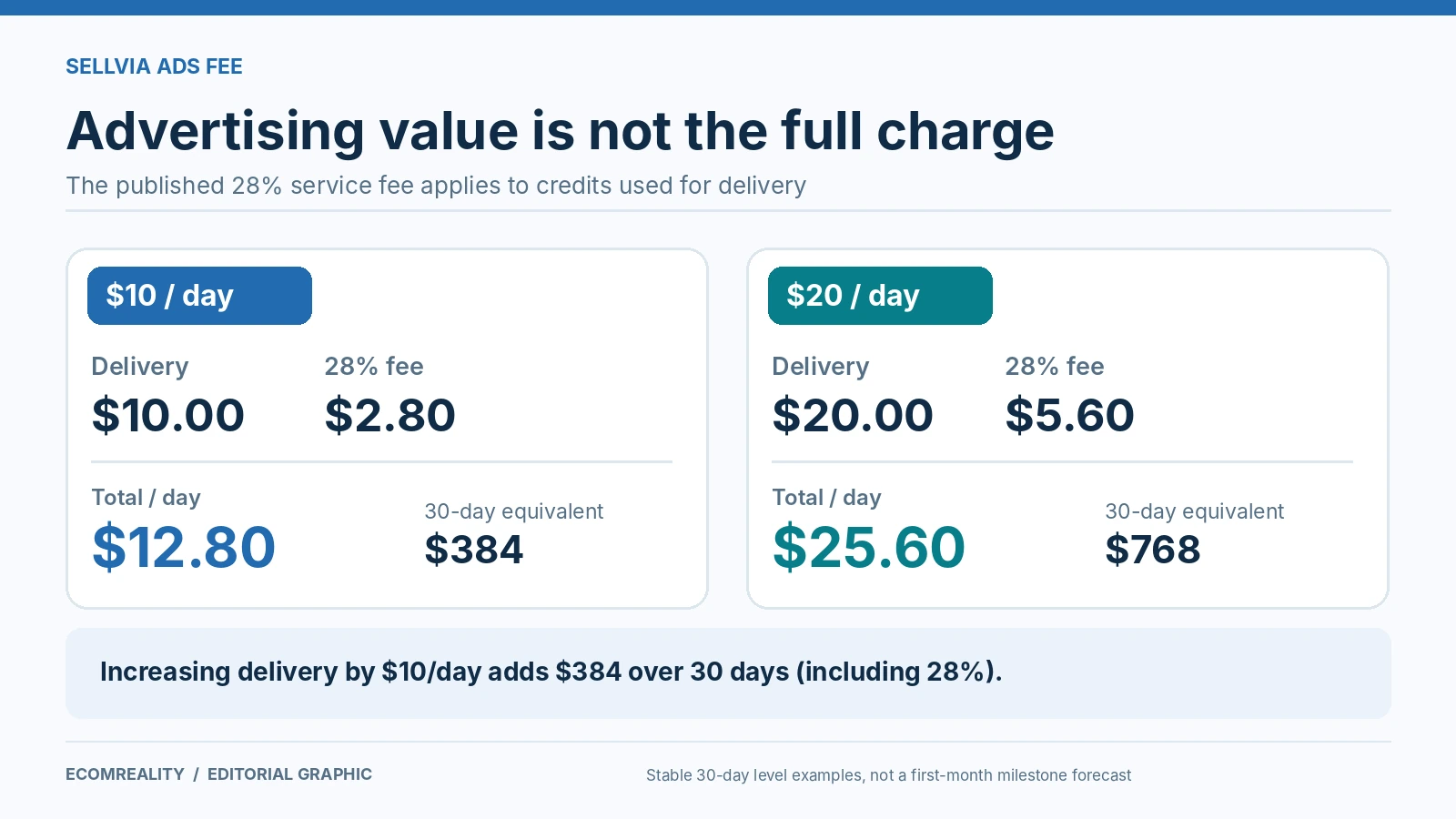
The current Sellvia terms say that a Promotion Service Fee of 28% applies to Ads Credits actually used for advertising delivery, not simply when credits are purchased. The fee is additional to the credits applied to delivery. In other words, a day with 20 Ads Credits used for promotion is associated with a total 25.60 Ads Credits deduction under that rule. A simple spreadsheet should have two separate columns: value applied to promotion and total credits deducted. If your account report already shows an all-in deduction, do not add 28% again. Double counting makes a healthy campaign look worse than it is.
For a stabilized 30-day hypothetical period at a daily delivery value of $20, the media-equivalent amount is $600 and the fee is $168, yielding $768 all-in before credits and adjustments. This is not a first-month forecast because daily budget packages unlock in stages. It is a controlled example showing how to price a fixed daily level once available. At $10 per day, the equivalent 30-day amounts are $300 for advertising and $84 for the fee, or $384 combined. The extra $10 daily delivery level therefore requires $384 more over 30 days after the service fee is considered.
The first question when the budget rises from $10 to $20
Suppose a store is already receiving orders at a lower spend and the next eligible budget has unlocked. The operator considers moving from $10 per day to $20 per day for a comparable 30-day period. The incremental delivery value is $300; the incremental 28% fee is $84; the complete incremental charge is $384. If an additional completed order yields $18 before advertising, the budget increase needs at least 22 genuinely additional orders to cover itself because 21 orders contribute only $378, which is below the $384 incremental charge. That is the decision threshold in this particular example.
The word "additional" is doing the work. Twenty-two orders in the higher-budget period are not enough if the store would have received 18 of them anyway at the lower budget. You need the difference attributable to the increase. If the lower-budget baseline would have produced 20 processed orders and the higher level produced 35, there are only 15 incremental orders, contributing $270. That fails to recover $384, even though the total number of orders grew impressively. This comparison makes the decision about incremental efficiency, not vanity metrics or whether the marketing dashboard looks busy.
An upgrade should be a test, not a permanent commitment
A useful experiment begins with a hypothesis: increasing spend should generate a measurable number of additional completed orders without lowering contribution per order beyond a tolerable point. Write that hypothesis before changing the setting. Then decide the measurement window, the maximum amount of additional advertising you are willing to fund, and the minimum number of incremental orders needed. A short window may be necessary to protect cash, but a single day is rarely reliable because buyer behavior and campaign delivery can fluctuate. A test that has no defined stop rule is simply a more expensive habit.
Keep the conditions as stable as possible. Avoid simultaneously changing the digital-product mix, large landing-page elements, prices and advertising budget, because then a different order count cannot be confidently attributed to the budget alone. If a product must be changed for another reason, record the date. You are not conducting a laboratory experiment, but you can preserve a useful before-and-after comparison. Look for meaningful differences in comparable weekdays, campaign duration and product availability. A disciplined operator is allowed to wait for sufficient evidence before raising the daily level further.
Attribution: which orders actually came from paid traffic?
Paid advertising should be assessed against orders that reasonably relate to its delivery period and channel. That does not mean every sale after an ad click can be attributed with perfect precision. A customer may see a promotion, return directly later, discuss the product with a friend or buy a different item. Equally, a store may receive organic orders that are not caused by the current paid campaign. Mixing them all into "ad-generated orders" makes a campaign appear more efficient than it is. The practical solution is to distinguish clearly attributed paid orders, ambiguous orders and independently sourced orders where the available reports permit it.
When attribution is incomplete, use a range rather than false certainty. A conservative view credits only orders with strong paid evidence; a broad view includes possible influenced orders. If both views support the budget change, the decision is stronger. If only the broadest optimistic assumption produces profit, the marketing case remains fragile. The important point is not to invent a precision that the platform does not provide. Record the data you genuinely have, and make the remaining uncertainty visible in your private decision worksheet.
Processed orders are not the same as order notifications
Sellvia operates an order-processing workflow. A new order appearing in the dashboard is an indicator of demand, but it should not be treated as settled profit before the necessary processing and status changes occur. For ad analysis, reconcile the number of created orders with orders actually completed and the contribution ultimately earned. A campaign might initially look attractive based on orders placed, then less attractive after failed payments, cancellations, processing charges or other adjustments. This is particularly relevant when increasing advertising causes orders to arrive faster than the operator can fund or approve them.
Define your measurement terms before looking at the graph. "Orders created" tells you about customer response. "Orders processed" tells you about execution. "Contribution after applicable order charges" is the economic input needed for the decision. "Available balance" tells you something different again: how much credited money has cleared for withdrawal. The same customer transaction can appear at several stages on different days. Summing stages or mixing definitions makes the analysis unreliable. Choose one operational definition for each figure and keep it consistent across tests.
The best scale signal is marginal contribution
The common temptation is to compare average cost per order before and after raising the budget. Average cost is useful, but it can hide a decline in the performance of the last increment. Suppose a campaign produces 20 paid-associated completed orders for an all-in advertising charge of $384. That is $19.20 per order. If increasing the budget creates 15 more orders at an extra cost of $384, the marginal advertising cost of those additional orders is $25.60 each. The blended figure across 35 orders becomes $768 divided by 35, or about $21.94 per order. The blended figure looks moderate even as the newly purchased volume is clearly less efficient.
Compare that marginal cost with the per-order contribution before ads. At an assumed $18 contribution, the first batch of 20 orders already trails its advertising cost, and the extra 15 are even less efficient. A store with a higher contribution could have a different outcome, which is why this example is about the method rather than a verdict on Sellvia. The central rule is to avoid using the blended average to justify an increment that does not pay for itself. Scaling is attractive only when extra spend buys extra value at an acceptable price.
Product mix can make a budget change look deceptively good
Two campaigns with the same number of orders can generate different economic results because the digital products sold differ in price, catalog terms or applicable charges. If higher spend shifts buyers toward products with less net contribution, total order count may improve while operating profit stays flat. A proper advertising worksheet therefore separates products or at least product groups when the dashboard supports that level of detail. Compare earned contribution per product category, not only its number of purchases. A promotion that attracts many low-contribution orders may be less useful than a smaller campaign focused on a stronger product mix.
This is not an argument for selling only expensive products. Some lower-priced items may be easier for a new customer to buy and may lead to future purchases. But those benefits need observation rather than assumption. Unless you can document a repeat-purchase pattern, do not assign imaginary lifetime value to justify a losing first transaction. Keep an initial contribution calculation and a separate repeat-customer analysis. If repeat purchasing becomes measurable, it can legitimately inform acquisition limits. Until then, cash funding decisions should be based on outcomes the store can already support.
Fixed expenses should not be charged twice
Sellvia's base subscription and any applicable optional tiers belong in the period's operating result. They do not necessarily belong in the marginal cost of increasing daily advertising if those fixed charges would have been paid regardless of the test. This is an important distinction. When asking whether the overall store made money this month, deduct the full subscription and every relevant period expense. When asking whether raising the ad budget from one level to another was worthwhile, compare the additional ad charge with the additional processed-order contribution and any extra cost the change itself caused. Both analyses are valid; answering one question with the other's formula is not.
For example, if a $39 subscription is already committed, adding it to both the lower and higher budget scenarios does not change the difference between them. If a different product package or paid feature is purchased specifically to support the higher budget, that incremental cost does matter. This is why good reporting uses a period operating statement and a separate budget-decision worksheet. One tells you whether the whole operation is self-supporting; the other tells you whether the next spending step improved the result.
A cash-flow bottleneck can stop a profitable test
It is possible for a campaign to show positive expected contribution and still create a funding problem. Advertising may consume credits now, while processing orders requires separate money or balances and earned commissions become available only after the applicable status and reserve rules. A merchant who treats Pending or Incoming amounts as immediately spendable can run out of working capital despite a respectable accounting projection. That is not necessarily evidence that advertising was unprofitable. It is evidence that the timing of the cash flows was not planned alongside the unit economics.
Build a funding calendar: daily advertising charges, anticipated order-processing obligations, subscription renewal, any weekly services and the earliest realistic dates on which cleared amounts could be withdrawn. Keep a conservative buffer so a few strong sales days do not force a pause in operations. The budget decision should pass two tests: the expected incremental contribution is positive, and the required working capital is available without relying on funds that are still restricted. A larger ad budget is not operationally helpful if the store cannot process the additional customer demand responsibly.
A framework for the next budget decision
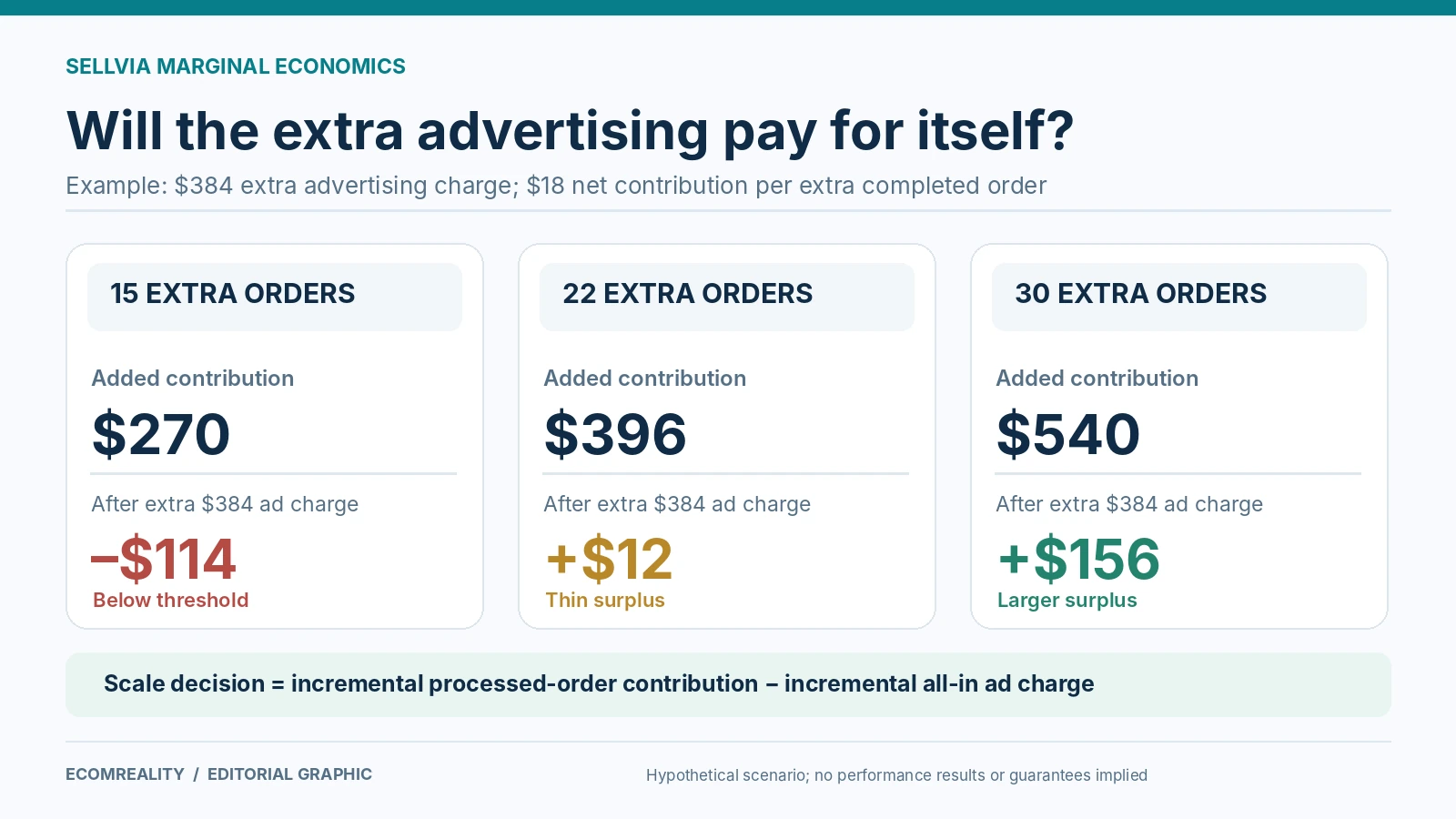
Imagine three possible observations after a 30-day test of an additional $384 all-in advertising charge. The first scenario generates 15 additional completed orders, each worth an assumed $18 before ads: the added contribution is $270 and the increment is negative by $114. The second generates 22 additional completed orders: $396 of contribution minus $384 equals a $12 surplus, which is mathematically positive but leaves little room for adjustments. The third generates 30 additional orders: $540 minus $384 equals a $156 surplus. These are hypothetical outcomes, not campaign projections or platform performance averages.
The middle scenario illustrates a vital decision principle. Crossing zero by a few dollars may not justify aggressively increasing the budget when results can be revised, attribution is imperfect and order contribution varies. An operator may sensibly require a margin of safety. That threshold is a personal business rule rather than a Sellvia platform guarantee. The practical choice can be to keep the lower budget, improve product selection or continue observing until there is more evidence. The strongest expansion is not the one with the highest click count; it is the one the business can fund and whose additional economics remain attractive under reasonable downside assumptions.
Final perspective
Sellvia Ads reduces the need for a seller to build separate advertising infrastructure, and its staged packages give operators a clear path for increasing campaign capacity. That convenience is useful for digital-product businesses, but it should be paired with accurate contribution tracking. The 28% fee makes a visible difference: the actual cost of additional advertising is greater than the nominal delivery value. Campaign credits, fixed subscriptions, processing costs and unavailable commission balances need separate treatment to avoid misleading comparisons.
The most productive rule is to treat each budget increase as a measured test. Find the contribution of a completed order, calculate the extra all-in daily commitment, define how many truly additional orders are needed, then check whether those orders actually arrive. Protect the cash required to process them and resist assuming that all traffic becomes profit. When a budget change is justified by measurable incremental results rather than by a newly unlocked tier, advertising becomes a controllable business investment instead of a guess.
Frequently asked questions
Does a $20 Sellvia daily budget cost exactly $20?
Under the currently published terms, a 28% service fee applies to advertising credits used for promotional delivery. An example day with 20 credits applied to delivery therefore corresponds to 25.60 credits deducted before any valid promotion or adjustment; check the live account for the actual charge.
Is the $50 daily package available immediately?
The public milestone sequence starts at $10 and unlocks higher levels over time, with the $50 package associated with 30 days of continuous service. Account settings and current terms govern actual eligibility and any available reductions.
Do more orders always make higher ad spend worthwhile?
No. The extra completed-order contribution must exceed the extra all-in advertising cost and any other additional expense caused by scaling. Orders that would have occurred at the lower budget are not incremental benefit.
Should I include the welcome credit as profit?
No. Promotional advertising credits offset eligible advertising deductions. They are not customer payments or cash that can be withdrawn; keep them separate in the accounting and cash-flow views.
Can a campaign be profitable while cash is unavailable?
Yes. Processing obligations, balance statuses and reserves can delay availability even when an economic model indicates positive contribution. Plan the funding calendar separately from the campaign result.
What is the safest signal for raising the budget?
A sustained, measurable surplus from additional completed orders after the full incremental advertising charge, combined with sufficient processing cash and consistent reporting. One good day or a new unlocked package is not enough.
Sources and further reading
Sellvia Terms of Use (Ads package and fee provisions)
Advertising Promotional Credits Terms

Jo Carter is an editor and ecommerce researcher at Ecom Reality, where she covers ecommerce platforms, digital selling tools, online business software, pricing models, and emerging industry trends. She focuses on turning complex platform features and costs into clear, practical information for entrepreneurs and digital sellers. Her work combines detailed research with a balanced editorial approach, helping readers compare services, understand potential limitations, and choose tools that fit their business goals.
Comments
Related Articles



Leave a Reply