
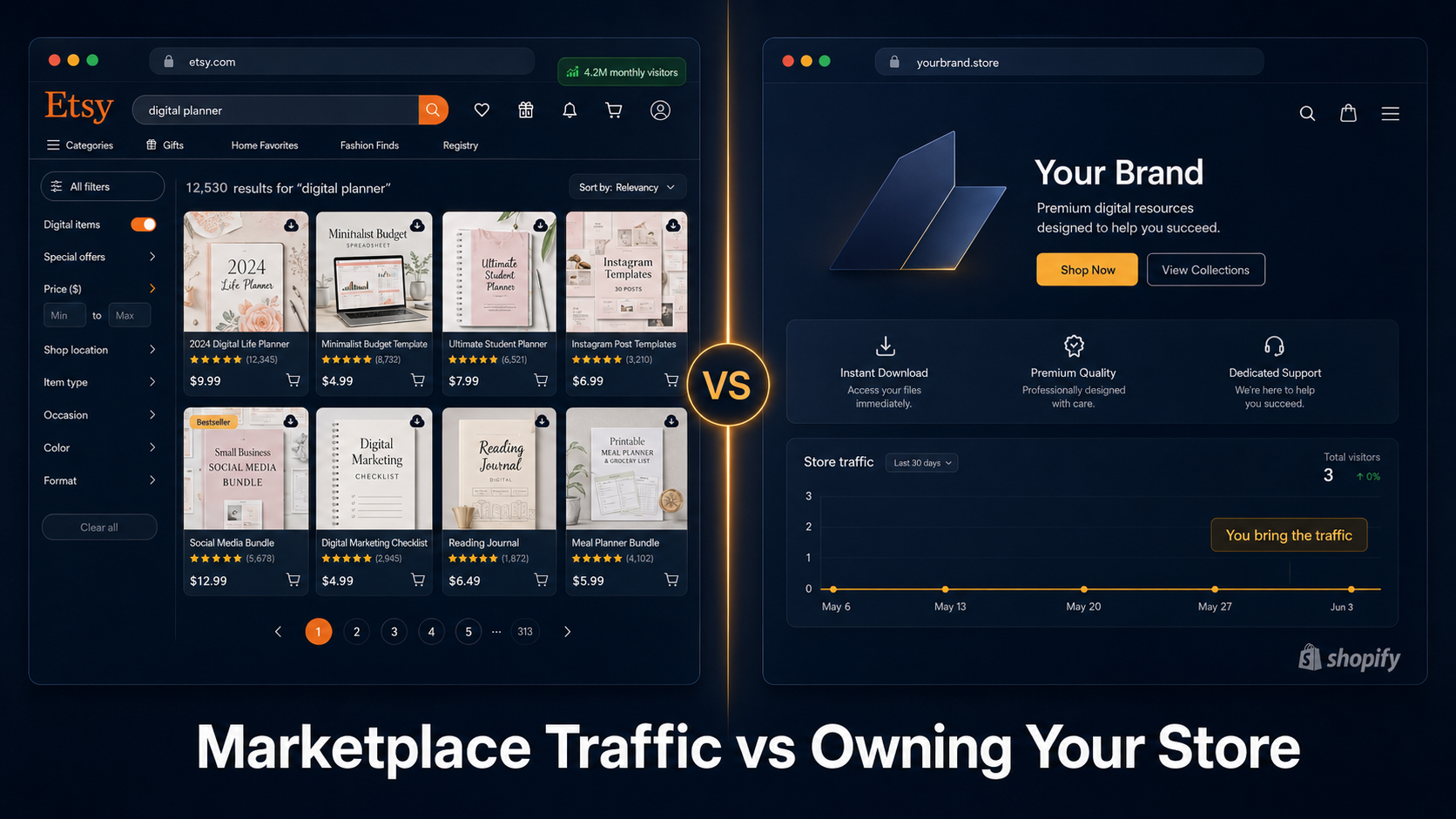
Quick Answer: Etsy Gives Access, Shopify Gives Control
There’s a version of this comparison that gets written every six months and sounds exactly the same every time: Shopify gives you control, Etsy gives you traffic. Pick one based on your priorities.
That framing isn’t wrong. It’s just incomplete – and for anyone actually trying to build a sustainable income selling digital products, incomplete is almost as bad as wrong.
Here’s a more precise way to think about it: Etsy solves the traffic problem first, but creates a dependency problem later. Shopify gives you ownership and flexibility, but makes traffic entirely your responsibility from day one.
Those aren’t just two versions of the same trade-off. They represent two fundamentally different theories of how an online business should be built – and in 2026, the consequences of choosing one over the other have become sharper, not softer, as both platforms have evolved.
This article works through those consequences in concrete terms: fees, margins, competition dynamics, branding constraints, digital delivery mechanics, and what happens when the model you chose stops working the way you expected.
What Etsy Is Better At
Built-in search demand. The Etsy marketplace hosts over 100 million active listings, and behind those listings sits a buyer base with active purchase intent. Shoppers arrive on Etsy specifically looking to buy – they are not browsing passively. For a new seller with no marketing infrastructure, this is a significant structural advantage.
Faster path to validation. If your digital product idea doesn’t resonate with buyers, you’ll find out on Etsy within weeks, not months. The feedback loop is tight because you’re fishing in an existing pond. On Shopify, you can run for three months spending on ads before you accumulate enough transaction data to draw meaningful conclusions.
Lower upfront commitment. There’s no monthly subscription to worry about on Etsy’s base model. You pay $0.20 per listing and a percentage per sale. If you sell nothing, you pay almost nothing. For someone testing a product concept before committing to a full storefront, that’s a real advantage.
Digital delivery is built in. Etsy’s digital download infrastructure works well out of the box. Customers receive their files immediately after purchase. No third-party apps required, no delivery configuration to set up.
What Shopify Is Better At
You own the customer relationship. Every buyer who purchases through your Shopify store is your customer. You have their email address. You can market to them again. You can build a list. You can create loyalty loops and repeat purchase sequences. On Etsy, the buyer belongs to Etsy – not to you. Etsy prohibits sellers from contacting customers outside of order-related communication. You cannot send them a launch announcement. You cannot offer them a discount code through an email sequence. You cannot retarget them on Facebook. Successful Etsy shops in 2026 are increasingly run by multi-channel sellers precisely because sellers have realized this limitation and started building parallel owned channels – but that requires operating two systems simultaneously.
Brand identity is actually possible. A Shopify store can look like a real brand. Custom domain, custom design, your name as the destination URL, your aesthetic throughout. An Etsy shop, regardless of how well-designed, will always read as “a shop on Etsy.” The platform’s visual frame is dominant. For sellers building toward a recognizable brand, Shopify is the only real path.
No algorithm dependency. Your Shopify store’s visibility is entirely determined by your marketing efforts. There’s no Etsy search algorithm that can decide to de-prioritize your listings because you raised your prices, changed a tag, or because a higher-volume competitor entered your category. The platform doesn’t control your organic reach because there’s no organic reach to control – or to take away.
Pricing flexibility. On Shopify, you price however you want, run whatever promotions you want, and offer any discount structure you want. There’s no marketplace pressure pulling prices toward the lowest common denominator in your niche.
Traffic: Built-In Marketplace Search vs Bringing Your Own Audience
This is the most operationally important difference between the two platforms, and it deserves more than a single paragraph.
The digital product market on Etsy is brutally competitive in 2026. There are 40+ million digital product listings. That’s the number you need to sit with. When you list a digital product on Etsy, you’re entering a marketplace where there are already 40+ million other digital items competing for the same buyer attention.
The low barrier to entry means saturation in popular categories. Success requires either exceptional design skills, narrow niche specialization, or smart positioning.
This is what “built-in traffic” actually looks like in practice: yes, buyers are there, but so are hundreds of thousands of other sellers. Etsy’s search algorithm determines who gets seen. That algorithm rewards listing volume, keyword optimization, reviews, conversion rate history, and recency. A new shop competing against sellers with 10,000+ sales and hundreds of reviews has a structural disadvantage regardless of product quality.
The best sellers have 100-500 listings and add 5-10 new products per month. Sellers who run their shop like a business – 100+ listings, consistent optimization, 15+ hours per week – typically earn $1,500-$5,000/month in revenue within 18-24 months. That’s the realistic timeline: 18-24 months of consistent effort to reach meaningful income. The “traffic is built in” narrative doesn’t mention the 24-month runway.
Shopify’s traffic situation is different but not necessarily worse once you account for what you can do with paid traffic on a platform you control. On Shopify, you can run Facebook and Google ads that send buyers directly to your store. You can build an email list from day one. You can run affiliates. You can do content marketing that drives search traffic to your domain. Every buyer you acquire is a data point you own and can re-market to.
The trade-off is cost and learning curve. Running profitable paid traffic to a Shopify store requires either ad management skill or money to hire someone who has it. Etsy’s organic search is free – but it’s not reliably available, and it comes with the dependency costs described throughout this article.
Fees and Margins: Why Cheaper Is Not Always Cheaper
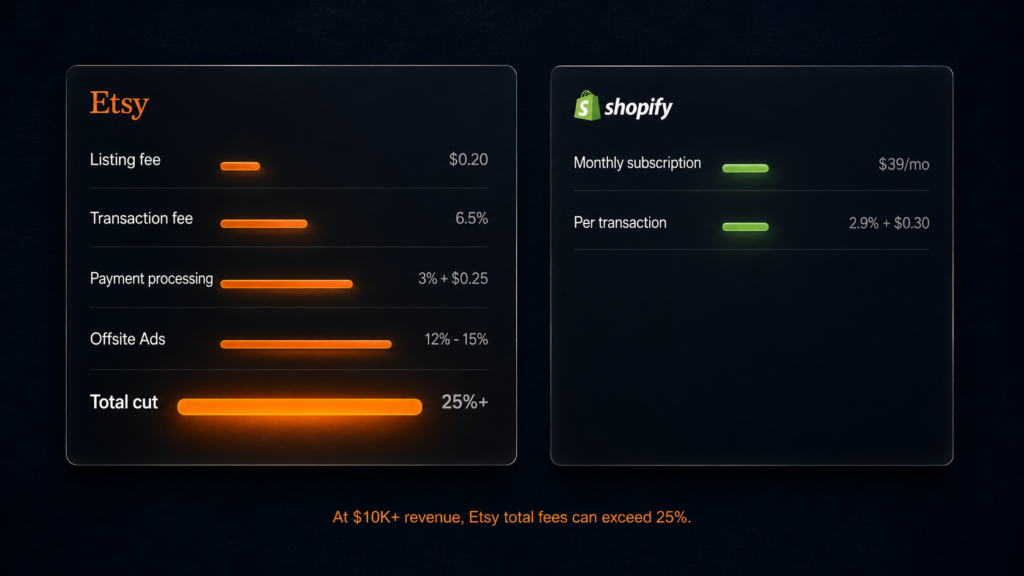
The fee comparison between Shopify and Etsy is more nuanced than either platform’s marketing suggests, and it shifts dramatically based on your revenue volume.
Etsy’s fee structure for digital products in 2026:
Etsy fees are a $0.20 listing fee per item, a 6.5% transaction fee on each sale, a payment processing fee of 3% plus $0.25, and optional costs for advertising and subscriptions.
On a $20 digital product, that’s roughly:
- Listing fee: $0.20
- Transaction fee: $1.30
- Payment processing: $0.85
- Total: approximately 11.75% per sale
That looks manageable. But there’s a compounding factor most new sellers don’t anticipate: shops under $10,000 in annual sales can opt out of Offsite Ads, but the fee is mandatory for sellers earning over $10,000 annually – and Etsy takes 12-15% of any sale attributed to their ads.
Cross the $10,000 annual revenue threshold – which for a digital product seller is barely $835/month – and a portion of your sales start carrying an additional 12% fee on top of everything else. When all fees are combined, Etsy takes 12-20% per sale. For digital product sellers relying on Etsy’s own ad network to drive discovery, total fees can exceed 25% of revenue.
Shopify’s fee structure in 2026:
Subscription fees run $39 for Basic, $105 for Shopify Grow, and $399 for Advanced per month, with 25% savings on annual billing. Transaction fees of 0.6% to 2.0% apply when using external payment providers, and are waived entirely with Shopify Payments. Shopify Payments processes at 2.4% to 2.9% plus $0.30 per transaction depending on plan.
On a $20 digital product using Shopify Basic with Shopify Payments:
- Payment processing: approximately $0.88 (2.9% + $0.30)
- Transaction fee: $0 (waived with Shopify Payments)
- Per-transaction cost: 4.4% of sale
- Plus $39/month subscription amortized across all sales
The breakeven point where Shopify’s flat subscription cost makes it cheaper per-transaction than Etsy’s percentage-based model arrives faster than most sellers expect. At 50 sales per month at $20 each ($1,000 total), Shopify becomes meaningfully cheaper per dollar of revenue. At $10,000 monthly revenue, total fees run about $389 with Shopify Payments versus much higher on Etsy once Offsite Ads fees kick in.
The “Etsy has no monthly fee” narrative is accurate at zero sales. It stops being the cheaper option faster than most beginners realize.
Competition and Pricing Pressure
The competition dynamics on Etsy and Shopify are structurally different in a way that compounds over time.
On Etsy, your direct competitors are visible to your buyers on the same page as your listings. Search “budget planner digital download” and every competitor in your niche is one scroll away. Competition in digital products is intense on Etsy according to marketplace insights. Success requires either exceptional design skills, narrow niche specialization, or smart positioning.
This creates continuous downward pricing pressure. When buyers can see 50 comparable products in the same search results, the cheapest credible option wins disproportionately. Sellers who started selling printable planners at $8 two years ago have watched prices compress to $3-5 as the category filled with competition. The platform’s discovery mechanism effectively pits sellers against each other, and buyers benefit from that dynamic at sellers’ expense.
On Shopify, there is no search results page showing your competitors next to your products. A buyer who arrives on your store sees only your catalog. Price comparisons require them to leave your site, find a competitor independently, and return. For well-marketed stores, most buyers never do that.
Standing out on Etsy requires either extremely specific niche targeting – not “budget planner” but “ADHD-friendly weekly budget planner for irregular income” – or volume: listing 200+ products and accepting thin margins. That’s the Etsy endgame for most digital product categories: a race toward volume and specificity, with margins that compress as the category matures.
Branding and Customer Ownership
On Etsy, you don’t have a customer list. The transaction happens on Etsy’s platform, under Etsy’s domain, with Etsy’s confirmation emails, and the buyer’s contact information belongs to Etsy. You can message the buyer about their order. That’s the extent of your post-purchase communication rights.
The economic consequence: every customer you acquire on Etsy costs you acquisition fees through Etsy’s search algorithm and optional Etsy Ads, and generates zero residual value. You can’t email them your next product launch. You can’t offer them a loyalty discount. You can’t build a relationship that reduces your cost per conversion over time.
On Shopify, every buyer is a customer you can market to again. Email marketing – which consistently delivers some of the highest ROI of any digital channel – is only possible when you own the customer relationship. A Shopify store with 2,000 customers and a functional email list can generate revenue from those customers repeatedly at near-zero marginal acquisition cost. An Etsy shop with 2,000 completed orders has no equivalent asset.
For a digital product business where the product costs nothing to reproduce and the only variable cost is acquisition, this distinction determines whether the business becomes more profitable over time or stays stuck in a perpetual acquisition loop.
Digital Product Delivery and Workflow
Both platforms handle digital delivery, but the mechanics differ in ways that matter operationally.
Etsy: Digital product delivery is native and requires no configuration. Upload your files during listing creation, and Etsy handles automated delivery to buyers after purchase. This works smoothly for standard formats – PDFs, ZIP files, templates. Limitations appear when dealing with large file sizes (Etsy’s limit is 20MB per file with a maximum of 5 files per listing), or when you need flexibility around licensing, access controls, or version updates.
Shopify: There’s no native digital delivery system included in Shopify’s base platform. You need a third-party app such as Digital Downloads (Shopify’s own free app), Sky Pilot, or FetchApp. Most stores use 5-15 apps with typical costs of $50-$300/month for a properly configured store. For digital-only sellers, one or two well-chosen apps are usually sufficient, but they add to your cost structure and require initial configuration.
The workflow trade-off: Etsy’s delivery is simpler to set up and requires less ongoing management. Shopify’s delivery requires setup investment upfront but offers more flexibility – higher file size limits, more delivery options, better integration with membership or subscription models if your product line evolves in that direction.
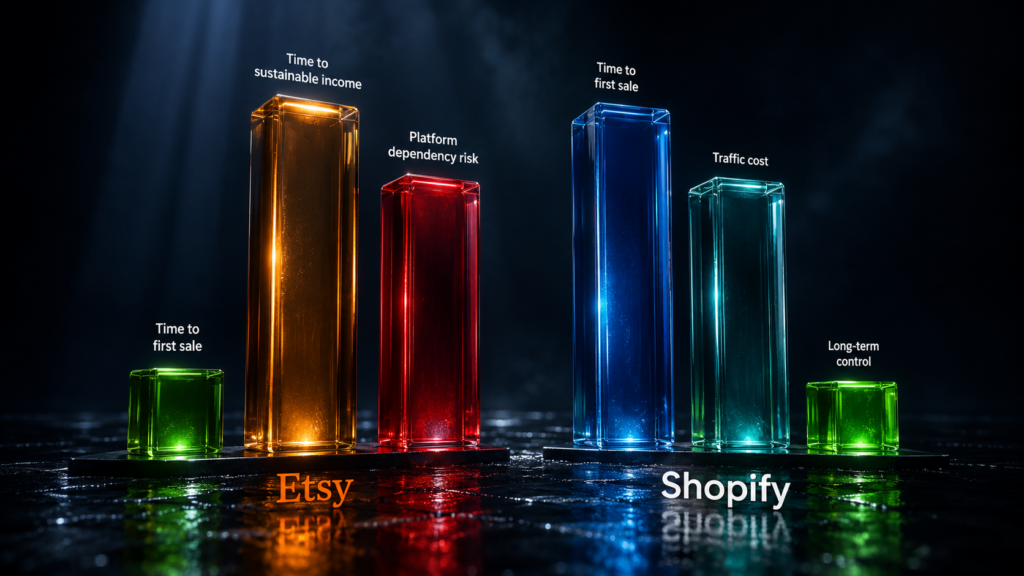
Beginner Risk: Low Friction vs Full Responsibility
The beginner risk profiles on Etsy and Shopify are mirror images of each other.
Etsy’s risk for beginners: Low friction to start, but high risk of hidden dependency. You can list your first product in under an hour and potentially make your first sale within days. The risk comes later – when Etsy changes its search algorithm and your listings drop, when a policy change affects your category, when you realize after two years that you’ve built a business on someone else’s platform and you own nothing about the customer relationship.
There’s also a psychological risk that doesn’t get discussed often: Etsy’s initial low-friction experience creates a false impression of simplicity. Getting your first sale on Etsy isn’t hard. Building a sustainable income on Etsy – competing against 40 million digital listings, managing SEO for hundreds of products, navigating algorithm changes – is considerably harder than the first sale suggests.
Shopify’s risk for beginners: High friction upfront, full responsibility forever. You’re not just building a store – you’re responsible for driving traffic to it. The starting point for most sellers is Shopify Basic at $39/month or $29/month annually. Beyond the subscription, you’re looking at app costs, potential theme investment, and marketing spend. Shopify doesn’t reduce the traffic problem – it eliminates any platform-provided solution to it.
For a beginner with no marketing knowledge and no budget for paid traffic, Shopify’s blank-canvas model can result in a technically functional store with exactly zero visitors. The risk isn’t losing your account to an algorithm change – it’s spending months building something nobody ever finds.
Where Does the Third Option Fit
The Shopify vs Etsy framing assumes two choices: own a store with no built-in traffic, or list on a marketplace and give up ownership. Most beginners hit a wall with both – Etsy because the category they chose is already saturated, Shopify because they have no idea how to get their first visitor.
This is where a different category of platform starts to make sense. Some tools – Sellvia being the most discussed example in 2026 – bundle the store, the product catalog, and a traffic system into one subscription. You’re not building from scratch like on Shopify, and you’re not competing inside a marketplace like on Etsy. The store is yours, but the infrastructure comes pre-assembled.
The trade-off is real: you’re operating inside someone else’s ecosystem and product catalog rather than building something fully custom. But for a beginner trying to understand whether digital products are even a viable path before investing months into either Shopify or Etsy, that trade-off is often the right one to make first.
The built-in ads component is the part that matters most in the context of this comparison – it’s a direct answer to the traffic problem that makes Shopify difficult for beginners and the dependency problem that makes Etsy difficult to scale out of. Whether the economics work depends on the same margin math discussed above, but the structural gap it fills is the exact gap this comparison keeps returning to.
Shopify vs Etsy: Platform Comparison Table
| actor | Etsy | Shopify |
|---|---|---|
| Traffic | Marketplace search already exists | You must bring all traffic yourself |
| Control | Limited by marketplace rules and algorithm | High control over store, brand, and customer data |
| Setup | Faster for beginners with no tech skills | More flexible but requires significant setup |
| Fees | $0.20 listing + 6.5% transaction + 3% + $0.25 processing; 12-15% Offsite Ads above $10K/year | $39-$399/month subscription + 2.9% + $0.30 per transaction on Basic with Shopify Payments |
| Competition | Direct price competition visible to buyers in search | Competition depends entirely on your marketing |
| Branding | Etsy brand always dominant; no owned customer list | Full brand ownership; customers belong to you |
| Best for | Testing demand quickly with no existing audience | Building a long-term independent business with repeat customers |
Which One Makes More Sense for Beginners?
This question deserves a more honest answer than “it depends.”
Etsy makes more sense for beginners who have a genuinely differentiated product – not a generic printable in an already-saturated category – want to validate a concept before investing in a standalone store, have strong SEO instincts or are willing to develop them, and understand that a first sale on Etsy doesn’t automatically mean sustainable income.
Shopify makes more sense for beginners who have a marketing background or budget for paid traffic, are building toward a recognizable brand rather than a marketplace presence, want to retain customer data and build an email list from day one, and are willing to invest 6-12 months before seeing consistent revenue.
The honest complication: most beginners have neither the design differentiation Etsy rewards at scale nor the traffic-generation skill set Shopify requires. Both platforms require more than they appear to require from the outside.
This is the structural gap that alternatives like Sellvia are designed to address – not as a permanent replacement for either platform, but as a more guided entry point for sellers who want a functioning business without a 12-24 month learning runway. You can read a deeper breakdown of how Sellvia compares to AliExpress-based dropshipping and how the first sale trap affects beginners across all platforms on this site.
Final Verdict
Shopify and Etsy are not interchangeable options. They’re different bets on different problems.
Etsy bets that buyer discovery is the hardest problem a new digital seller faces, and solves it by embedding you in an existing marketplace. The cost of that solution is platform dependency: Etsy’s algorithm controls your visibility, Etsy’s fee structure takes an increasing percentage of your revenue as you scale, and Etsy owns your customer relationships permanently.
Shopify bets that business ownership is the most valuable thing to optimize for, and gives you a platform where you control everything. The cost of that bet is that you have to build – and sustain – your own traffic. For sellers who can’t or won’t do that, the flexibility is theoretical.
In 2026, the practical answer for most beginners isn’t “pick the better platform.” It’s to be clear-eyed about which problem you’re capable of solving right now – traffic or brand-building – and choose the platform aligned with that capability. Then build toward the other one.
If you’re at the very beginning, with no audience, no marketing skills, and a product idea you haven’t yet validated: Etsy lets you test at lower cost and lower risk. If you have something proven – a product people are buying, a growing customer base, and a reason to build a brand rather than a marketplace presence – migrate toward Shopify and start owning the relationship.
The sellers who run into trouble are the ones who stay on Etsy after they’ve validated demand, because the platform’s economics punish scale. And the ones who launch on Shopify with no traffic plan and wonder why the store is empty six months later.
Neither platform is a passive income machine. The difference is where the work shows up.
This article is an independent editorial piece based on publicly available platform data, fee structures, and marketplace statistics current as of May 2026. We do not guarantee business results. Individual outcomes vary based on product quality, marketing execution, and market conditions.
16 responses to “Shopify vs Etsy for Digital Products: Marketplace Traffic vs Owning Your Store”
-
ran an etsy shop for a year and this nails exactly why i eventually walked away – the algorithm dependency thing is real and nobody warns you about it going in
-
the fee comparison table alone is worth bookmarking this page. did not realize offsite ads fees kicked in automatically once you cross the revenue threshold on etsy
-
switched from a diy shopify setup to something more structured after reading comparisons like this. the “blank canvas equals zero visitors” line is uncomfortably accurate
-
the customer ownership point changes the whole calculation for me. built an email list of maybe 40 people on etsy in a year because you basically can’t market to buyers there
-
good breakdown. the part about shopify’s app costs stacking up to $50-300/month on top of subscription matches what happened to my own store exactly
-
the mention of sellvia as a middle option makes sense after reading through the rest of this. bundling the traffic problem and the ownership problem into one thing is appealing if you’re starting from zero
-
40 million digital listings on etsy is a genuinely sobering number when you see it written out like that. explains why my printables never got traction
-
appreciate that this doesn’t just say “it depends” and leave you there. actual criteria for choosing between them is rare in these comparison articles
-
the psychological risk point about etsy’s easy first sale creating false confidence hit close to home. got my first sale in three days and thought i had it figured out. did not have it figured out
-
the branding section explains why my etsy shop never felt like “mine” even after two years running it. always just felt like a listing inside someone else’s mall
-
digital delivery comparison is genuinely useful, didn’t realize etsy caps file size at 20mb until i actually hit that wall myself
-
solid analysis of why cheaper isn’t actually cheaper once you factor in offsite ads and scale. wish i’d read this before choosing a platform two years ago
-
the built-in ads point for the “third option” platforms is what actually convinced me to look into alternatives instead of just picking between these two
-
this is one of the more balanced shopify vs etsy breakdowns i’ve read, most comparison content just picks a side and cherry picks stats to support it
-
the competition dynamics section explains exactly why prices on my printables kept dropping even though my product didn’t change. race to the bottom is real on etsy



Jo Carter is an editor and ecommerce researcher at Ecom Reality, where she covers ecommerce platforms, digital selling tools, online business software, pricing models, and emerging industry trends. She focuses on turning complex platform features and costs into clear, practical information for entrepreneurs and digital sellers. Her work combines detailed research with a balanced editorial approach, helping readers compare services, understand potential limitations, and choose tools that fit their business goals.
Related Articles


Leave a Reply