
If you typed “Sellvia vs AliExpress” into Google at some point in the last year, you already know the first page looks identical on every site. Same bullet points. Same “both have pros and cons.” Same energy as a 2018 WordPress blog that hasn’t been updated since.
This isn’t that article. Something genuinely important happened between May 2025 and today, and most of the comparison content out there still pretends it didn’t. So let’s skip the part where we explain what an “e-commerce platform” is and get into the numbers that actually decide whether a business works.
1. The Day the AliExpress Math Broke
For fifteen years, one loophole quietly underwrote the entire “cheap stuff from China” business: de minimis. Any package valued under $800 could enter the United States duty-free, no customs broker, no paperwork, no tariff. This is what made the $3 phone case, the $7 LED lamp, and the $12 smartwatch economically possible. It’s also what made a huge chunk of the AliExpress seller universe viable.
On May 2, 2025, the Trump administration eliminated that exemption for shipments from China and Hong Kong. The replacement tariff schedule looks like this:
- May 2 – May 31, 2025: $100 per item, or 120% of item value (whichever is greater)
- June 1, 2025 onwards: $200 per item, or 120% ad valorem
In July 2025, Congress went further and passed legislation ending de minimis for all countries by 2027. There’s no workaround on the horizon.
The reaction was immediate and measurable:
- Temu lost 58% of its U.S. daily active users in May alone, per PYMNTS reporting
- FedEx publicly flagged a $1 billion annual revenue headwind from the policy change
- A Morning Consult brand tracker showed Temu’s net value score dropping 6.3 points between April and May 2025
Now apply this to an AliExpress seller. ECDB data from late 2025 confirms that 89% of top-selling items on AliExpress are priced under $25. A $200-per-item floor tariff doesn’t reduce margin on that category – it erases it. A seller selling a $15 item and collecting a 15% margin ($2.25) now owes $200 in duty before the item reaches the buyer’s door.
The platform itself is fine. AliExpress revenue hit $102.7 billion in 2025, up 10.4% year-over-year. Alibaba’s international retail segment grew 33% in Q3 2025 to $14.9 billion. The corporate entity is thriving – buyers are still buying. What broke is the economics for individual sellers targeting American customers with low-priced goods.
Sellvia is on the other side of this wall entirely. Its products are files – PDFs, video lessons, online tools, checklists. Files don’t clear customs. A guide sold in Texas costs exactly the same to deliver as one sold in Tokyo: zero. No tariff, no shipping, no duty. Whatever happens at U.S. ports in 2027, Sellvia’s unit economics stay identical.
That’s the single most important fact in this comparison, and almost nobody writing about it mentions it.
2. The “Just Sign Up” Myth
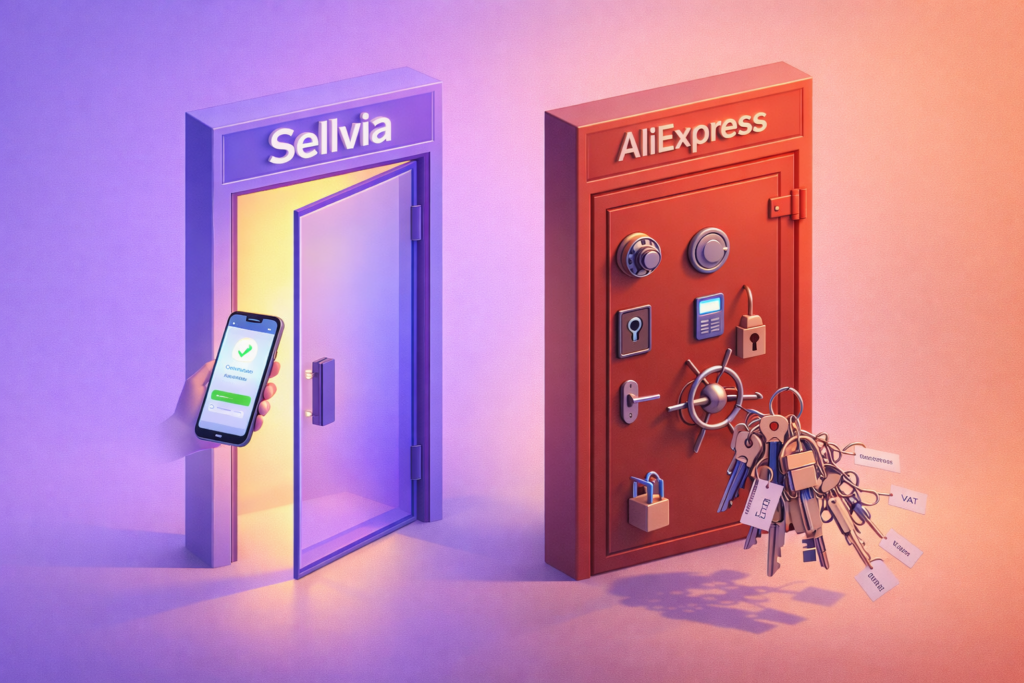
Every beginner tutorial online describes the AliExpress signup process like it’s roughly as hard as making an Instagram account. It isn’t. Here’s what the platform actually requires from a new seller in 2026, pulled directly from AliExpress Seller Center documentation and verified by third-party onboarding guides:
1. A legally registered business entity. AliExpress does not accept private suppliers or individual sellers, per the platform’s own registration rules. You need a company – LLC, corporation, or an equivalent foreign structure.
2. Eligibility limited to 9 countries. At the time of writing, only sellers from China, Japan, Spain, France, Germany, South Korea, Poland, the United Kingdom, and the United States can register. Turkey, Brazil, and Italy appear in some historical documentation but vary by category. Your country selection is locked on registration – it cannot be changed.
3. Annual technical service fee. Set by category, typically 1,000 to 10,000 RMB (roughly $140 to $1,400) paid upfront. Top-performing stores may qualify for partial or full refunds at year-end if they hit sales thresholds – which, of course, requires actually having sales.
4. Alipay business account, tied to the same business entity as the seller account, cannot be opened as an individual.
5. Trademark proof for branded categories. Selling branded goods without registered trademarks or official authorization documents is grounds for removal. Some categories require English-language trademarks specifically, even for sellers based in non-English markets.
6. VAT/tax registration compliance. For European buyers, AliExpress collects up to 20% VAT under the IOSS system. The seller is still responsible for correct tax categorization and ongoing reporting.
7. Legal representative’s ID or passport, with contact details and personal accountability for the business entity’s activity.
And none of that is the hard part. The hard part is that after you’ve done all seven, you still have to source your products, build your catalog, write listings that rank, negotiate with factories, manage returns, handle disputes, and compete against thousands of sellers with years of head start.
Now Sellvia. Signup: an email address. The store is already built. The catalog is already loaded. The $40 advertising coupon is applied to your account automatically during the 14-day trial, so you can test whether the ad system produces sales before you spend a dollar of your own. The whole flow is designed to work on a phone – which matters, because the company’s own data shows a large share of its users don’t own a laptop or desktop computer.
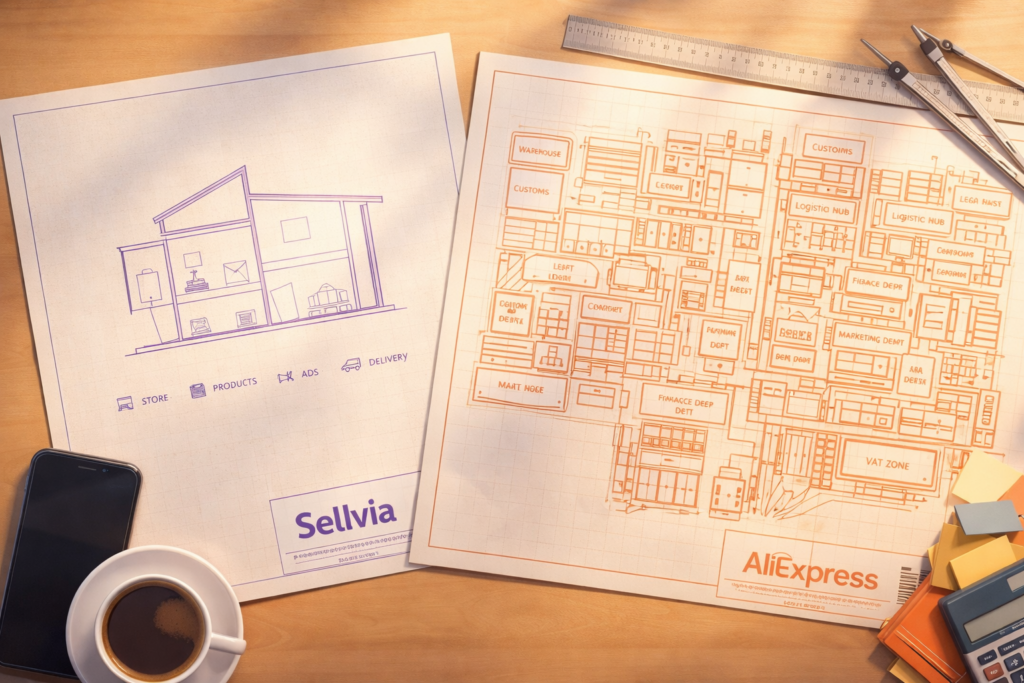
The gap isn’t a matter of “harder” versus “easier.” It’s a different product category entirely. AliExpress is infrastructure for existing businesses. Sellvia is a packaged first business for people who’ve never had one.
3. The Margin Stack Most Sellers Never Actually Calculate
Ask a dropshipping YouTuber for their margin and they’ll give you a gross number – what they make minus what the factory charges. That’s not profit. Profit is what’s left after every line item has taken its share, and on a marketplace, that list is longer than most first-time sellers realize.
Walk through the real per-sale stack on a typical AliExpress order of a $20 product (the exact example used in the AliExpress Fee Calculator’s own documentation):
| Line item | Amount | Cumulative cost |
|---|---|---|
| Gross product sale | $20.00 | – |
| Platform commission (8%, apparel) | $1.60 | $1.60 |
| Transaction fee (2%) | $0.40 | $2.00 |
| Shipping / Cainiao logistics | varies, ~$2–5 | $4–7 |
| Product cost from factory (~$8) | $8.00 | $12–15 |
| Refund buffer (3–5% industry standard) | $0.60–$1.00 | $12.60–$16.00 |
| PPC advertising (if used) | varies | varies |
| Post-May-2025 U.S. tariff | up to $200 | ∞ for low-price items |
| Annual platform fee (amortized per sale) | $140–$1,400/year | depends on volume |
| VAT for EU/UK buyers (up to 20%) | $4.00 | adds separate burden |
Outcome in the baseline scenario (U.S. buyer, post-tariff): the entire economics collapse for any item under roughly $25 on China-origin shipments. Even for a $50 or $100 product, the tariff line item slices the margin into slivers.
This isn’t theoretical. In a 2026 industry analysis of physical-goods e-commerce, the line was: “Physical retailers often lose 15 to 30 percent of gross margin to logistics and fulfillment alone. By the time you pay everyone, that 50 percent gross margin might become 20 percent net.” That was written before the de minimis policy had fully propagated through seller P&Ls.
Now walk through the per-sale stack on a Sellvia digital product selling for the same $20:
| Line item | Amount |
|---|---|
| Gross product sale | $20.00 |
| Platform commission | 0% |
| Transaction fee | $0 (digital) |
| Shipping | $0 (digital delivery) |
| Product cost | $0 (already in catalog) |
| Refund risk | minimal (digital products) |
| Tariff exposure | $0 (not imported) |
| VAT on digital goods (varies by jurisdiction) | modest, no physical duty |
Seller keeps 50–70% markup as pure profit. The $39/month subscription is the only fixed cost, and it’s the same whether you sell 2 orders or 200.
The margin benchmarks confirm the pattern at the category level:
- Digital products: 70–90% gross margin, top performers 85–95% (Opensend, 2025)
- Physical products on marketplaces: 20–50% gross, 20% net after full stack (multiple 2026 sources)
Or, as a widely-cited e-commerce analysis put it: “Create once, sell forever. A course takes three months to build and sells for three years.” That is an entirely different kind of business from one where every sale consumes a new unit of inventory and clears customs on the way to a customer.+
4. Who Owns the Customer? (This Is the Question Nobody Asks)
There’s a deeper problem with marketplace selling that doesn’t show up in the fee schedule. You don’t own your customers.
On AliExpress, when someone buys your product, AliExpress has the email address. AliExpress has the phone number. AliExpress has the browsing history, the cart abandonment data, the repeat-purchase signals. You get: a shipping address you can’t retain for marketing, and a review that lives on the platform’s servers forever.
Multiple 2025 e-commerce analyses (Builder.ai, SmartOSC, Blocksy) hammer the same point from different angles:
- Marketplaces restrict access to customer data – sellers can’t retarget, can’t run loyalty programs, can’t email past buyers about new releases
- A single algorithm change can make your entire listing portfolio invisible overnight
- Accounts can be banned or suspended without prior notice, and appeal outcomes are opaque
That last one isn’t hypothetical. In 2021, Amazon banned 50,000+ Chinese merchant accounts in a single enforcement wave tied to fake-review incentive schemes – an estimated $15.4 billion USD in expected merchant revenue evaporated, per public filings summarized by SmartOSC. AliExpress has similar policy enforcement authority over its sellers, and historical precedent shows these platforms will use it.
The marketplace model has a structural trade-off baked in: you rent access to an audience you don’t own, on terms you don’t control, in exchange for not having to build that audience yourself. If the terms change, your business changes with them.
Sellvia works differently. Your store runs on your own branded domain. Customers who buy from you are your customers – their data flows to you, and the built-in advertising system uses that data to retarget and build repeat purchases over time. If Sellvia changed its pricing tomorrow, you still have a customer list. On AliExpress, if the algorithm reshuffles, you don’t.
This is also why the comparison “AliExpress has 400M buyers, so it’s easier” is misleading. Those 400 million buyers belong to AliExpress. A new seller doesn’t get them – they get the chance to fight for visibility in an ocean where StoreLeads data from Q1 2026 shows 9.7% of AliExpress stores carry just 1–9 products. That’s the reality of new-seller presence on the platform: microscopic catalogs trying to surface inside a search index of hundreds of millions of SKUs.
5. The Advertising Math Nobody Shows You
Here’s the number that ends a lot of first-time seller careers before they start: 78.2% of Google Ads advertisers fail to make their campaigns profitable, per a 2025 industry benchmark analysis covering over $1.2 billion in ad spend. The platform generates $225 billion in annual revenue, but most individual advertisers are on the losing side of that math.
The reason is structural. Google Ads is not a “set it and get sales” system unless you’ve already spent years building the skillset. New advertisers run into:
- Average CPC for e-commerce search: $0.82 to $4.00 depending on category and keyword intent (2025 Backlinko and Shippingbo benchmarks)
- Rising CPC environment: up 12.88% year-over-year in 2025 across industries
- Minimum budget threshold for statistical significance: $1,000+/month, per a 2025 analysis from Quimby Digital – anything below that usually generates noise, not insights
- The “learning phase”: Google’s algorithm needs 30–50 conversions within a rolling 7-day window before it stabilizes – which can take weeks of spend for a new store with no history
Now picture a new AliExpress seller trying to stand up external Google Ads to drive traffic to their listing. They need to: research keywords, build ad groups, write copy, set bids, install conversion tracking (on a marketplace they don’t own), optimize for the learning phase, and survive the cost per click while it ramps. The industry data suggests about 1 in 5 of them will come out profitable. The rest pay tuition.
Sellvia’s built-in advertising system sits in a different category of product. The seller doesn’t run the campaigns – the platform does. The interface is: choose a daily budget between $10 and $50, toggle on, and let the system handle targeting, creatives, and optimization against its own aggregated conversion data across the 1.5 million stores already on the platform. Sellvia’s own reporting indicates that most users who activate ads receive their first orders the same day.
The difference isn’t “one has ads and the other doesn’t.” It’s that one system hands you the steering wheel of a racecar and says good luck, and the other gives you a button labeled “go.”

6. The Credibility Gap Between the Platform and the Seller
AliExpress is part of Alibaba Group. Alibaba’s 2025 annual revenue: $138.7 billion. The parent company is one of the largest technology conglomerates on earth. The AliExpress brand commands global recognition across 220+ countries in 18 languages.
None of that transfers to you.
When a new AliExpress seller opens a listing, they start at zero reviews, zero transaction history, zero rating. The platform’s reputation is real – it just doesn’t belong to the individual seller. Buyers on AliExpress trust AliExpress. They don’t know who the seller is. They filter out new stores, sort by review count, and gravitate toward established listings with thousands of five-star ratings. A new seller competes not with “buyer skepticism” but with the visible track record of competitors who’ve been on the platform for 5+ years.
Now Sellvia’s credential stack, which is unusually deep for a platform in its category:
- Forbes Communications Council – official member since 2020
- Inc. 5000 – ranked #1818 among America’s fastest-growing private companies (2022); also #282 in California and #175 in Business Products & Services
- Entrepreneur Leadership Network – member since 2025
- TITAN Business Awards – Platinum Winner and Gold Winner for Best E-commerce Platform (Marketing and E-commerce categories)
- Hermes Creative Awards – Platinum Winner for Leading E-commerce Platform; Gold Winner for Best IT Product 2025–2026
- MarCom Awards – Gold Winner for Social Media Marketing Service and Ecommerce Advertising Service
- dotCOMM Awards – Gold Winner for E-commerce Platform / E-commerce Ecosystem
- 1,500,000+ stores launched on the platform to date
- $1.5 billion+ earned by store owners
The credentials matter because the Sellvia store you’re running is yours – it runs on your own domain, the products go out under your branding, and the customers are yours to retain. The platform’s legitimacy becomes your platform’s legitimacy by extension. On AliExpress, the legitimacy stays at the marketplace level; the individual seller is one of millions, undifferentiated at checkout.
7. The Numbers, Side by Side
| Factor | Sellvia | AliExpress |
|---|---|---|
| Legal setup required | None | Registered business + VAT + ID |
| Eligible countries for sellers | Anywhere | 9 countries, locked at registration |
| Startup cost | $0 (trial + $40 ad coupon) | Business license + 1,000–10,000 RMB annual fee |
| Monthly cost | $39/month fixed | Variable: commissions + fees + ads |
| Per-sale platform fees | 0% | 5–8% commission + 1–3% transaction fee |
| Typical net margin | 50–70% (digital) | ~20% after full stack |
| Product sourcing | Provided catalog | Seller’s responsibility |
| Inventory & shipping | None (digital delivery) | Seller handles everything |
| Advertising | Built-in, $10–50/day, 1-click | Self-managed; 78.2% of Google advertisers lose money |
| Minimum ad budget for results | $10/day | $1,000+/month for statistical significance |
| U.S. tariff exposure (post-May 2025) | $0 (digital) | Up to $200/item on China-origin |
| Customer data ownership | Full access (your store) | None (marketplace holds it) |
| Platform ban / algorithm risk | N/A (your store, your domain) | Real (50K+ Amazon bans = $15.4B lost in 2021) |
| Mobile-first? | Designed for phone | Computer strongly recommended |
| Time to first sale | Same day (with ads on) | Weeks to months |
8. Who Each Platform Actually Fits
AliExpress works for a seller who:
- Already operates a registered business in one of 9 eligible countries
- Has working capital to invest in inventory, ad spend, and annual fees
- Understands customs, VAT, and – critically – the post-2025 tariff environment
- Can absorb the economics of the 78% of digital advertisers who lose money while learning
- Wants to compete at scale in physical-goods categories and accepts platform-dependency risk
Sellvia works for someone who:
- Is starting their first online business
- Doesn’t have (or want) a registered company, VAT number, or customs broker on speed dial
- Has a limited monthly budget and wants predictable costs
- Wants the store, the products, and the advertising to be done for them
- Wants to own their customers, not rent access to a marketplace’s audience
- Works mostly from a phone
These aren’t the same person. The overlap is smaller than every generic comparison article pretends.
The Takeaway
The 2025 tariff changes didn’t kill AliExpress. The platform hit record revenue and the parent company had its strongest year. But they permanently altered the seller economics for anyone targeting U.S. buyers with sub-$100 physical products – which, historically, was the majority of new sellers on the platform.
The bigger pattern is worth noticing: in 2026, the businesses structurally exposed to global friction – tariffs, customs policy, currency fluctuations, platform algorithm changes, VAT compliance shifts – are the ones built on physical cross-border trade. The businesses structurally insulated from those forces are the ones built on digital goods, owned customer relationships, and fixed subscription cost structures.
That’s the real meaning of “SaaS vs marketplace.” Not two ways to sell the same thing, but two different bets on what the next decade of commerce looks like.
One bet is that cross-border physical trade keeps getting harder – more tariffs, more compliance, more platform fees, more policy shocks. The data from May 2025 to today strongly suggests that bet is correct.
The other bet is that building, launching, and running a small online business should feel more like signing up for Spotify than founding a corporation – and that regular people, not registered corporations, should be able to make that bet for $39/month.
Where you land on those two bets is where this comparison actually ends.
Sellvia’s 14-day free trial includes a $40 ad coupon and doesn’t require a credit card to start. If the bet above makes sense to you, that’s how you test it.
We are not affiliated with Sellvia, AliExpress, or Alibaba Group. All figures and policy references in this article were compiled from publicly available sources as of April 2026 and are subject to change – verify current details with the respective platforms before making business decisions.
Not sure which platform is cheaper for your sales volume?
Use our free Ecommerce Platform Cost Calculator to compare subscriptions, transaction fees, payment processing, apps, advertising, and operating expenses.
12 responses to “Sellvia vs AliExpress: A Practical Comparison for Anyone Starting an Online Business”
-
Honestly, this is one of the few comparisons that actually explains why the experience feels so different, not just what each platform does.
AliExpress still makes sense if you’re already operating like a business – entity set up, budgets, logistics, all that. But for someone starting from zero, the amount of moving parts is easy to underestimate. It’s not just “find a product and sell,” it’s more like running mini-operations across sourcing, ads, and compliance at the same time.
What stands out with Sellvia is how much of that complexity is removed upfront. You’re not solving five different problems before you even know if you can get a sale. You’re basically testing demand first, then deciding how deep you want to go. That order of steps makes way more sense for beginners.
Also the digital model is just… calmer. No tracking issues, no supplier surprises, no waiting weeks to see if something even works. For a first project, that simplicity is underrated.
-
fr tho. i tried aliexpress first and it was like juggling 10 things at once before even making a single sale lol. sellvia just cuts all that noise out. no shipping nightmares, no random supplier ghosting you. way easier to just get in and see if it works before going all in
-
-
What makes Sellvia more compelling here is not that it replaces AliExpress in every scenario, but that it removes a lot of the fragility that makes first-time online businesses stall out. With AliExpress, even when the model works, you’re still juggling sourcing, fees, timing, and platform dependence all at once. Sellvia feels more focused: simpler economics, fewer operational layers, and a setup that lets you test whether you can actually sell before you build a whole system around it. For beginners, that kind of clarity is a real advantage.
-
the tariff math section is what made this click for me. $200 duty on a $15 item isnt a margin problem its a business extinction event lol
-
that plus the 78% of google advertisers losing money stat. i burned through $2k on google ads before i even knew what a conversion pixel was. sellvia just having a button for it is a completely different experience
-
-
what neither of you mentioned is the exit option tho. on aliexpress you build someone elses listing. on sellvia you own the store, grow it, sell it on sellvia market after 60 days. thats an actual asset not just a side hustle
-
This comparison made me think of it less as “which platform is bigger” and more as “which one has fewer ways to quietly drain a beginner.”
AliExpress has scale, no question. But scale does not automatically make it beginner-friendly. Sellvia’s advantage is that the boring parts are already simplified: no customs math, no supplier hunt, no shipping puzzle, no ad setup marathon. For a first business, boring and predictable can actually be a superpower. -
The 120% tariff detail really drives home why the AliExpress model is essentially dead for US sellers now. I’ve been looking at side income options for the past few months and kept seeing AliExpress pitched as easy money, but the math never worked when I actually calculated it out. The point about owning your customers versus the marketplace owning them is huge – that’s been my biggest frustration watching friends chase commission-based sales. Digital products eliminate so many of those friction points that physical goods sellers are now dealing with, and honestly that’s where I’m focusing my time now since I only have a few hours a week to dedicate to this.
-
The part about the $40 ad coupon covering your first test is exactly how it played out for me with Sellvia – I had my first sale within 48 hours of turning the built-in ads on, and honestly I just sat there staring at the notification like, wait, that actually worked. I do translation work remotely so I had tried other ways to build something on the side, and both times I ended up buried in setup before I ever got to the part where money moves, so getting that first sale before I even had to think about optimizing anything felt genuinely different. Right after I hit my first withdrawal I stopped second-guessing the whole thing and started thinking about what else I could actually build on top of it.
Has anyone else here found that the first sale came faster than they expected once the ads were running?
-
The customer data ownership section hit me because before I tried this thing I was pouring energy into building an audience I never actually owned, but what caught me off guard was getting a real SMS from a Growth Manager on day one – not an automated drip sequence, an actual person who walked me through setup while I was sitting on the floor of my gym at 11pm when I finally had time after the last client left. Before that contact I had zero confidence I was setting anything up correctly, but after that first conversation I had my store live and ads running within the same night. Ended up with 4 sales in my first 6 days.
-
The catalog depth point is what your article dances around without landing – late at night around week three I finally opened the full product library and counted over 40 distinct guide categories, which is the moment I stopped questioning whether the tool had enough to build a real store around and just started selling.
-
[…] more detailed comparisons, see Sellvia vs AliExpress and Ecomzy Review on this […]



Jo Carter is an editor and ecommerce researcher at Ecom Reality, where she covers ecommerce platforms, digital selling tools, online business software, pricing models, and emerging industry trends. She focuses on turning complex platform features and costs into clear, practical information for entrepreneurs and digital sellers. Her work combines detailed research with a balanced editorial approach, helping readers compare services, understand potential limitations, and choose tools that fit their business goals.
Comments
Leave a Reply
Related Articles



Leave a Reply