


The First Sale Trap: Why Ecommerce Beginners Quit Right After Getting Results
Most beginners don’t quit when things are going badly. They quit right after things start working – and the reason is almost always the same misunderstanding about what early results actually mean.
There is a specific moment in ecommerce where more beginners quit than at any other point in the journey. It is not when revenue is zero. It is not during the confusing setup phase. It happens right after the first sale – sometimes the second or third – when the business has technically proven it can work, but the reality of what comes next becomes visible for the first time.
This pattern is not random. It follows a predictable psychological and financial logic that plays out across platforms, business models, and product types. Understanding it before you hit that moment is the difference between building something real and becoming one of the statistics.
And the statistics are brutal. Around 80 to 90% of ecommerce businesses fail within their first 120 days. Seven out of ten fail within the first year – more than double the average failure rate across all business types. These numbers are not driven by people who never got a single sale. A significant portion of them are driven by people who got their first results, misread what those results meant, and made a premature decision based on incomplete information.
1. The First Sale Feels Like Proof – But It Is Not
When a beginner makes their first online sale, something important happens in their psychology: the business stops being theoretical. Before that moment, everything is a bet. After it, something real has occurred. A stranger found the store, decided the product was worth money, and paid for it. That is meaningful.
But it is not proof of the thing most beginners believe it proves. A single sale – or even a handful of sales over a few days – does not prove that the business model is working. It proves that a transaction occurred. Those are very different claims.
The confusion between these two statements is at the root of almost every premature quit decision in ecommerce. Beginners interpret early sales as evidence that they have validated a business. What they have actually validated is that the product can sell. Whether the business around that product is viable – whether the margins are sustainable, whether the traffic can scale profitably, whether the operation can survive without heroic daily effort – none of that is answered by the first few transactions.
The validation trap
Early sales feel like validation of the whole system. They are only validation of one part – the product. Traffic cost, margin sustainability, churn rate, customer acquisition cost, and repeatability are all still unknown quantities after the first sale. Making decisions based on early sales data alone is like judging a restaurant by its first table of the night.
The inverse problem is equally common. Some beginners make their first few sales, find the numbers lower than expected, and conclude the business does not work – when in reality they are measuring a period of data so short it has no statistical significance. Both extremes – premature confidence and premature abandonment – come from the same source: treating early results as more meaningful than they are.
2. Why Early Ecommerce Results Are Emotionally Misleading
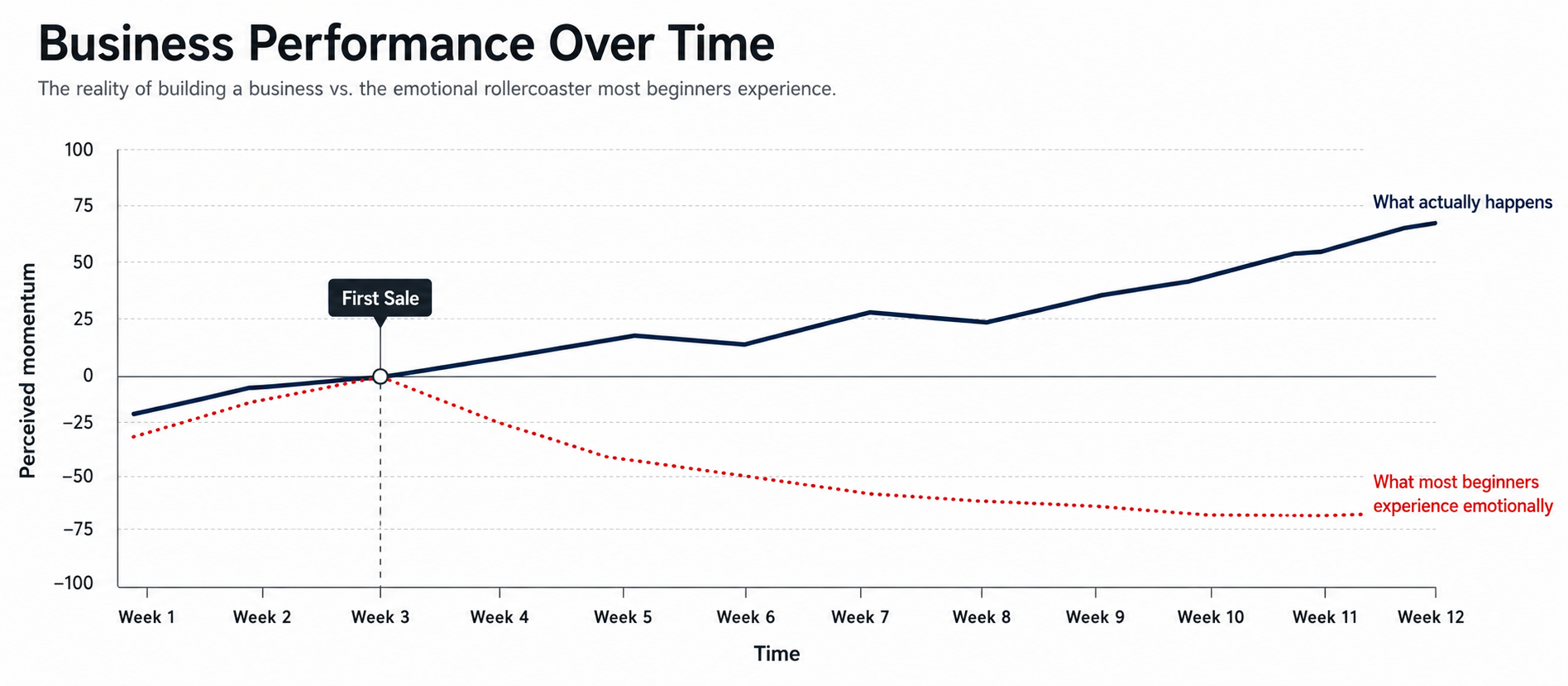
The emotional arc of early ecommerce is almost universally the same, regardless of platform. It goes: excitement during setup, anxiety during the first days without sales, relief and euphoria at first sale, followed very quickly by a different kind of anxiety – one that is harder to name.
That second anxiety is the one that does the damage. It arrives when the first sale does not immediately lead to a second. Or when the second sale happens but the numbers don’t add up the way the beginner imagined. Or when they realize that the work required to maintain even modest volume is higher than they expected. The emotional high of the first sale creates a contrast effect – everything that follows feels like a comedown even when the business is performing normally.
This is compounded by something specific to how ecommerce is sold to beginners. Most content about online business – YouTube channels, courses, social media accounts – documents the highlight reel. The first $10K month. The screenshot of orders rolling in. The “I quit my job” story. None of that content shows the six weeks of flat performance between breakthrough moments. None of it shows the days where the dashboard shows three sales and two of them were tests. The result is that beginners have a reference point that is unrealistically compressed and emotionally charged.
“The first sale creates a reference point. Every day that doesn’t match it feels like failure – even when those days represent completely normal business performance.”
What looks like quitting due to poor results is very often quitting due to results that are normal – but that feel inadequate relative to a distorted expectation. The business was not failing. The beginner’s measurement framework was.
3. Revenue Is Not Profit
This sounds obvious. It is apparently not, because it is the single most common financial misunderstanding among ecommerce beginners, and it causes more premature quits than almost any other factor.
Revenue is the total amount that came in. Profit is what remains after everything it cost to generate that revenue has been subtracted. In ecommerce – particularly for beginners using paid traffic – the gap between those two numbers is enormous, and it is almost always larger than expected.
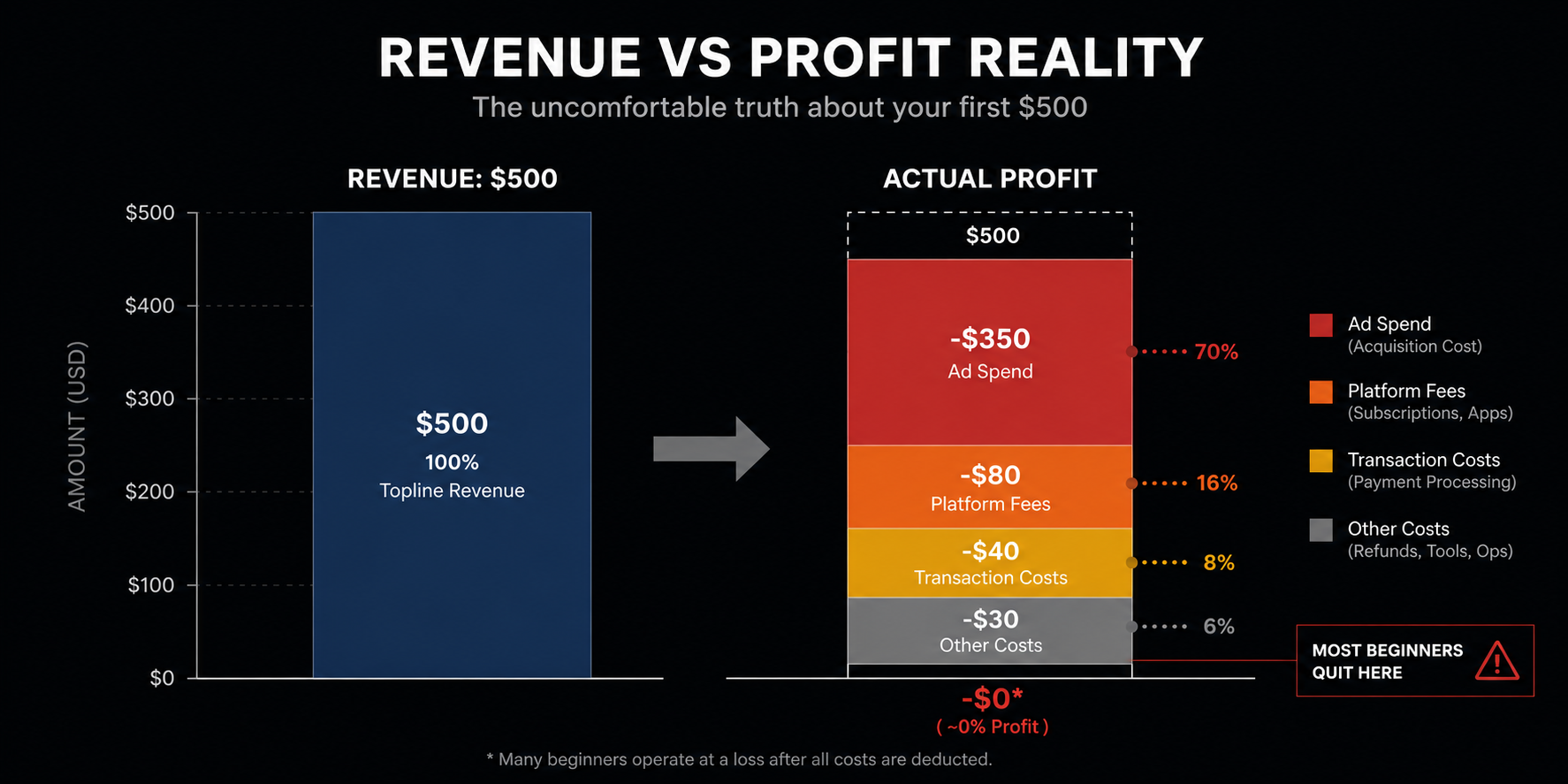
Consider a beginner running a Shopify store with $500 in revenue in their first month. The headline sounds promising. But subtract $350 in ad spend, $80 in platform and app fees, $40 in transaction costs, and $30 in miscellaneous operational expenses. The actual profit on $500 of revenue is zero – or negative. The business has not made money. It has spent money to acquire the experience of making sales.
This is not a failure state. It is a completely normal early phase for a business that is still in the process of finding its cost-per-acquisition, optimizing its funnel, and identifying which products and ads perform. But it feels like failure if the only number the beginner was watching was revenue – and it prompts quitting at precisely the moment when the data needed to improve the business is just starting to accumulate.
The metric that actually matters early on
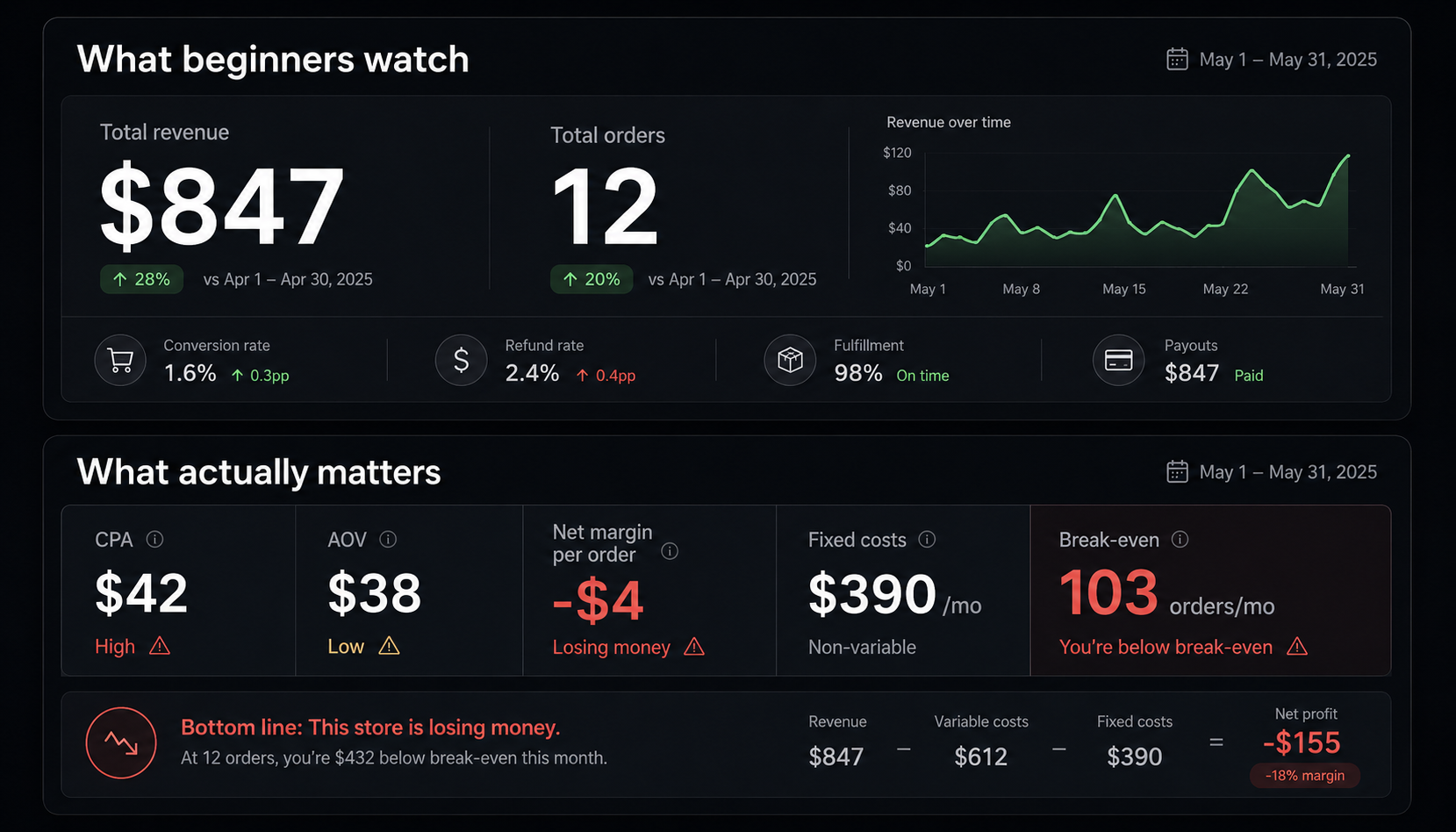
In the first 30 to 60 days, the only number worth obsessing over is Cost Per Acquisition (CPA) relative to Average Order Value (AOV). If you’re spending $18 to acquire a customer who spends $22, the margin is thin but positive and improvable. If you’re spending $30 to acquire a customer who spends $22, you have a structural problem to solve. Revenue alone tells you neither.
4. The Hidden Pressure of Ad Spend
Paid advertising creates a specific psychological pressure that organic or marketplace-based models do not. Every day that ads are running costs money. Every day without a sale while ads are running feels like a loss. This pressure changes how beginners interpret their results – and it causes decisions to be made on timelines that are far too short to be meaningful.
A beginner running $20 per day in Facebook ads and seeing no sales for three days has spent $60. That $60 feels like evidence that the business does not work. In reality, three days is not statistically significant for any advertising campaign. The learning phase for most ad platforms takes 7 to 14 days of consistent spend before the algorithm has enough data to optimize properly. Quitting after three days of poor performance is equivalent to judging a new employee’s entire potential based on their first half-week.
The pressure intensifies because ad spend is immediate and visible. You can watch the spend number go up in real time. Revenue, when it comes, arrives in smaller, less frequent increments that feel harder to connect to the spend. The ratio looks worse than it is during the early phase, then gradually improves as the algorithm optimizes – but most beginners never get to that improvement phase because they cut the ads before it arrives.
There is a compound effect here as well. When a beginner stops ads after three bad days, then restarts them two weeks later when they feel more motivated, they have reset the algorithm’s learning phase. The campaign performs poorly again – not because the product does not work, but because the data has been broken. The beginner interprets this as further evidence of failure. The cycle repeats until they quit permanently.
The minimum viable test window
No paid traffic campaign should be evaluated on less than 14 days of consistent data at a consistent budget. Within that window, you are feeding data to the algorithm, not running a business. The business starts after the learning phase ends. Most beginners evaluate their business during the learning phase – which is the worst possible time to make any conclusions.
5. Why Platform Choice Changes the Type of Risk
Different ecommerce platforms do not just create different opportunities. They create different types of risk – and the type of risk determines where the First Sale Trap is most likely to spring.
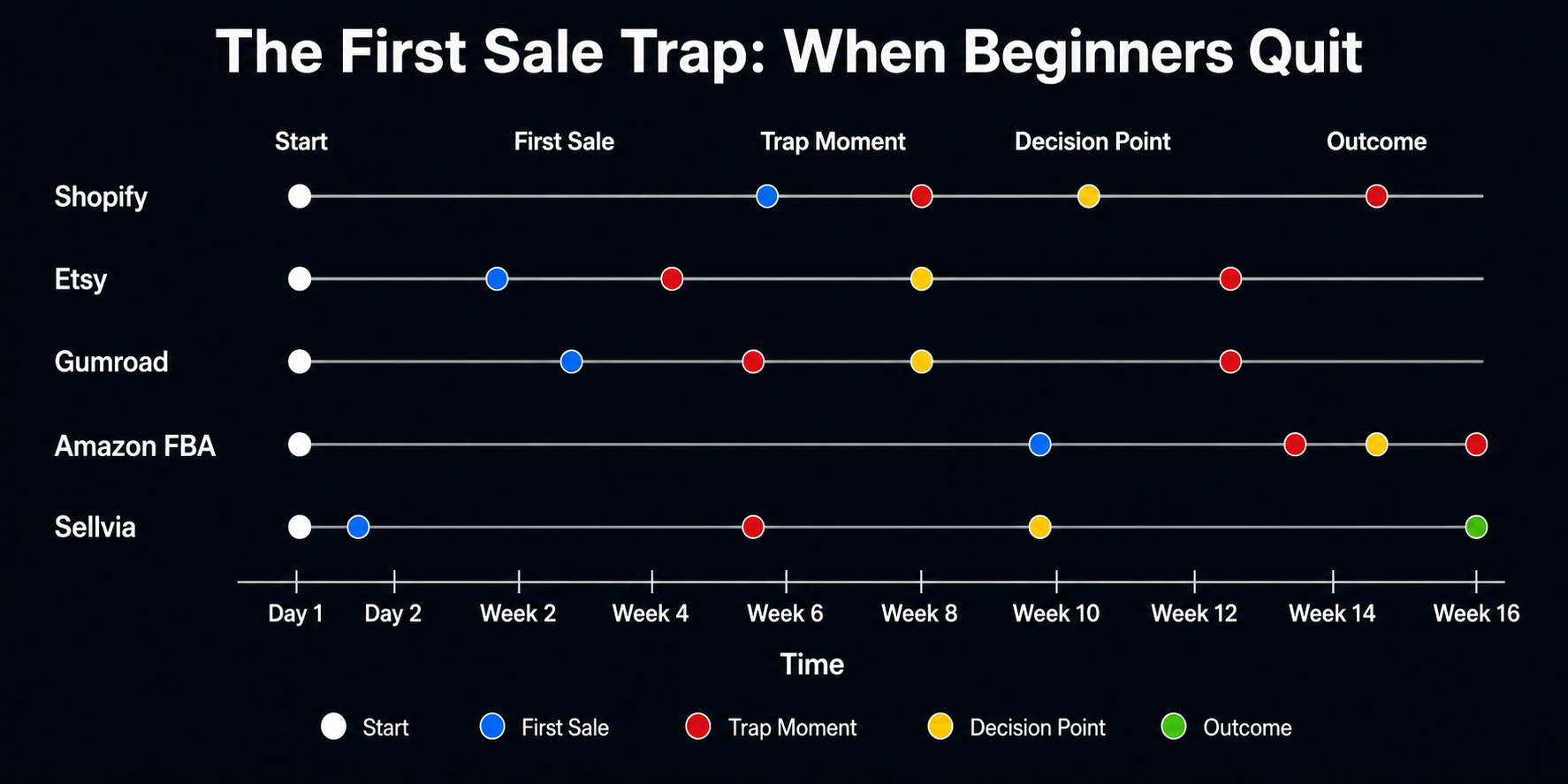
A Shopify beginner usually struggles with setup complexity, app costs, product positioning, and traffic. The hardest part is getting the first sale at all, because nothing is built in. When it comes, the relief can trigger premature confidence – “the hard part is over.” In reality, on Shopify, getting the first sale is the beginning of the hard part, not the end. The store needs continuous optimization, product testing, audience refinement, and marketing investment to reach sustainable profitability.
A Sellvia user may skip some of the setup complexity – the store is pre-built, the products are pre-loaded, and the advertising system handles traffic acquisition – but still has to understand ad spend timing, processing fees, cash flow between orders, and the difference between gross revenue and net profit. The First Sale Trap on Sellvia looks different: because the first sale comes quickly (often in the first day or two after activating ads), the danger is the opposite of Shopify – overconfidence from fast early results, followed by confusion when volume doesn’t immediately scale to the monthly income the beginner had projected.
An Etsy seller may get marketplace exposure from day one, but faces heavy competition, pricing pressure, and a volatile search algorithm. The trap here is the opposite of the ad-spend trap: a seller might get strong early sales from a well-optimized listing, scale their expectations accordingly, then experience a sudden drop when the algorithm deprioritizes their listing. They interpret this as the business breaking, when it may just be normal algorithmic variance that an experienced seller would optimize around.
Gumroad makes the mechanics of selling simple, but it does not magically create demand. The trap for Gumroad beginners is confusing ease of listing with viability of the product. A digital product can be live on Gumroad within an hour. That speed creates a false sense that the hard work is done – when finding buyers for that product, marketing it, and building an audience has not even started.
Amazon FBA can offer scale, but usually requires significantly more capital, operational complexity, and patience than other models. The First Sale Trap here is often financial: beginners see their first units sell and feel momentum, without yet understanding that their actual unit economics – after FBA fees, storage, advertising, and returns – may not be profitable at their current sales velocity.
Hard to get first sale. When it comes, the danger is treating it as proof of a working system before the economics are understood. Requires sustained investment in traffic and optimization after the first sale – not before it.
First sales come fast due to built-in ad traffic. The trap is projecting early velocity into monthly income before the real cost structure – ad spend, processing fees, subscription – is fully understood. Fast start requires careful tracking, not relaxation.
Marketplace exposure is real but fragile. Strong early listings can create expectations that a single algorithm update can shatter. Competition and price pressure are persistent. The first sale on Etsy requires optimization, not just listing.
Zero friction to publish, but zero built-in audience. Ease of setup creates a false sense of progress. The real work – building an audience, driving traffic, validating demand – has not started when the product goes live.
High entry costs and complex fee structures mean first sales frequently look profitable when the full unit economics – FBA fees, PPC spend, storage, returns – have not yet been applied. Requires more capital and patience than most beginners expect.
6. Why Beginners Quit After Seeing “Some” Results
The paradox at the heart of the First Sale Trap is this: the beginners most likely to quit are not the ones who got zero results. They are the ones who got enough results to confirm the business could work, but not enough to create the psychological commitment needed to push through the difficult middle phase.
Getting a few sales is worse than getting no sales in one specific way: it removes the excuse of “this does not work.” Once you have evidence that it works, quitting requires a different kind of rationalization. The most common one is the conversion of a measurement problem into a conclusion: “I made some sales, but not enough to make it worthwhile.” What that sentence almost always means is: “I did not make enough sales fast enough to justify the effort and cost in the short term, so I am projecting that forward.”
That projection is almost always wrong. Early ecommerce performance is almost universally negative or near-zero in terms of net profit. The stores and businesses that succeed are the ones that pushed through that phase long enough to accumulate the data, optimization, and operational efficiency needed to become profitable. The ones that quit typically did so two to four weeks before that inflection point.
There is also a specific dynamic around effort and return. Running an ecommerce store in the early phase requires significant effort: daily ad monitoring, order processing, customer service, product adjustments. When that effort does not immediately produce proportional financial return, it feels unfair. The work does not feel worth the reward. But the effort during the early phase is not being paid for by the early phase results – it is being paid for by the store’s future performance. Beginners who quit early are not getting a bad deal. They are getting out before the deal pays.
The inflection point most beginners never reach
Studies of ecommerce store performance consistently show that stores which survive past 90 days show dramatically different performance trajectories than those that fail within 120 days. The data suggests a non-linear improvement curve: flat or negative in the first 30 to 60 days, then accelerating quickly once ad algorithms have optimized, product-market fit is confirmed, and operational processes are efficient. Most quits happen in the flat phase, right before the curve changes direction.
7. What to Track Before Deciding a Store Is Working
The solution to the First Sale Trap is not emotional resilience. It is replacing emotion with the right metrics. When you are tracking the right numbers, you do not need to guess whether the business is working. The numbers tell you.
The metrics that matter depend on the phase of the business. In the first 30 days, almost nothing matters except the relationship between Cost Per Acquisition and Average Order Value. Everything else is noise. In the 30 to 90 day phase, profitability metrics become relevant: net margin per order, monthly fixed costs versus variable revenue, return rate, and customer acquisition trends. Past 90 days, retention, lifetime value, and organic traffic growth become the primary indicators of whether the business is building momentum or plateauing.
The metrics in the final two rows – revenue and daily sales count – are the ones beginners watch most closely. They are also the ones with the least decision-making value. This is not a coincidence. These are the numbers that look most dramatic, change most visibly, and generate the most emotion. They are the ones most likely to trigger a premature quit or an unjustified scale-up.
8. When Quitting Is Smart – and When It Is Just Impatience
Not every quit is a mistake. Some businesses genuinely do not work, and continuing to invest in them is not perseverance – it is avoidance of an obvious reality. The skill is in telling the difference.
Quitting is a smart business decision when the unit economics are structurally broken – when the cost to acquire a customer will never be lower than the profit generated from that customer, no matter how much optimization is applied. If a product costs $4 to manufacture and sells for $12, but the average customer acquisition cost is $25, the model does not work. That is not a patience problem. That is a math problem that requires a different product, a different pricing strategy, or a different audience.
Quitting is also smart when the operational demands of the business are incompatible with the time and capital available. An Amazon FBA operation that requires $15,000 in inventory to test properly is not the right model for someone with $1,500 to invest. Starting, struggling, and quitting is not failure – it is a mismatch between model and resources that should have been identified before launch.
Quitting is impatience – not strategy – when the business has not been running long enough to generate statistically meaningful data. Shutting down a store after 3 weeks of paid traffic is impatience. Abandoning a Sellvia store because the first week of ad spend did not produce the monthly income equivalent is impatience. Closing an Etsy shop after 10 listings and 30 days is impatience. In all these cases, the decision is being made before the business has had a reasonable opportunity to demonstrate what it is actually capable of.
Quit – It’s a strategic decision
- CPA is structurally higher than AOV after 30+ days of optimization
- Unit economics are negative even at scale
- Capital required exceeds available resources
- Market is structurally oversaturated with no differentiation path
- Operational demands exceed available time and skills
- Platform fundamentally changed (algorithm, policy, fee structure)
Stay – It’s impatience
- Less than 14 days of ad data exists
- CPA is high but trending down week over week
- First sales came but volume is not yet consistent
- Decisions are based on revenue, not profit per order
- The comparison is to someone else’s month 6, not your week 2
- The quit decision comes right after a bad 3-day stretch
9. The Specific Moment Most Beginners Actually Quit
Based on observed patterns across ecommerce communities and platform data, there is a very specific moment where most beginner quits occur. It is not at zero sales. It is at the point where the beginner has had enough results to feel the weight of what is required, but not enough to feel the pull of what is possible.
It usually happens between week two and week five. The first sale has occurred. The dopamine of that moment has faded. The ad spend is accumulating without proportional revenue. The daily routine of checking the dashboard and finding it underwhelming has begun to feel exhausting. A small voice starts suggesting that the money and time could be better spent elsewhere.
At this moment, the beginner often seeks confirmation – they go back to the YouTube channel or the forum where they found the platform in the first place, looking for reassurance. What they often find instead is a comment thread full of people saying the platform does not work, or a video that raises doubts about the model. The algorithm that brought them into ecommerce now serves them content about why ecommerce is a scam. This is not coincidence – it is the attention economy’s response to their changed emotional state.
The beginner makes the quit decision not based on their own data, but based on the emotional environment they are consuming. They do not ask: what do my specific metrics show? They ask: is this worth continuing? And they answer that question with content from people who are not running their store, on their platform, with their products, in their market conditions.
The content trap
The platforms and content ecosystems that help beginners start ecommerce businesses are optimized for acquisition, not retention. The messaging that gets you in the door – “start making money online today” – sets expectations that the actual early-phase experience will not meet. The resulting disappointment is not a reflection of the business’s potential. It is a product of the gap between the marketing and the reality. Understanding this gap in advance is one of the most practical things a new ecommerce operator can do.
10. Final Take
It is not better products. It is not better platforms. It is not even better marketing. The primary differentiator between ecommerce beginners who build something real and those who quit after seeing some results is a single skill: the ability to evaluate results on the right timeline, with the right metrics, against the right expectations.
The First Sale Trap claims as many victims as it does because early ecommerce performance is genuinely difficult to interpret without a framework. Revenue looks impressive when it is not profitable. A few bad days look catastrophic when they are actually normal variance. The emotional arc of the first few weeks – excitement, doubt, first sale, post-sale anxiety – is so predictable that it should almost be included in the onboarding documentation of every ecommerce platform.
Most beginners quit not because their businesses were failing. They quit because they were measuring the right data on the wrong timeline, or the wrong data on any timeline. The business was on its way to working. They just did not stay long enough to find out.
The practical implication is simple: before you launch, define the minimum test window you will commit to before making any quit decision. For most ad-driven models, that is 60 to 90 days of consistent operation with consistent spend. For organic models, it is longer. Write that commitment down before you see your first sale. Because after you see it – and especially after the novelty fades – you will need something more durable than motivation to hold the course.
Related on Ecom Reality
If you found this useful, the following articles go deeper on the platform-specific versions of this problem: Sellvia Complete Guide and Review · Shopify Problems & Complaints · Sellvia vs Shopify
Content is provided for informational and editorial purposes only. Ecom Reality does not guarantee business results or outcomes from any platform or service mentioned on this site. Failure rate statistics sourced from publicly available industry research and company reports.

Croom Raymond is an ecommerce writer and digital business researcher at Ecom Reality. He covers online selling platforms, SaaS tools, pricing structures, platform features, and practical strategies for building digital businesses. His articles focus on clear, evidence-based analysis that helps readers understand how different services work, compare their advantages and limitations, and make more informed business decisions.
Leave a Reply