
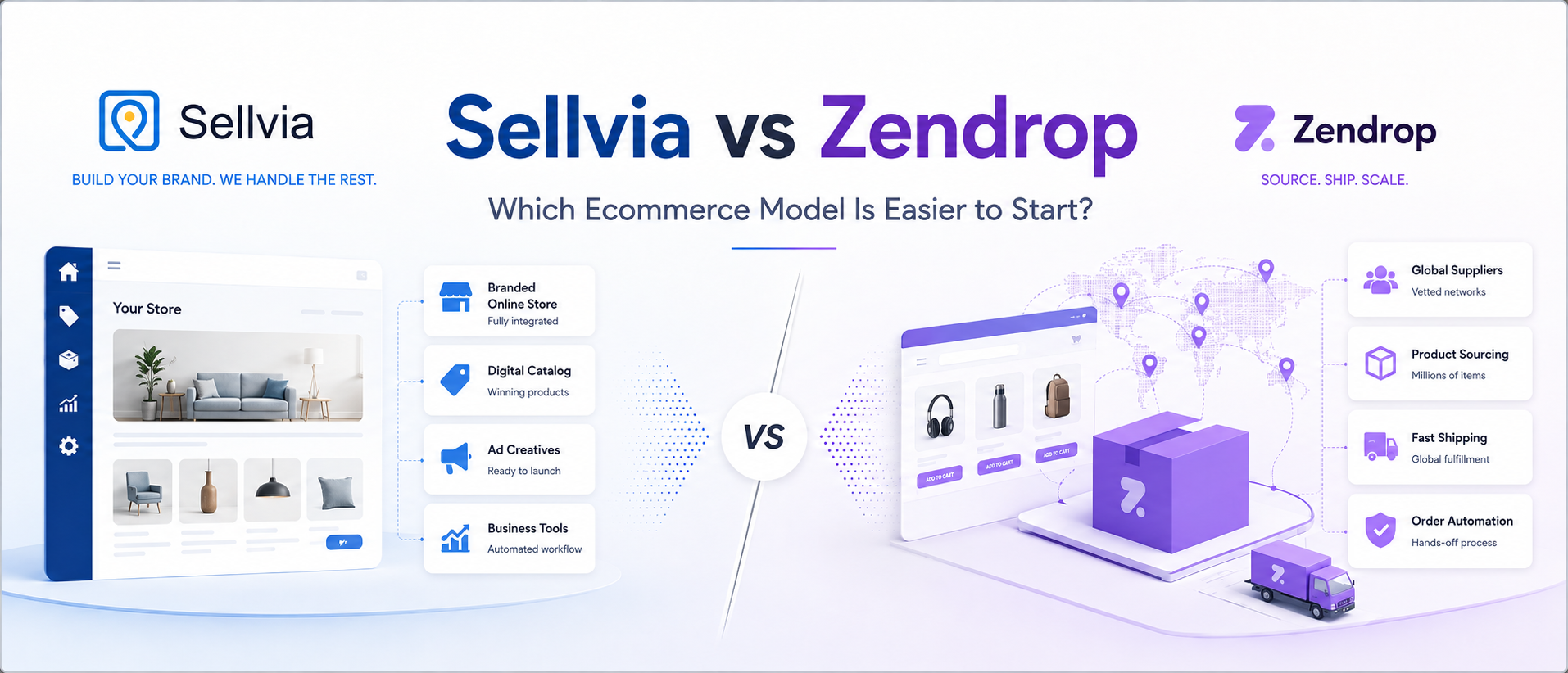
Search for ways to start an online business and Sellvia and Zendrop can easily end up in the same research session. Comparison directories often place them side by side, which makes the choice look like a normal feature-versus-feature contest. That framing is increasingly misleading.
Both companies have expanded their beginner-facing tools, but they still sit at different layers of an ecommerce business. Sellvia’s current model is centered on a ready storefront, a catalog of digital products, an internal order and account workflow, and built-in advertising infrastructure. Zendrop is centered on physical-product dropshipping: sourcing, product discovery, fulfillment and automation. Zendrop can now also generate an AI-built Shopify store and create advertising assets, which makes it much more beginner-friendly than older comparisons suggest, but the underlying commerce and paid-media layers still extend beyond Zendrop itself.
What stood out when I compared the two current workflows was not a simple feature gap. It was a boundary question: which parts of the business actually live inside the platform, and which parts still live somewhere else?
Sellvia is structurally easier for a true beginner who wants a preassembled digital-product business environment with fewer independent systems to manage. Zendrop is the stronger fit for someone who specifically wants physical-product dropshipping and values control over the storefront, products and surrounding stack enough to accept more external dependencies.
Sellvia vs Zendrop: why a normal feature comparison misses the point
A conventional comparison would ask which platform has more products, which plan is cheaper, or which dashboard has more automation. Those questions matter, but they do not identify the real difference.
The more useful test is to ask what happens if you remove each service from the business.
The replacement test
If Sellvia disappears from a Sellvia-based setup, most of the operating environment disappears with it: the Sellvia-hosted storefront, platform catalog access, internal workflow and native advertising layer are all tied to the same ecosystem while the subscription is active.
If Zendrop disappears from a Zendrop-powered setup, the impact is different. The Shopify, Wix, TikTok Shop or ClickFunnels commerce layer can still exist, but the sourcing catalog, product-linking workflow, fulfillment automation and Zendrop-specific product operations disappear. Even when Zendrop creates an AI-built Shopify store for a beginner, the storefront itself still operates on Shopify rather than becoming a proprietary Zendrop commerce engine.
That is the distinction many comparison pages flatten. Sellvia is trying to contain more of the business environment. Zendrop is building an increasingly broad dropshipping ecosystem around a sourcing-and-fulfillment core, while still relying on an external storefront layer.
What each platform actually gives you
| Business layer | Sellvia | Zendrop |
|---|---|---|
| Storefront | Included inside the Sellvia subscription environment | Can connect an existing store or generate an AI-built Shopify store; the commerce layer still runs on an external storefront platform |
| Product model | Digital-product catalog, including guides, courses, checklists, templates and similar products | Physical-product sourcing and dropshipping catalog |
| Sourcing responsibility | No conventional physical supplier workflow in the current digital model | Product selection, sourcing economics and fulfillment choices remain central |
| Shipping | No conventional parcel shipping for digitally delivered products | A core part of the physical-product model, including delivery expectations and tracking |
| Order workflow | Handled inside Sellvia’s platform environment | Connects storefront orders to Zendrop’s sourcing and fulfillment network |
| Marketing tools | Built-in advertising system that can manage the campaign layer from inside Sellvia | Built-in AI ad-creative generation; paid media buying still happens through external ad channels |
| Store ownership/control | More platform-defined and dependent on the Sellvia subscription | More control over the external storefront and broader technology stack |
| Operational complexity | More consolidated | More distributed because physical fulfillment and an external commerce layer remain part of the model |
This table is more useful than a raw feature checklist because it shows where responsibility sits. Zendrop has added tools that reduce beginner friction, especially its AI-built stores and AI creative tools. What those additions do not change is the underlying business model: the seller is still operating a physical-product store with a separate commerce platform, shipping, fulfillment economics and paid acquisition to manage.
Two ecommerce tools that solve different parts of the business
Main differenceSellvia is closer to an integrated business environment. Zendrop is closer to a sourcing and fulfillment layer inside a larger ecommerce stack.
Sellvia contains more of the operating environment inside one platform relationship, while Zendrop concentrates on physical-product sourcing and fulfillment within a broader ecommerce stack.
What does “starting from zero” look like now?
Older Zendrop comparisons often assume a beginner has to build a Shopify store manually before doing anything else. That is no longer accurate. Zendrop can now generate an AI-built Shopify storefront and pre-load it with a starter selection of products. That materially reduces setup work.
It does not, however, make the Sellvia and Zendrop starting positions identical.
The Sellvia starting position
The user enters a platform where the storefront, hosting, digital catalog, order environment and built-in advertising system are designed as parts of one operating model. The early work is mostly about reviewing what has been provided, selecting or positioning products, understanding the workflow and deciding how much to spend on customer acquisition.
The Zendrop starting position
The user can connect an existing store or request an AI-built Shopify store, select physical products, link those products to the store and use Zendrop for fulfillment. The process is easier than manually building everything from scratch, but the operator still has to complete the Shopify commerce setup, payment configuration, product economics and external traffic acquisition.
This is a subtler difference than “one has a store and the other does not.” Zendrop now helps create the store. Sellvia goes further by making the storefront itself part of the same platform relationship as the catalog and operating workflow.
The real gap is where the business boundary sits
The easiest way to understand these platforms is to draw the boundary around what each company directly controls.
With Sellvia, the boundary reaches across more of the customer journey. The storefront is supplied within Sellvia’s environment, the products come from the platform catalog, the order activity is managed through the dashboard, and the advertising system can be activated from the same ecosystem. The business is narrower and more platform-dependent, but also more contained.
With Zendrop, the boundary is strongest around product sourcing and fulfillment. The company has expanded outward with product research, AI-built Shopify stores, training and AI creative generation, yet important parts of the commercial system still sit outside Zendrop: the storefront platform itself, payment processing and the ad networks where campaigns actually run.
That difference matters because every external boundary is another relationship the operator has to understand. It may be a Shopify subscription, a payment processor, a Meta or TikTok ad account, or the practical realities of shipping physical products. More boundaries can mean more flexibility. They can also mean more places where costs, settings and policies need attention.
How much of the business is already assembled before you start?
Sellvia
More of the operating environment already exists inside one ecosystem.
Zendrop
More surrounding infrastructure still has to be assembled around the core service.
DefinitionThe stack gap is everything the operator still has to build around the platform before the business works end to end.
The “stack gap” is the infrastructure an operator still has to assemble around the core platform. Sellvia’s gap is narrower; Zendrop deliberately leaves more of the surrounding commerce stack under the merchant’s control.
Before the first sale: which decisions are still open?
The best measure of beginner difficulty is not how many buttons are on the dashboard. It is how many unresolved business decisions remain after signup.
A Sellvia beginner starts with a predefined digital-product model. The product type is already decided. There is no conventional supplier search, no shipping configuration for parcels, and no requirement to choose a separate ecommerce platform before the store can exist. The user still has meaningful decisions to make about positioning, products, budget and whether the economics make sense, but many architecture decisions have already been closed.
A Zendrop beginner can now skip much of the visual store-building work by using its AI-built Shopify option. That is a real improvement. But several decisions remain inherently part of the physical dropshipping model: which products to link, whether the selling price leaves enough room for product and shipping costs, how delivery expectations will be communicated, how the Shopify store will be configured, and where paid traffic will come from.
Neither approach is automatically better. Sellvia reduces the number of open decisions by defining more of the business. Zendrop reduces setup friction while preserving more freedom over what the physical-product business becomes.
After the first sale, the models separate even more
The difference becomes clearer once a customer actually buys something.
In Sellvia’s current digital model, the customer is buying a digital item rather than a parcel that has to travel through a carrier network. The order still enters Sellvia’s internal processing and account workflow, so “digital” should not be confused with “nothing happens after checkout.” The important operational point is that there is no conventional warehouse-to-carrier-to-customer shipping chain for the merchant to manage.
With Zendrop, fulfillment is one of the reasons to use the platform in the first place. A storefront order is linked to Zendrop’s fulfillment workflow, the physical product has to be sourced and shipped, and tracking and delivery expectations become part of the customer experience. Zendrop automates a large share of that process, but automation does not remove the fact that a physical item still has to reach a real address.
For someone who wants to run a physical-product store, that is not a negative. It is the business. For someone whose priority is reducing operational categories rather than selling tangible goods, the absence of physical shipping is a meaningful structural advantage for Sellvia.
Digital products versus physical products changes the workload
This is the most important difference that generic “Sellvia vs Zendrop” pages tend to understate.
Physical ecommerce introduces variables that simply do not exist in the same form for digitally delivered products: supplier availability, product cost changes, shipping prices, delivery windows, tracking, damaged parcels, returns, customs exposure in some destinations and customer expectations around physical quality.
Zendrop’s value is that it tries to make those variables easier to manage. Its sourcing network, one-click product linking, fulfillment automation and product tools are meant to reduce the friction of physical dropshipping. It should therefore be judged on how well it handles that job, not criticized because shipping exists.
Sellvia avoids the entire physical-fulfillment category by operating around digital products. There is no inventory to replenish and no parcel that can be delayed in transit. That does not make the commercial side effortless. Demand can still be weak, ad spend can still fail to convert, customers can still request refunds, and the operator still has to decide which offers are worth promoting. What disappears is a class of logistics work rather than business risk itself.
Neither model removes the work — it changes what kind of work the operator manages
Core ideaDigital products remove logistics-heavy work. Physical products add sourcing and fulfillment work. Both still require real business decisions.
Digital products do not remove business work; they shift it away from physical logistics. Zendrop’s physical-product model keeps sourcing, fulfillment, delivery and returns in the operating equation.
Which model asks more from the operator?
| Responsibility | Sellvia | Zendrop |
|---|---|---|
| Store setup | Mostly predefined within Sellvia’s environment | Can be accelerated with an AI-built Shopify store, but the external commerce setup still needs to be completed and maintained |
| Product sourcing | Selection from a digital catalog | Core part of the model: choosing and evaluating physical products and their economics |
| Shipping literacy | Not a conventional operating requirement for digital delivery | Important because delivery times and shipping costs affect the offer |
| Advertising creative | Supported through Sellvia’s advertising environment | Zendrop can generate AI video/image creatives |
| Paid media execution | More contained within Sellvia’s managed advertising system | Campaign buying and channel management remain external |
| Platform integration | Lower because core components are already tied together | Higher because storefront and fulfillment remain separate systems, even when setup is assisted |
The Zendrop model is therefore not simply “harder.” It asks for a different skill mix. An operator who enjoys testing physical products, adjusting prices, working with Shopify and learning paid social may find that freedom energizing rather than burdensome.
Sellvia is more likely to suit someone who wants a bounded system and would rather spend less time deciding which commerce components need to be connected in the first place.
Control versus consolidation
The strongest argument for Sellvia is also its main tradeoff.
More of the operating model sits inside one ecosystem. That compresses setup and reduces integration work, but it also increases dependence on Sellvia’s catalog, platform rules, subscription and internal workflow. The user gets fewer architectural decisions because the platform has already made more of them.
Zendrop gives the operator a wider degree of control. A merchant can use an existing Shopify store, request an AI-built one, select physical products, change the storefront independently, choose the marketing stack and build a business whose front end is not limited to a proprietary Zendrop storefront.
That flexibility has a cost in complexity. The store platform, fulfillment service and ad channels remain distinct systems with separate rules and, potentially, separate bills. For an experienced operator, that separation can be an advantage. For a beginner who does not yet know what stack they want, it can create additional decision pressure.
Pricing: compare the system, not one subscription number
Pricing is another place where old comparison pages can be misleading because Zendrop’s current billing is not represented by a single universal monthly fee.
Sellvia’s Basic subscription starts at $39 per month after a 14-day free trial. Higher Sellvia subscription levels exist, but reproducing that entire structure here would duplicate a separate guide. The more relevant point for this comparison is that the entry subscription sits inside a broader bundle that includes the Sellvia storefront environment, hosting, catalog access and platform workflow. For the current plan structure and limits, see our detailed Sellvia pricing analysis.
Zendrop currently has two billing models. Its Usage-Based Billing model is the current path for many new Shopify and Wix signups and is based on the highest number of linked products reached during the billing cycle: 0 linked products can remain free, 1–20 linked products is $29 per month, 21–100 is $49 per month, and 101+ is $79 per month. Zendrop also maintains flat-rate Standard plans for eligible accounts, including Pro at $49 per month and Plus at $79 per month.
The important point is not whether $29, $39 or $49 looks cheaper in isolation. A Zendrop seller still has a separate storefront layer to account for. If the store runs on Shopify, Shopify’s own subscription and payment environment exist independently of Zendrop, even when Zendrop generated the initial storefront. Advertising spend is separate as well.
Sellvia also has costs beyond the Basic subscription. Orders have their own economics, and advertising is not free simply because the ad system is integrated. So the honest comparison is not “Sellvia costs $39 and Zendrop costs X.” It is what complete operating system does that fee buy, and what additional components still have to be funded around it?
Marketing: Sellvia Ads and Zendrop AI creatives are not the same thing
This is another area where the current products need to be compared carefully.
Sellvia includes a built-in advertising environment that can take the operator beyond creative production and into campaign execution. The user can allocate a budget inside the platform and work within Sellvia’s managed advertising workflow rather than building the entire paid-media setup from scratch. That does not guarantee profitable traffic, and it does not remove the need to monitor economics. For the mechanics, budget rules and limitations, see our hands-on Sellvia Ads analysis.
Zendrop now has a built-in AI Ad Generator and Creative Studio capable of producing UGC-style video and image creatives for Zendrop products. That is useful, especially for a beginner who does not want to hire creators for every test. But generating an ad is not the same as buying the traffic. The finished creative still has to be deployed through channels such as TikTok, Instagram or other advertising platforms, with campaign budgets and optimization handled outside the Zendrop fulfillment layer.
So the comparison is no longer “Sellvia has marketing tools and Zendrop does not.” The accurate distinction is: Sellvia integrates more of the campaign-management layer, while Zendrop increasingly helps create the assets used by an external paid-acquisition system.
Where Zendrop is clearly the more logical choice
Zendrop makes more sense when physical products are not an incidental preference but the core of the business model.
- You specifically want to sell tangible products rather than digital products.
- You already have a Shopify, Wix, TikTok Shop or ClickFunnels setup and need sourcing and fulfillment.
- You want broad control over products, storefront design and the wider commerce stack.
- You are comfortable evaluating product cost, shipping cost, delivery expectations and physical-product margins.
- You want AI-assisted store creation or ad creative generation without committing the entire business to one proprietary storefront environment.
For this type of operator, Zendrop’s external storefront architecture is not an inconvenience. It is part of the appeal. The merchant can change or expand the front end while continuing to use Zendrop as the sourcing and fulfillment engine. For a broader examination of its plans, fulfillment model and limitations, see our independent Zendrop review and the Zendrop company page.
Where Sellvia is structurally easier
The case for Sellvia does not require pretending Zendrop still makes beginners hand-build every component. Zendrop has clearly reduced that friction. Sellvia’s advantage comes from a different place: more of the business remains inside one defined operating environment after setup is finished.
The storefront is part of Sellvia’s platform relationship. The product model is already defined around digital goods. Conventional parcel shipping is absent. The order and account workflow is internal. The advertising layer can also be operated through Sellvia. A beginner therefore has fewer systems whose policies, billing and integrations have to be understood independently before the business becomes usable.
“Easier” does not mean passive or guaranteed. The user still needs to make decisions, process account activity, fund advertising when using it, monitor results and decide whether the economics justify continued spending. A preassembled business environment can reduce setup complexity; it cannot manufacture demand.
For a deeper look at the dashboard, catalog and overall operating model, see our full Sellvia review. User ratings and company background are available separately on the Sellvia company page.
Three founder profiles make the choice clearer
Founder A: starting from nothing and wants the shortest operating path
This person has no store, no product catalog, no existing supplier workflow and limited interest in assembling software. Sellvia is the more natural fit. Its advantage is not that every task is automatic; it is that the core business model, storefront and product environment arrive already defined.
Founder B: wants a physical-product brand and is comfortable with Shopify
This person wants to choose tangible products, control the storefront and use a specialist fulfillment system behind it. Zendrop is the stronger match. Its AI-built store can shorten launch time, while the merchant still retains a conventional external storefront and the flexibility that comes with it.
Founder C: already has a store and only needs better sourcing and fulfillment
For this operator, Sellvia would solve the wrong problem. The storefront already exists. The missing layer is product sourcing, fulfillment and shipping automation, which is precisely where Zendrop is designed to fit.
Frequently asked questions
What is the main difference between Sellvia and Zendrop?
Sellvia is a more vertically integrated ecommerce environment built around a ready storefront, digital-product catalog, internal workflow and built-in advertising. Zendrop is a physical-product dropshipping ecosystem centered on sourcing and fulfillment. It can also create an AI-built Shopify store and ad creatives, but the storefront and paid-media channels remain external systems.
Is Sellvia easier to start than Zendrop?
For a beginner starting without a store or established ecommerce stack, Sellvia usually leaves fewer independent systems to configure and maintain. Zendrop has become easier to launch with because it offers AI-built Shopify stores, but operating a physical-product business still involves a separate commerce layer, fulfillment and shipping variables.
Does Zendrop provide a store?
Zendrop can generate an AI-built Shopify store or connect to an existing compatible storefront. The important distinction is that the resulting commerce layer operates on Shopify or another connected platform rather than as a proprietary Zendrop storefront.
Do I need Shopify to use Zendrop?
Not in every case. Zendrop supports multiple store connections, including Shopify, Wix, TikTok US and ClickFunnels. Its AI-built store option is Shopify-based.
Does Sellvia sell physical products?
Sellvia’s current beginner-facing store model centers on digital products such as guides, courses, checklists and similar downloadable or accessible products, so conventional physical shipping is not part of that workflow.
Does Zendrop have built-in advertising tools?
Zendrop has an AI Ad Generator and Creative Studio for producing video and image ad creatives. That is different from a managed media-buying layer: the campaigns themselves still need to run through external advertising platforms.
Which platform requires less operational work after a sale?
Sellvia removes conventional physical fulfillment and shipping from the merchant’s workload because the current model is digital. Zendrop automates much of physical fulfillment, but delivery times, tracking, shipping costs and other physical-product variables still exist.
Which is better for physical products?
Zendrop is the more logical choice because physical-product sourcing and fulfillment are central to its service. Sellvia’s current model is better aligned with someone who specifically wants a preassembled digital-product environment.
The verdict
Zendrop is the stronger choice when the business you want to build is a physical-product dropshipping operation. Its current product is broader than a basic fulfillment app: it can help build the Shopify storefront, source products, automate fulfillment and generate ad creatives.
Sellvia is still structurally easier for the true beginner who wants fewer independent systems. Its storefront, digital catalog, order environment and advertising workflow are more tightly contained within one platform relationship, and the digital model removes conventional shipping and supplier logistics from day-to-day operations.
That is why the answer to Sellvia vs Zendrop is not really a generic “which platform has more features?” verdict. Zendrop gives a physical-commerce operator more freedom over the business around its fulfillment engine. Sellvia gives a beginner more of the business architecture before that beginner has to decide how to assemble it.
If the goal is maximum control over a physical-product store, Zendrop is the more natural fit. If the goal is to reduce the number of platforms, logistics decisions and integrations required to get a first ecommerce operation running, Sellvia has the cleaner starting position.
One response to “Sellvia vs Zendrop: Which Ecommerce Model Is Easier to Start?”
-
The boundary question in this piece is actually what made me stay – I needed to know what I’d lose if I walked away, and for me the answer was enough to justify the $39 a month. At 50-70% profit margin, the subscription pays for itself faster than I expected. The integrated stack being the point, not a selling feature, is the framing I wish I’d had earlier.


Jo Carter is an editor and ecommerce researcher at Ecom Reality, where she covers ecommerce platforms, digital selling tools, online business software, pricing models, and emerging industry trends. She focuses on turning complex platform features and costs into clear, practical information for entrepreneurs and digital sellers. Her work combines detailed research with a balanced editorial approach, helping readers compare services, understand potential limitations, and choose tools that fit their business goals.
Comments
Leave a Reply
Related Articles



Leave a Reply