

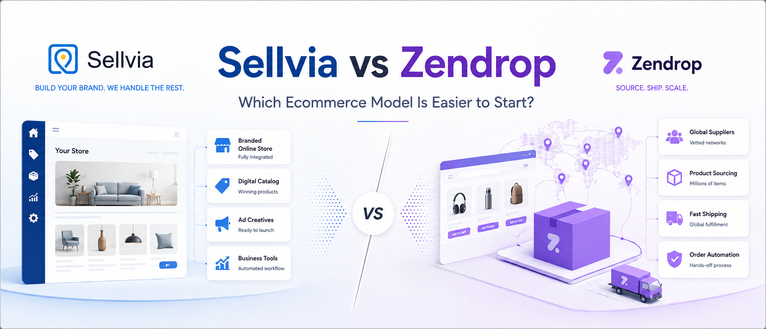
Quick Answer: The biggest difference is not the storefront itself. Sellvia packages a more guided digital-product business system around the store: a ready-made store, a catalog of digital products, built-in one-click advertising, payment and balance workflows, and support intended to reduce the number of separate decisions a beginner must make. Traditional ecommerce platforms such as Shopify or WooCommerce are broader infrastructure: they give the merchant more freedom to choose what to sell and how to assemble the stack, but the merchant normally makes more of those choices independently. Sellvia is therefore best understood as a business system with an ecommerce storefront, while a traditional platform is usually commerce infrastructure that you configure around your own business model.
That distinction matters because two services can both produce an online store while asking very different things from the owner after launch. We checked Sellvia’s current public onboarding and offer pages on September 20, 2026 and compared the visible workflow with the broader platform model covered across EcomReality.
The storefront is the least interesting difference
At first glance, the products can look similar: you get a branded online store, product pages, checkout and an admin area. If you compare only those visible pieces, the business-model difference is easy to miss.
The better question is: who is responsible for assembling the business behind the storefront?
With a conventional platform, the merchant typically decides on the product strategy, creates or sources the products, configures the storefront, chooses marketing channels, connects additional tools when necessary and develops the operating process. That flexibility is valuable, especially for experienced operators with a specific model in mind.
Sellvia deliberately compresses several of those decisions. Its current public offer describes a store that comes with digital products such as guides, courses and checklists, plus built-in advertising and a guided starting workflow. That changes the role of the platform from ‘software you build on’ to something closer to ‘an operating environment you start inside.’
For the broader company overview, see our Sellvia company profile. If you want the marketplace side specifically, our Sellvia Mall explained guide covers that separately.
Sellvia versus a traditional platform at a glance
| Layer | Sellvia model | Traditional platform model |
|---|---|---|
| Store setup | Guided, ready-made store workflow | Merchant selects theme, structure and configuration |
| Products | Digital-product catalog is part of the system | Merchant normally supplies or creates the catalog |
| Marketing | Built-in one-click advertising is part of the current offer | Merchant chooses channels, apps, agencies or campaigns |
| Business model | More opinionated and guided | More general-purpose and configurable |
| Learning curve | Fewer initial architecture decisions | More decisions, but more freedom over the stack |
| Best fit | Beginner wanting a structured digital-commerce starting point | Merchant with a defined product, workflow or custom stack |
1. Sellvia starts with a business model, not an empty shell
One of the clearest things we observed on Sellvia’s current public onboarding page is that the pitch begins with the operating package: a store, digital products, built-in ads and guidance. The page currently describes the catalog as digital products including guides, courses, checklists and tools. It also advertises a 14-day free trial and a $40 advertising credit.
This is strategically important. A beginner using a general-purpose platform can spend the first week deciding what the business should be. Sellvia reduces that blank-page problem by defining a starting model.
The trade-off is equally clear: a more opinionated system is naturally less open-ended than a platform designed to support almost any commerce architecture. That is not inherently a weakness. For the right user, reducing choice is the feature.
2. The catalog changes what ‘launching a store’ means
On a traditional platform, creating the store and creating the offer are separate jobs. The platform can provide excellent commerce infrastructure while still leaving the merchant responsible for the product itself.
Sellvia’s current model ties store access to a digital-product catalog. That means the user can move from account setup to a populated store without first producing an ebook, course, checklist or other digital asset from scratch.
This also changes how we evaluate setup speed. ‘Store ready’ is more meaningful when the store already has something to sell. Our Sellvia pricing guide looks more closely at what the subscription covers.
3. Marketing is brought closer to the core product
Sellvia’s current public page prominently presents one-click ads as part of the experience and includes a $40 ad credit for the trial. In other words, customer acquisition is not treated purely as an external problem that begins after the software is configured.
A traditional platform may provide native marketing features and integrations, but the merchant generally has wider responsibility for deciding what campaign stack to use, what channels to test, how to configure tracking and whether to use apps or outside services.
Sellvia’s approach is appealing for users who want fewer interfaces and a clearer next action. Experienced marketers may prefer the freedom of a broader stack. The distinction is guided execution versus maximum configurability.
4. The order and balance workflow is part of the business logic
Sellvia does not just present a storefront. The account includes order processing and balance states that shape how the merchant experiences cash flow. Customer payments, order processing, pending/incoming balances and available balances are operational concepts inside the system.
That is different from thinking of the ecommerce platform only as the place where checkout happens. A traditional stack can absolutely provide sophisticated order and payment management, but the exact workflow depends on the payment processor, apps and business architecture the merchant chooses.
For beginners, a predefined workflow can make the process easier to understand because the steps are consistent across the system. For advanced operators, a custom stack can provide more freedom to design finance and fulfillment logic around existing operations.
5. Sellvia optimizes for fewer startup decisions
There is a hidden cost in ecommerce that rarely appears on a pricing page: decision load. Which theme? Which product strategy? Which checkout extensions? Which email tool? Which ad platform? Which analytics stack? Which upsell system?
Traditional platforms often win on breadth because they let the merchant answer those questions independently. Sellvia’s value proposition is almost the opposite: answer more of them in advance so the user can concentrate on operating the store.
| Decision | Sellvia | Traditional platform |
|---|---|---|
| What type of catalog? | Digital catalog supplied within the platform | Merchant decides and builds/sources it |
| How to start advertising? | Built-in ad workflow available | Merchant chooses tools and channels |
| How much can I customize the stack? | More structured | Usually broader and more modular |
| Who benefits most? | Beginner prioritizing speed and guidance | Operator prioritizing control and custom architecture |
6. Subscription economics should be compared at the system level
Sellvia’s current public offer lists a 14-day free trial and a $39 monthly plan after the trial for its entry offer. A useful comparison is not simply ‘$39 versus another platform’s monthly fee.’ You should compare what must be added around each system to reach the workflow you actually want.
With a general platform, the base subscription may be only the first software line item. Depending on the business, the merchant may add apps, email software, specialized page tools or marketing services. With Sellvia, more of the starting workflow is intentionally bundled.
Conversely, if a merchant already owns a product catalog, has an advertising stack and knows exactly which tools to use, the bundled guidance may be less important than the flexibility of a general platform.
Our Ecommerce Platform Cost Calculator is useful here because it encourages total-stack comparisons rather than headline-price comparisons.
7. Control and convenience sit on opposite ends of the same spectrum
It is tempting to frame ecommerce comparisons as ‘more control is always better.’ In practice, control has a management cost. Every choice you own is also a choice you must make, document and maintain.
Sellvia leans toward convenience and a defined workflow. Traditional platforms lean toward general-purpose flexibility. A first-time operator can reasonably prefer the former, while a developer-led brand with custom requirements can reasonably prefer the latter.
The important thing is matching architecture to skill level and business intent.
Who should prefer the Sellvia model?
Based on the current workflow we checked, Sellvia makes the strongest case for someone who wants to start with digital products and would rather receive a structured system than assemble the business piece by piece. The model is particularly coherent when these statements are true:
- You want a store populated with digital products rather than beginning with an empty catalog.
- You value a built-in path to advertising.
- You prefer a guided workflow over researching a large app ecosystem.
- You are comfortable operating inside a more defined business model.
- You want the platform to reduce technical and strategic setup decisions.
This is also why Sellvia should not be evaluated as if it were merely another website builder. The storefront is one layer of the offer.
Who should prefer a traditional platform?
A traditional ecommerce platform is likely the better architectural fit when the merchant already has a distinct catalog, needs deep customization, has developers or specialists managing the stack, wants to select every marketing and operational tool independently, or expects unusual integrations.
That is the strength of general-purpose infrastructure: it does not assume one business model.
Where Sellvia Mall fits
Sellvia Mall adds another layer to the ecosystem. It is not the same thing as the merchant’s store. The Mall is a marketplace/discovery environment, while Sellvia itself provides the store and operating workflow. Our Sellvia Mall company profile and marketplace explainer separate those roles in detail.
This distinction matters for entity clarity: store infrastructure, catalog access, advertising workflow and marketplace exposure are related components, but they should not be collapsed into one vague feature.

A practical way to choose
Write down the first ten tasks required to get from ‘I want to sell online’ to ‘a customer can buy.’ Then mark who is responsible for each task under each platform.
If you prefer the option where more tasks are pre-structured, Sellvia’s model becomes attractive. If you prefer to own the architecture and make each choice yourself, a traditional platform becomes attractive.
This method is more useful than counting features because it measures operational responsibility.
FAQ
Is Sellvia just a website builder?
No. The current public offer combines a ready-made store with a digital-product catalog, built-in advertising and an operating workflow. The store is one component of the system.
Does Sellvia currently focus on digital products?
Yes. The public onboarding page we checked describes products such as guides, courses, checklists and tools and explicitly presents the model as digital-product commerce.
What is the current starting subscription?
Sellvia’s public offer currently advertises a 14-day free trial followed by a $39 monthly plan, with a $40 advertising credit included for starting the ad workflow. Always confirm the live checkout before subscribing because offers can change.
Is a traditional platform more flexible?
Generally, yes. General-purpose platforms are designed to support many different business models and often provide large extension ecosystems. That flexibility also means the merchant makes more architecture decisions.
Which is easier for a beginner?
For a beginner who specifically wants a guided digital-product model, Sellvia reduces several startup decisions by bundling the store, catalog and marketing path. A beginner with a unique product or highly custom plan may prefer a broader platform despite the additional setup work.
Final takeaway
Sellvia and traditional ecommerce platforms overlap at the storefront layer, but they are solving different problems. A traditional platform asks, ‘What kind of commerce business do you want to build on this infrastructure?’ Sellvia answers more of that question in advance by packaging a digital-product catalog, store and marketing workflow into a guided ecosystem.
That makes Sellvia particularly compelling for people who value a faster, more structured starting point. The cost of that simplicity is less architectural freedom than a general-purpose platform. The benefit is that the user can spend less time assembling tools and more time learning how to operate the business.
Verification note: we checked Sellvia’s live public onboarding offer and current public terms on September 20, 2026. The live offer showed a 14-day free trial, $39 monthly entry subscription after trial, a $40 advertising credit, digital products and built-in one-click advertising. Terms and offers can change, so verify the live pages before purchasing.
Featured photo: Ngital / Unsplash.

Croom Raymond is an ecommerce writer and digital business researcher at Ecom Reality. He covers online selling platforms, SaaS tools, pricing structures, platform features, and practical strategies for building digital businesses. His articles focus on clear, evidence-based analysis that helps readers understand how different services work, compare their advantages and limitations, and make more informed business decisions.
Comments
Related Articles


Leave a Reply