
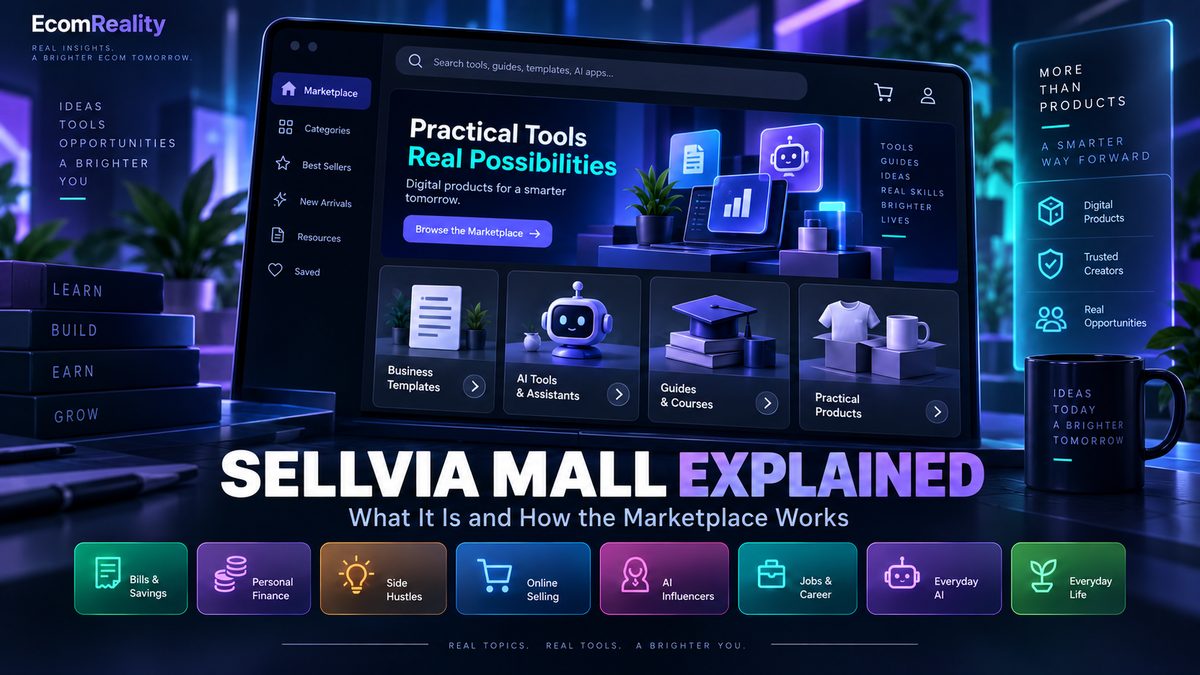
Sellvia Mall is easy to misunderstand if you arrive from the main Sellvia brand. The name sounds like another store-building product, a supplier marketplace, or a catalog of products for ecommerce sellers. The current Sellvia Mall concept is different: it is a digital marketplace built around practical tools, guides, assistants, apps and AI-powered products designed to help users complete specific tasks.
The organizing idea is not “pick a software category and learn it.” It is closer to “start with a problem and leave with something usable.” A user might want to reduce a recurring bill, understand a financial document, rewrite a resume, prepare for a salary conversation, create a side-hustle plan, improve product copy, build a month of content, or use AI without first learning prompt engineering. Sellvia Mall packages those jobs into individual digital products.
Quick Answer: What Is Sellvia Mall?
Sellvia Mall is a marketplace for practical digital products. Its catalog combines downloadable guides and cheat sheets, AI-powered tools and assistants, more structured apps, and ready-made AI personas. Products are organized around real-life outcomes such as lowering bills, managing money, earning on the side, selling online, getting hired, using AI and handling everyday tasks. Items can be purchased individually, while the catalog materials also describe a Pass that provides broader access.
Sellvia Mall Is Built Around Problems, Not Software Categories
Most digital-product marketplaces are organized by file type or creator category: ebooks, templates, courses, graphics, software, prompts. Sellvia Mall’s current catalog is more outcome-driven. The user is not expected to know whether the solution should be a template, a prompt sequence, a checklist or an app before starting. The catalog groups products by the problem they are meant to address.
That distinction matters because it changes the search behavior the marketplace is designed for. Someone looking at a higher internet bill probably does not want to compare “AI productivity tools.” They want to know what changed, what alternatives exist and what to say when they call the provider. Someone facing a job interview does not necessarily want a generic AI subscription. They may want a structured mock interview workflow and feedback prompts. Sellvia Mall’s product architecture tries to turn those specific moments into packaged digital workflows.
The source materials describe the concept as “AI on your side.” The practical meaning is that AI is often hidden behind a guided task rather than sold as an open-ended chatbot. The user supplies the relevant input — for example a bill, job post, resume, policy summary or product information — and the tool is designed to return something concrete such as a script, plan, checklist, comparison or draft.
What You Can Find Inside Sellvia Mall
The current catalog is split into eight lines. The important point is not the number of products in each line; it is the breadth of use cases. Sellvia Mall stretches well beyond ecommerce and includes consumer finance, career, household and everyday AI workflows.
1. Lower Your Bills
This section focuses on recurring expenses and situations where a user may be able to ask better questions, compare alternatives or challenge an unexpected charge. Examples in the current catalog include a Lower Internet Bill Assistant, Subscription Cleanup Tool, Cheaper Car Insurance Tool, Medical Bill Fixer Tool and Fee Refund Scripts.
These products are framed as educational tools and structured workflows, not as guarantees that a provider will reduce a bill or approve a request. That distinction is important: the product can organize the request and help prepare the user, but the outcome still depends on the provider, account history and circumstances.
2. Fix Your Finances
The finance line covers organization rather than regulated financial advice. Examples include the Budget That Sticks App, Paycheck Planner App, Debt Payoff App, Credit Report & Score Explainer, Emergency Fund Roadmap and tax-related educational checklists.
A common design pattern appears here: instead of delivering a long course, the tool tries to turn a user’s own numbers into a usable next step. A paycheck-planning product, for example, is useful because the timing of bills often matters as much as the total monthly budget.
3. Earn on the Side
This is one of the broadest sections in the catalog. It moves from selling items you already own to freelancing, local services, tutoring, UGC, digital products and basic bookkeeping. Representative products include the Side Hustle Finder Tool, Sell Your Stuff Tool, Freelance Profile Assistant, Winning Proposals Assistant, Etsy Printables Tool and Simple Bookkeeping App.
The source materials explicitly avoid income guarantees. That is the right way to interpret this line: these products can help structure a process or create supporting materials, but they cannot determine demand, customer acquisition, pricing power or the user’s execution.
4. Sell Anything Online
This line is the closest bridge between Sellvia Mall and the broader ecommerce audience already familiar with Sellvia. It includes tools for Instagram, TikTok and Shorts, Facebook, Pinterest, basic Google SEO, email and SMS, product descriptions, ad copy, video scripts, customer support and launch planning.
Examples such as the Product Description Assistant, TikTok & Shorts Promotion Assistant, Google SEO Tool and 30-Day Content Plan App are designed to be usable by sellers on different platforms rather than only inside one storefront system.
5. AI Influencers
This is the most unusual category. Sellvia Mall includes both an AI Influencer Playbook and packaged virtual creator products for specific niches, plus an Influencer Builder Tool for creating a custom persona.
The catalog materials put an important boundary around these products: virtual personas should be disclosed as virtual, should not invent personal experiences, and should follow platform and advertising disclosure rules. That makes the category materially different from using fake human testimonials or pretending an AI character has lived experiences it does not have.
6. Get Hired & Paid More
Career products include a Resume Rewrite Tool, Cover Letter Assistant, LinkedIn Profile Assistant, Mock Interview Assistant, Salary Negotiation Assistant, job-search planning and career-change workflows.
These products are most useful when they work from the user’s real experience and the actual job description. The value is not in generating generic career advice; it is in translating existing experience into a clearer application or conversation.
7. Everyday AI
This line is intended for people who want AI utility without turning prompting into a hobby. Products include the Talk to AI Cheat Sheet, Everyday Writing Assistant, Learn Anything App, Spreadsheet Formula Tool, Fine Print Decoder Tool, AI Scam Spotter Handbook and planning tools.
The section also shows why Sellvia Mall is not simply a prompt marketplace. Some products are static educational resources, some are guided prompt systems, and others behave more like lightweight applications with a repeatable workflow.
8. Everyday Life
The final line focuses on practical household tasks: meal planning, grocery savings, insurance explanations, car repair quotes, car buying, security deposits, ticket appeals, scams, moving and holiday budgeting. Examples include the Budget Meal Planner, Car Repair Quote Tool, Security Deposit Recovery Assistant and Moving Day Checklist.
This category reinforces the marketplace’s consumer orientation. Not every Sellvia Mall product is about entrepreneurship. Many are designed for ordinary decisions where a structured checklist, script or AI-assisted explanation can save time.
The Three Product Formats Matter More Than the Category Names
To understand what you are actually buying, it helps to separate the catalog into three product formats. Two items in the same category can work very differently.
Guides & Cheat Sheets
Static digital resources that explain a process, summarize rules, provide scripts or give the user a checklist. Downloading them does not require an AI generation.
Tools, Assistants & Apps
Interactive workflows that take the user’s own information and return something finished: a plan, rewrite, comparison, document, schedule or content set. AI-powered generations can use tokens.
AI Personas
Packaged virtual creators with a defined niche, visual direction, scripts and content structure. They are intended to remain disclosed as virtual rather than impersonating real people.
This is one of the most useful distinctions in the entire catalog. A guide is mainly information. An assistant is mainly transformation: you give it something and it gives you a customized output. An AI persona is closer to a packaged creative system with identity, content direction and generation needs.
How the Sellvia Mall Pass Works
The catalog materials describe two ways to access products: items can be purchased individually, while broader catalog access is available through a subscription referred to simply as the Pass. The current documentation intentionally avoids older working names such as “Business Pass” or “Insider Pass.”
A downloaded guide, checklist or other catalog file is a separate action from running an AI generation.
The initial 100 tokens are used when supported tools generate personalized outputs. They are topped up when needed rather than renewed as a monthly allowance.
| Part of the access model | How it works in the reviewed materials | What to watch |
|---|---|---|
| Free trial | 7 days; browsing the catalog, 5 downloads and 100 AI tokens. | A card is required and the subscription starts automatically if not canceled. |
| Monthly Pass | $9.99 per month after the trial, with unlimited catalog downloads. | Commercial terms can change; verify the live checkout before subscribing. |
| AI tokens | Used for AI generations inside supported tools. | They are separate from downloads and are topped up as needed. |
| New products | The materials say new products are added weekly and members see them first. | Larger separate releases may be offered at a member price. |
| Cancellation | Cancellation is described as a one-click account action, with access continuing through the paid period. | New downloads stop when access ends. |
| Downloaded products | Files already downloaded remain available to the user after cancellation. | The license does not allow reselling or redistributing the files. |
Downloads and AI Tokens Are Not the Same Meter
This is the detail most likely to confuse new users. A digital marketplace can combine downloadable products and AI generation in the same account, but those two activities have different economics.
A download is access to a product or resource in the catalog. Under the current Pass model, the free trial has a limited number of downloads and the paid subscription moves to unlimited downloads. Downloading does not reduce the AI-token balance.
An AI token, in Sellvia Mall’s terminology, is a usage credit for generation inside AI-enabled tools. The reviewed documentation says generations start from a small token cost that is shown before generation. The initial 100-token balance is meant to let a new user test those generation workflows. When the balance is used, the account can be topped up.
What a Typical Sellvia Mall Workflow Looks Like
The products vary, but many follow a similar pattern:
- Start with a specific problem. For example, an internet bill increased, a user has a job interview, or a seller needs product descriptions.
- Choose a focused product instead of a general AI tool. The catalog directs the user toward the assistant, app, guide or checklist built for that job.
- Add the user’s own context. An interactive product may ask for a bill, job post, resume, product specification or other source information.
- Generate or follow the structured output. The result may be a call script, comparison, rewritten document, checklist, schedule or set of content drafts.
- The user takes the real-world action. Sellvia Mall can prepare material, but it does not make the call, negotiate with an employer, approve a refund, hire the user or guarantee a financial outcome.
That last step is important. The marketplace is strongest when viewed as a preparation layer between “I have a problem” and “I know what to do next.” It is not a replacement for the company, employer, government agency, bank, insurer or marketplace that makes the final decision.
Sellvia Mall vs Sellvia: Same Brand Family, Different Job
EcomReality tracks Sellvia Mall separately from the main Sellvia platform because the user intent is different.
Sellvia Mall
A consumer-facing digital marketplace focused on practical guides, AI assistants, apps, creator products and everyday workflows. The unit of value is usually a specific digital tool or task.
Sellvia
A subscription ecommerce platform centered on launching and operating a digital-product storefront. The unit of value is the broader store, catalog and ecommerce operating system.
That distinction helps prevent a common category error. Someone researching Sellvia Mall may simply want a resume assistant or a bill-related guide; they do not necessarily want to launch an ecommerce store. Someone researching Sellvia may want the opposite: an operating platform rather than one consumer tool.
If your main question is about the larger ecommerce product, start with our Sellvia review. If your question is specifically about the marketplace described on this page, the Sellvia Mall company profile is the more relevant hub.
Who Sellvia Mall Is Most Likely to Make Sense For
People who want an outcome, not an AI learning curve
The product-first structure is useful when you know the task but do not want to design the prompts and workflow yourself.
Users who repeatedly need templates and assistants
The subscription model becomes easier to understand when several different catalog products are useful in the same month.
Creators and small sellers
The online-selling and AI-influencer lines cover promotion, copy, content planning, reviews, customer support and creator workflows.
People solving practical life admin
Bill questions, job applications, budgeting, moving, car decisions and household tasks are a major part of the catalog.
The weakest fit is someone who wants one highly specialized professional service and expects the tool to replace a lawyer, financial adviser, medical professional or other licensed expert. The catalog repeatedly frames relevant products as educational resources rather than professional advice.
What Sellvia Mall Does Not Promise
The strongest way to evaluate this marketplace is to separate what a digital tool can control from what it cannot.
- It can organize information. A tool can turn scattered input into a structured checklist, comparison or document.
- It can draft communication. It can help create a complaint, application, negotiation script, follow-up message or content plan.
- It can explain a process. A guide can summarize what to check and point the user toward official sources.
- It cannot guarantee approval. A provider, employer, bank, insurer or agency still decides the outcome.
- It cannot guarantee income. Side-hustle and selling products depend on demand, execution, pricing and many factors outside the tool.
- It is not a substitute for regulated professional advice. The catalog contains explicit educational disclaimers where legal, tax, financial, insurance or health topics are involved.
That boundary is a strength rather than a weakness when it is stated clearly. Digital tools are most credible when they define the part of the process they can actually improve.
What Happens to Downloads If You Cancel?
According to the reviewed access terms, cancellation stops future catalog access after the applicable paid period, but products already downloaded remain with the user. The license allows use in the user’s own life, work and projects. It does not grant the right to resell or redistribute the underlying files.
This is a meaningful difference from software that becomes unusable the moment a subscription ends. A Sellvia Mall member may stop having access to new downloads, but the downloaded resource itself is not described as disappearing from the user’s possession.
AI-powered workflows require a second distinction: retaining a downloaded product is not the same as receiving unlimited future AI generation. Generation is governed by the separate token model described above.
Editorial Assessment: What Is Actually Different Here?
The interesting part of Sellvia Mall is not that it sells PDFs or uses AI. Neither idea is rare. The more distinctive element is the attempt to combine several product types under a single problem-first catalog.
A static guide is appropriate when the answer does not need personalization. An assistant makes more sense when the user’s own input changes the output. An app becomes useful when the workflow needs structure or state. An AI persona is a different product again, because the customer is buying a repeatable creator framework rather than a one-time answer.
That product-format separation is more useful than a generic “AI marketplace” label. It also gives users a better way to judge value: ask what the product actually returns, how much customization is involved, whether AI generation is required, and whether the task is likely to recur.
For EcomReality, Sellvia Mall is therefore best understood as a digital utility marketplace: a catalog that packages practical knowledge and AI-assisted execution into narrowly defined products. Whether the Pass is economical depends on how many of those products a user genuinely needs and how heavily they use generation features.
Questions to Check Before Paying
Because the catalog and access terms can evolve, I would check five things on the live checkout or account page before subscribing:
- The current monthly price and trial terms. The reviewed materials show a 7-day trial and $9.99 monthly Pass, but current checkout is the final reference.
- What the trial includes. Confirm the download allowance and starting AI-token balance.
- Whether the products you actually want are included. A large catalog has little value if your intended tools are separate releases.
- How many tokens a specific AI workflow uses. The system is designed to show generation cost before the run.
- The cancellation state of your account. Confirm when access ends and keep copies of any products you want before that date.
Frequently Asked Questions
What is Sellvia Mall?
Sellvia Mall is a marketplace of digital products including practical guides, cheat sheets, AI-powered assistants, apps and AI persona products. The current catalog is organized around real-life tasks rather than only ecommerce.
Is Sellvia Mall the same thing as Sellvia?
No. EcomReality treats them as separate products with different primary jobs. Sellvia is the broader ecommerce/store platform, while Sellvia Mall is a marketplace of individual digital tools and resources. You can view their separate profiles at Sellvia and Sellvia Mall.
Does Sellvia Mall only contain products for online sellers?
No. Online selling is one catalog line, but the marketplace also covers bills, personal finance organization, side income, careers, everyday AI and household tasks.
What is included in the Sellvia Mall free trial?
The catalog materials reviewed by EcomReality describe a 7-day trial with access to browse the catalog, 5 downloads and 100 AI tokens. A card is required, and monthly billing begins after the trial unless canceled.
How much does the Sellvia Mall Pass cost?
The reviewed materials list the Pass at $9.99 per month after the trial. Because commercial terms can change, verify the current price at checkout.
Do Sellvia Mall downloads use AI tokens?
No. Downloads and AI-token usage are separate. AI tokens are consumed only by supported AI-generation workflows.
Do AI tokens renew every month?
The reviewed materials say no. The starting 100 tokens are a welcome balance, and additional tokens are topped up when needed rather than arriving as a monthly allowance.
What happens if I cancel Sellvia Mall?
The reviewed terms say the user keeps products already downloaded. Future downloads stop after account access ends. The files are licensed for the user’s own life, work and projects, not for resale or redistribution.
Are Sellvia Mall tools legal, medical or financial advice?
No. Products in sensitive categories are described as educational tools and resources. They can help organize questions, explain processes or draft material, but they do not replace licensed professional advice.

Croom Raymond is an ecommerce writer and digital business researcher at Ecom Reality. He covers online selling platforms, SaaS tools, pricing structures, platform features, and practical strategies for building digital businesses. His articles focus on clear, evidence-based analysis that helps readers understand how different services work, compare their advantages and limitations, and make more informed business decisions.
Comments
Related Articles



Leave a Reply