


The phrase “is Sellvia legit?” sounds like a yes-or-no question, but that is not how I approached it. A useful legitimacy check has to follow an evidence trail: who is identified as the operator, whether the service has real operational depth, whether billing and cancellation rules are published, whether money movement is visible, and whether the platform’s promises can be separated from the results that depend on the user.
That distinction matters because most pages answering this query fall into one of two camps. Some repeat promotional claims and conclude that Sellvia must be legitimate because it has a polished website. Others collect negative comments and conclude that any unexpected cost proves the opposite. Neither method is strong enough. A real business can have complaints, and a polished sales page is not proof of anything by itself.
For this review, I compared Sellvia’s current public Terms of Use, contact information, Privacy Policy, subscription documentation, cancellation instructions, and the platform structure already documented by the Ecom Reality editorial team. I also looked at the recurring questions behind negative reviews—not to treat every review as verified fact, but to identify what a careful user should check before paying.
My verdict: Sellvia is a legitimate, functioning ecommerce platform with an identifiable operator, published legal terms, account-based services, documented subscription rules, customer-support channels, order-management infrastructure, and defined cancellation and refund procedures.
That verdict does not mean every campaign will be profitable, every add-on will suit every user, or every customer experience will be frictionless. It means the service has a real operating structure that can be independently examined. For a wider evaluation of the platform itself, read our complete Sellvia review.
The Search Gap: Most “Legit” Reviews Test the Wrong Things
The strongest information gap in current search results is not the absence of opinions. There are plenty of opinions. The gap is a reliable method for separating evidence of legitimacy from evidence of profitability, value, customer satisfaction, or fit.
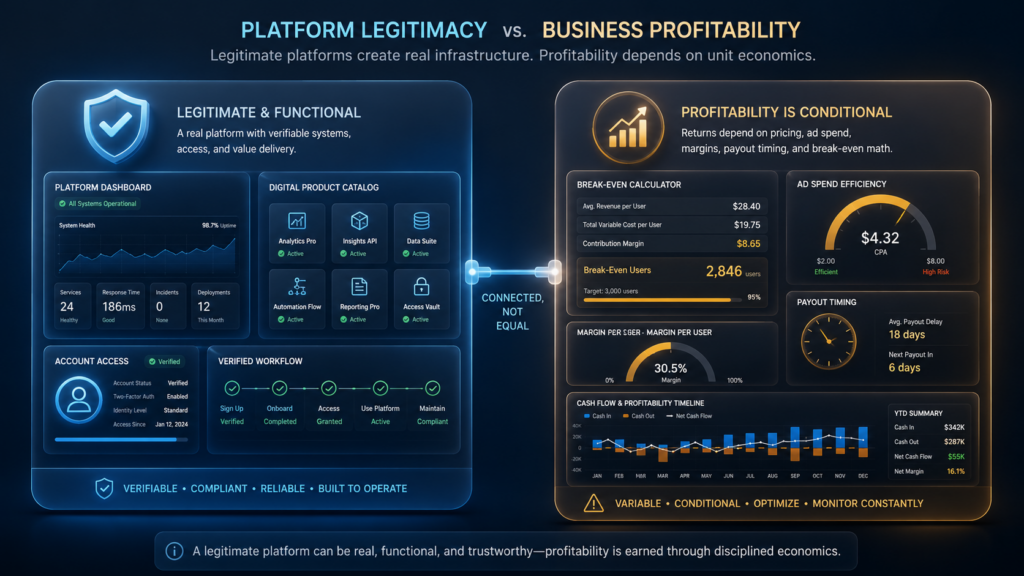
Those are related questions, but they are not interchangeable:
Legitimacy
Does the service exist, identify an operator, provide the product it sells, publish rules, and maintain functioning customer and billing systems?
Profitability
Can a particular user generate more net income than the total cost of subscription, advertising, order processing, and other services?
Value
Does the platform save enough setup time, technical work, and operational complexity to justify its cost for a specific user?
Satisfaction
Did the service, support, pricing and results match what an individual customer expected when signing up?
A platform can be legitimate and still be a poor financial fit for someone with no testing budget. It can be legitimate and still receive complaints. It can also be legitimate while using marketing language that a careful reader should interpret conservatively. My goal was therefore not to defend every claim or dismiss every complaint. It was to determine whether the underlying service survives a serious evidence check.
The Seven-Point Sellvia Legitimacy Check
I used seven categories rather than relying on a star rating or one customer story. No single category is decisive, but together they create a much stronger picture.
| Evidence category | What I looked for | What the current evidence shows |
|---|---|---|
| Identifiable operator | Company name, address, support channel and dated legal pages | Sellvia’s current pages identify Sunshine Ecommerce LLC, doing business as Sellvia LLC, list an Irvine address and publish a support email. |
| Operational product | Account access, dashboard functions, plans, store tools and order-management structure | The service is documented as an account-based platform with subscription access, store management, product tools and order workflows. |
| Published contract | Terms that explain eligibility, billing, service limits and performance disclaimers | The Terms of Use are publicly available and were updated in July 2026. |
| Billing transparency | Recurring-charge rules, separate paid services and plan consequences | Official subscription documentation distinguishes the subscription from additional paid services and explains missed-payment consequences. |
| Reversibility | Cancellation route, refund rules and what happens after cancellation | The Help Center documents account cancellation and a refund framework for the latest subscription payment. |
| Money-flow visibility | Order, balance, processing and withdrawal records rather than an unexplained earnings number | Sellvia publishes help material for orders and balance withdrawals, indicating defined operational stages rather than an anonymous payment loop. |
| Accountability surface | Support, complaint channels and enough public documentation to challenge or verify a claim | Sellvia maintains public contact information, a Help Center, Terms, Privacy Policy and customer-service documentation. |
1. There Is an Identifiable Operator Behind the Service
The first thing I checked was not the homepage design or the number of testimonials. It was whether Sellvia clearly identifies who operates the service and how that operator can be contacted.
Sellvia’s current Terms of Use and contact page identify the operator as Sunshine Ecommerce LLC, doing business as Sellvia LLC. The site lists an address at 2 Park Plaza, Suite 680, Irvine, California, and gives [email protected] as a customer-support channel. The Terms also state that users must be at least 18, or the age of majority in their jurisdiction, and that access depends on accepting the published agreement.
This does not prove that every claim made in marketing is correct. It does, however, distinguish Sellvia from the type of anonymous offer that hides its operator, has no stable legal pages, and provides no meaningful support address. A user has identifiable documents to read, a named business to contact, and written terms against which billing or service behavior can be compared.
You can verify the current operator information directly in Sellvia’s Terms of Use and contact page.
2. Sellvia Has Operational Depth, Not Just a Checkout Page
The second test was whether the paid service has enough operational structure to be treated as software rather than a lead-generation page wrapped around a recurring charge.
Sellvia’s public documentation describes an account environment with store access, product and catalog tools, plans, order management, billing, support, and cancellation controls. The Help Center contains procedural articles showing users how to access their account, manage a subscription, process orders and request withdrawals. Even where a help article may describe a particular service configuration or an older interface, the overall evidence points to a real operating platform with multiple connected systems.
That matters because a fake or purely cosmetic “business opportunity” usually fails this test. It may show a revenue illustration, a few testimonials and a payment form, but it does not have a deep operational trail. Sellvia has a much larger surface area: account authentication, stores, subscriptions, products, order states, support procedures and written service policies.
In my review, the most persuasive signal was not any single feature. It was the consistency of the system around the feature. Plans connect to account access. Orders connect to processing instructions. Cancellation connects to a documented dashboard path. Support connects to an identifiable email and Help Center. That interconnectedness is difficult to explain as an empty front.
3. The Contract Explicitly Separates the Platform From Guaranteed Results
A platform’s own performance disclaimer is an important legitimacy signal because it defines what the company is—and is not—contractually promising.
Sellvia’s July 2026 Terms state that the company does not guarantee business outcomes, advertising performance, revenue, profitability or customer acquisition. Services are provided on an “as-is” and best-effort basis. That language is less exciting than the promotional side of an ecommerce offer, but it is exactly the kind of distinction a serious user should look for.
It means the product being sold is access to services and infrastructure, not a contractual promise that a particular store will make money. When someone says, “I paid for Sellvia and did not earn what I expected,” that may be a genuine and important customer experience. It does not automatically show that the platform itself is fake. To establish that, the relevant question would be whether the promised service was absent, billing contradicted the agreement, or the account behavior could not be reconciled with the published rules.
The useful distinction: Sellvia can legitimately provide a working platform while an individual user still runs an unprofitable campaign. Platform operation and business outcome should be evaluated separately.
4. Pricing Is Real, but the Headline Price Is Not the Whole Decision
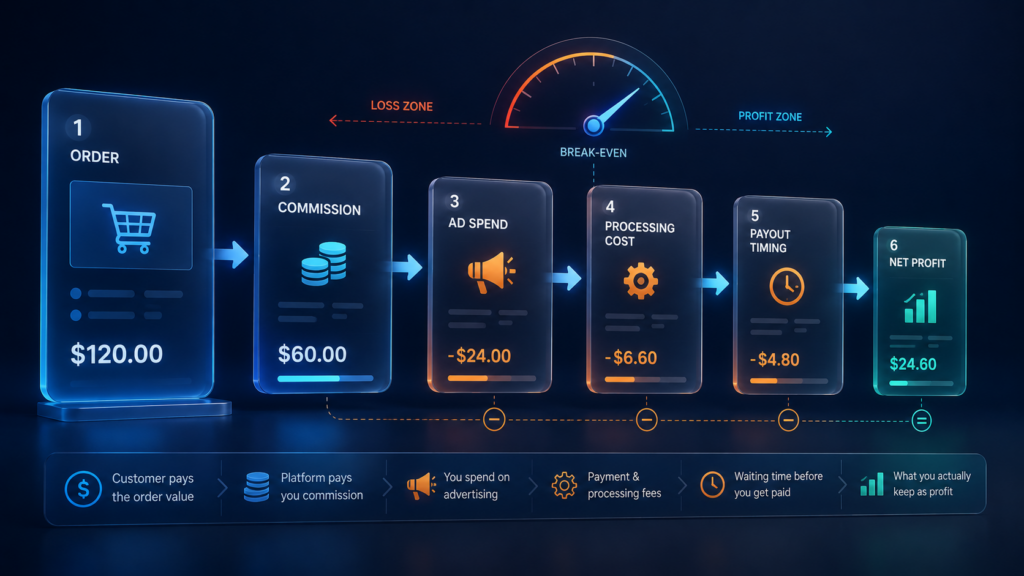
Pricing is where suspicion often begins. A user sees an accessible starting offer, then later encounters advertising, upgrades, processing requirements or other paid services. The natural reaction is to ask whether those costs were “hidden.”
The better test is more precise: were the additional systems disclosed, and did the charge match a service or rule that the user could identify?
Sellvia’s subscription documentation distinguishes core subscription access from additional paid services. The current Terms include separate sections for multiple service types and state that performance is not guaranteed. The existence of separate charges is therefore not, by itself, evidence that the platform is illegitimate. The risk arises when a user assumes the base subscription represents the entire operating budget or accepts an add-on without understanding its renewal and refund conditions.
This article does not repeat the full cost structure because that would overlap with our dedicated Sellvia pricing and plan analysis. For the legitimacy question, the important conclusion is narrower: a recurring subscription plus separately priced operating services is a recognizable SaaS model. It needs careful budgeting, but it is not an inherently fraudulent structure.
5. Cancellation and Refund Rules Are Publicly Documented
A legitimate subscription service should provide a way to end the relationship and explain what cancellation changes. I therefore treated reversibility as a major part of the audit.
Sellvia’s Community Help Center currently states that a subscription can be canceled through the user account and that canceling also deactivates the associated turnkey store. A separate cancellation article gives a dashboard path through My Account, the Plans tab, an options menu, and an unsubscribe-and-delete-store action. The subscription page also states that the latest subscription payment may be refunded within 30 days on request, while additional services are generally not refundable.
The same documentation warns that an unpaid subscription becomes inactive and that hosting and the turnkey store may be deleted after seven days. That consequence is significant, but it is also disclosed. Sellvia is not presenting the store as permanently independent of the subscription. The user is paying for access to a managed platform environment, and stopping payment can end that access.
For a careful customer, the practical lesson is simple: save the current cancellation confirmation, understand which purchases are subscriptions and which are separate services, and do not assume that every add-on inherits the base subscription’s refund treatment.
The relevant official pages are Sellvia’s subscription documentation and cancellation instructions.
6. Money Movement Is Documented as a Process, Not a Mystery Number
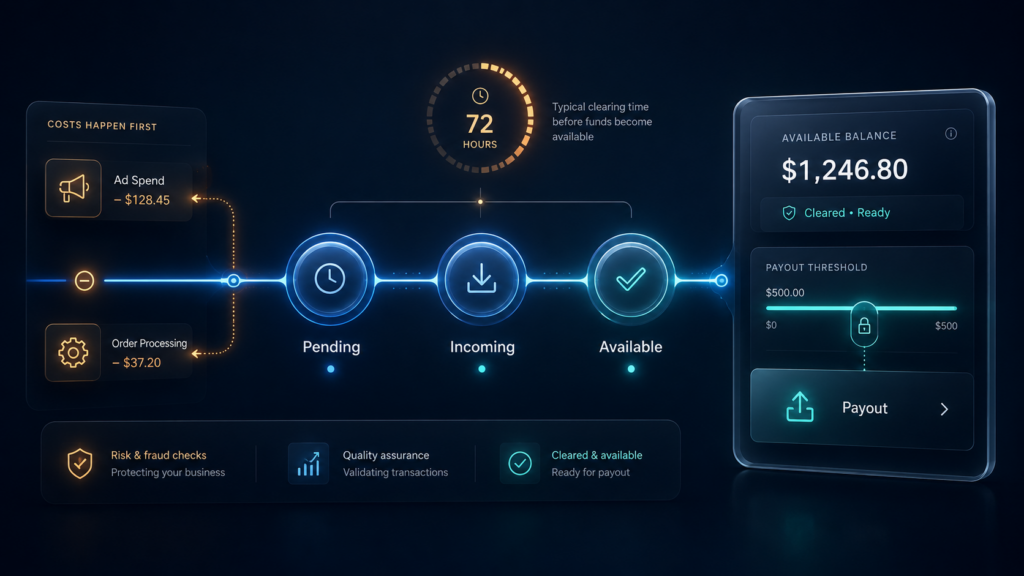
Another common source of “is this a scam?” searches is the gap between seeing a sale in a dashboard and having cash available outside the platform. A legitimacy review should not assume that every delay is normal, but it should check whether the system has defined stages and documented requirements.
Sellvia’s Help Center includes order-processing instructions and a separate balance-withdrawal process. The published material describes account-based order handling, balance conditions, withdrawal methods and timing. This creates an auditable sequence: an order appears, the account records an action, the platform applies its processing rules, and a withdrawal request follows defined conditions.
The existence of a process does not mean every user will like its economics or timing. It means the platform is not simply displaying an unexplained “profit” number with no documented path to action. A user can compare what happened in the account with the current Help Center and Terms, then raise a specific issue if the two do not match.
That is also why screenshots and transaction records matter more than broad accusations. A useful complaint identifies the charge, date, service, account state, expected rule and actual outcome. The more specific the evidence, the easier it is to distinguish a platform failure from a misunderstanding about processing or availability.
7. Public Complaints Should Be Read as Issue Reports, Not a Binary Vote
Sellvia has positive reviews, negative reviews and strongly worded complaints. That is relevant, but a legitimacy verdict should not be produced by counting emotional language on either side.
During my review, I grouped complaints by the issue they described:
- unexpected recurring or add-on charges;
- advertising spend that did not produce the expected return;
- the need to fund order processing before funds became available;
- cancellation or refund timing;
- support response quality;
- confusion between dashboard revenue, commission and withdrawable cash;
- expectations created by promotional language.
These categories are useful because they tell a prospective user what to verify. They do not all point to the same conclusion. Unprofitable advertising is a business-performance problem. A charge that clearly contradicts the accepted agreement would be a billing problem. A refund that arrives later than expected may be a payment-processing problem. A service that never existed would be a legitimacy problem.
Third-party review platforms also have their own moderation limits. Star ratings can be affected by selection bias, duplicate experiences, incentivized feedback, unverifiable claims and enforcement actions. I therefore use public reviews to discover recurring questions, not as the sole proof that a company is legitimate or illegitimate.
What Can Look Suspicious Without Proving the Platform Is Fake
Several parts of the Sellvia model can feel unusual to a beginner. They deserve explanation, but they should not be treated as automatic proof of fraud.
| What a user notices | Why it can feel suspicious | How to evaluate it properly |
|---|---|---|
| The subscription is not the only cost | The initial price can become the mental reference point for the whole business | Separate platform access from optional services, advertising and order-related requirements before paying. |
| A sale does not always equal immediately withdrawable cash | Dashboard activity feels like money already owned and available | Check the current balance statuses, processing conditions and withdrawal rules rather than relying on the headline order total. |
| The store depends on an active subscription | Some users expect permanent independent ownership after setup | Read the subscription and cancellation terms before treating the store as a portable standalone asset. |
| Higher-priced services may be offered after signup | Upsells can feel like the original service was incomplete | Judge each offer separately. Confirm price, renewal, scope and refund status before accepting it. |
| Support may use scripted onboarding or retention steps | Standardized communication can feel impersonal or sales-driven | Focus on whether the team answers the specific account question and provides a written resolution. |
None of these issues should be dismissed. They can materially affect the user experience. The point is that each has a more precise test than “this felt unexpected, therefore the entire platform is fake.”
What Would Be a Genuine Warning Sign?
A positive verdict does not mean ignoring evidence that would change it. I would treat the following as genuine warning signs requiring immediate documentation and escalation:
- a charge that cannot be matched to any accepted subscription, service or confirmation;
- a material account rule that directly contradicts the current written terms;
- the absence of a functioning cancellation route after following the documented steps;
- continued billing after written cancellation confirmation, without another active service explaining it;
- account figures that change without a traceable transaction, adjustment or documented rule;
- support refusing to identify the service connected to a charge;
- marketing presented as a guaranteed result despite the contractual performance disclaimer;
- pressure to buy a higher service before the user receives written scope, price and renewal terms.
The right response is not an immediate social-media verdict. Save screenshots, export transactions, record dates, identify the exact service and ask support for a written explanation. If the explanation does not reconcile with the evidence, the user then has a much stronger basis for a payment dispute, complaint or regulatory inquiry.
Why Older Sellvia Reviews Can Be Misleading
Sellvia has accumulated years of articles, videos and Help Center pages. Some describe different products, account versions, logistics models or service packages. Search engines do not always rank the newest or most relevant page first.
This is one of the biggest gaps in competing “is Sellvia legit?” content. A reviewer may compare a current account with an article written for an older service configuration, then treat every difference as evidence of deception. The opposite problem also occurs: an old positive review may describe features, prices or conditions that are no longer available.
My rule is to rank evidence by freshness and proximity:
- the current account screen connected to the user’s actual purchase;
- the current dated Terms of Use;
- current billing and cancellation confirmations;
- current official Help Center material for the same service;
- recent independent reviews with specific evidence;
- older third-party summaries and promotional articles.
This approach does not automatically favor Sellvia. It favors the evidence most likely to describe the service a user is actually receiving.
What I Personally Found Most Persuasive
After working through the evidence, three things carried more weight than the rest.
First, Sellvia has an accountability trail. The operator, address, support channel, Terms, Privacy Policy and Help Center are publicly available. A user can identify the rules and challenge account behavior against them.
Second, the systems connect logically. Subscription documentation links access to the store. Cancellation documentation explains how to end that access. Order and balance documentation explain how account activity moves through the platform. This is the structure of an operating service, not merely a sales page.
Third, the contract does not guarantee profit. That is important because much of the online argument around Sellvia is really an argument about financial results. The platform can be real while the result remains uncertain. Treating that uncertainty honestly makes the positive legitimacy verdict more credible, not less.
Who Is Most Likely to Have a Positive Sellvia Experience?
Sellvia is most compelling for someone who values structure over maximum independence. It can reduce the amount of technical assembly involved in starting and operating an ecommerce project, give the user a defined account environment, and connect several business functions inside one system.
The users most likely to evaluate it fairly tend to do four things:
- read the current subscription and refund rules before entering payment details;
- separate the base plan from advertising, order-related costs and optional services;
- treat initial activity as a test rather than guaranteed income;
- keep written records of purchases, renewals, cancellations and support decisions.
That is a positive case for Sellvia, but not a promotional one. The platform’s value is in the infrastructure and guided environment it provides. The user still needs to decide whether that environment fits the budget, level of control and operating style they want.
A Pre-Payment Verification Checklist
- Confirm the exact name and price of the service shown at checkout.
- Check whether the charge is one-time, monthly, weekly or automatically renewing.
- Read the refund rule for that specific service, not only the base subscription.
- Save the checkout page, order confirmation and renewal date.
- Confirm what happens to the store and account data if the subscription ends.
- Identify which services are included and which are additional.
- Check the current cancellation path inside the account.
- Decide how much total money can be used for testing without financial pressure.
- Do not treat a dashboard sale as immediately available cash until the account rules confirm it.
- Use the current Terms and account interface rather than relying only on an old review.
Following this checklist does not merely protect the user. It also makes the eventual judgment more accurate. A documented disagreement about a specific charge is more useful than a broad claim that “everything was hidden.”
Final Verdict: Is Sellvia Legit?
Yes. Based on the current evidence, Sellvia is a legitimate ecommerce platform with an identifiable operating company, public legal documents, functioning account services, subscription management, customer support, order-related infrastructure, cancellation instructions and a documented refund framework.
The strongest reason for that conclusion is not the company’s own testimonials or a third-party star rating. It is the depth and consistency of the operating trail. There is a real service to inspect, written rules to compare against account behavior, and a documented path for managing or ending the subscription.
Sellvia is also a commercial platform with recurring charges, optional services and uncertain business outcomes. A user can have a disappointing or unprofitable experience without the platform being fake. That is why the most useful verdict is positive but precise:
Sellvia is legitimate as a platform and business service. Its suitability depends on whether the user understands the exact service being purchased, the ongoing cost structure, the account’s money flow, and the fact that no platform can guarantee profitable results.
For a broader examination of features, workflow and limitations, continue with our Sellvia platform review. For a focused comparison of subscription levels and upgrade value, see our Sellvia pricing analysis.
Frequently Asked Questions
Is Sellvia a real company?
Sellvia’s current public pages identify Sunshine Ecommerce LLC, doing business as Sellvia LLC, as the operator. The company publishes an Irvine address, support email, Terms of Use, Privacy Policy and customer-support documentation. These provide an identifiable accountability trail beyond the sales page.
Is Sellvia a scam?
The available evidence supports treating Sellvia as a legitimate operating ecommerce platform, not an anonymous scheme. It provides account-based services, subscriptions, store tools, order-related workflows and published policies. That does not guarantee profit or eliminate the possibility of billing and support disputes.
Does Sellvia guarantee that I will make money?
No. Sellvia’s current Terms explicitly state that it does not guarantee business outcomes, advertising performance, revenue, profitability or customer acquisition. The platform provides services and infrastructure; financial outcomes depend on costs, execution and user decisions.
Why do some users call Sellvia a scam?
Common reasons include unexpected add-on costs, advertising losses, order-processing requirements, payout timing, cancellation disputes and expectations shaped by promotional content. Each issue should be investigated using account records and the current terms rather than treated as proof by itself.
Can I cancel Sellvia?
Sellvia’s Help Center documents cancellation through the user account, including the Plans area and an unsubscribe-and-delete-store option. Because interfaces can change, users should save the final cancellation confirmation and verify that no separate paid service remains active.
Does Sellvia offer refunds?
Current subscription documentation states that the latest subscription payment may be refunded within 30 days upon request, while additional paid services generally have separate and more restrictive refund rules. The exact service and purchase date therefore matter.
Is Sellvia legit for beginners?
Yes, provided beginners understand that a simpler setup does not equal guaranteed profit. Sellvia can reduce technical complexity and provide a structured operating environment, but users should still read the billing rules, plan a controlled budget and monitor account activity.
What is the best evidence that Sellvia is legitimate?
The strongest evidence is the combined operating trail: identifiable company information, dated legal terms, a functioning account platform, documented subscription and cancellation rules, order and balance procedures, and accessible customer-support channels.
Should I trust Sellvia reviews?
Reviews are useful for discovering recurring issues, but they should not be the only basis for a decision. Give more weight to specific reviews that include dates, charges, account states and written support responses, and compare those claims with the current official documentation.
46 responses to “Is Sellvia Legit? What Beginners Should Know Before Signing Up”
-
Writing this at day 31 because day 30 felt too convenient – and what I keep coming back to is your point about confusing legitimacy with profitability, because that exact distinction is what almost made me walk away when a family member forwarded me a Forbes Communications Council piece citing SaaS platform dependency risks, which honestly spooked me more than any negative review. The moment I understood what automation actually means in practice… it stopped being an abstract risk and started being a math problem I could actually solve, and the numbers held up in a way the tool I was previously paying for never managed. Worth it, with the caveat that you read this article first and not after.
-
The article nails the legitimacy-versus-profit distinction – that single clarification is what stopped me from walking away on day 9, when the $39 subscription plus ad spend plus processing fees looked like a losing equation on paper until I actually mapped the 50 to 70 percent margin against real numbers – and the math held.
-
Didn’t usually write reviews but the article’s framing around legitimacy versus profit is exactly the distinction I needed in week 2 – well, not exactly but close enough that I stopped second-guessing the setup. What I wish someone had told me before I started is that the processing fee per transaction is the number to watch, not the subscription line. My colleague asked why I stopped complaining about order tasks, and honestly I didn’t have a clean answer except that the first sale happened while I was asleep and I convinced myself it was luck. The SEO package being available through this thing means I’m less dependent on paid ads over time, which matters when you’re careful with spending and needed actual proof before committing another dollar.
-
Great content! Keep up the good work!
-
The hidden cost nobody prepared me for wasn’t the subscription – it was the 3 separate tools I was already paying for monthly that the system replaced, which I only realized on day 19 when I actually mapped out my spending. Well, not exactly replaced but close enough that cancelling two of them covered most of my platform cost. I spent more time analyzing the commission math before signing up than I did actually using it in week one, and honestly the 50-70% margin range held up closer to the real number than I expected from a landing page claim.
-
The article nails the legit-versus-profitable split, which is honestly the thing I couldn’t articulate until week 13. What clicked for me was waking up at 6am to see two orders processed overnight – that’s when “automation” stopped being a buzzword. (I’d told myself I was canceling at month-end, then just… didn’t.)
-
After reading what felt like every Sellvia review on the internet, I finally just started the trial – and the thing no review actually explained clearly was the gap between first commission and first withdrawal. Week six told me more than six weeks of reading did.
-
The article separates “legit” from “profitable” well, but the part nobody wrote about before I signed up was the Sellvia Market exit option – knowing at week 10 that I could list the whole store for sale after 60 days and recover my investment through installment payments changed how I’d framed the risk in my spreadsheet from day one. Ngl I almost skipped it entirely because of one negative review, then realized the reviewer never mentioned this feature existed. Three people asked me this week what I’m using, and the first thing I told all of them was that the store-as-an-asset framing matters more than the monthly margin math when you’re budget-conscious about every tool.
-
The legit-versus-profitable distinction is the thing I needed to read before I started, not six weeks in when I was already frustrated. What actually shifted my thinking around day 22 was running the break-even calculation properly – not just “how much did I earn” but “what did each sale actually cost me to acquire.” Once I mapped the 50-70% margin against real ad spend per order, the platform stopped feeling risky and started feeling like a math problem I could control.
-
the red flags vs normal business risks section is the most useful framework i’ve seen for evaluating this platform without either dismissing every complaint or panicking over normal growing pains
-
the net result per order table breaking $18 gross commission down to $2.20 after ad spend, processing, and subscription share is exactly the math nobody shows you in the ads
-
appreciate the pre-ads checklist, i genuinely didn’t have answers to half those questions before i turned my campaigns on and it showed in my first few weeks
-
the comparison table against shopify, gumroad, etsy, and woocommerce is the fairest version of that comparison i’ve read, doesn’t pretend one platform is universally better
-
the “more orders are not always better” point is something i learned the expensive way, ten orders that each lose $2 is still a loss no matter how good the order count looks
-
this distinction between legit and profitable should be the opening line of every single sellvia review that exists, most people conflate the two immediately
-
the pre-signup checklist at the end took me about five minutes and revealed how many gaps i actually had before spending anything
-
worth reading alongside the sellviaexperience thread on what nobody tells you before starting, similar spirit of separating real risk from normal friction
-
the “why people ask if sellvia is legit” section describing the specific patterns, polished marketing, mixed reviews, payout timing anxiety, was uncomfortably accurate to my own search history before i signed up
-
same lesson here, took me way too long to realize order count and profit are not the same metric at all
-
-
the complaints section separating what’s a real platform issue from what’s a beginner expectation mismatch is more balanced than most reviews that pick a side and stay there
-
this level of nuance, legit as infrastructure but not a guarantee of profit, is rare to find written this clearly anywhere
-
the point about platform dependency, your business isn’t portable if the subscription stops, is a real consideration i hadn’t fully thought through before reading this
-
for a more personal account of the same legit vs profitable distinction over a longer timeframe, sellviaexperience has a post about someone’s 6 month experience running a store that covers similar territory
-
the who is likely to suit vs who is likely to be disappointed sections should honestly be shown to everyone before they enter payment details
-
appreciate that this doesn’t use awards or credentials as proof of legitimacy on their own, actually evaluates the mechanics instead
-
the point about a campaign generating orders while still losing money after total ad spend is the single most important distinction in the whole article
-
this reads like it was written by someone who actually ran the numbers rather than someone repeating talking points from either side of the debate
-
the practical break-even formula given here, net contribution per order minus acquisition cost minus other charges, is something i wish had been the very first thing i learned about this platform
-
if anyone wants a broader verdict style breakdown alongside this specific one, sellvia.reviews has a piece called sellvia verdict 2026 who should join and who should skip it that covers similar decision criteria
-
the point about upsells being genuinely useful at the right stage but harmful before you understand the basics matches exactly what happened when i bought a product pack too early
-
the honest framing that a beginner needs a real testing budget and a willingness to absorb a slow start rather than expecting instant profit is the most useful filter for deciding if this platform fits your situation
-
genuinely the most balanced sellvia legitimacy piece i’ve come across, most others lean hard one direction or the other
-
The “legit doesn’t mean profitable” framing is the thing I needed six weeks before I started, not six weeks after. Took me two months to understand my break-even number. Once I did, the math actually worked.
-
But isn’t that on the platform for not making it clearer upfront? If most beginners miss the break-even math, that’s a product design problem not a user problem.
-
Fair point but every Sellvia review I read before starting covered this – I just skipped the parts that felt boring. The information was there. I chose not to read it carefully. That’s on me.
-
Ok I’ll grant that. Still think the $39 headline vs $340 realistic monthly budget gap is too wide to leave to user research. But yes, the terms are disclosed if you actually read them.
-
-
The payout timing section answered a question I’d been sitting on for three weeks. I had $140 in my dashboard and kept wondering why I couldn’t withdraw. The 72-hour hold plus $100 minimum – nobody explained that during onboarding. Found it here instead.
-
Same exact situation at day 31. Seeing the balance and not being able to touch it felt wrong until I understood the mechanics. Once I mapped the 3-day hold against my weekly ad spend the whole cash flow picture made sense.
-
Exactly. The dashboard shows you the number but not the timeline. That gap between “earned” and “withdrawable” is the thing that trips up almost everyone in the first month.
-
-
I’ve read probably a dozen articles trying to answer this question. This is the first Sellvia review that actually separates “is the platform real” from “will it work for me” as two distinct questions. That distinction alone is worth bookmarking.
-
The distinction is useful but I’d push back on the Ecomzy comparison in the table. “Less established third-party review coverage” is a polite way of saying there’s almost no independent data on results. That’s a meaningful difference from Sellvia’s track record.
-
-
That’s a fair critique of the table. Though I’d argue newer platforms always start with less coverage – doesn’t make them worse, just less documented. The question is whether the model makes sense, not whether there are 500 reviews yet.
-
Model making sense and model being proven are different things. I’d want 12 months of public user data before putting real money into Ecomzy. Sellvia at least has a 2016 track record you can verify independently.
-
Month four here. The pre-ads checklist in this article is exactly what I wish I’d run before day one. Specifically the break-even cost per order question – I activated ads without knowing that number and spent three weeks confused about why profitable-looking months still felt tight.
-
-
-
Completely agree on product selection. My growth manager made the same point around day 12 – I was selling low-margin items and wondering why the numbers felt wrong. Switched to higher-priced catalog items in week three and the picture changed within 10 days.
-
Coming back after five months to close the loop. Went in skeptical, ran the checklist in this article before paying anything, budgeted for $400 month one instead of $39. Net positive since week 11. The platform works exactly as described here – no more, no less. Effort and math determine the outcome, not the platform.



Croom Raymond is an ecommerce writer and digital business researcher at Ecom Reality. He covers online selling platforms, SaaS tools, pricing structures, platform features, and practical strategies for building digital businesses. His articles focus on clear, evidence-based analysis that helps readers understand how different services work, compare their advantages and limitations, and make more informed business decisions.
Comments
Leave a Reply
Related Articles



Leave a Reply