
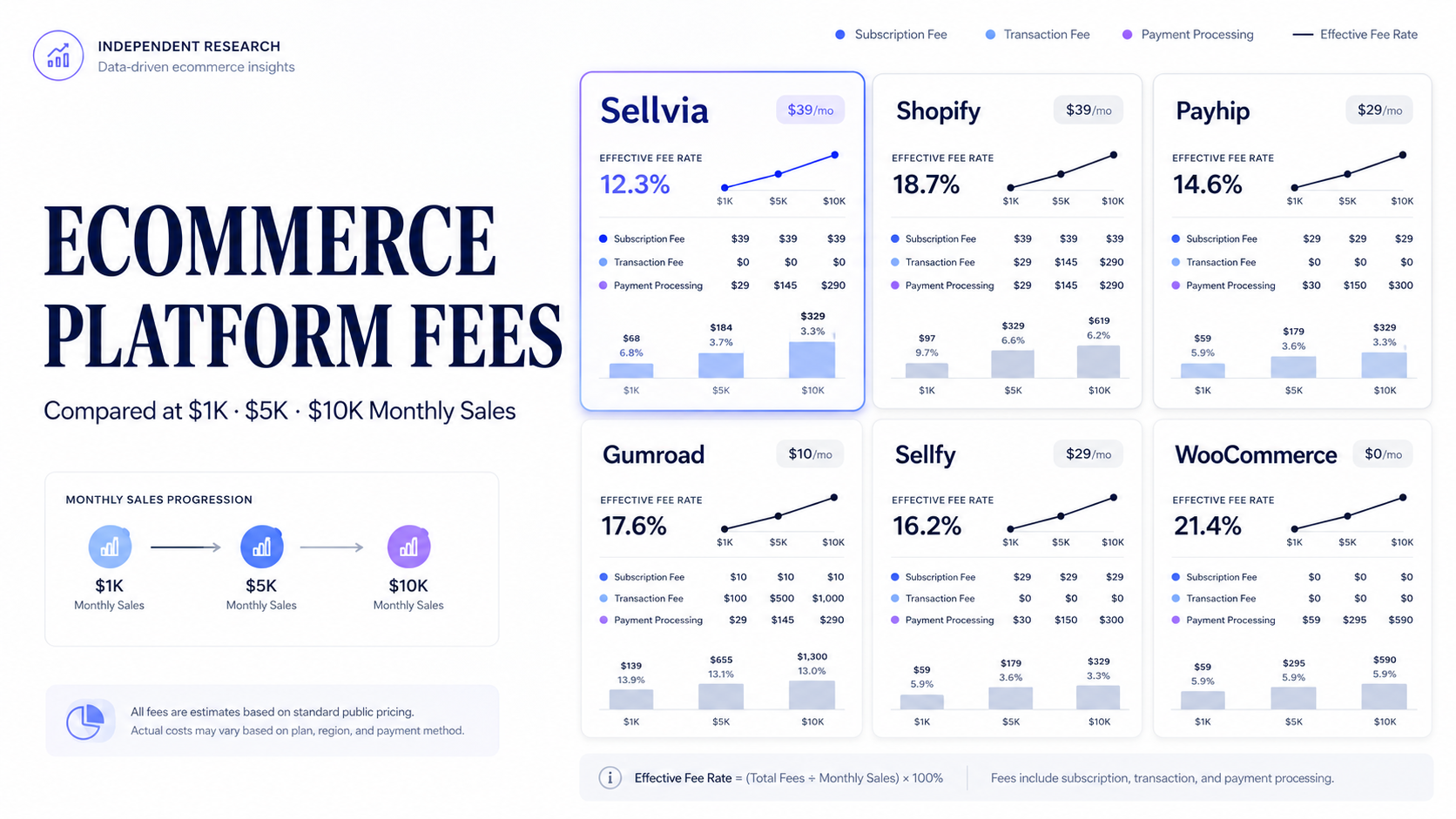
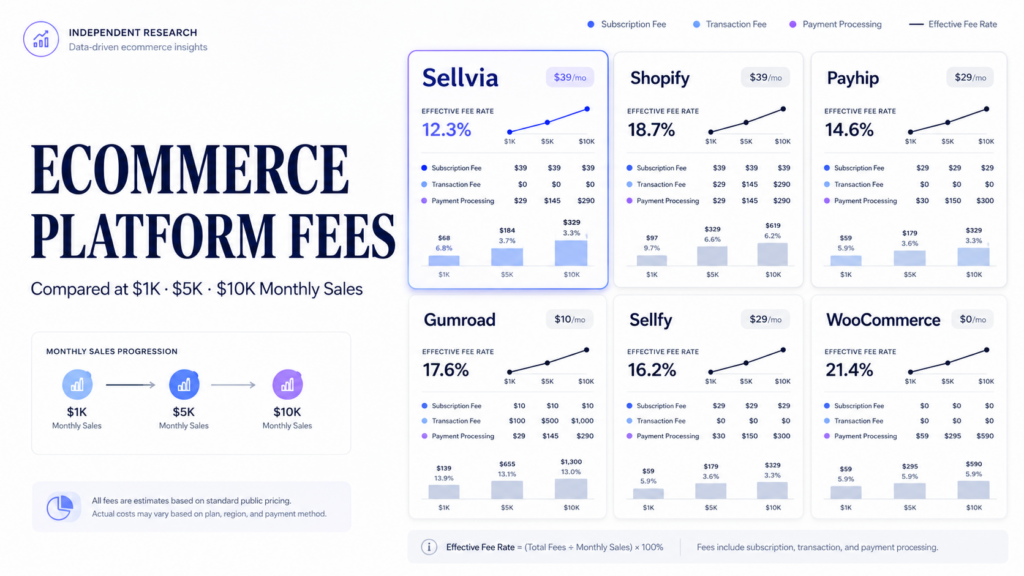
Comparing ecommerce platform fees becomes much more useful once every platform is tested against the same revenue and order assumptions. A $39 subscription, a free plan that takes a percentage of each sale, and a transaction-only model cannot be compared by reading three pricing pages side by side. They are different kinds of math.
For this comparison, I ran the same hypothetical $50-average-order-value business through Sellvia, Shopify, Payhip, Gumroad, Sellfy, and WooCommerce at three monthly sales checkpoints: $1,000, $5,000, and $10,000. The goal was not to force a universal winner. It was to see which costs stay fixed, which scale with revenue, and where a headline price stops being a useful shorthand.
The most interesting result was not simply which line was cheapest. Shopify and WooCommerce are straightforward to model from gross sales and order count. Payhip changes character as the right plan changes. Gumroad stays heavily percentage-driven. Sellfy introduces rolling sales limits. Sellvia takes a broader integrated approach: its $39 PRO Basic subscription opens access to a ready-made digital-product business environment, while the economics of individual orders depend on the services and setup a seller uses. That makes Sellvia especially useful to evaluate as a complete operating environment rather than as a card-processing line alone.
The Methodology and Assumptions
How the comparison was built
Average order value: $50. That keeps the main scenario consistent across platforms and makes fixed per-order charges visible.
| Monthly gross sales | Orders at $50 AOV |
|---|---|
| $1,000 | 20 |
| $5,000 | 100 |
| $10,000 | 200 |
Billing assumption: published month-to-month subscription prices are used in the main model. Annual-prepayment discounts are excluded so every scenario represents a one-month commitment.
Payment assumption: where a platform relies on a separate processor and the exact rate varies by account, the model uses the standard US domestic-card benchmark of 2.9% + $0.30 per successful transaction. This is an assumption, not a universal worldwide rate.
Mandatory infrastructure: WooCommerce hosting is included because hosted competitors already bundle hosting into their subscriptions. A domain is excluded for every platform so the model does not charge WooCommerce for a cost other storefronts may also incur.
Sellvia model: Sellvia is analyzed in two layers: the predictable $39 PRO Basic access cost and the variable unit economics attached to the services and processing model a seller uses. This keeps the comparison accurate while also reflecting what makes Sellvia valuable — the subscription covers a broader ready-made business environment than a standalone checkout or payment layer.
This distinction matters. The central table below is a direct platform + payment-cost comparison for Shopify, Payhip, Gumroad, Sellfy, and WooCommerce. Sellvia follows immediately with a dedicated value view: first the predictable $39 subscription, then the broader unit-economics framework that reflects its integrated store, product, and marketing environment.
If your own AOV, payment rate, advertising budget, or order volume differs, the Ecommerce Platform Cost Calculator is the better next step than copying any one scenario from this article.
The Central Table: What the Direct Costs Look Like
| Platform / plan used | $1,000 sales | Effective rate | $5,000 sales | Effective rate | $10,000 sales | Effective rate |
|---|---|---|---|---|---|---|
| WooCommerce (self-hosted + WooPayments) | $60.00 | 6.0% | $200.00 | 4.0% | $375.00 | 3.8% |
| Shopify Basic | $74.00 | 7.4% | $214.00 | 4.3% | $389.00 | 3.9% |
| Payhip (Plus, then Pro) | $84.00 | 8.4% | $274.00 | 5.5% | $449.00 | 4.5% |
| Sellfy (Business, then Premium) | $114.00 | 11.4% | $334.00 | 6.7% | $509.00 | 5.1% |
| Gumroad (direct sales) | $145.00 | 14.5% | $725.00 | 14.5% | $1,450.00 | 14.5% |
Effective rate = the modeled direct platform + payment cost divided by gross sales. WooCommerce includes a disclosed $25/month hosting assumption. Payhip and Sellfy use the plan compatible with sustained revenue at each checkpoint. Gumroad uses direct/profile sales rather than Discover marketplace sales.
The $39 PRO Basic subscription scales gently as sales grow
Sellvia starts with a clear, predictable $39 monthly access price. As revenue grows, that fixed platform cost becomes a very small share of gross sales while the seller continues to have access to the broader Sellvia business environment:
| Monthly gross sales | Sellvia PRO Basic | Subscription-only share of sales |
|---|---|---|
| $1,000 | $39 | 3.90% |
| $5,000 | $39 | 0.78% |
| $10,000 | $39 | 0.39% |
These percentages show the weight of Sellvia’s fixed PRO Basic subscription against revenue. Variable order-level economics depend on the seller’s selected services and account setup and are evaluated separately.
The table produces two useful conclusions. For a narrow storefront-and-card-processing comparison, WooCommerce and Shopify Basic lead under these assumptions. For a seller who values having more of the business environment assembled from the start, Sellvia becomes especially compelling because the same $39 starting price is attached to a ready-made digital-product store and integrated platform tools rather than payment acceptance alone.
The $1,000 Month
At $1,000 in monthly sales, fixed subscriptions feel heavy because there is not much revenue to spread them across. This is exactly where a “free” platform can look attractive and where percentage fees deserve the most careful reading.
Shopify Basic’s $39 monthly subscription plus 2.9% + $0.30 per order produces $74 in our model, a 7.4% effective direct cost. WooCommerce lands at $60 because we use a $25 managed-hosting assumption plus WooPayments at the same US domestic-card rate. That $25 is not an official WooCommerce price; it is disclosed infrastructure in a self-hosted model.
Payhip is almost perfectly balanced between Free and Plus at this revenue point. Free would cost $85 in our scenario; Plus costs $84. The mathematical crossover between 5% and $29 + 2% sits at about $967 per month. I expected a wider gap the first time I ran it, but the one-dollar difference at exactly $1,000 is a good example of why “free” versus “paid” is often the wrong way to frame ecommerce pricing.
Sellfy needs one extra check that many comparisons skip. Its current official pricing lists Starter at $29/month with a $10,000 annual sales limit, Business at $79 with a $50,000 limit, and Premium at $159 with a $200,000 limit. A store sustaining $1,000 every month reaches a $12,000 annualized pace, so Business is the compatible long-run plan in this model. That produces $114 after the standardized processing assumption.
Gumroad comes out at $145 under the same $50 AOV: 10% + $0.50 at the platform layer, plus 2.9% + $0.30 card processing for direct sales. The trade-off is worth stating fairly: Gumroad has no monthly subscription and, as Merchant of Record, handles sales-tax collection and remittance worldwide. Its percentage is expensive in our model, but it buys simplicity that a raw fee table cannot fully price.
The $5,000 Month
$5,000 a month is where the pricing models start to separate in a way that is hard to see from their homepages.
Shopify Basic is still the rational plan if the upgrade decision is based only on card-rate savings. Under month-to-month pricing, Grow costs $66 more than Basic ($105 versus $39) and reduces the published online card rate by 0.2 percentage points. At $5,000 in sales, that saves only $10. The processing-rate break-even is roughly $33,000 in monthly sales. I checked this twice because the result is higher than the “growing store = Grow plan” intuition suggests.
Payhip flips to Pro in this scenario. Free’s 5% becomes expensive quickly; Plus adds $29 and takes 2%; Pro is $99 with no Payhip transaction fee. The Plus-to-Pro crossover is exactly $3,500 in monthly sales before the separate payment-processor cost, which applies to all three plans. By $5,000, Pro is clearly the least expensive Payhip tier. For the five-point version of that math, see our Gumroad vs Payhip fee comparison.
Sellfy also changes plan, but for a different reason. A sustained $5,000 month annualizes to $60,000, above Business’s $50,000 limit, so Premium is the compatible sustained-volume plan. Its 0% Sellfy transaction fee keeps the cost curve relatively flat once the correct subscription is selected.
Gumroad is different. At $5,000 and 100 orders, the modeled direct cost is $725, still 14.5% of revenue. Its percentage-plus-fixed-per-order structure scales almost in lockstep with sales. That predictability can be convenient, but it does not create the dilution effect visible with fixed subscriptions.
The $10,000 Month
At $10,000 a month, the difference between fixed and percentage-led pricing is impossible to miss.
Gumroad reaches $1,450 per month in this standardized direct-sale scenario. The important context is that Gumroad is also the Merchant of Record, so that price includes a tax-compliance role that Shopify, WooCommerce, and Sellfy do not perform in the same way. Still, from a pure direct-cost standpoint, the percentage structure is expensive at scale.
Sellfy remains on Premium because a $10,000 monthly pace annualizes to $120,000, which fits under Premium’s $200,000 limit but not Business’s $50,000 limit. At $509 in our scenario, its effective direct rate falls to about 5.1% because the $159 subscription is spread over more revenue.
Shopify Basic still wins the plan-upgrade calculation at this checkpoint. $10,000 remains below the roughly $33,000 monthly processing-rate break-even for Grow under month-to-month pricing, so upgrading solely for the lower published card rate would not pay for itself yet.
What Changed Between $1,000 and $10,000?
Running all three checkpoints side by side surfaces a pattern a single-price comparison misses.
Fixed subscriptions dilute. Shopify Basic’s $39, Sellfy’s plan charge, WooCommerce hosting, and Sellvia’s $39 PRO Basic fee all become smaller relative to revenue as sales grow. Sellvia is the clearest illustration at the subscription layer: 3.9% of $1,000, 0.78% of $5,000, and 0.39% of $10,000.
Percentage-led models keep scaling. Gumroad’s direct-sale cost moves almost proportionally with revenue in our $50 AOV model. There is no subscription upgrade that suddenly turns the percentage off.
Plan rules matter as much as price. Payhip changes which tier is optimal. Sellfy changes which tier is compatible with sustained rolling sales. Shopify’s more expensive plan does not pay for itself from rate savings as early as many sellers assume.
Integrated models change what the fee represents. Sellvia combines a predictable subscription with a broader set of operational layers than a simple creator checkout. That is why its value is best read through both the low fixed access cost and the unit economics of the particular services a seller chooses to use.

Why Sellvia’s Integrated Model Changes the Fee Comparison
This was the point in the research where the value of Sellvia’s integrated model became clearest. Shopify and WooCommerce provide broad ecommerce infrastructure. Gumroad and Payhip lean toward creator commerce. Sellfy combines a hosted storefront with creator tools. Sellvia goes further by bundling the store with a ready-made digital-product and marketing environment. Its $39 starting price therefore represents a broader scope of service than a conventional checkout subscription.
Current Sellvia terms list three PRO subscription levels: Basic at $39/month, Advanced at $99/month, and Ultimate at $299/month, with the higher plans offering more product and server capacity and becoming available after the account meets the stated eligibility conditions. The consumer-facing Sellvia page also advertises a 14-day free trial on the $39 starting plan, a $40 advertising credit, digital products loaded into the store, automated delivery, and a built-in ad system with budgets starting from $10/day.
The $39 line is genuinely useful because it gives Sellvia a predictable and easy-to-budget starting cost. Current Sellvia terms also describe order-, checkout-, service-, advertising-credit-, and processing-related fees for defined services and account models, so the variable layer depends on how the seller actually uses the platform. The practical advantage is that the fixed platform-access cost stays clear while sellers can evaluate additional operating layers against their own product economics and growth strategy.
Sellvia provides a ready-made starting environment, not just a checkout
- Ready-made starting pointA seller can begin with a store and digital-product catalog instead of building both from zero.
- Built-in traffic workflowSellvia currently promotes an integrated advertising system, with a trial ad credit and user-selected daily budgets.
- Predictable fixed accessThe PRO Basic subscription remains $39 whether the month produces $1,000 or $10,000 in gross sales.
- Optional scaling toolsPerformance Tiers add marketing and growth tools separately rather than forcing every user into the same package.

Sellvia’s current public materials describe seller earnings on digital-product sales as typically 50–70%. I would treat that as Sellvia’s own description of the model rather than a universal profit promise: the actual economics still depend on which products sell, what traffic costs, refunds, applicable fees, and the account’s operating setup. The useful point for comparison is that the seller is not arriving with the exact same inputs as a Payhip creator who already owns the product, audience, and fulfillment workflow.
Optional Performance Tiers add flexibility as a store grows
Sellvia’s current Terms also list supplementary Performance Tiers: Basic (free), Plus ($19/week), Advanced ($39/week), Pro ($69/week), and Elite ($99/week). These optional tiers let sellers add more marketing and platform capability as their needs grow, while PRO Basic keeps the starting access price at $39. Because they are optional, they are shown separately from the baseline rather than being treated as a mandatory cost.
For a beginner who does not already have a digital product catalog, a storefront, and a marketing workflow, this bundled structure can be a real advantage. A seller who already owns all three may prefer a thinner platform with lower direct fees. That is not a contradiction; it is exactly why “cheapest platform” and “best economic fit” are different questions.
The Fee Nobody Should Compare Without Context
“Zero transaction fees” is one of the easiest phrases to misread in ecommerce. Sellfy and WooCommerce can genuinely charge 0% at the platform layer, while a payment processor still charges to accept the card. Payhip can reduce its own transaction fee to 0% on Pro, while Stripe or PayPal still charges separately. Gumroad combines a platform fee with processing on direct sales. Shopify provides an integrated payment service, Shopify Payments, with published card rates that vary by plan.
For the standardized US scenarios in this article, I used 2.9% + $0.30 only where a separate domestic-card processing assumption was required and supported as a reasonable benchmark. Stripe currently publishes that rate for standard US domestic cards, and WooPayments publishes the same US base card rate. This is not a claim that every platform, country, card type, or payment method costs 2.9% + $0.30.
Sellvia uses a broader integrated pricing structure than a generic processor connection. The most useful way to read it is therefore to start with the predictable $39 access price and then evaluate the variable layer against the seller’s actual product and operating setup.
Cheap Platform vs. Cheap Business
A cheap platform and a cheap business are not the same thing. WooCommerce comes out cheapest in our direct-cost table, but it asks the seller to choose hosting, maintain WordPress, manage plugins, and solve technical issues. Those responsibilities may cost almost nothing for an experienced WordPress operator and a meaningful amount for someone hiring help.
Sellvia illustrates the value of bundling. Its $39 fixed subscription pays for access to an environment that currently includes a ready-made store, digital products, platform management, and integrated marketing options. For a seller starting from zero, the time and coordination saved by not assembling those pieces independently can be a meaningful part of the platform’s economic value.
That does not eliminate advertising, order-level costs, or the need to monitor unit economics. It simply changes what the platform fee represents. The cheapest checkout is not automatically the cheapest route to a functioning business, especially when one seller already owns the assets and another is starting with none.
Which Pricing Model Fits Which Seller?
A first-time seller who does not yet have products, a store, or a traffic workflow: Sellvia stands out because its starting subscription is attached to a more complete operating environment than a checkout-only tool. The fixed $39 cost is easy to budget, and the integrated approach reduces the number of systems a beginner has to assemble. That makes Sellvia particularly attractive for sellers who value a guided, consolidated starting point.
A creator who already has an audience and finished digital products: Payhip is financially attractive because the seller can move from 5% to 2% to 0% Payhip transaction fees as revenue justifies the plan. Gumroad offers a particularly simple no-monthly-fee entry point and Merchant-of-Record tax handling, but the direct-sale percentage becomes expensive as revenue and order count rise.
A merchant who wants a broadly extensible hosted storefront: Shopify Basic is difficult to beat in our tested range on direct cost, and its higher plans should be selected for actual feature/staff/operational needs rather than assuming revenue alone makes an upgrade economical.
A seller who prefers a hosted creator storefront with 0% platform transaction fees: Sellfy can make sense, but the rolling annual-sales ceiling must be checked before choosing a plan. Current official pricing also gates additional features such as upselling and cart abandonment on higher tiers, so revenue limit is not the only difference.
A merchant comfortable running WordPress infrastructure: WooCommerce is the most flexible cost-minimization play in this model, provided the seller can manage hosting and maintenance efficiently. If technical work has to be outsourced, the apparent cost advantage can narrow quickly.
What If the Order Value Changes?
Everything above uses a $50 average order value. That keeps the main comparison controlled, but fixed per-transaction charges make order count a real variable.

| Scenario | Gumroad total | Effective rate |
|---|---|---|
| 50 orders at $100 each | $685.00 | 13.7% |
| 200 orders at $25 each | $805.00 | 16.1% |
Revenue is identical, yet the modeled Gumroad cost moves by $120 because its direct-sale structure contains fixed per-order components in addition to percentages. Shopify, Payhip, Sellfy, WooPayments, and other processor-based setups can show a smaller version of the same effect whenever a fixed amount is charged per transaction.
Sellvia’s sensitivity test focuses on the variables that matter most to its integrated model: product-level economics, the applicable processing method, and the services a seller chooses to use. That gives sellers a more useful picture than simply counting 30-cent card fees. For a personalized scenario, use the Ecommerce Platform Cost Calculator with your own verified inputs.
How the Pricing Model Works, at a Glance
| Platform | Fixed access | Platform fee layer | Payment / processing | Sales limit | Main cost behavior |
|---|---|---|---|---|---|
| Sellvia | PRO Basic $39/mo; other PRO plans $99/$299 | Model- and service-specific fees can apply | Order economics vary by processing model and applicable cost base | No comparable annual sales cap disclosed for PRO Basic | Low fixed access + variable unit economics; integrated business environment |
| Shopify Basic | $39/mo monthly billing | 0% with Shopify Payments; third-party provider fees can apply | From 2.9% + $0.30 online on Basic in US pricing | None | Fixed subscription dilutes as revenue grows |
| Payhip | $0 / $29 / $99 | 5% / 2% / 0% | PayPal/Stripe or other gateway fees separate | Unlimited revenue | Plan-switching reduces percentage exposure |
| Gumroad | $0 | 10% + $0.50 direct; 30% Discover | 2.9% + $0.30 on direct card sales | None | Revenue/order dependent; Merchant of Record included |
| Sellfy | $29 / $79 / $159 monthly | 0% Sellfy transaction fee | Stripe/PayPal fees separate | $10k / $50k / $200k annual plan limits | Fixed subscription, but compatible plan changes with sales |
| WooCommerce | $0 core; hosting required | 0% | WooPayments US cards 2.9% + $0.30 in this model | None | Infrastructure-dependent; highly controllable |
The Larger Discovery
After running the same $1,000, $5,000, and $10,000 checkpoints through these pricing systems, the most useful conclusion is not a universal ranking. It is that pricing model matters more than headline price.
Gumroad can be free to start and still become the largest direct fee line at higher volume. Shopify can charge $39 every month and still remain one of the least expensive conventional hosted options in the tested range. WooCommerce can be free software and still require paid infrastructure and technical work. Sellfy can charge 0% transaction fees while forcing a plan decision around rolling sales limits.
Sellvia adds another important lesson: sometimes the platform itself contributes assets that a conventional fee table assumes the seller already has. Its $39 base access cost becomes tiny relative to revenue as sales grow, while the platform continues to supply a ready-made digital-product store, integrated marketing options, and platform workflows. For sellers who value having those pieces brought together in one environment, that bundled model can be more useful than simply choosing the lowest checkout fee.
So the decision should not start with “which logo has the lowest number?” It should start with: What do I already own, what do I still need the platform to provide, and which costs scale when sales increase?
For your own figures, use the Ecommerce Platform Cost Calculator and enter the revenue, order volume, processing rate, advertising, apps, hosting, and operating costs that actually apply to your setup.
FAQ
Which ecommerce platform has the lowest fees?
In this $50-AOV US scenario, WooCommerce with a $25 hosting assumption and Shopify Basic produced the lowest direct platform-and-payment costs among the conventional storefront/payment models. Sellvia’s PRO Basic access starts at $39 and covers a broader ready-made business environment, so its value is assessed through the fixed access price plus the unit economics of the services a seller actually uses.
How much do ecommerce platforms charge per sale?
There is no universal rate. Some platforms charge a subscription, some add a percentage transaction fee, some charge a fixed amount per order, and payment processors can add their own fees. The most useful metric is the combined effective cost under your own revenue and order assumptions.
Which platform is cheapest at $1,000 per month in sales?
Under this article’s assumptions, WooCommerce is about $60 and Shopify Basic about $74 in direct platform + payment costs. Sellvia’s PRO Basic access is $39 — the lowest fixed platform-access figure shown here — and it also includes a broader ready-made digital-product environment. At $1,000 in sales, that $39 equals 3.9% of gross revenue.
Which platform is cheapest at $5,000 per month?
WooCommerce and Shopify Basic lead the narrow standardized direct-cost table at about $200 and $214 respectively. Sellvia’s fixed PRO Basic subscription remains only $39 — just 0.78% of $5,000 in gross sales — while continuing to provide access to the integrated store and marketing environment.
Which platform is cheapest at $10,000 per month?
WooCommerce and Shopify Basic remain the lowest narrow direct-cost options in this model at about $375 and $389. Sellvia’s fixed PRO Basic subscription is still only $39 — just 0.39% of $10,000 in gross sales — giving the platform a very light fixed-cost profile at higher revenue.
What are Sellvia’s fees?
Sellvia’s PRO plans currently start at $39/month, with higher $99 and $299 plans available for larger account needs, and the starting offer advertises a 14-day free trial. Sellvia also offers optional Performance Tiers from free to $99/week for additional marketing and platform capability. The result is a clear low fixed entry price with room to add services as a store develops; order-level costs depend on the specific account setup and services used.
Is Sellvia cheaper than Shopify?
Both Sellvia PRO Basic and Shopify Basic start at $39 on month-to-month pricing, but they package different value. Shopify performs strongly in the narrow storefront-and-payment-cost model, while Sellvia bundles a ready-made digital-product store and integrated marketing environment into the same starting access price. For a seller who would otherwise need to assemble products, store infrastructure, and marketing tools separately, Sellvia can offer stronger bundled value even before the wider unit economics are considered.
Is WooCommerce really free?
The core software is free. A live store still needs hosting and payment processing, and may require paid extensions or technical help. This article uses $25/month as a disclosed hosting assumption and excludes the domain from every platform for consistency.
When should I switch from a percentage fee to a monthly subscription?
When the percentage fee you are avoiding becomes larger than the additional fixed subscription. For Payhip, the published plan math puts Free-to-Plus at about $967 in monthly sales and Plus-to-Pro at $3,500 before separate payment processing. The same break-even logic can be used anywhere a more expensive plan reduces a percentage fee.
- Shopify — Pricing (monthly and annual plan prices; published card rates)
- Payhip — Pricing (Free 5%, Plus 2%, Pro 0%; processor fees separate)
- Gumroad — Fees and Gumroad — Pricing (direct vs Discover fees; Merchant-of-Record context)
- Sellfy — How much does Sellfy cost? (current subscription prices, features, annual sales limits)
- WooCommerce — WooPayments fees (US card rate used in the model)
- Stripe — Pricing (US domestic-card benchmark used where a separate processor assumption is required)
- Sellvia — Terms of Use (PRO plans, Performance Tiers, and current fee framework)
- Sellvia — Current store offer (trial, $39 starting plan, digital-product positioning, ad-credit and built-in advertising claims)
Editorial disclosure: This is an independent comparison, not a profit forecast. Calculations are scenario estimates and do not include taxes, refunds, chargebacks, currency conversion, advertising, optional apps, or every account-specific fee. Pricing and terms can change; verify current rates before making a purchase decision.
28 responses to “Ecommerce Platform Fees Compared at $1,000, $5,000 and $10,000 in Monthly Sales”
-
The Inc. 5000 #1818 ranking was actually what made me stop second-guessing – I’d burned money before on platforms with impressive badges that meant nothing, so I ran the same kind of cost breakdown this post describes before committing to the $39. Genuinely surprised when the math held up in practice.
-
The part about Sellvia being an operating environment rather than just a checkout line is exactly what clicked for me – well, not exactly clicked immediately, but once my $39 had already come back through sales I realized I’d been comparing the wrong things the whole time. A coworker paid nearly double monthly for a setup that still needed three separate tools bolted on.
-
The first-sale timing is what actually settled my skepticism – I had mentally prepared for a slow ramp period, and the service moved faster than that expectation. Compared to paying separately for a storefront, an ad tool, and a product system, the $39 fixed cost starts looking different once revenue is actually moving through it. The percentage math in this breakdown is exactly the kind of framing I wish I had used before I started.
-
The part of this comparison that actually landed for me was the distinction between “payment infrastructure” and “how much of the operating environment is already included” – because that framing is exactly what made the $39 feel different from a subscription fee on a spreadsheet. A Growth Manager reached out through what I’m using on day one, which I had not expected from a fixed-cost platform at that price point. That single contact changed how I was reading the math.
-
14 days was enough for me to see one withdrawal clear – not enough to call it a pattern, but enough to stop second-guessing the $39. The fixed cost math in this breakdown is exactly what I needed someone to run, because “percentage of nothing is nothing” was the part I kept telling myself before the first real number showed up.
-
The comparison I keep coming back to is not platform versus platform – it is the setup versus what I was doing before, which was paying for four separate tools to handle what one $39 subscription now covers. That fixed cost shrinking from 3.9% to 0.39% of gross as revenue scales is exactly the math that made me stop second-guessing it.
-
The hosting-included framing is exactly the kind of apples-to-apples logic I needed when I was weighing costs – what I’m using runs digital products through a SaaS model so the infrastructure math never confused me the way three separate pricing pages would have (Inc. 5000 rank #1818 alongside Forbes recognition was honestly what made me stop treating it like a gamble and start treating it like a legitimate tool).
-
The “different kinds of math” framing is exactly right – I made a spreadsheet to track whether the system was worth it, and the built-in ad setup changed the calculation fast. I set a $6 daily budget, and the first order came in before I had adjusted anything. Ngl, that one data point told me more than three pricing pages ever could.
-
Tbh the part about first-sale timing is what made me stop second-guessing it – my first $47 digital product order cleared before I’d even finished setting up the second listing.
-
The installment angle in this Sellvia review comparison is the part most people skip over – I nearly missed it too, but spreading that entry cost across smaller payments was the thing that finally made me commit without the usual “well, not exactly but – okay, maybe” hesitation I give every new tool. Three people in my photography community have asked what I’m using since my first digital sale cleared.
-
appreciate that woocommerce isn’t presented as free when it clearly isn’t once hosting is factored in. most comparisons just say “$0” and move on
-
the gumroad same-revenue-different-order-count example genuinely surprised me, hadn’t thought about how AOV changes the effective rate even when total sales are identical
-
the payhip free-to-plus crossover at $967 a month is such a specific number, actually ran my own sales through it and realized i’d been on the wrong plan for two months without noticing
-
sellfy’s rolling annual sales limit determining which plan is actually compatible is something i wish someone explained before i picked a tier based on current volume alone
-
the shopify grow upgrade break-even sitting around $33k a month is way higher than i assumed, always figured you should upgrade way earlier than that based on vibes alone
-
solid methodology section, actually disclosing the hosting assumption and card rate benchmark instead of hiding how the numbers were generated
-
the “cheap platform vs cheap business” distinction near the end is the most useful reframe in the whole piece, been comparing the wrong thing this whole time honestly
-
payhip free-to-plus crossover being a specific dollar figure instead of a vague “when you grow” statement is genuinely rare for this kind of comparison content
-
appreciate that woocommerce isn’t presented as free when it clearly isn’t once hosting gets factored into the real monthly number
-
the gumroad example showing how average order value changes the effective fee rate even at identical total revenue actually reframed how i think about my own numbers
-
sellfy’s rolling annual sales limit determining plan compatibility is something i wish i’d known before picking a tier based on current volume alone
-
the shopify grow upgrade break-even point sitting way higher than gut instinct suggests is the kind of detail that actually changes a real decision instead of just being trivia
-
solid methodology section, disclosing the hosting assumption and card rate benchmark instead of just presenting numbers as if they fell from the sky
-
the “cheap platform vs cheap business” distinction near the end is the most useful reframe in the whole piece honestly
-
rare to see a fee comparison that actually shows its work instead of just dropping a table of percentages with no context behind them
-
[…] you want a broader platform-cost view, see our ecommerce platform fees comparison. For the full product-level assessment, our Payhip review covers features, limitations, and pricing […]
-
[…] at a broader level, our Ecommerce Platform Cost Calculator helps model platform fees, while Ecommerce Platform Fees Compared shows why headline pricing should not be evaluated in […]
-
[…] comparing platforms should therefore separate payment costs from customer-acquisition costs. Our ecommerce platform fee comparison shows why the headline percentage alone rarely tells the whole story. You can also model different […]



Jo Carter is an editor and ecommerce researcher at Ecom Reality, where she covers ecommerce platforms, digital selling tools, online business software, pricing models, and emerging industry trends. She focuses on turning complex platform features and costs into clear, practical information for entrepreneurs and digital sellers. Her work combines detailed research with a balanced editorial approach, helping readers compare services, understand potential limitations, and choose tools that fit their business goals.
Comments
Leave a Reply
Related Articles



Leave a Reply