

Vida Markets Review: Copy Trading, PAMM Accounts and Legal Entities
Vida Markets is not just selling access to a trading terminal. Its wider proposition includes MetaTrader trading, strategy copying and pooled allocation through PAMM-style accounts. That combination is interesting because it serves three different audiences: the person executing trades independently, the investor following a strategy and the manager operating an allocation program. Those users can encounter very different risks even when they enter through the same website. In this Vida Markets review, the emphasis is on the mechanics behind those services rather than on screenshots of recent winners. The decisive questions are who controls positions, how fees are calculated, which company serves the account and how an investor can exit a strategy when markets move against it.
The broker’s website describes market access across forex, indices, commodities and other CFDs. It also publishes terms for trade copying and PAMM arrangements, which provide much more useful detail than simple claims that users can follow successful traders. Those documents show why automated execution should never be confused with guaranteed portfolio management. They also make one important distinction clear: the group contains an entity regulated for financial services in South Africa and an Anguilla company that the website explicitly describes as providing non-regulated services. A client should identify the contracting entity before deciding which protection statements are relevant.
The proposition in one minute
Vida Markets brings together ordinary CFD accounts and two ways to delegate trade decisions. In copy trading, an investor chooses a strategy and authorizes the platform to replicate eligible trades. In PAMM, one manager executes within a managed arrangement while investor results are allocated according to the applicable agreement. Both reduce the burden of selecting individual trades, but neither removes exposure to leverage, market gaps, execution costs or the manager’s judgment. The strongest use case is a trader who understands those risks and wants a clear operating system for supervising several strategies. The weakest use case is someone expecting a performance chart to substitute for due diligence.
A broad marketing description can obscure the differences. A follower might be able to change allocations or stop copying, yet still bear the cost of closing positions at current market prices. A PAMM participant may have less direct control over trade timing and may face scheduled withdrawal windows. A manager, meanwhile, faces the practical challenge of fair allocation, reporting and fee calculation. For a meaningful comparison, users should evaluate the decision rights and account documentation of each service separately. There is no single universal answer to whether Vida Markets is a good choice for every type of investor.
The difference between copy trading and PAMM
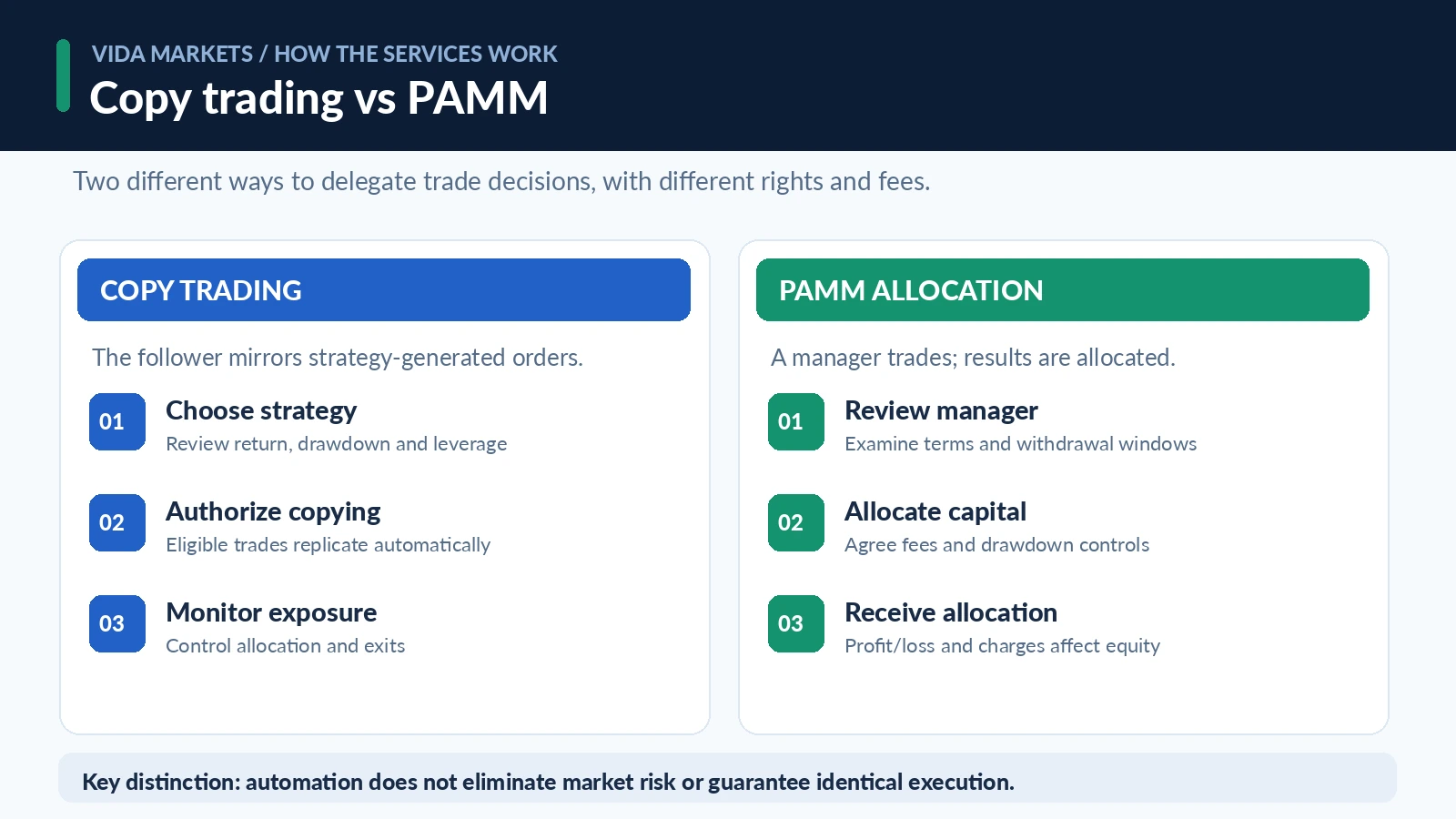
Copy trading is easiest to visualize as a rule linking one account to another strategy. When the provider enters an eligible position, the platform attempts to create a corresponding trade for the follower. Position sizes can differ because account balances, chosen allocations, market conditions and margin availability differ. The copy provider does not need to transfer a client’s money into a personal account to send trading signals, but the follower is still accepting decisions generated by someone else. The website highlights strategy analytics and automatic position synchronization. Those conveniences matter, yet the signed copy-trading agreement should determine the limits of actual execution.
PAMM, or percentage allocation management module, serves a different operating model. The manager takes the central investment decisions; a platform allocates results across participating accounts according to the arrangement. Vida Markets’ PAMM page describes central management, investor monitoring and automatic profit distribution. Its agreement also states how investor equity is adjusted for deposits, withdrawals, profit or loss and fees. In practical terms, this means a PAMM participant needs to understand both the trading method and the commercial relationship with the manager. A low advertised spread is not the same thing as a low total cost once management or performance charges enter the equation.
A useful test is to ask who gets to press the close button. In a self-directed account, that is principally the trader. In copy trading, the follower can influence participation settings, but entries arise from the chosen strategy. In PAMM, the manager controls the core trade decisions and the participant’s withdrawal rights may be subject to defined windows. A service can be operationally convenient while offering less immediate control than users assume. That trade-off belongs near the top of any serious comparison, not buried in a footnote.
What the copy-trading agreement actually changes
Vida Markets’ published trade-copying terms include language authorizing trades generated by copied strategies without new confirmation for each order. That is central to the product. If a user had to approve every trade manually, the system would no longer replicate the provider’s timing. But it also means a poorly timed strategy can open exposure while the investor is doing something else. The agreement discusses technical disruption, inaccurate data feeds and orders that fail to reproduce a model portfolio exactly. Those are not unusual theoretical possibilities: they are operational risks of any automated execution chain.
The documentation describes monitoring strategy performance through factors including return, risk and maximum drawdown. Maximum drawdown is especially important because it illustrates the gap between a favorable final return and the losses suffered along the way. Imagine a strategy rising from $10,000 to $12,000, falling to $7,500 and eventually finishing at $11,000. A casual glance sees a positive ending; the investor who experienced the decline endured a $4,500 peak-to-trough fall, or 37.5% from the peak. Traders should examine that path rather than focusing on the final percentage alone. Historical charts cannot forecast the exact next drawdown.
The agreement also explains that the firm may execute block trades when several investors copy the same strategy and may close open positions when a strategy is removed. That introduces execution timing considerations beyond the provider’s decisions. A good evaluation should include what happens when liquidity is thin, an order slips, an instrument becomes unavailable or a strategy terminates unexpectedly. The marketing phrase ‘copy automatically’ describes the instruction flow; it does not guarantee identical entry prices or identical portfolio outcomes for every follower.
How a PAMM performance fee affects net results
The published PAMM agreement identifies deposit, withdrawal, management and performance fees as potential deductions in investor equity. Its performance-fee formula is based on trading profit minus trading loss, multiplied by a success-fee percentage. Importantly, the document describes a high-water-mark principle: negative results can be carried forward so that a manager does not simply charge for recovering a previous loss. This provides a recognizable framework for evaluating performance fees, but it does not specify that every individual account has the same manager fee or identical investment conditions. The offer associated with the particular strategy remains crucial.
Consider a purely illustrative account starting at $10,000 with no deposits or withdrawals. If the manager’s strategy earns $1,500 during a chargeable interval and the agreed success fee is 20%, the performance fee is $300, leaving $1,200 before any other applicable costs. If the strategy loses $1,000 in a later interval, the account is not suddenly profitable because a website presents a lifetime return. The manager would typically have to recover that loss before further success fees could arise under the stated high-water-mark mechanism. The exact calculation period and the agreement’s definitions are more important than a catchy advertised return.
The PAMM agreement also references investor-set close-out loss levels. That sounds helpful, but a stop or drawdown limit is not a guarantee of an exact exit price. During rollover or sudden price jumps, loss can exceed the specified level. An investor might assume ‘I set 20%’ means ‘I cannot lose more than 20%’. That is the wrong interpretation. It is a rule for initiating action, subject to market execution and instrument behavior. If a strategy holds leveraged CFDs through illiquid periods, the gap between the requested threshold and realized result can be material.
Legal entities: the distinction that cannot be skipped
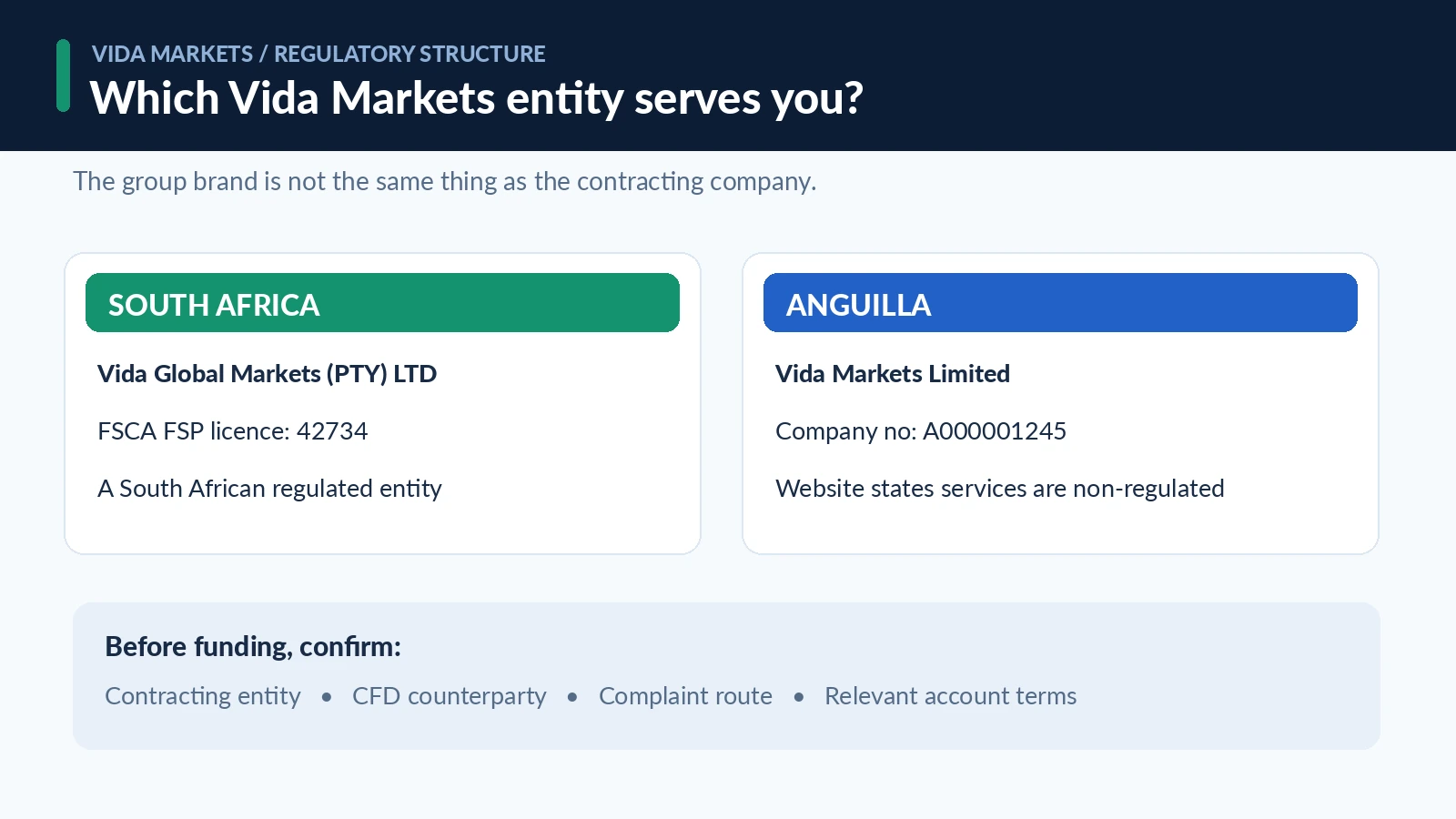
The Vida Markets website identifies Vida Global Markets (PTY) LTD as a South African financial services provider associated with FSCA license 42734. The same site also identifies Vida Markets Limited, incorporated in Anguilla under company number A000001245, and says that services on the website are non-regulated and provided by that company. Another group company is listed as a St Vincent and the Grenadines LLC. These names should not be collapsed into one vague sentence about ‘global regulation’. They are distinct legal references with potentially distinct obligations and routes for complaints.
The distinction matters because a reader seeing an FSCA license might conclude that every account comes under the same supervisory regime. That would be an unsafe assumption. Check the exact legal name on the proposed client agreement, not only the logo on the landing page. Ask which entity handles the account, which entity is counterparty to CFDs, which company offers the copying or managed service and where disputes must be submitted. If these answers appear on different documents, request a written explanation before funding. The legal analysis is especially important for an allocation account, where an investor delegates trade selection and may also pay manager fees.
It is equally important not to overstate what a license means. A regulated corporate entity is a meaningful fact, but it does not insure every trading loss, make an offshore company locally licensed or guarantee that all products can be offered everywhere. Client protections depend on jurisdiction, service type and agreement. Vida Markets’ published regional restrictions include the United States and various sanctioned jurisdictions. A user’s ability to access a website is not confirmation that the account may legally be opened from their country.
What trading costs should be included?
Vida Markets presents an STP account with spreads starting from 1.2 pips, while ECN-style account materials refer to tighter raw spreads accompanied by commissions. Its broader commission guide notes that rates depend on instrument, tier and trading volume, but does not present a single uniform rate for every client in the headline material. Avoid comparing ‘0.0 pips’ with ‘1.2 pips’ as if one number settles the question. For a standard EUR/USD lot, a pip is often approximately $10 when the account currency is USD. A 1.2-pip spread would then imply roughly $12 of spread cost, before slippage or overnight financing. A raw-spread account charging $3.50 per side would add $7 round-trip commission on that lot, even if spread were near zero. These are examples, not personalized quotes.
For copy trading, trading frequency multiplies that cost. A strategy entering 40 round trips per month can incur very different transaction expenses from one entering four, even with similar gross performance. For PAMM, add manager fees and possible allocation or withdrawal charges. Overnight swaps may also matter where positions stay open past the broker’s rollover. The headline account type does not tell you whether the strategy is a high-frequency intraday system or a longer-duration position strategy. A cost-sensitive investor needs a full trade-history view, not simply a spread advertisement.
Another practical issue is deposit and account currency. Converting funds from a domestic currency into a base account currency may create bank or payment-provider charges, while later profits may require conversion back. The site describes bank wires, cards and electronic payment systems, with availability varying by country. Before paying, verify the payer-name requirements, minimum amounts, withdrawal destination rules and whether any manager’s compensation is deducted automatically. A ‘low spread’ is irrelevant if an account is funded through a costly method or the expected withdrawal route is unsuitable.
How to evaluate managers without chasing a leaderboard
Performance rankings invite recency bias. A strategy that recently doubled is visually appealing, yet the number alone does not show maximum exposure, average holding time, largest individual loss or how often positions were averaged down. Examine results across different market regimes and compare them against the trader’s stated method. A trend-following approach may struggle in a narrow range; a mean-reversion approach can appear exceptionally steady until a genuine breakout. Neither personality is inherently superior. The relevant question is whether the investor understands the conditions in which the method can suffer.
Look carefully at the number of live observations. Twelve months of consistent trading provide a different kind of evidence from six profitable trades completed in one volatile week. Compare equity curves with closed-trade balances. A strategy with substantial floating losses can show a flattering realized-profit chart while carrying meaningful exposure in open positions. Ask whether leverage has changed over time and whether the current manager size is representative of earlier performance. If the records omit essential context, the correct response is to defer the allocation rather than invent confidence.
Diversification requires more thought than copying multiple usernames. Three providers all trading correlated US indices may behave like one concentrated position in a market shock. A more resilient allocation considers assets, duration, methods and common sources of risk. Even then, losses remain possible. The discipline is to set a budget that can absorb a poor month, agree on a maximum tolerable decline and review performance using a schedule instead of checking each profitable trade. Copying is a portfolio decision, not an entertainment feed.
Who controls withdrawals and what happens on exit?
A self-directed trader ordinarily closes positions and requests available cash. Managed allocation accounts may work differently. Vida Markets’ PAMM materials describe withdrawals within designated windows or according to manager offer terms. This matters most when an investor wants to exit immediately after a sudden loss. If there are open positions, allocations or settlement rules, the date of instruction and actual proceeds may differ. Users should ask whether partial withdrawals are permitted, whether open positions are reduced proportionally and whether an early exit produces extra charges or different pricing.
For copy trading, turning off a strategy should not be confused with a guaranteed ability to close all market exposure at a predetermined value. Review whether copied positions remain open, are closed automatically or require a separate instruction, and what happens when the provider disappears from the platform. The trade-copying terms describe conditions in which removing a strategy can trigger automatic close-out of positions. Such detail can matter more than a promotional promise of being able to ‘stop at any time’.
Strong points and genuine drawbacks
Vida Markets has several substantive strengths. It publishes dedicated trade-copying and PAMM documents instead of relying on brief app descriptions. It gives users a way to access self-directed, copied and manager-led workflows under one brand. It also describes account structures, demo access and platform choices that may reduce the need for separate software providers. For an experienced user building a multi-strategy arrangement, those are useful practical features. They can make oversight more organized if risk reporting and execution data are reviewed properly.
The weaknesses are just as concrete. The corporate structure complicates regulatory comparisons, and the main website’s disclaimer about non-regulated services must not be overlooked. Manager fees and the exact contractual allocation rules are not reducible to a universal public price. Performance followers can suffer timing differences, leverage effects and system errors. PAMM participants may encounter predefined withdrawal windows, and risk limits are not guaranteed execution prices. The platform can be a coherent solution, but it demands more due diligence than a simple app download would suggest.
Verdict
Vida Markets’ combination of copy trading and PAMM is its defining feature. Its published agreements provide a useful foundation for analyzing how strategies are mirrored, results allocated and performance fees applied. For capable traders who appreciate the difference between automated instructions and true discretion, the ecosystem may be useful. The deciding factor is not the availability of a copy button: it is whether the selected strategy, fee terms, contractual entity and exit rules match the investor’s needs. Vida Markets merits consideration for its breadth, but the distinction between the South African-regulated entity and the non-regulated website services calls for clear written verification before funding.
Frequently asked questions
Does copy trading give the strategy provider access to withdraw my funds?
The copy-trading arrangement concerns generation and execution of investment instructions, rather than permission for a provider to make personal withdrawals from the follower’s account. Users should confirm exact account custody and permissions in their agreement rather than infer them from a marketing description.
Are copy trading and PAMM identical?
No. Copy trading follows strategy-generated trades in a follower’s account, while PAMM involves managed allocation and fee rules associated with a manager. Control, calculation of results and exit rights can be different.
Does a high-water mark guarantee that a PAMM will be profitable?
No. It is a way to determine when success fees may be payable after past losses. It does not prevent losing money or guarantee the timing and price of an exit.
Is every Vida Markets account regulated by South Africa’s FSCA?
Do not assume so. The official website lists a South African entity with FSCA license 42734 and also states that website services are provided by an Anguilla company as non-regulated services. Confirm the precise contracting entity.
Does a demo account show real copy-trading costs?
A demo is useful for familiarizing yourself with workflow and position sizing, but it should not be treated as evidence of live liquidity, slippage or manager performance. Compare live cost disclosures and account records before an allocation.
Sources and further reading

Sylvia Pierce is an editor and ecommerce researcher at Ecom Reality. She specializes in reviewing ecommerce platforms, digital selling tools, pricing models, and online business software. Her work focuses on providing clear, practical, and balanced information that helps entrepreneurs make informed decisions.
Comments
Related Articles



Leave a Reply