
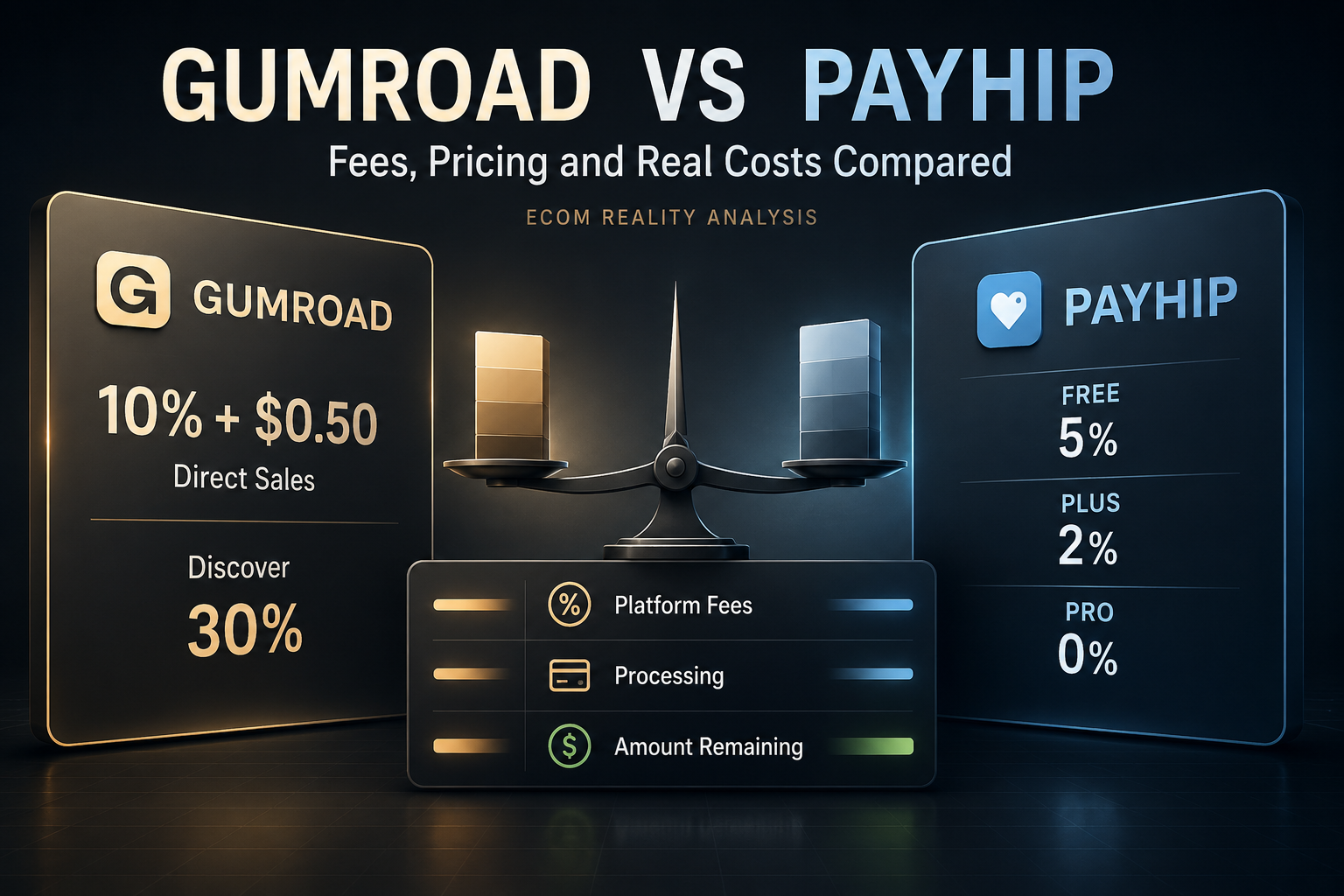
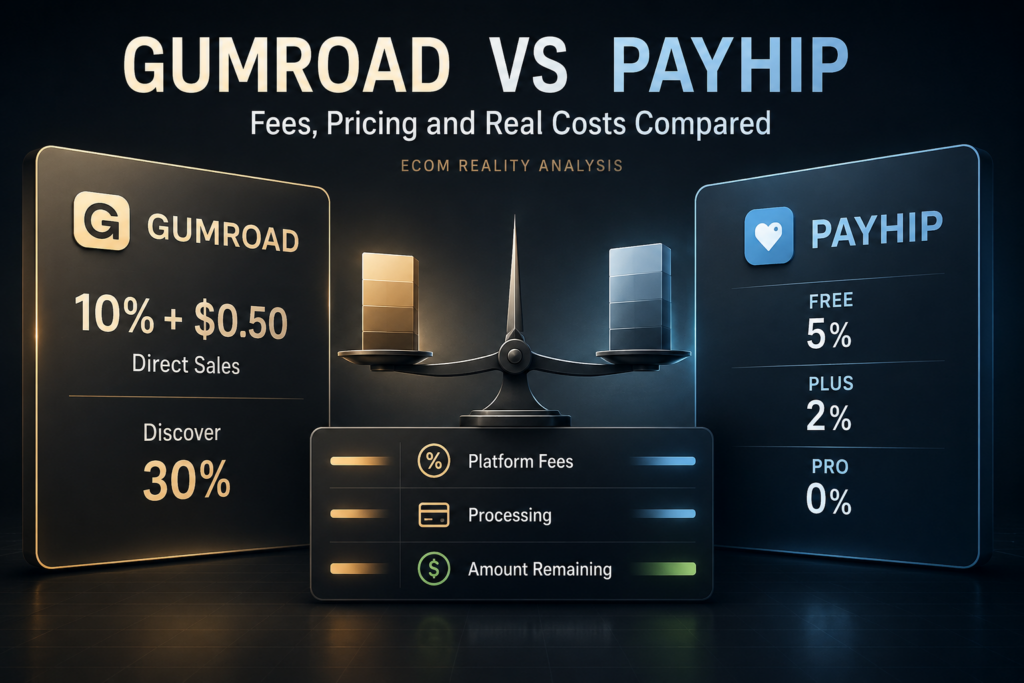
Gumroad vs Payhip is usually framed as a question about interface, ease of setup, or which platform “feels” more professional. Those comparisons rarely answer the question that actually affects a seller’s income: what does each platform cost once platform fees, monthly subscriptions, and payment processing are all added together at a specific sales volume?
This is a calculation-based comparison, not a feature tour. We built one cost model, applied it to Gumroad’s direct-sales fee structure and to all three current Payhip plans, and ran it at five monthly sales levels: $500, $1,000, $3,500, $5,000, and $10,000. The goal is to show the total estimated monthly cost, the effective cost rate, and the estimated amount remaining after fees for each option, so the comparison reflects real math rather than an advertised headline rate.
Quick Verdict
There is no single winner across every seller profile. The results depend heavily on sales volume, order count, and how much a seller values built-in reach versus a lower transaction rate.
- No sales yet or very irregular revenue: Gumroad’s zero-subscription model means there is nothing to pay when nothing sells. Payhip’s Free plan is equally free to start, so this is close to a tie until sales begin.
- Around $500 in monthly sales: Payhip’s Free plan is the cheapest option in this comparison, and Gumroad costs noticeably more once processing is added to its 10% + $0.50 rate.
- Around $1,000 in monthly sales: Payhip’s Plus plan ($29/month) edges past the Free plan and costs meaningfully less than Gumroad direct sales.
- $3,500 in monthly sales: This is close to the mathematical break-even point between Payhip’s Plus and Pro plans; both land at roughly the same total cost, and both remain well below Gumroad’s direct-sale total.
- $5,000 to $10,000 in monthly sales: Payhip’s Pro plan ($99/month, no transaction fee) becomes the cheapest tested option, and the gap versus Gumroad’s flat percentage widens every month.
- Sellers who rely on their own traffic: A lower percentage rate compounds in their favor, making Payhip’s paid plans increasingly attractive as volume grows.
- Sellers who want built-in marketplace discovery: Both platforms now have built-in marketplaces, but the economics differ. Gumroad charges a 30% fee on Discover-generated sales, while Payhip says Marketplace sales carry no additional marketplace fee beyond the seller’s usual plan and payment-processing costs. Eligibility, approval and actual reach are not guaranteed on either platform.
- Sellers who want tax handled centrally: Gumroad’s merchant-of-record model remains broader. Payhip automatically handles EU/UK digital VAT, US sales tax, and most Canadian GST/HST and PST obligations; as of July 2026, its documentation said Quebec QST registration was still pending.
- Sellers ready to manage their own Stripe or PayPal account: Payhip’s lower or zero transaction fee rewards sellers who are comfortable holding that payment relationship directly.
Gumroad vs Payhip: Quick Comparison
| Category | Gumroad | Payhip |
|---|---|---|
| Monthly subscription | None | $0 (Free), $29 (Plus), $99 (Pro) |
| Platform transaction fee | 10% + $0.50 per direct sale | 5% (Free), 2% (Plus), 0% (Pro) |
| Payment processing | Charged separately on direct sales | Charged separately on all plans |
| Free plan | Yes, only option for direct sales (no tiers) | Yes, Free Forever plan |
| Paid plans | None for direct sales | Plus and Pro |
| Direct sales | Yes, via link, email, or own site | Yes, via storefront or embed |
| Marketplace discovery | Gumroad Discover (30% fee, processing included) | Payhip Marketplace (no additional marketplace fee; eligibility and review apply) |
| Tax handling | Merchant of record for worldwide tax collection and remittance since Jan 1, 2025 | EU/UK digital VAT; US sales tax; Canadian GST/HST and PST, with QST caveat as of July 2026 |
| Digital products | Yes | Yes |
| Online courses | Yes | Yes |
| Memberships | Yes (subscriptions) | Yes |
| Email marketing | Basic built-in tools | Built-in email marketing |
| Affiliate tools | Built-in affiliate system | Built-in affiliate program |
| Custom domain | Supported; storefront customization remains relatively limited | Supported with a more customizable store builder |
| Best suited for | Occasional or irregular sellers, and those wanting reach through Discover | Sellers with consistent volume or their own traffic who want a lower percentage rate |
Calculate Your Own Gumroad vs Payhip Costs
Sales volume is only one part of the calculation. Order count, average order value, payment-processing rates and the Payhip plan you select can materially change the result. Use the Ecom Reality Ecommerce Platform Cost Calculator to enter your own numbers and compare the estimated monthly cost.
How We Calculated the Costs
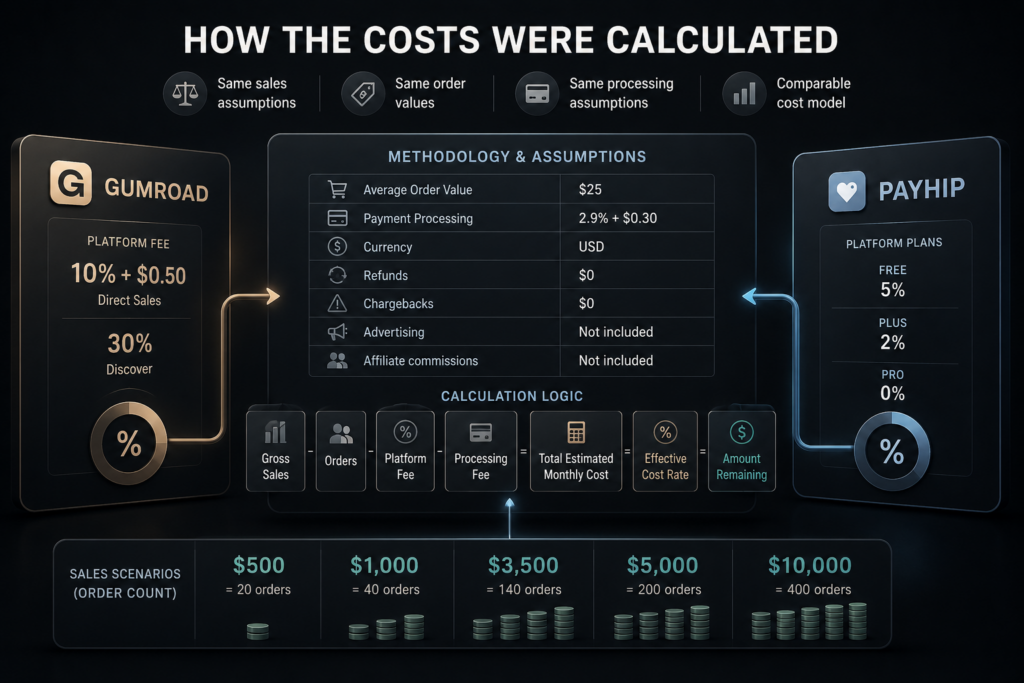
For this comparison, we used the same sales assumptions for both platforms. We separated platform fees from payment-processing costs to avoid a misleading comparison, since a platform that advertises a lower headline rate can still cost more once processing is added on top.
| Assumption | Value |
|---|---|
| Currency | USD |
| Average order value | $25.00 |
| Payment-processing assumption | 2.9% + $0.30 where separately applicable |
| Refunds | $0 |
| Chargebacks | $0 |
| Advertising | Not included |
| Affiliate commissions | Not included |
| Currency conversion | Not included |
| Gumroad Discover sales | Not included in primary comparison |
Order count matters because fixed per-order charges (Gumroad’s $0.50, and the $0.30 processing fee) do not scale with gross sales the way percentage fees do. A store with $5,000 in monthly sales and 200 orders pays a different total than a store with $5,000 in sales and 50 orders, even though gross revenue is identical, because the fixed per-order fee is charged 150 more times in the first case. We applied the same order values and payment-processing assumptions across the scenarios: at a fixed $25 average order value, $500 in sales equals 20 orders, $1,000 equals 40 orders, $3,500 equals 140 orders, $5,000 equals 200 orders, and $10,000 equals 400 orders.
Readers can reproduce the scenarios with the Ecom Reality platform cost calculator, changing the order volume, average order value, or processing rate to match their own store.
Payment processing itself is not a single universal number. We used Stripe’s standard published rate of 2.9% + $0.30 per successful domestic card transaction as a standardized assumption for this comparison, but Stripe’s official pricing page lists additional surcharges of 0.5% for manually entered cards, 1.5% for international cards, and 1% when currency conversion is required, so the real rate a seller pays depends on card type, currency, and country. PayPal’s published business rates differ from Stripe’s and vary further by transaction type and geography, as detailed on PayPal’s official business fee schedule. This comparison focuses on listed platform and payment costs rather than estimated net profit, and every effective rate below assumes the standardized 2.9% + $0.30 figure applies uniformly, which will not be exactly true for every seller.
Gumroad Pricing and Fee Structure
Gumroad charges no monthly subscription for direct sales. Instead, according to Gumroad’s official fee documentation, every direct sale carries a flat platform fee of 10% plus $0.50, and this fee does not include credit card processing or PayPal fees, which are charged on top. That distinction matters for accurate math: a seller who quotes “10%” as Gumroad’s cost is describing only the platform’s cut, not the total transaction cost once processing is added.
Direct sales are different from sales generated through Gumroad’s built-in marketplace, which uses a separate 30% rate and is covered on its own later in this article. On a refund, Gumroad’s published fee guidance says its own fee on the refunded portion is returned, while the underlying payment-processing portion is retained because payment processors do not return it. Purchases processed through a seller’s connected Stripe or PayPal account can work differently, so refund economics should be checked against the payment method used. Currency conversion, when it applies to an international buyer, is a separate cost that this comparison does not model.
Since January 1, 2025, Gumroad has operated as a merchant of record for its sellers. According to Gumroad’s VAT documentation, Gumroad collects and remits VAT on digital product sales to buyers in the EU and UK automatically, and sellers cannot opt out of this or make VAT-inclusive pricing optional. Separately, Gumroad’s sales-tax documentation confirms Gumroad now handles sales tax collection and remittance worldwide as merchant of record, removing the need for sellers to register for tax in most jurisdictions where they sell. This tax-handling responsibility is one factor that can make a nominally higher percentage fee easier to justify for sellers who would otherwise need to manage multi-jurisdiction tax compliance themselves.
For a broader analysis of Gumroad’s storefront, creator tools, payment model and limitations, read our full Gumroad review.
Payhip Pricing and Fee Structure
According to Payhip’s official pricing page, Payhip offers three current plans, and all three include the same feature set: unlimited products and unlimited revenue on every tier, with no feature-gating between them. The only variable across plans is the monthly subscription price and the platform transaction-fee rate.
| Plan | Monthly Subscription | Platform Transaction Fee |
|---|---|---|
| Free Forever | $0.00 | 5% |
| Plus | $29.00 | 2% |
| Pro | $99.00 | 0% |
Payhip’s own FAQ confirms that PayPal and Stripe processing fees apply on top of every plan, including Pro’s 0% platform fee. That means “0% fee” describes only Payhip’s own cut, not the total cost of a transaction, in the same way that Gumroad’s 10% figure omits processing.
Which Payhip plan is cheapest changes as monthly revenue grows, because the fixed subscription cost of Plus and Pro is only worth paying once the percentage-fee savings exceed it. We calculate the exact break-even points later in this article. Payhip automatically collects and remits digital VAT for EU and UK buyers and, from July 1, 2026, handles US sales tax and most Canadian GST/HST and PST obligations. Its Canadian documentation stated that Quebec QST registration was still pending as of July 2026.
Payhip also operates a built-in Marketplace that can recommend approved digital products to prospective customers beyond a seller’s existing audience. According to Payhip’s Marketplace documentation, marketplace sales carry no additional marketplace fee: the seller continues to pay the normal fee for their selected Payhip plan plus payment processing. Eligibility requires at least $10 in genuine sales, an account review and approval of individual products.
Our detailed Payhip review examines the platform’s features, payment setup and practical limitations beyond the fee calculations covered here.
Gumroad vs Payhip Cost Comparison
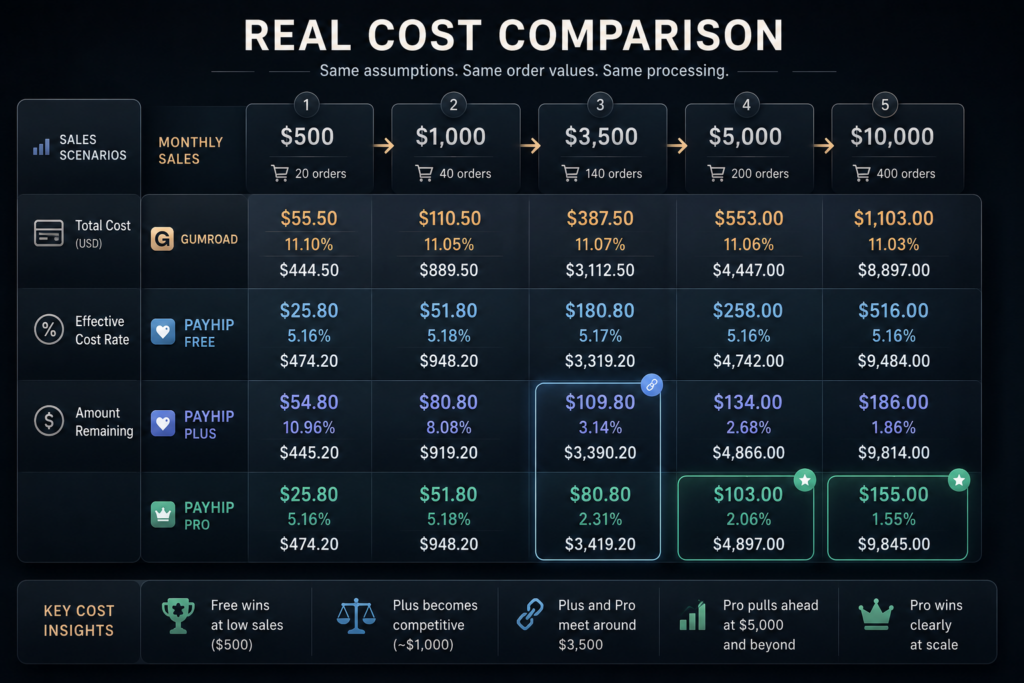
Our calculations show how each pricing model changes as monthly sales increase. The table below shows the total estimated monthly cost for Gumroad direct sales and for each Payhip plan, at every tested sales level.
| Platform or Plan | $500 Sales | $1,000 Sales | $3,500 Sales | $5,000 Sales | $10,000 Sales |
|---|---|---|---|---|---|
| Gumroad (direct sales) | $80.50 | $161.00 | $563.50 | $805.00 | $1,610.00 |
| Payhip Free | $45.50 | $91.00 | $318.50 | $455.00 | $910.00 |
| Payhip Plus | $59.50 | $90.00 | $242.50 | $334.00 | $639.00 |
| Payhip Pro | $119.50 | $140.00 | $242.50 | $304.00 | $509.00 |
| Cheapest Payhip option | $45.50 (Free) | $90.00 (Plus) | $242.50 (Plus/Pro tie) | $304.00 (Pro) | $509.00 (Pro) |
Ecom Reality Research Note: All platforms in this table were compared at the same gross sales figures, using the same $25 average order value and the same order counts. The standardized 2.9% + $0.30 processing rate was applied only where processing is charged separately from the platform fee, and Gumroad’s processing was not counted twice: its 10% + $0.50 platform fee and its separate processing charge were each counted exactly once. Advertising, affiliate commissions, currency conversion, and Gumroad Discover sales were excluded from this table. This is a comparison of pricing models, and the estimated amount remaining shown in a later section is not net profit.
Scenario: $500 in Monthly Sales
At $500 in monthly sales across 20 orders, Gumroad’s direct-sale total comes to $80.50: $60.00 in platform fees ($50.00 plus $10.00 in fixed per-order charges) and $20.50 in processing. Payhip’s Free plan totals $45.50, its Plus plan totals $59.50, and its Pro plan totals $119.50. Free is the cheapest Payhip option at this volume, and the $29 monthly subscription for Plus is not yet earning its keep: the fee-rate savings from 5% down to 2% is worth only $15.00 at this sales level, less than the subscription itself.
At this volume, a paid Payhip plan is not mathematically justified. The relevant question is whether $500 in monthly sales represents this seller’s typical volume or an early or unusually slow month. A seller who expects growth may still prefer Gumroad’s simplicity of having no subscription decision to make at all, even though it costs $35.00 more than Payhip’s Free plan at this level.
Scenario: $1,000 in Monthly Sales
At $1,000 in monthly sales across 40 orders, Gumroad’s total cost is $161.00, an effective rate of 16.10%. Payhip’s Free plan costs $91.00, and Plus costs $90.00, essentially a tie, with Plus edging ahead by exactly $1.00. This is close to the mathematical break-even point between Free and Plus, which sits at $966.67 in monthly sales. Pro, at $140.00, is not yet worth its $99 subscription at this volume.
The dollar difference between Gumroad and the cheapest Payhip option here is $71.00 per month, or roughly a 7% difference in monthly gross sales terms. That is a real but not dramatic gap at this volume, and it is worth weighing against how much a seller values Gumroad’s larger built-in tax handling or Payhip’s lower fee before switching platforms over $71.00 a month.
Scenario: $3,500 in Monthly Sales
At $3,500 in monthly sales across 140 orders, Gumroad’s total reaches $563.50. Payhip’s Free plan costs $318.50, while Plus and Pro are tied at $242.50 each, since $3,500 is the exact mathematical break-even point between those two plans. Below this level Plus is cheaper; above it, Pro takes over.
The monthly difference between Gumroad and the cheapest Payhip option is $321.00. Extrapolated across twelve months at an unchanged sales level, that is a mathematical 12-month extrapolation of $3,852.00, not a guaranteed annual saving, since actual monthly sales will fluctuate. A seller sitting near this $3,500 break-even point should watch whether their revenue is trending consistently above or below this line before deciding whether Plus or Pro is the better long-term fit, rather than reacting to a single strong or weak month.
Scenario: $5,000 in Monthly Sales
At $5,000 in monthly sales across 200 orders, Gumroad’s total cost is $805.00. Payhip’s Free plan costs $455.00, Plus costs $334.00, and Pro costs $304.00, making Pro the cheapest option at this volume. The monthly gap between Gumroad and Payhip Pro is $501.00, and the mathematical 12-month extrapolation of that gap is $6,012.00.
At this sales level, the percentage-based portion of Gumroad’s fee becomes more significant than the fixed subscription cost of any Payhip plan. A 10% platform rate on $5,000 in sales is $500.00 before processing is even added, while Payhip Pro’s flat $99 monthly cost barely increases in dollar terms relative to the revenue it is measured against. This is the volume level where a flat percentage model and a fixed subscription model start to diverge sharply.
Scenario: $10,000 in Monthly Sales
At $10,000 in monthly sales across 400 orders, Gumroad’s total cost is $1,610.00, still at the same 16.10% effective rate as every other tested level, since Gumroad’s fee structure does not include any volume discount. Payhip’s Free plan costs $910.00, Plus costs $639.00, and Pro costs $509.00, keeping Pro as the cheapest tested option. The monthly difference between Gumroad and Payhip Pro is $1,101.00, and the mathematical 12-month extrapolation of that difference is $13,212.00.
A seller consistently generating $10,000 in monthly sales through Gumroad direct sales has strong reason to revisit their fee structure regularly, since the flat 10% + $0.50 rate does not decrease at any volume tested here. That said, the estimated amount remaining after fees is not the same as net profit, and Gumroad’s centralized handling of global tax obligations may offset part of the difference for a seller who would otherwise need to manage that compliance independently on a lower-fee platform.
Effective Cost Rate Comparison
| Platform or Plan | $500 | $1,000 | $3,500 | $5,000 | $10,000 |
|---|---|---|---|---|---|
| Gumroad (direct sales) | 16.10% | 16.10% | 16.10% | 16.10% | 16.10% |
| Payhip Free | 9.10% | 9.10% | 9.10% | 9.10% | 9.10% |
| Payhip Plus | 11.90% | 9.00% | 6.93% | 6.68% | 6.39% |
| Payhip Pro | 23.90% | 14.00% | 6.93% | 6.08% | 5.09% |
Gumroad’s effective rate stays flat at every volume tested because it has no monthly subscription to amortize; at a fixed $25 average order value, its per-order fee (10% plus $0.50, plus processing) costs the same 16.10% whether a seller sells 20 orders or 400. Payhip’s Free plan behaves the same way, holding steady at 9.10%, because its 5% fee plus processing scales purely with order volume as well.
Plus and Pro, by contrast, carry a fixed monthly subscription that gets diluted across a growing sales base, so their effective rate drops noticeably as volume increases. This is why a free plan is not automatically the cheapest option once monthly sales pass a few hundred dollars: a monthly subscription plus a lower percentage fee can beat a subscription-free plan with a higher percentage fee, once enough revenue is flowing through the account to amortize that subscription. Order count also matters independently of gross sales, since the fixed $0.50 and $0.30 per-order charges hit a store with many small orders harder than a store with fewer, larger ones at the same total revenue.
How Much Money Remains After Fees?
| Platform or Plan | $500 | $1,000 | $3,500 | $5,000 | $10,000 |
|---|---|---|---|---|---|
| Gumroad (direct sales) | $419.50 | $839.00 | $2,936.50 | $4,195.00 | $8,390.00 |
| Payhip Free | $454.50 | $909.00 | $3,181.50 | $4,545.00 | $9,090.00 |
| Payhip Plus | $440.50 | $910.00 | $3,257.50 | $4,666.00 | $9,361.00 |
| Payhip Pro | $380.50 | $860.00 | $3,257.50 | $4,696.00 | $9,491.00 |
The estimated amount remaining is the gross sales figure minus the total estimated monthly cost shown earlier. It is not net profit. A seller’s actual take-home can be further reduced by product-development costs, software subscriptions, contractors, advertising, affiliate commissions, refunds, chargebacks, accounting and legal services, income tax, any VAT or sales tax not handled by the platform, currency conversion, and payout-related banking fees. Treat these figures as the starting point of a profit calculation, not the end of one.
Payhip Plan Break-Even Points
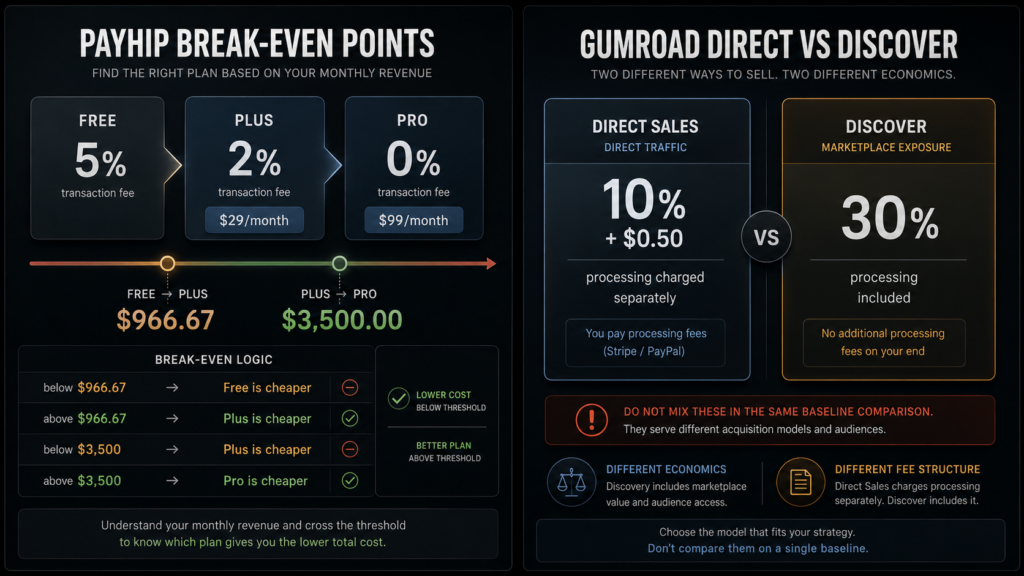
The point at which a paid Payhip plan becomes cheaper than a lower tier is a fixed mathematical calculation, not a rule of thumb.
Break-even sales volume = Difference in monthly subscription price ÷ Difference in platform transaction-fee rate
| Upgrade | Subscription Difference | Fee Difference | Break-Even Monthly Sales |
|---|---|---|---|
| Free to Plus | $29.00 | 3% (5% – 2%) | $966.67 |
| Plus to Pro | $70.00 | 2% (2% – 0%) | $3,500.00 |
Below $966.67 in monthly sales, the Free plan’s absent subscription outweighs its higher fee rate, making it the cheaper option. Above that figure, Plus’s lower fee rate earns back its $29 subscription and then some. The same logic applies to the Plus-to-Pro threshold at $3,500.00: below it, Plus is cheaper; above it, Pro’s zero transaction fee wins out.
These thresholds assume stable monthly revenue, and monthly sales volatility matters here. A single unusually strong month above a break-even line does not necessarily justify an immediate upgrade, since the subscription is a recurring cost that must be paid every month regardless of that month’s results. A seller whose revenue fluctuates between $2,000 and $4,000 month to month may be better served staying on Plus and revisiting the decision once revenue is consistently and predictably above $3,500, rather than upgrading and downgrading with each swing. Consult Payhip’s billing and upgrade documentation for how the plan-change process itself works. It is also worth noting that all three Payhip plans include the same feature set, so the decision to upgrade is purely a financial one; a seller is never upgrading for extra tools, only for a lower transaction fee rate on a specific revenue base.
Gumroad Discover: A Different Cost Scenario
Gumroad Discover is Gumroad’s built-in marketplace, where the platform surfaces a seller’s products to buyers who did not arrive through the seller’s own link or marketing. According to the Gumroad Discover documentation, products need to meet eligibility requirements, including a completed payout setup and a minimum sales history, before they can be listed. Discover sales use a separate 30% fee that includes payment processing, rather than the 10% + $0.50 rate used for direct sales.
To illustrate the difference, take the same $1,000 sales scenario used earlier, at 40 orders of $25 each, but assume all of it came through Discover instead of a direct link.
| Metric | Value |
|---|---|
| Gross sales | $1,000.00 |
| Orders | 40 |
| Discover fee (30%, processing included) | $300.00 |
| Total estimated cost | $300.00 |
| Effective cost rate | 30.00% |
| Estimated amount remaining | $700.00 |
| Difference vs. Gumroad direct sales ($161.00) | $139.00 more |
| Difference vs. cheapest Payhip option ($90.00) | $210.00 more |
The 30% Discover rate should not be blended into the direct-sales table above because it represents a different transaction: Gumroad is attributing the sale to its marketplace rather than simply processing traffic generated by the seller. Payhip now has its own built-in Marketplace, but its pricing model is different. According to Payhip’s Marketplace documentation, there is no additional marketplace fee beyond the seller’s normal Payhip plan and payment-processing costs, although eligibility requires at least $10 in genuine sales, an account review and approval of individual products. The two marketplaces cannot be compared on fees alone because neither platform publishes directly comparable reach or conversion data. Marketplace exposure is not guaranteed, and its practical value depends on the product category, listing approval and the volume of qualified buyers each platform sends.
Tax Handling and Merchant-of-Record Differences
Gumroad’s status as a merchant of record, effective since January 1, 2025, means Gumroad is legally the seller of record for tax purposes on every transaction it processes. Per Gumroad’s VAT documentation, this covers digital EU and UK VAT automatically, with no forms for sellers to file. Per Gumroad’s sales-tax documentation, Gumroad also handles global sales tax collection and remittance, though sellers who already have a sales tax registration obligation may need to file their Gumroad sales as non-taxable resales using a reseller certificate Gumroad provides.
Payhip’s tax coverage is structured differently. Per Payhip’s digital VAT documentation, Payhip automatically calculates, collects, and remits VAT on digital product sales to EU and UK buyers, similar in scope to Gumroad’s EU/UK coverage. Per Payhip’s US sales-tax documentation, Payhip has handled US sales tax as a marketplace facilitator since July 1, 2026, although sellers with a physical presence in certain states may still need to file a zero-dollar return. Payhip’s Canadian sales-tax documentation says it also handles GST/HST and PST from July 1, 2026, but its QST registration was still pending as of the document’s June 30, 2026 update. Sellers with an existing Quebec QST obligation therefore needed to continue handling that tax until Payhip confirmed registration. For other jurisdictions, sellers may need to configure taxes manually and remain responsible for filing.
Neither platform’s tax handling removes every obligation a seller has. Both explicitly disclaim their tax articles as informational rather than legal or tax advice. Tax responsibilities depend on the seller’s location, business structure, customer location and applicable law. Sellers should verify their obligations with a qualified tax professional.
Feature Differences That Can Justify Higher Costs
A lower total cost does not automatically make a platform the better operational fit. Gumroad’s broader merchant-of-record scope can be worth its higher percentage fee for a seller who would otherwise need to manage sales tax or VAT across multiple jurisdictions. Gumroad Discover and Payhip Marketplace can both expose approved products to buyers beyond a seller’s own audience, but their economics differ sharply: Gumroad applies a 30% Discover fee, while Payhip says Marketplace sales carry no additional marketplace fee beyond the normal plan and processing charges. Neither platform guarantees meaningful marketplace traffic, so discovery should be evaluated as a possible acquisition channel rather than a substitute for the seller’s own marketing.
Payhip’s advantages sit elsewhere: a lower percentage fee at every plan tier once a seller has meaningful, consistent volume; a more customizable storefront and custom domain support; and the ability to plug in a Stripe or PayPal account the seller already controls, rather than routing every transaction through Gumroad’s own processing relationship. Payhip’s identical feature set across all three plans also means a seller never has to weigh “which tier has the feature I need,” only “which tier is financially worth it at my current volume,” which simplifies the upgrade decision considerably.
Neither platform is built as a full customizable ecommerce storefront in the way a dedicated store builder is, and sellers with more complex catalog, checkout, or integration needs may find both options limiting regardless of fee structure.
Gumroad vs Payhip for Different Sellers
Choose Gumroad if…
- You want the simplest possible launch, with no subscription decision to make before your first sale.
- Your revenue is irregular or unproven, and you do not want a fixed monthly cost regardless of sales.
- You expect Gumroad Discover to generate enough incremental sales to justify its separate 30% marketplace fee.
- You want a single platform to handle sales tax and VAT compliance across most jurisdictions without separate setup.
- You are comfortable paying a higher percentage rate in exchange for that operational simplicity.
Choose Payhip if…
- You already generate meaningful traffic through email, social media, SEO, advertising, partnerships or an existing audience.
- Your monthly sales are consistently above roughly $966.67 (favoring Plus) or $3,500.00 (favoring Pro), based on the break-even calculations above.
- You are comfortable connecting and managing your own Stripe or PayPal account for processing.
- You want the option to change plans as your business grows, without any feature differences to navigate between tiers.
- A more customizable storefront and custom domain support matter to your brand.
- You want eligibility for Payhip Marketplace without an additional marketplace fee and can meet its $10 sales, account-review and product-approval requirements.
Reconsider Both if…
- You need a fully brandable ecommerce store with deep customization beyond a creator-style storefront.
- Your catalog is large or complex, spanning many product variants or categories.
- You sell both physical and digital products at meaningful volume.
- You need advanced integrations beyond what either platform’s app ecosystem supports.
- You require more advanced built-in analytics than either platform provides natively.
- You need a more developed international payments and tax infrastructure than either platform’s current coverage offers.
Sellers who need a more complete storefront, stronger branding or a different pricing model can compare the best platforms for selling digital products before choosing either option.
Final Verdict
Gumroad vs Payhip does not resolve to a single universal answer, but the calculations above give a concrete basis for the decision. Gumroad can be simpler at the very start, when revenue is irregular and there is nothing to pay without a sale, and its broader merchant-of-record model may justify part of its higher percentage cost for the right seller. Both platforms now offer marketplace discovery, but the economics differ: Gumroad charges 30% on Discover-generated sales, while Payhip says Marketplace transactions carry no extra marketplace fee beyond the normal plan and processing costs. Payhip becomes progressively cheaper as monthly sales grow past roughly $1,000, and by $5,000 to $10,000 in monthly sales its Pro plan produces a meaningfully lower total cost than Gumroad’s flat 10% + $0.50 rate, which does not decrease at any volume tested in this comparison.
The most useful exercise is not picking a platform based on an advertised percentage, but calculating total cost, including processing, at the seller’s actual or expected sales volume and order count. Run your own numbers with the Ecommerce Platform Cost Calculator before choosing a platform or changing your Payhip plan.
FAQ
Is Payhip cheaper than Gumroad?
At every sales level tested in this comparison, from $500 to $10,000 in monthly sales, the cheapest available Payhip plan produced a lower total estimated cost than Gumroad’s direct-sale fee once processing was included. The gap is small at low volume and widens substantially as monthly sales grow, since Gumroad’s 10% + $0.50 rate does not decrease with volume, while Payhip’s paid plans amortize a fixed subscription over a larger revenue base.
How much does Gumroad take from each sale?
Gumroad charges 10% + $0.50 per transaction on direct sales, according to its official fee documentation, and this does not include payment processing, which is charged separately at approximately 2.9% + $0.30 for a standard domestic card. Sales made through Gumroad Discover instead use a flat 30% rate that already includes processing.
Does Gumroad charge a monthly fee?
No. Gumroad does not charge a monthly subscription for direct sales. Its cost is entirely transaction-based: a seller with no sales in a given month pays nothing that month.
Does Payhip charge transaction fees?
Yes, on every plan. The Free plan charges 5%, Plus charges 2% for $29 a month, and Pro charges 0% for $99 a month. PayPal and Stripe processing fees apply on top of all three plans, since Payhip’s own fee only covers its platform’s cut of the transaction.
Which is better for beginners, Gumroad or Payhip?
Both are approachable for a first-time seller, since neither requires a paid plan to start. Gumroad’s single transaction-based model can feel simpler for someone unsure whether sales will be consistent, while Payhip’s Free plan offers the same no-cost entry point with a lower platform fee. Both platforms now have built-in marketplaces, but Gumroad charges 30% on Discover-generated sales, whereas Payhip says Marketplace sales carry no additional marketplace fee beyond the seller’s normal plan and processing costs. Beginners should compare fees, tax handling, storefront control and the realistic value of marketplace exposure rather than assuming either platform will supply dependable traffic.
Which platform is cheaper at $1,000 in monthly sales?
Payhip, using its Plus plan, which totals $90.00 versus Gumroad’s $161.00 at this sales level under our standardized assumptions. Payhip’s Free plan is nearly identical to Plus at this specific volume, at $91.00, since $1,000 sits close to the mathematical break-even point between those two Payhip tiers.
Which platform is cheaper at $5,000 in monthly sales?
Payhip’s Pro plan, at $304.00 total, compared with Gumroad’s $805.00 at the same sales level under our standardized assumptions, a difference of $501.00 per month.
Does Gumroad handle sales tax and VAT?
Yes. Gumroad has operated as a merchant of record since January 1, 2025, and according to its official documentation it collects and remits VAT for EU and UK buyers and sales tax globally, without requiring sellers to register in most jurisdictions themselves.
Does Payhip handle VAT or sales tax?
Payhip automatically collects and remits digital VAT for EU and UK buyers. From July 1, 2026, it also handles US sales tax as a marketplace facilitator and most Canadian GST/HST and PST obligations. Sellers with a physical presence in certain US states may still need to file a zero-dollar return, and Payhip’s Canadian guidance stated that Quebec QST registration was still pending as of July 2026. Coverage outside these areas may require the seller to configure taxes manually and remain responsible for filing.
Can I move my products from Gumroad to Payhip?
Neither platform offers a direct one-click migration tool between the two. A seller switching would typically need to re-upload product files, re-create product listings, and reconnect their payment processor on the new platform manually. Existing customer and sales history does not transfer between platforms.
Pricing and fees checked in July 2026. Gumroad and Payhip pricing, fee structures, and tax-handling policies are subject to change; verify current rates on each platform’s official pricing page before making a decision.
5 responses to “Gumroad vs Payhip: Fees, Pricing and Real Costs Compared”
-
I thought the $40 coupon the plugin offered was a gimmick – it wasn’t, and it covered my first ad spend the morning after my first withdrawal cleared.
-
The $3,500 break-even point between plans is exactly where my own spreadsheet landed before I committed to what I’m using – about 63 days in now and firmly in the grow phase, which is where that math actually starts to matter. Running the numbers first is the only reason I talked myself out of quitting early on. Real automation – not the word, but the actual mechanics of it – only clicked once I stopped treating fee structure as a footnote.
-
I thought the $40 coupon the plugin offered was a gimmick – it wasn’t, and it covered my first ad spend the morning after my first withdrawal cleared.
-
When three people asked me what I’m using this week, I told them the same thing – stop obsessing over fee comparisons at $500/month and just find one tool that handles the backend so you can actually ship work. Tbh the plugin answered that for me around week 6 when I realized automation meant I stopped being the person manually tracking every transaction. The opportunity cost of not having this earlier is the number I wish someone had put in a comparison chart.
-
[…] matters when comparing Podia with marketplace-led platforms or lightweight storefronts. Our Gumroad vs Payhip comparison, for example, focuses heavily on transaction economics. Podia asks a different question: how much […]



Sylvia Pierce is an editor and ecommerce researcher at Ecom Reality. She specializes in reviewing ecommerce platforms, digital selling tools, pricing models, and online business software. Her work focuses on providing clear, practical, and balanced information that helps entrepreneurs make informed decisions.
Comments
Leave a Reply
Related Articles



Leave a Reply