


Gumroad has a very clear promise: if you have something digital to sell, you can put it online quickly and start accepting payments without building a full ecommerce website.
That promise is real. Gumroad is one of the simplest platforms for creators who want to sell ebooks, templates, guides, courses, memberships, digital files, or small creator products without dealing with hosting, plugins, payment integrations, or store design.
But that simplicity is also the main thing sellers need to understand.
Gumroad makes the first step easier. It does not make the business easy.
That difference matters.
A beginner can publish a product page on Gumroad in a short amount of time. But publishing a product is not the same as building demand, generating traffic, earning trust, improving conversion, protecting margins, or creating a long-term digital product business.
That is where many Gumroad reviews are too shallow. They focus on how easy it is to set up a product, but they do not spend enough time on the economics behind the sale.
This Gumroad review looks at the platform from a practical business angle: setup, fees, audience limitations, product limits, customization, and when Gumroad makes sense compared with Shopify, WooCommerce, or a dedicated website.
The short version is this:
Gumroad is a strong starting point for creators who want to sell simple digital products quickly. It is not always the best long-term platform for sellers who need lower fees, stronger branding, advanced funnels, deeper analytics, or full control over the customer journey.
What Is Gumroad?
Gumroad is a platform that helps creators sell digital products directly online.
It is commonly used for:
- Ebooks
- Paid guides
- Templates
- Online courses
- Digital downloads
- Creative assets
- Memberships
- Software files
- Notion templates
- Design resources
- Educational material
The platform is built around a simple idea: creators should be able to upload a product, create a sales page, set a price, and start selling without building a full online store.
That makes Gumroad attractive for writers, designers, educators, consultants, indie makers, and creators who already have something to sell but do not want to manage a complicated ecommerce stack.
Gumroad is not trying to be a full Shopify replacement. It is not trying to be a fully customizable WooCommerce setup. It is closer to a lightweight creator checkout system with product delivery built in.
That makes it useful.
But it also creates limits.
The platform works best when the offer is simple, the catalog is small, and the creator already has a way to bring people to the product page.
The Main Thing Gumroad Gets Right
Gumroad’s biggest advantage is not advanced ecommerce functionality.
Its biggest advantage is speed.
A creator can go from idea to live product page without spending days comparing themes, installing plugins, connecting checkout tools, or configuring hosting. This matters because many digital product sellers get stuck before they ever launch.
They overbuild the website.
They spend too much time on design.
They compare too many platforms.
They delay publishing because the system is not perfect.
Gumroad helps remove that friction.
For a first product, that can be a major advantage. A creator selling a $19 ebook does not necessarily need a full ecommerce store. A designer selling a small template pack may not need Shopify. A consultant selling a PDF guide may not need WooCommerce.
In these cases, Gumroad gives the seller exactly what they need:
- A product page
- A checkout
- File delivery
- Payment handling
- A simple way to share a sales link
That is enough to test whether people are willing to buy.
This is Gumroad’s strongest use case: fast validation.
Instead of spending months building infrastructure, a creator can launch the offer, send it to an audience, and learn from real buyer behavior.
That is valuable because the first version of a digital product is rarely perfect. The seller may need to change the title, reposition the offer, improve the product, adjust the price, rewrite the page, or target a different audience.
Gumroad makes that testing process easier.
But the same simplicity that helps at the beginning can become restrictive later.
Who Gumroad Is Best For
Gumroad is best for creators who want to start selling without turning the setup process into a technical project.
It is especially useful for:
- Beginners testing their first digital product
- Writers selling ebooks or guides
- Designers selling templates or creative assets
- Educators selling small courses or workshops
- Consultants selling digital resources
- Newsletter creators monetizing an existing audience
- Indie makers selling simple tools
- Solopreneurs who want a clean checkout link
The best Gumroad user is usually someone with a simple offer and some form of existing attention.
That attention can come from a newsletter, social media audience, YouTube channel, blog, community, podcast, client base, or professional network.
This point is important because Gumroad does not remove the need for traffic.
A creator with an audience can use Gumroad as a simple checkout layer. A creator with no audience may publish a product and still get no sales.
That is not a Gumroad-specific problem. It is a digital product business problem.
But it is one of the most common reasons beginners become disappointed with platforms like Gumroad. The product is technically live, but nobody is seeing it.
Gumroad can make selling possible. It does not automatically make selling happen.
Gumroad Fees: The Part Sellers Should Not Ignore
Gumroad’s pricing looks simple, but sellers need to understand what it means for margins.
At the time of writing, Gumroad lists a fee of 10% + $0.50 per transaction for sales through a creator’s profile or direct links. Sales made through Gumroad Discover are listed at 30% per transaction. Gumroad’s Help Center also notes that the standard fee does not include credit card processing or PayPal fees.
This is where the “simple setup” story becomes more complicated.
A 10% platform fee may feel reasonable when a creator is starting out. There is no traditional monthly subscription to worry about, and the seller does not need to pay for hosting, plugins, or a full store setup.
For beginners, that trade-off can make sense.
But transaction-based fees become more noticeable as revenue grows.
A seller making a few sales may not care much. A seller doing consistent monthly volume may start asking whether convenience is costing too much.
The key question is not only “How much does Gumroad charge?”
The better question is:
How much control, infrastructure, and convenience am I getting in exchange for the fee?
For a beginner selling a first product, Gumroad may be worth the fee because it saves time and reduces complexity.
For a more serious seller, the math may look different.
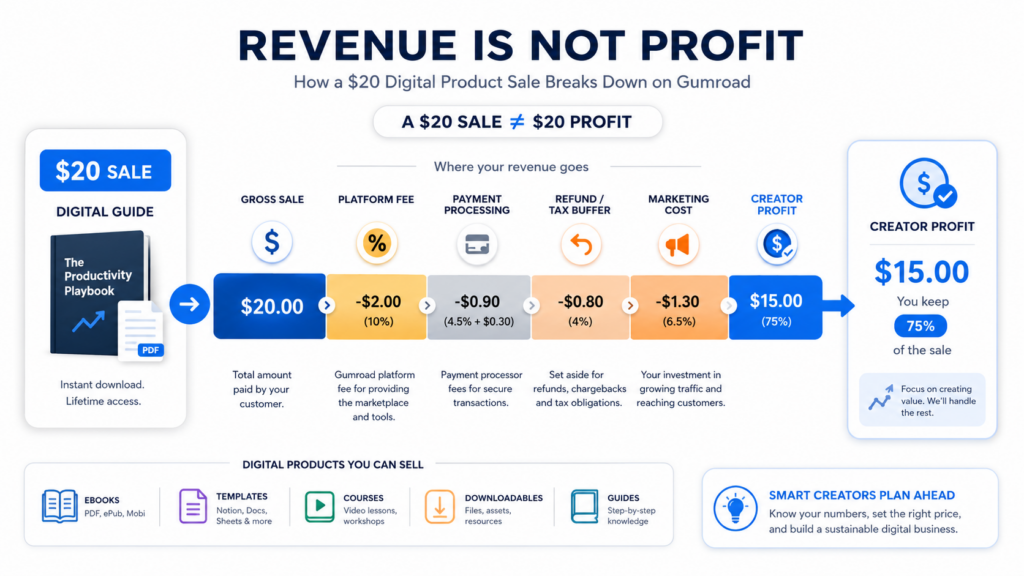
Example: Why A $20 Sale Is Not Really $20
Digital products can look highly profitable from the outside because there is no physical inventory, shipping cost, or warehouse involved.
But that does not mean every sale is pure profit.
Imagine a creator sells a $20 digital guide.
At first glance, that looks clean. The file already exists. The product is delivered automatically. The creator might assume that almost the full $20 is theirs.
But the real economics are different.
From that $20, the seller may need to account for:
- Gumroad’s platform fee
- Payment processing
- Possible PayPal fees
- Refunds
- Taxes
- Email software
- Design tools
- Time spent creating the product
- Time spent supporting customers
- Advertising or content production costs
- Future product updates
The actual profit is not the listed product price. It is what remains after all selling costs are counted.
This is especially important if the creator uses paid traffic.
If someone spends money on ads to sell a $20 guide, the margin can disappear quickly. A few dollars in platform and payment fees plus a few dollars in customer acquisition cost can turn a product that looks profitable into a weak business.
That does not mean Gumroad is bad.
It means sellers need to separate revenue from profit.
A simple checkout does not remove business math.
The Real Cost Is Not Gumroad. It Is Getting Buyers.
Many creators focus too much on platform fees and not enough on the harder part: getting people to buy.
Gumroad can process the transaction, but it does not automatically solve:
- Audience building
- Product positioning
- Trust
- Traffic
- Conversion
- Offer clarity
- Pricing strategy
- Buyer objections
- Repeat sales
This is the part beginners often underestimate.
They think the question is, “Where should I sell my digital product?”
But the more important question is, “Why will anyone buy this digital product from me?”
That question is harder.
A product page alone does not create demand. A checkout link does not create trust. A digital file does not become valuable just because it is uploaded.
The creator still needs a real reason for people to care.
For example, a Notion template may need a clear use case. An ebook may need a specific reader problem. A course may need proof that it helps someone achieve a result. A design asset may need to save time or improve output for a specific audience.
Gumroad can help deliver the product after the buyer decides to purchase.
It cannot create that decision from nothing.
This is why Gumroad works best for creators who already have some kind of audience or distribution channel.
Gumroad Discover: Helpful, But Not A Full Traffic Strategy
Gumroad Discover can help some products get exposure inside Gumroad’s marketplace. That sounds attractive because it suggests buyers may find the product without the creator sending every visitor manually.
But sellers should be careful with expectations.
Discover is not the same as owning a traffic engine.
Marketplace discovery can be useful, but it is not something a seller should fully depend on. Products still need to compete for attention. The creator still needs positioning, quality, social proof, and a product that fits what buyers are looking for.
There is also the fee difference. Gumroad Discover sales are priced differently from direct/profile sales, with a higher platform percentage.
That creates a strategic trade-off.
If Discover brings a buyer the creator would not have reached otherwise, the higher fee may be acceptable. But if the creator can generate direct traffic through a newsletter, website, search, or social audience, direct sales may be more attractive economically.
This is an important distinction:
Discovery is useful as an additional channel. It should not be treated as the entire business model.
A creator who relies only on marketplace discovery is still dependent on a platform they do not control.
Digital Product Limits: Where Gumroad Starts To Feel Small
Gumroad is good for simple digital product selling.
It is less ideal when the business becomes more complex.
Sellers may start to feel limited when they need:
- A larger product catalog
- Better category structure
- Advanced product filtering
- More control over site design
- Custom checkout flows
- Order bumps
- Advanced upsells
- Segmented email automation
- Deep analytics
- Stronger SEO control
- More flexible landing pages
- A full brand experience
This is not because Gumroad fails at its purpose. It is because Gumroad’s purpose is simplicity.
A creator selling one guide does not need complex navigation.
A creator selling 50 digital resources across multiple categories may need a real storefront.
A beginner selling one template does not need advanced analytics.
A seller spending money on ads may need detailed conversion tracking, funnel reporting, and better control over the customer journey.
A writer testing a paid PDF does not need deep customization.
A creator building a serious digital product brand may eventually want more control over design, SEO, email capture, checkout behavior, and post-purchase experience.
That is where Gumroad can start to feel like a starting point rather than a final platform.
Branding And Customer Journey Control
One of the biggest long-term limitations of Gumroad is control.
When you sell through Gumroad, the experience is shaped by Gumroad’s structure. That is convenient, but it also means the creator has less control than they would with a dedicated website or custom ecommerce setup.
For early-stage sellers, this may not matter.
For serious creators, it can matter a lot.
Branding is not just colors and logos. It is the full buyer journey:
- How the product is presented
- What the checkout feels like
- What happens after purchase
- How customers are encouraged to buy again
- How email capture works
- How trust is built
- How related products are shown
- How content supports the sale
The more serious the business becomes, the more these details matter.
A simple Gumroad page may convert well enough for a basic offer. But it may not support a more advanced funnel, a content-driven SEO strategy, a premium brand experience, or a larger product ecosystem.
This is why many creators start on Gumroad and later move some parts of the business to their own website.
They do not necessarily leave because Gumroad is bad.
They leave because their needs changed.
Gumroad For Beginners: Useful, But Easy To Misunderstand
Gumroad is beginner-friendly, but that can create a false sense of progress.
It feels productive to publish a product. The page is live. The checkout works. The link can be shared.
That feels like a business.
But it may only be infrastructure.
A beginner still needs to answer the hard questions:
- Who exactly is this product for?
- What problem does it solve?
- Why is this product better than free content?
- Why should a buyer trust this creator?
- Where will traffic come from?
- What makes the offer urgent or valuable?
- How will the seller improve the product over time?
Gumroad makes the technical part easier, but it does not remove these questions.
That is why Gumroad is a good beginner platform only when the seller uses it correctly.
It is good for testing.
It is not good for hiding from the real work.
A creator can use Gumroad to validate demand quickly. That is smart.
But if the product gets no sales, the answer is not always to switch platforms. The issue may be the offer, the audience, the positioning, the price, or the traffic source.
Changing from Gumroad to Shopify will not fix a weak offer.
Changing from Gumroad to WooCommerce will not create demand.
The platform matters, but it is not the whole business.
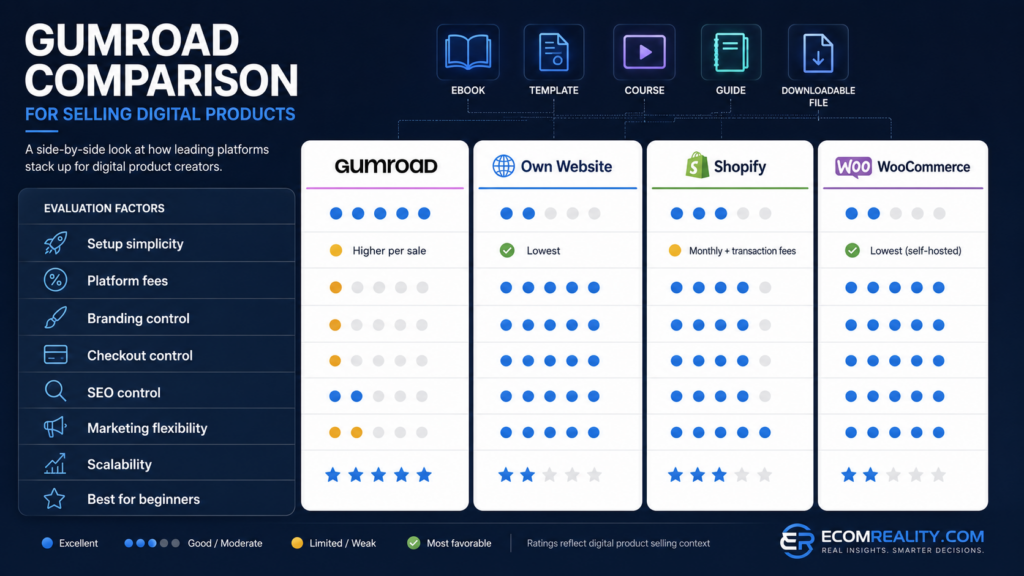
Gumroad vs Building Your Own Website
The biggest alternative to Gumroad is not always another marketplace. Sometimes it is building your own website.
This comparison comes down to speed versus control.
Gumroad is better when you want to launch fast.
A dedicated website is better when you want to build long-term ownership.
Gumroad advantages
Gumroad gives you:
- Faster setup
- Less technical work
- Simple product publishing
- Built-in checkout
- Digital file delivery
- No hosting decisions
- Fewer tools to manage
This makes Gumroad a strong option for early validation.
If you are testing your first guide, ebook, template, or digital resource, Gumroad can be enough.
Own website advantages
A dedicated website gives you:
- Stronger brand control
- Better content structure
- More SEO control
- More flexible sales pages
- Better funnel ownership
- More analytics flexibility
- More customer journey control
- More room for a large product catalog
A website is usually better for creators who think long term.
If your digital product business depends on content, search traffic, repeat customers, email capture, and brand trust, your own website can become more valuable over time.
But it also requires more work.
You need to manage the site, design the pages, connect tools, maintain the system, and make more decisions.
So the right choice depends on the stage.
For testing, Gumroad is often better.
For long-term brand building, your own website may be stronger.
Gumroad vs Shopify
Gumroad and Shopify are not built for the same type of seller.
Gumroad is designed for creators who want simple digital product sales.
Shopify is designed for people building full ecommerce stores.
Gumroad is usually better for:
- Ebooks
- Templates
- Guides
- Simple downloads
- Small courses
- Creator-led offers
- Fast product validation
Shopify is usually better for:
- Larger stores
- More complex catalogs
- Advanced themes
- App-based customization
- More structured ecommerce operations
- Multi-product brands
- Sellers who need deeper checkout and marketing tools
But Shopify is not automatically better.
For someone selling one $9 checklist or one $29 template bundle, Shopify may be too much. The seller may end up paying for a bigger system than they need.
Gumroad is cleaner for simple offers.
Shopify becomes more attractive when the seller needs a real ecommerce infrastructure, stronger storefront control, deeper app integrations, and more room to scale.
The simple way to think about it:
Gumroad is better for launching a digital product. Shopify is better for building a full ecommerce store.
Gumroad vs WooCommerce
WooCommerce is another common option, especially for creators who already use WordPress.
The difference is simple:
Gumroad is easier. WooCommerce gives more control.
With Gumroad, the seller can publish quickly and avoid most technical setup.
With WooCommerce, the seller gets more ownership but also more responsibility.
WooCommerce may require:
- Hosting
- WordPress setup
- Theme configuration
- Payment gateways
- Plugins
- Updates
- Security management
- Checkout optimization
- Email integrations
- Troubleshooting
That can be too much for a beginner who just wants to sell one digital product.
But WooCommerce can be powerful for sellers who want to build a serious content-driven business.
It gives more control over:
- SEO
- Product pages
- Blog content
- Checkout extensions
- Customer data
- Analytics
- Site structure
- Branding
- Long-term platform ownership
Gumroad is better when simplicity is the priority.
WooCommerce is better when control is the priority.
A creator may start with Gumroad, validate the product, and later move to WooCommerce when the business becomes more serious.
That is a normal path.
Pros And Cons Of Gumroad
Gumroad Pros
Very fast setup
Gumroad makes it easy to publish a digital product without building a full ecommerce website.
Good for digital products
The platform is well suited for ebooks, guides, templates, courses, digital downloads, and creator resources.
Beginner-friendly
Non-technical sellers can use Gumroad without managing hosting, plugins, or complicated checkout systems.
No traditional monthly platform fee
For beginners, transaction-based pricing may feel less risky than paying a monthly ecommerce subscription before sales exist.
Useful for creators with an audience
If you already have traffic, Gumroad can work well as a simple checkout and delivery system.
Good for testing product ideas
Gumroad is useful when you want to validate demand before investing in a more complex platform.
Gumroad Cons
Fees can become expensive as sales grow
Transaction-based fees may be acceptable early, but they become more noticeable at higher revenue levels.
Limited customization
Gumroad does not offer the same level of storefront and checkout control as a dedicated website or larger ecommerce platform.
Not a complete marketing system
Sellers still need their own traffic, audience, content, and demand generation strategy.
Limited advanced ecommerce features
The platform is not ideal for complex funnels, large catalogs, deep segmentation, or advanced analytics.
Less brand ownership
The buyer experience is partly shaped by Gumroad’s platform structure.
Marketplace dependence can be risky
Discover may help, but sellers should not build the whole business around platform discovery alone.
Is Gumroad Worth It?
Gumroad is worth it if your main goal is to start selling digital products quickly without technical complexity.
It is especially useful for creators who already have some audience and want a simple way to monetize that attention.
Gumroad makes sense if you want to:
- Test a digital product idea
- Sell a simple ebook, guide, course, or template
- Avoid building a full store
- Launch quickly
- Reduce technical friction
- Focus more on the product than the platform
But Gumroad may not be worth it if you need:
- Lower long-term transaction costs
- Full control over branding
- Advanced sales funnels
- Deep analytics
- Sophisticated email automation
- Large catalog structure
- More SEO control
- A fully owned ecommerce system
The real question is not whether Gumroad is good or bad.
The better question is:
What stage is your digital product business in?
For early-stage creators, Gumroad can be a smart and practical tool.
For advanced sellers, it may become too limited.
Final Verdict: Gumroad Is A Starting Point, Not A Full Business System
Gumroad is useful because it removes friction.
It helps creators stop overthinking the technical setup and start selling. For a first digital product, that can be exactly what is needed.
But Gumroad should not be mistaken for a complete business system.
It does not solve traffic.
It does not create trust.
It does not guarantee sales.
It does not replace positioning.
It does not remove the need to understand margins.
It does not give sellers unlimited control.
That is the real conclusion of this Gumroad review.
Gumroad is not a bad platform. It is a simple platform. And simple platforms are strongest when the business is also simple.
If you are selling one guide, one template, one course, or one digital download to an audience that already trusts you, Gumroad can work very well.
If you are trying to build a larger digital product brand with advanced funnels, strong SEO, deeper analytics, lower long-term costs, and full control over the customer journey, Gumroad may eventually feel too small.
The best way to use Gumroad is as a launch tool, a validation tool, or a simple selling layer.
It can help you start.
It may not be where every serious digital product business should stay forever.
This article is for informational purposes only. EcomReality.com is not affiliated with Gumroad. Platform fees, features, and policies may change, so always verify current details on Gumroad’s official website before making a business decision.
12 responses to “Gumroad Review: Simple Setup, Fees and Digital Product Limits”
-
The distinction you draw between publishing a product and building demand is the exact line I had to learn the hard way after two previous attempts that never got past setup. Late at night around week six with the tool I am currently using, I noticed the SEO package had started pulling consistent organic visits that genuinely reduced how much I was leaning on the paid ad system each day. That shift matters because the built-in ad budget is useful early on, but depending on it indefinitely eats into the 50-70 percent margins that made the whole thing worth trying in the first place. Your point about long-term platform economics is where most reviews stop short, and it is also where the SEO component becomes less of a feature and more of a structural decision about whether the business sustains itself or stays dependent on spend. My plan next is to track the organic-to-paid ratio through the end of the quarter and see whether I can reduce the daily ad budget further without losing the traffic volume I have built.
-
At week 14, the part of this article I keep coming back to is the gap between “live product page” and “actual demand” – because that gap is exactly where I was stuck before I switched to this platform and woke up one morning to processed sales I hadn’t manually touched. Well, not exactly woke up to them – I saw the deposits already sitting there, which is a quieter kind of proof than any feature list.
-
The article nails the gap between publishing and demand – that’s exactly where I got stuck before I found the system I use now. What surprised me most at day 61 wasn’t the product delivery side, it was how the ad setup inside the system actually found buyers without me manually figuring out targeting, which as a complete beginner I assumed would take months to learn. Well, not exactly months, but a coworker paid twice as much somewhere else and still spent weeks doing that part manually. Cheap tools that eat your time aren’t cheap – that’s the real fee nobody calculates.
-
The article is right that publishing a product is not the same as building demand – but what surprised me at day 14 was waking up to a completed order that processed while I was asleep (nobody touched it, including me). I came in with no real expectations and a 30-day rule before forming any opinion, so finding what I’m using had already handled the checkout, delivery, and payment without me was quietly impressive. Before this I was paying for three separate tools to do the same thing.
-
The article nails the gap between publishing and demand – that’s exactly where I got stuck before I found the system I use now. What surprised me most at day 61 wasn’t the product delivery side, it was how the ad setup inside the system actually found buyers without me manually figuring out targeting, which as a complete beginner I assumed would take months to learn. Cheap tools that eat your time aren’t cheap – that’s the real fee nobody calculates.
-
[…] For a broader analysis of Gumroad’s storefront, creator tools, payment model and limitations, read our full Gumroad review. […]
-
[…] On pure platform-fee math, Payhip is meaningfully cheaper at almost every revenue level once a seller processes more than a small amount of monthly sales, since Gumroad’s 10% direct-sale rate exceeds even Payhip’s uncapped 5% Free-plan rate, and Payhip’s Plus and Pro tiers push the effective percentage down further as revenue grows. Both platforms now offer marketplace discovery, but their economics differ. Payhip currently charges no additional Marketplace surcharge beyond the seller’s normal plan fee, while Gumroad charges a 30% fee on Discover sales. Gumroad’s Discover system is more established, while Payhip’s Marketplace provides a newer supplementary channel for approved digital products. Gumroad’s full merchant-of-record status can also reduce a seller’s own tax administrative burden in some situations. For a full breakdown, see our detailed Gumroad review. […]
-
i spent almost a year assuming gumroad discover would eventually become a real traffic source and it just never scaled the way i hoped, ended up back on direct sales and email almost entirely
-
comparing this against woocommerce specifically helped me realize how much of my early frustration was actually a traffic problem dressed up as a platform problem
-
appreciate that this doesn’t pretend switching platforms fixes a weak offer, learned that lesson myself after moving from gumroad to a custom site and seeing basically identical conversion numbers
-
genuinely useful breakdown of when simplicity stops being an advantage and starts becoming a ceiling, felt that shift around month eight running my own store there
-
good reminder that pending commission sitting still doesn’t mean anything sinister, just means the order hasn’t crossed the approval step yet



Croom Raymond is an ecommerce writer and digital business researcher at Ecom Reality. He covers online selling platforms, SaaS tools, pricing structures, platform features, and practical strategies for building digital businesses. His articles focus on clear, evidence-based analysis that helps readers understand how different services work, compare their advantages and limitations, and make more informed business decisions.
Comments
Leave a Reply
Related Articles



Leave a Reply