

The bottom line. Stan Store and Podia solve different creator-business problems. Stan Store is designed around a fast, mobile-first link-in-bio storefront and offers Creator at $29/month or Creator Pro at $99/month, with a 0% Stan transaction fee before card-processing charges. Podia is a broader website, course, community and email-marketing platform: Mover is $49/month plus 5% of sales, Shaker is $99/month with no Podia transaction fee, and Earthquaker is $179/month, also without a Podia transaction fee. The cheapest plan is not automatically the best fit. A social-first coach and a search-driven course publisher need different tools.
Two creator platforms, two very different starting points
A creator choosing between Stan Store and Podia often begins with a misleading question: which one is cheaper? Pricing matters, but the two platforms approach the business from different directions. Stan Store is built to help someone monetize attention already arriving through social platforms. Its familiar home is the link in a creator’s Instagram or TikTok profile, where visitors can quickly find a digital product, lead magnet, booking or coaching offer. Podia is closer to a self-contained business website. It brings digital products, courses, community spaces, email marketing and site-building into one broader environment.
Those differences change almost every other decision. Both platforms can sell digital products. The relevant distinction is where customers come from, how they are converted, and what happens after the first purchase. A polished feature list cannot answer that without considering the creator’s actual business model.
This comparison uses current public pricing from official company documents, rather than old plan names or outdated fee calculators. It distinguishes platform fees from payment processor charges, and it treats newsletter functions, automation and social integrations as separate buying decisions. That is especially important because a platform advertised as “all-in-one” may still need supporting software depending on how the business grows.
Stan Store’s current plans and what they unlock
Stan’s own help center lists Creator at $29 per month, or $300 annually, and Creator Pro at $99 per month, or $948 annually. The Creator plan includes a mobile-friendly storefront, booking and calendar tools, unlimited course-building features, subscriptions, analytics, lead collection, community features and Instagram AutoDM. That is a substantial entry-level feature set for someone whose primary business is sending followers from social content to a fast checkout or booking experience. Importantly, Creator can collect email addresses, but full email broadcasts and flows are positioned in the higher tier.
Creator Pro adds a different category of tools: email broadcasts, automated email flows, contact imports, affiliate-management features, discount codes, payment plans, upsells, order bumps, funnel tools, advanced analytics and advertising-pixel connections. These additions may be valuable once a creator is optimizing conversion rates rather than simply validating a first offer. They are less valuable when there is only one inexpensive download and no repeat-customer strategy. A higher tier can make a storefront more powerful, but it also creates pressure to use those advanced tools well enough to justify another $70 per month.
Stan Store states that it takes 0% of transactions as its own platform fee, while Stripe, PayPal and other payment methods may still charge processing fees. This distinction should be preserved in comparisons. Someone seeing a product priced at $100 does not automatically receive a full $100 of cash after processor charges, refunds or tax obligations. On the other hand, Stan’s lack of an additional percentage platform fee can be attractive for creators with meaningful sales volume, especially against Podia’s Mover plan, which charges a separate 5% transaction fee.
Podia’s three-tier pricing in 2026
Podia’s current pricing information lists Mover at $49/month when billed monthly, or $42/month on annual billing. It includes a website, blog, landing pages, digital products, courses, community and core email-marketing tools, with a 5% Podia transaction fee. Public documentation also lists Mover limits such as 50 products, 500 videos and 25 community spaces. Users get an initial included email subscriber allowance rather than an unlimited list. These constraints matter for established creators who are evaluating total cost beyond the front-page sticker price.
Shaker costs $99/month, or $84/month when billed annually, and removes Podia’s platform transaction fee. It also adds marketing and monetization features such as affiliate marketing, upsells, integration options, an assistant seat and larger limits for products, video hosting and community spaces. Earthquaker costs $179/month, or $150/month when billed annually, offering still higher or unlimited limits on several resources. All plans include core email-marketing functions, but subscriber allowances rise from 100 on Mover to 500 on Shaker and 1,000 on Earthquaker. Larger email lists may require additional paid capacity.
The most important pricing distinction is not Mover versus Creator. It is Mover’s 5% fee on sales versus the subscription-only structure of Shaker and Stan’s platform plans. A creator with a successful launch can easily cross a threshold where the cheaper-looking Mover bill is not cheaper anymore. Podia does not control the standard fees charged by Stripe or PayPal, so the payment processor costs sit on top of this comparison. In a clean cost model, the platform bill, platform revenue share, processor fee and optional email upgrades should each be separate lines.
Where the two platforms are genuinely different
Stan Store is particularly well aligned with short-form social funnels. A creator can invite viewers to visit the link in bio, download a lead magnet, buy an entry product and book a session with minimal navigation. Stan’s AutoDM feature also matters in an Instagram-centered sales workflow, because it connects social engagement with a direct response. For someone who already posts daily and thinks in terms of conversion from a profile to a checkout, this feels natural. The storefront itself is the action page; it does not have to become a large multi-page content website.
Podia’s advantage shows up when discovery and retention extend beyond social posts. The company offers a website, blog, landing pages and interconnected product and email features. Those tools make sense if a creator wants educational articles indexed by search engines, a larger course library and longer-term audience ownership. An individual course can sit within a content ecosystem rather than only behind a profile link. Podia’s broader site-building model can reduce the need for a separate website host or content-management tool, although sophisticated businesses may still choose to use external services for specialized needs.
The downside for Podia is that the setup may feel larger than necessary for someone testing one offer. The downside for Stan is that creators who later prioritize SEO articles or a multi-page educational hub may need to bolt on a website or blogging tool. Are you scaling social conversion and appointment sales, or are you building a durable library of searchable content and products? That is the buying question hidden beneath the plan comparison.
Email marketing: a deciding factor for many creators
One of the most overlooked differences is the point at which useful email automation becomes available. Stan Store’s basic Creator plan provides email capture and lead-generation features. Its help center reserves email broadcasts and flows for Creator Pro, the $99 monthly option. Podia, by contrast, includes newsletters, email templates, segmentation, tagging and automations on its platform plans, with subscriber allowances varying by tier. A creator with a modest list may therefore find Podia Mover’s included email features valuable despite its higher base price and 5% transaction charge.
But included does not mean unlimited. Podia’s subscriber thresholds matter. A creator with 100 contacts has a different cost profile from a creator with 10,000 engaged subscribers. Additional capacity can change the economics and should be added before making a final choice. Stan Pro, meanwhile, describes unlimited contacts for its email marketing feature set in official help materials, but sending rules and acceptable-use policies still matter. Readers should verify any applicable email limits and deliverability conditions before importing a large list. Platform selection should never rest solely on the largest headline contact number.
A practical test is to map the emails you actually send. Do you need one welcome message and occasional offers, or do you need abandoned-checkout recovery, purchase follow-up, course onboarding, newsletters and segmentation by product interest? If it is the former, almost any reasonable workflow can work. If it is the latter, list-management features become business infrastructure. Podia’s built-in website and email relationship may be appealing; Stan Creator Pro’s commerce-specific flows may be more appropriate for a direct-response creator. The audience’s behavior matters more than the marketing category assigned to the feature.
Transaction-fee math: the Podia Mover break-even point
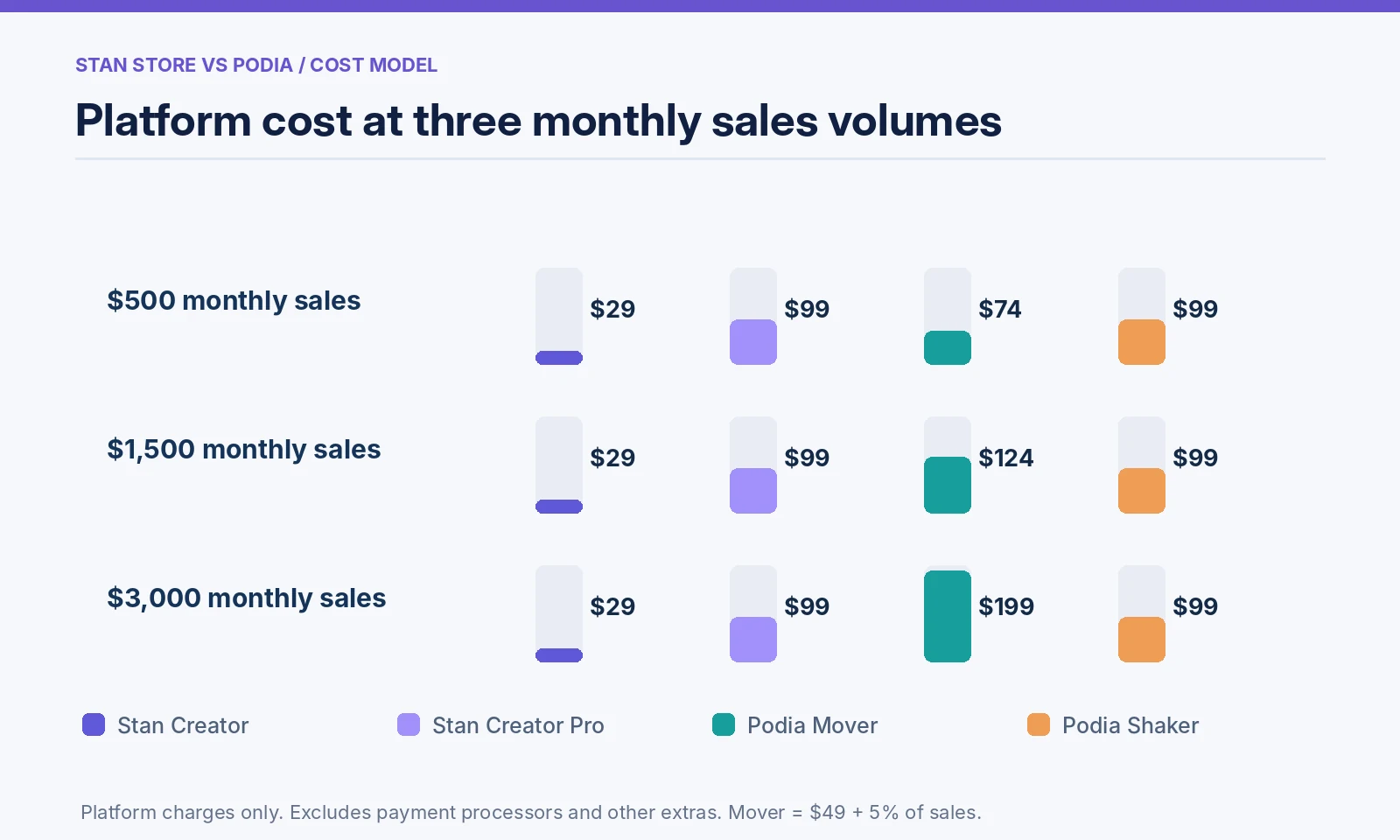
Because Mover and Shaker differ by $50 per month in headline monthly price, and Mover charges 5% of sales, the arithmetic is simple. Ignoring differences in features, email-list add-ons and external processor charges, $50 ÷ 0.05 = $1,000 in monthly sales. At that point, the 5% Mover fee equals the extra $50 needed to upgrade to Shaker. Below $1,000, Mover can be cheaper on the platform bill alone. Above $1,000, Shaker can be cheaper even before its additional features are considered. This is a threshold illustration, not a recommendation to upgrade automatically.
At $500 in monthly sales, Mover’s modeled cost is $49 plus $25 in Podia fees, or $74 before processing. At $1,500, it becomes $49 plus $75, or $124, while Shaker remains $99 before processor and other variable charges. At $3,000, the Mover platform total rises to $199. Stan Creator stays $29 and Stan Creator Pro $99 in platform subscription terms across all three examples, with processor fees and any extra services excluded. That table is useful, but the feature set may still justify paying more or less: a creator who needs a full website cannot replace that function with a pure subscription comparison.
Payment processor fees are deliberately excluded from the headline arithmetic because each service can vary by payment method, country and currency. In the United States, Stan’s published help center gives a standard Stripe card example of 2.9% + $0.30, while Podia also describes separate processor fees. Different checkout methods, installments and international payments can change the actual amount. Anyone doing a detailed comparison should use their own expected transaction size and geographic sales mix, not blindly apply a U.S. example to another country.
An additional cost many Stan comparisons omit: the separate website
If a Stan user wants only a social checkout destination, a separate website may add little. If that creator wants a blog, SEO landing pages, long-form educational content, topic clusters and organic search acquisition, they may want an additional site. That introduces domain costs, hosting or another software subscription, content maintenance and tracking integration work. It does not mean Stan is a poor choice. It means the true comparison can shift from Stan versus Podia to Stan plus a website tool versus Podia with its built-in site.
Consider the creator who spends six hours each week publishing searchable articles. Podia gives those articles a natural home connected to courses and email capture. Stan can still handle payment links effectively, but another publishing system may need to route visitors to it. That architecture can work very well for an advanced creator who prefers best-in-class components. It can also add cost and complexity for a small business. The value of Podia’s integrated model is strongest when the creator genuinely needs website, content, email and products in one operating environment.
Courses, coaching and memberships: do not compare labels alone
Both platforms advertise online courses and recurring offers, so the feature checklist may look deceptively similar. A more useful comparison asks what happens after purchase. Does the buyer receive a structured lesson area, downloadable materials, a welcome email sequence, access to a community space and renewal communication? How are cancellations and billing failures handled? Can the creator identify which students completed a lesson or which leads clicked an offer? These questions reveal platform differences that a basic “supports courses” row cannot show.
Stan’s storefront is compelling for a coach whose sales process moves from a short video to a calendar booking and then into a paid program. Its analytics and upsell features can support that funnel. Podia’s course and community architecture is attractive for an educator building a library, especially if multiple related products should appear on a single site. Readers should use trial accounts to test the delivery experience on a phone. A creator-platform decision is partly about the customer journey, not only the seller dashboard. Mobile checkout friction and course access clarity are legitimate quality factors even if they never appear in an advertised feature list.
What about annual billing, free trials and migration?
Annual billing improves the nominal monthly cost for both services, but it also means committing cash before the business knows exactly which features it will use. Stan lists $300 annually for Creator and $948 annually for Creator Pro; Podia lists annual equivalents of $42, $84 and $150 per month across its three tiers. If a creator expects to operate for only a season or is actively testing product-market fit, monthly billing may be worth paying more for flexibility. Annual savings are useful only if the product remains the right choice throughout the committed period.
Four buyer profiles and a sensible default for each
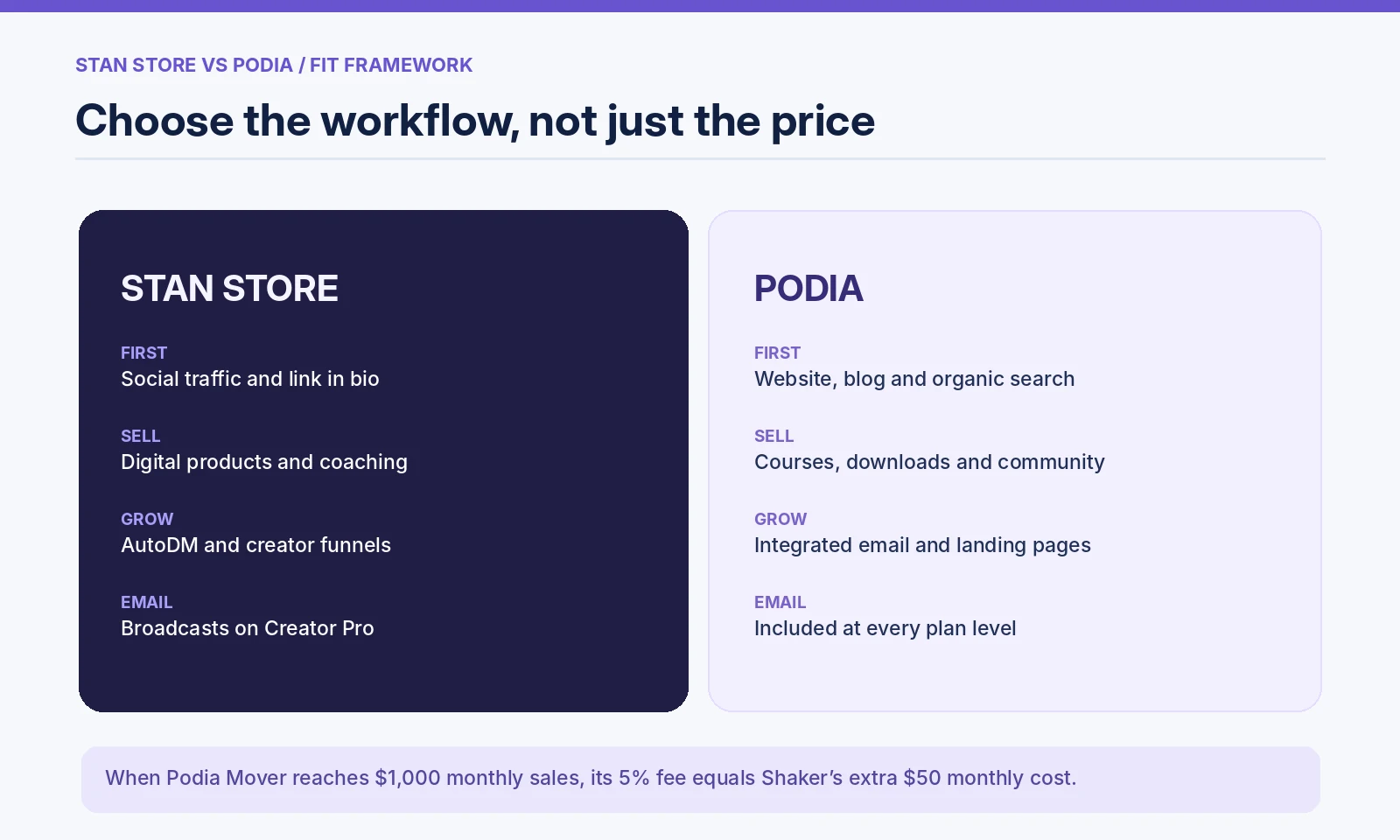
The social-first coach: A creator whose Instagram or TikTok audience already asks for coaching slots, mini-courses and downloadable resources will often appreciate Stan’s direct link-in-bio design. Creator can be a reasonable starting tier if email broadcasts and advanced funnels are not needed. Creator Pro makes more sense when automation and upsells become central to the business.
The course publisher with a growing blog: An educator producing articles, free resources, long courses and an ongoing newsletter will probably benefit more from Podia’s website-plus-email model. Mover is appealing when monthly sales remain modest; Shaker becomes financially interesting above the fee break-even point or when affiliate and upsell features are needed.
The established creator with substantial sales: At this stage, processor fees, platform fees, list growth, conversion rates and maintenance costs often matter more than the lowest subscription price. Compare Stan Pro and Podia Shaker with a real monthly sales model, then test funnel capabilities rather than choosing solely on an identical $99 sticker price.
The creator who wants maximum design freedom: Neither platform is a complete substitute for a custom website or independent marketing stack. It may be appropriate to keep a separate CMS and use either service only for its strongest functions. The trade-off is operational complexity. A more modular architecture can be flexible, but small teams often benefit more from reducing the number of moving parts than from maximizing theoretical customization.
What we would test before committing
Start with a single real offer. Build its page, attach a payment method, collect an email address, create a short welcome sequence and make a test purchase where permitted. Record the number of steps, mobile behavior, checkout appearance and delivery experience. Then ask whether the result feels like your brand and whether you can maintain it without specialized help. For a social-first creator, test the direct path from a mobile profile link to checkout. For a search-first creator, test publishing an article and connecting it to a product offer and email funnel.
Final verdict: Stan Store or Podia?
Stan Store wins on speed and focus for social monetization. Its Creator plan has a low fixed price, its platform takes no direct transaction share, and Creator Pro adds strong sales-oriented tools. Podia wins on breadth for creators building a website, courses, community and email operation together. It has more moving plan limits, and Mover’s 5% transaction fee is a real cost, but the integrated feature set can replace other subscriptions and publishing workflows.
There is no universal champion. Choose Stan when you want to turn an existing social audience into bookings, digital-product sales and direct offers with minimum site-building overhead. Choose Podia when content discovery, a full website, education delivery and email nurture are central to your strategy. Above all, compare the cost of the workflow you will actually use, not the longest list of features you might never touch.
Frequently asked questions
Which is cheaper, Stan Store or Podia?
Stan Creator starts at $29/month, compared with Podia Mover at $49/month plus 5% of sales. But the products differ in website, blogging and email features. At approximately $1,000 monthly sales, Podia Shaker’s $99 platform bill equals Mover’s base price plus its 5% fee, before processor charges.
Does Stan Store charge a transaction fee?
Stan says its own platform transaction fee is 0%. Stripe, PayPal or other payment services still charge their own processing fees, and those can vary by country and method.
Does Podia include email marketing?
Yes. Podia includes newsletters and automations on its platform plans, but there are email subscriber allowances and additional capacity may cost extra. Stan Creator Pro includes broadcasts and flows, while basic Creator emphasizes lead collection rather than full email marketing.
Which platform is better for SEO and blogging?
Podia includes a website and blog, making it a more natural option for content-led acquisition. Stan prioritizes link-in-bio social conversions; a creator needing a larger searchable website may prefer an additional publishing tool.
Should I choose annual billing immediately?
Not necessarily. Test the checkout, product delivery, email functions and support workflow first. Annual billing can save money, but it reduces flexibility if the platform proves unsuitable.
Official sources and review methodology
Pricing and features were checked against the Stan Creator versus Creator Pro help article, Stan transaction-fee help, Podia pricing and Podia plan limits, October 2026. Cost examples use published headline monthly prices, exclude processor fees unless stated and are not based on a live sales account or proprietary testing.

Croom Raymond is an ecommerce writer and digital business researcher at Ecom Reality. He covers online selling platforms, SaaS tools, pricing structures, platform features, and practical strategies for building digital businesses. His articles focus on clear, evidence-based analysis that helps readers understand how different services work, compare their advantages and limitations, and make more informed business decisions.
Comments
Related Articles


Leave a Reply