
Introduction
The online business space is crowded with platforms that promise simplicity and deliver complexity. Most require you to source your own products, build your own store, figure out marketing from scratch, and somehow compete with sellers who have been doing this for years. For someone with no ecommerce background and a limited budget, the barrier to entry remains stubbornly high.
Sellvia takes a fundamentally different approach. After analyzing the platform in depth – including its full pricing structure, subscription architecture, advertising mechanics, and product model – we believe it represents one of the more thoughtfully engineered entries in the beginner online business market today.
One thing needs to be said upfront: Sellvia is not a dropshipping tool. It is a SaaS online business platform built around digital products – guides, courses, checklists, and online tools. No warehouses, no shipping, no physical inventory. The distinction is architecturally important, and it shapes everything about how the platform works and who it works for.
This review covers the full picture – what you get, what it costs at every tier, how the advertising system actually scales, and what the real economics look like for a new store owner starting from zero.
1. What Sellvia Actually Is – And What It Isn’t
The single most important thing to understand about Sellvia is what category it belongs to – because the platform has been misclassified in online discussions more often than it deserves.
Not Dropshipping. A SaaS Business Platform.
Traditional dropshipping involves finding suppliers, listing physical products, managing logistics, and handling shipping delays and returns. It is operationally complex – exactly the kind of complexity that causes most beginners to quit within weeks.
Sellvia operates in an entirely different paradigm. Every product in the catalog is digital – delivered instantly and automatically when a customer completes a purchase. There is no supplier relationship to manage, no shipping timeline to worry about, no returns of physical goods. The store owner’s margin on each sale is 50-70%, and that margin is earned without touching a product.
The SaaS model is the key architectural insight. Sellvia charges a flat monthly fee in exchange for platform access, a ready-built store, a digital product catalog, and – critically – a built-in advertising system that drives traffic to that store. The customer is not managing a supply chain. They are operating a software-powered business on infrastructure Sellvia has already built.
This matters practically because:
- Digital products have no per-unit cost of goods – margin is structural, not negotiable
- Instant delivery eliminates the most common source of customer complaints in physical ecommerce
- No inventory risk – the catalog scales with demand without restocking or warehousing
- The business model is genuinely location-independent and runs on a smartphone
2. Platform Architecture: What You Actually Get
When a customer signs up for Sellvia, the onboarding is designed around a single principle: make the business operational before the customer has to make a single technical decision.
The Ready-Made Store
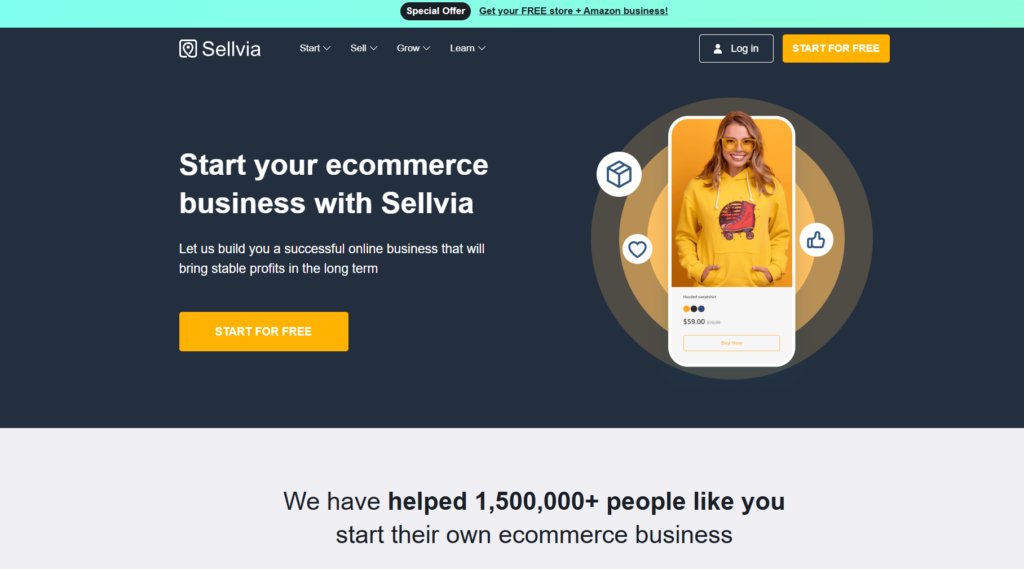
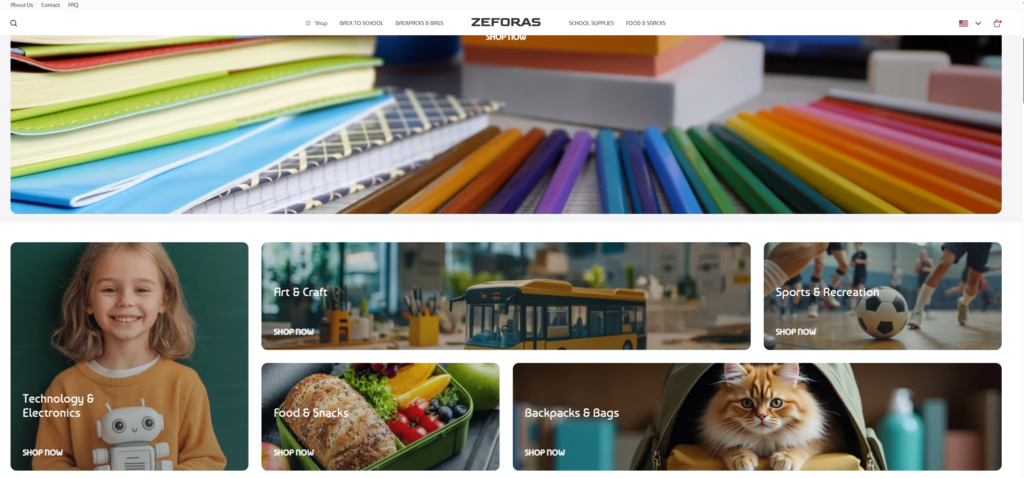
The store is built for you – not a template requiring customization, but a functional ecommerce storefront pre-loaded with digital products from the Sellvia catalog. Store infrastructure, design, checkout system, and hosting are all in place from day one.
For comparison: Shopify gives you a blank canvas and a powerful toolset, but you are responsible for every decision from store design to product sourcing to marketing strategy. For someone who has never run an online business, this is an enormous cognitive and technical burden. Sellvia removes that burden entirely. The store is a vehicle. The customer’s job is to turn on the engine.
The Digital Product Catalog
All products in the Sellvia catalog are created and owned by Sellvia – not sourced from third parties, not PLR (Private Label Rights) content, and not repackaged material. The platform’s Terms of Use confirm that each digital guide and educational material is developed internally by the Sellvia team. This matters for quality control – the product Sellvia sells as its own is the product its clients’ customers receive.
The economics are straightforward: a store owner marks up catalog products 50-70% above the base price. On a digital guide priced at $25 and marked up to $42, the store owner keeps roughly $17 per sale after the order processing fee. Volume of 50 sales per month generates approximately $850 in profit against a $39 monthly platform cost. The unit economics scale cleanly.
The Built-In Advertising System
This is the feature that genuinely sets Sellvia apart from every competitor at this price point, and the one that most directly addresses the biggest failure mode for new online businesses: the traffic problem.
Every major ecommerce platform – Shopify, WooCommerce, BigCommerce – hands you a store and expects you to figure out customer acquisition independently. You either hire a marketing agency, learn paid advertising yourself, or wait for organic traffic that may never come. For a beginner with no marketing background, this is where almost everyone fails.
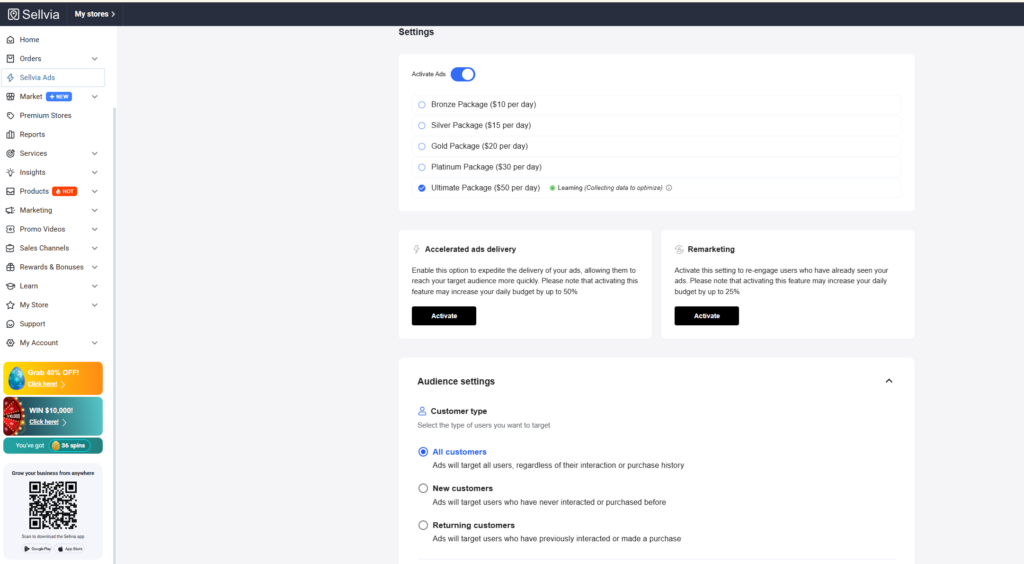
Sellvia’s built-in ad system eliminates this bottleneck. The customer sets a starting daily budget, activates the system, and the platform handles targeting, creative assets, and optimization. Many customers see their first orders on the same day they activate ads. During the 14-day free trial, a $40 advertising coupon is included – enough to run the system for 4 days at the starting budget before spending a dollar of personal money.
3. Pricing: What $39/Month Actually Buys You
Most platform reviews bury the pricing details or mention only the headline number. We did the opposite – we went through Sellvia’s full Terms of Use to map every layer of the cost structure. The conclusion is straightforward: $39/month is not a teaser price. It is the complete, functional package. Everything else is optional.
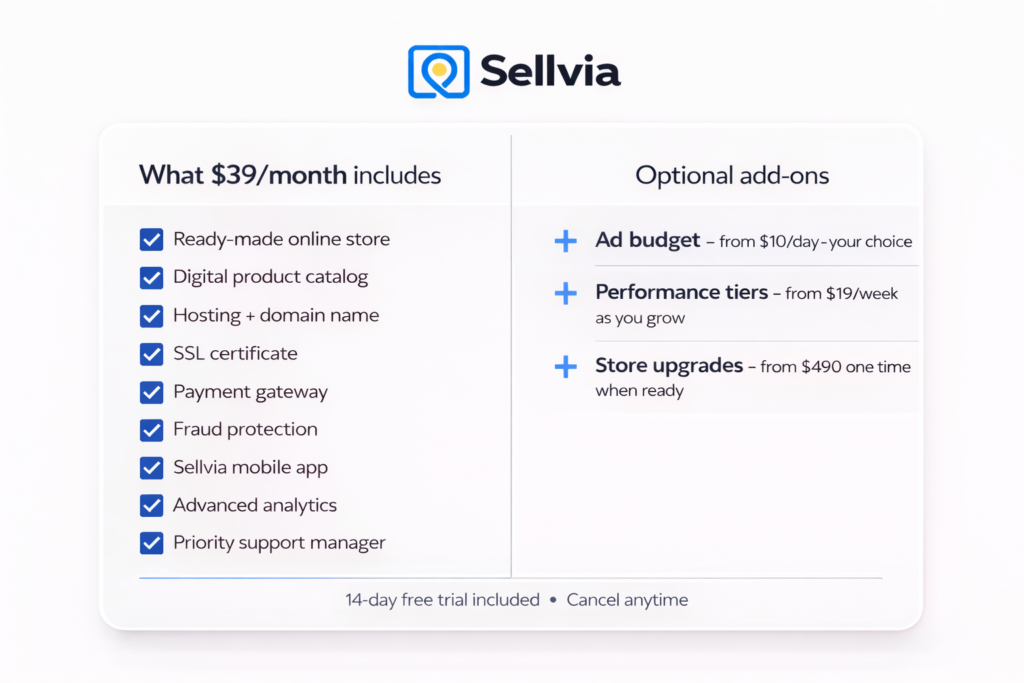
What’s Included in the $39/Month Plan – Everything You Need to Start
The Basic plan at $39/month is a complete online business infrastructure. Here is exactly what that covers:
- A fully built and hosted online store – no setup required, live from day one
- Access to the full Sellvia digital product catalog – guides, courses, checklists, online tools
- 50 products pre-loaded into your store by default
- Free domain name included
- Hosting included – no separate hosting bill
- One branded business email address (support@yourdomain)
- Basic SEO metadata configured
- Access to the built-in advertising system
- $40 advertising coupon included with the 14-day free trial
- Personal growth manager available via SMS
- Up to 5,000 products and 4GB server space
To be direct about the value comparison: Shopify at $39/month gives you a blank store shell and nothing else. You still need to source products, build the store design, and figure out marketing independently. Sellvia at $39/month gives you a store, products, hosting, a domain, and a built-in advertising system. For a beginner starting from zero, that difference is the difference between starting and not starting.
$39/month is not an entry price to a more expensive product. It is the product. A complete, operational online business for approximately $1.30/day. The free trial means you can verify this yourself before spending a cent.
Optional: Advertising Budget (Your Choice, Your Control)
The built-in advertising system is included in the $39 plan – but the advertising budget itself is the store owner’s investment, not a platform fee. This is an important distinction. Think of it like a retail store: the lease is your fixed cost, the inventory marketing budget is your growth investment. One is required to operate, the other is how fast you grow.
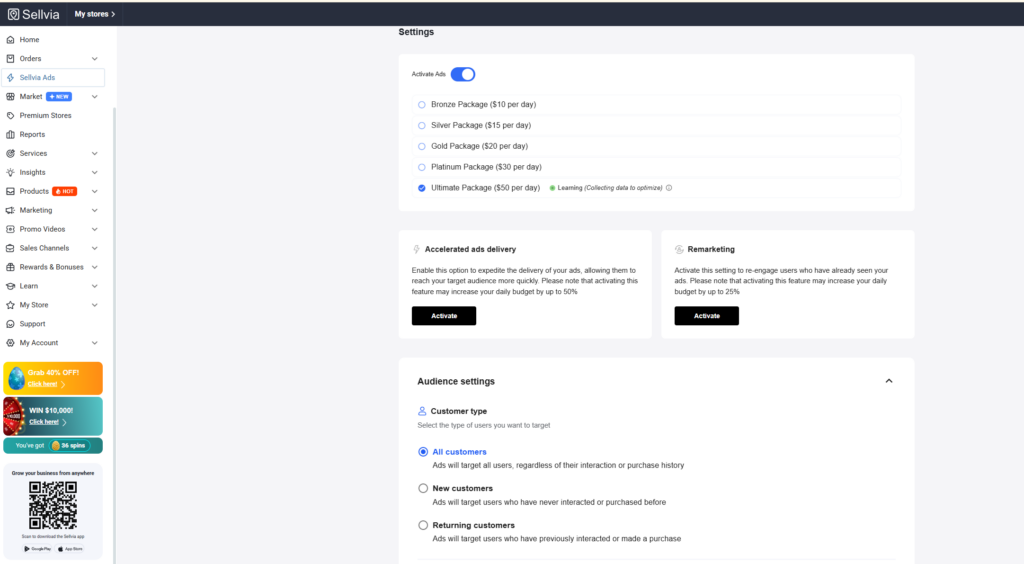
The ad system starts at $10/day and scales progressively as campaigns mature and the algorithm gathers data:
| Package | Daily Spend | Unlocked After | Monthly Ad Budget |
| Bronze (default) | $10/day | Day 1 | ~$300/month |
| Silver | $15/day | Day 5 | ~$450/month |
| Gold | $20/day | Day 10 | ~$600/month |
| Platinum | $30/day | Day 20 | ~$900/month |
| Ultimate | $50/day | Day 30 | ~$1,500/month |
The progression from $10/day to higher budgets happens automatically based on campaign duration – and it reflects sound advertising practice. Budgets scale as the system has more data to optimize against. Crucially, a store owner can reduce their daily spend back to any previously reached level at any time through the dashboard. The $40 trial coupon covers the first 4 days at the starting rate, meaning many customers see real orders before spending any personal money on ads.
Advertising spend is the accelerator, not the engine. The store runs on the $39/month platform. Ad spend determines how fast customers arrive. A store owner who wants to move slowly can stay at $10/day indefinitely. A store owner who sees strong returns can let the system scale.
Optional: Performance Tiers (Only When You’re Growing Fast)
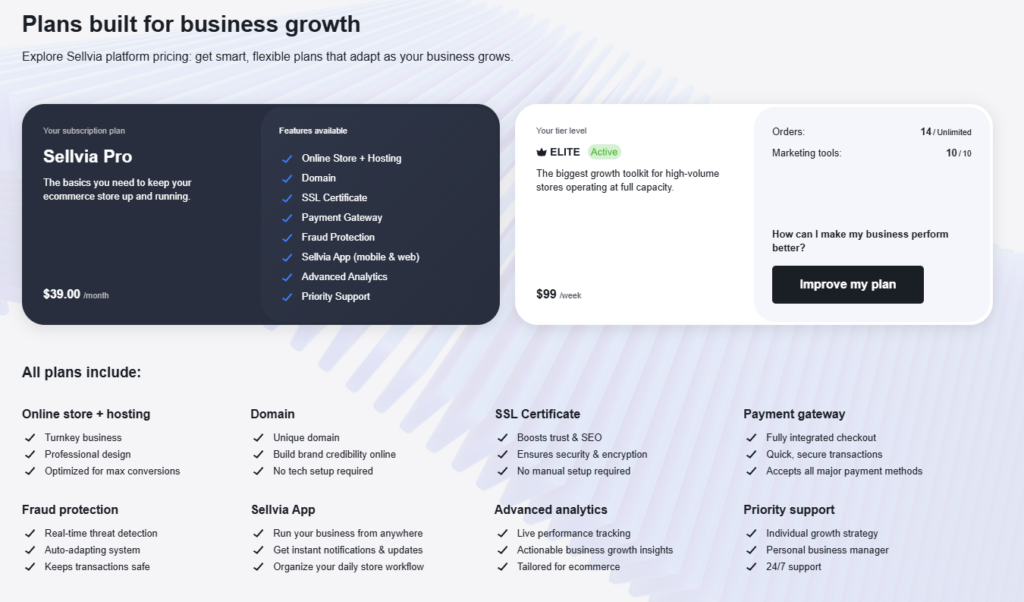
Performance Tiers are an entirely optional add-on that becomes relevant when a store is processing significant order volume. The free Basic Performance Tier handles up to 50 orders per month – which is a meaningful level of business for a store that is just starting out. Most new store owners will never need to upgrade beyond the free tier in their first months.
| Tier | Weekly Cost | Order Cap | Key Tools Included |
| Basic | Free | 50 orders | Limited access |
| Plus | $19/week | 100 orders | Email Marketing, Google Backlinks |
| Advanced | $39/week | 250 orders | + Social Media, SEO Blog, Design Tools |
| Pro | $69/week | 500 orders | + YouTube Marketing, Promo Videos |
| Elite | $99/week | Unlimited | Full tool suite incl. TikTok, Instagram Ads |
When a store does scale past 50 orders per month, the paid tiers unlock additional marketing tools: email automation, Google backlinks, social media tools, SEO blog posts, design customization, YouTube marketing, and more. These are growth-stage tools, not starter requirements. The free tier is genuinely sufficient for launch and early operation.
Optional: Store Upgrade Packages (For Those Who Want a Head Start)
For store owners who want a more differentiated setup from day one, Sellvia offers one-time upgrade packages. These are completely optional and the standard $39/month store is fully functional without them:
- Silver Package: $490 one-time – unique custom store design, unique logo, 20 unique products, 25 high-margin products, 250 proven best-sellers, 25 promotional articles
- Gold Package: $990 one-time – expanded inventory with 40 unique products, 50 high-margin products, 500 proven best-sellers
- Platinum Package: $1,690 one-time – full premium setup with 100 unique products, 100 high-margin products, cinematic homepage video, 1,000 proven best-sellers
These packages make most sense for store owners who have already validated the model and want to invest in standing out from the standard catalog. They are not a prerequisite to getting started – they are an acceleration option for those who want one.
How Commissions Work: Getting Paid
When a sale is made through the store, the commission moves through a three-stage lifecycle: Pending (order awaiting processing) to Incoming (order processed, 72-hour verification) to Available (ready to withdraw). The 72-hour window is standard fraud prevention practice – the same logic used by every major payment platform.
To withdraw: the Sellvia subscription must be active, and a minimum of $100 in available commission must have accumulated (for US residents). For a store running at 10-15 sales per month at $15-20 margin per sale, this threshold is reachable within the first couple of months of active operation.
$39/month gives you everything needed to start and operate a fully functional online business. Advertising spend ($10/day minimum) is your growth investment – optional but recommended. Everything else – upgrade packages, higher Performance Tiers, additional marketing services – is strictly on your own terms, when and if you decide the returns justify it.
4. Competitive Positioning: How Sellvia Compares
Platform Comparison
| Feature | Sellvia | Shopify | Wix | Etsy |
| Ready-made store | Yes – day one | Build yourself | Build yourself | No store |
| Products included | Full catalog | Source yourself | Source yourself | Make/source own |
| Built-in ad system | Yes – 1-click | No | No | Limited only |
| Digital products | Yes – all products | Optional | Optional | Allowed |
| Entry price | $39/mo | $39-$399/mo | $17-$159/mo | No monthly fee |
| Free trial | 14 days + $40 ad coupon | 3 days | Free plan (limited) | None |
| Experience needed | None | Moderate | Low-Moderate | Low-Moderate |
The table above reveals a structural advantage that goes beyond feature-by-feature comparison. Sellvia is the only platform in this group that combines a pre-built store, a pre-loaded product catalog, and a built-in advertising system at a beginner-accessible price point. Every other platform requires the user to solve at least one of these three problems independently – and for most beginners, any one of them is enough to cause failure.
The Traffic Problem: Sellvia’s Core Differentiator
The single largest failure mode for new online businesses is the traffic problem: a store is built, products are listed, and then no one visits. Digital marketing is a professional discipline – Google Ads, Facebook Ads, audience targeting, creative testing, bid optimization. Most beginners have no practical foundation in any of it.
Sellvia solves the traffic problem at the platform level. The built-in ad system means a customer who activates ads on day one is immediately in the paid acquisition marketplace with infrastructure the platform has already optimized. This is categorically different from any competitor handing you a store and expecting you to figure out marketing independently.
In the beginner online business segment, Sellvia has no direct competitor that matches its full-stack approach at this price. The closest analogues are franchise models or business-in-a-box systems that cost tens of thousands of dollars upfront.
5. Industry Recognition and Credibility Signals
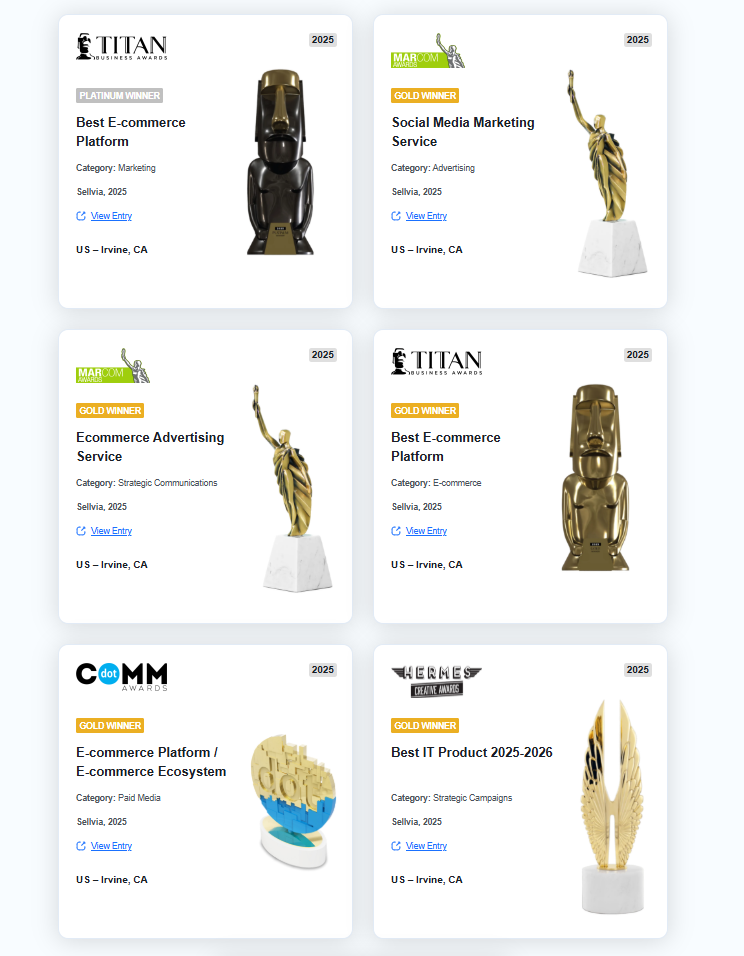
We approach award claims in platform reviews with measured skepticism. Sellvia’s recognition portfolio, however, warrants genuine consideration because it spans independently verified categories.
- TITAN Business Awards – Platinum (Best E-commerce Platform) and Gold (Best E-commerce Platform): peer-reviewed competition requiring competitive submission
- Hermes Creative Awards – Platinum (Leading E-commerce Platform) and Gold (Best IT Product 2025-2026): evaluated by the Association of Marketing and Communication Professionals
- G2 Best Commerce Software 2026 – top 1% globally: rankings derived from verified user reviews, not editorial panels
- Inc. 5000 #1818 among America’s fastest-growing private companies: revenue-verified, independently audited
- Forbes Communications Council and Entrepreneur Leadership Network: organizational credibility affiliations
The G2 recognition carries particular analytical weight because it reflects what actual verified users say about the platform – not what an industry panel thinks about it. Top 1% of commerce software globally is a significant statement when the benchmark is user-reported satisfaction.
6. The Customer Journey: What the Data Shows
Funnel Performance
Sellvia’s conversion funnel operates at strong efficiency: approximately 50% of leads convert to a free trial, and 30% of trial users convert to paid subscribers. Typical SaaS trial-to-paid conversion sits at 10-25% – Sellvia’s 30% figure reflects genuine product-market fit, not just aggressive marketing.
The customer acquisition cost of approximately $20 per trial, against a lifetime value of approximately $300, produces a 4.5x LTV/CAC ratio. This is the financial signature of a platform that delivers enough real value to justify continued payment.
The Activation Moment
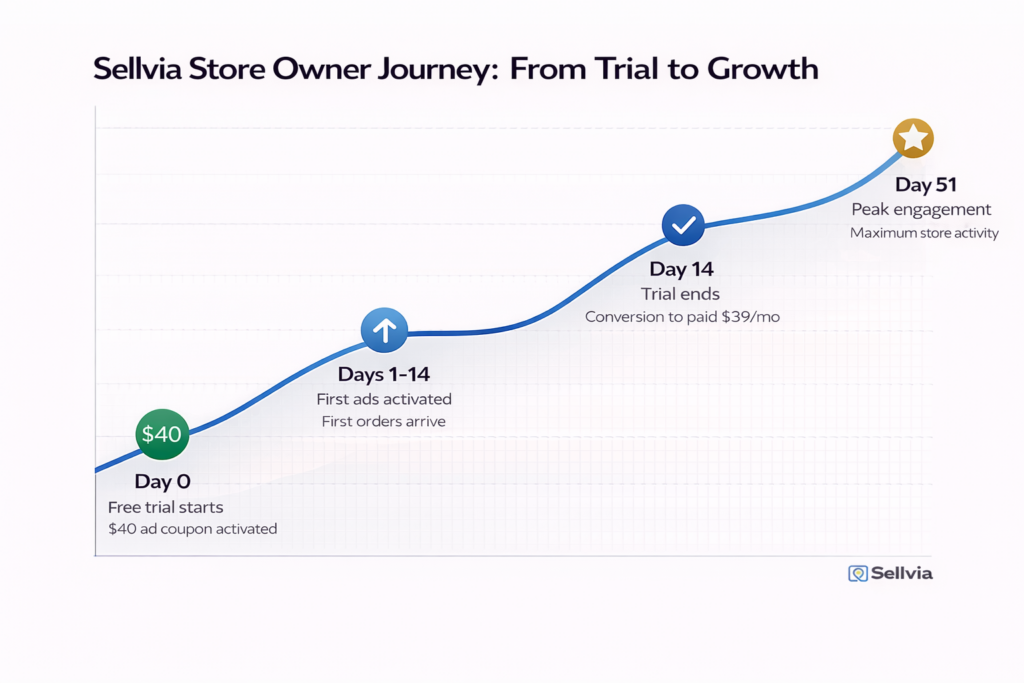
The most strategically important insight from Sellvia’s customer data is the primacy of what the platform calls the activation moment: the first time a new store owner launches ads and sees real orders come in.
Customers who reach this moment within the first 14 days convert to paid at substantially higher rates. This is precisely why the $40 ad coupon is included with the trial – it is not just a promotional incentive, it is a mechanism for ensuring new customers reach their activation moment before the trial ends. Peak customer spending occurs around day 51, suggesting that early momentum genuinely compounds.
Realistic Expectations
A complete analysis requires acknowledging the full picture alongside the strengths:
- The average customer lifetime of 2-3 months indicates that sustained engagement requires consistent effort. This is true of any business – not a platform-specific failure.
- Building and maintaining ad performance requires attention to the dashboard and willingness to reinvest revenue into continued advertising.
- Results vary based on product selection, ad performance, and market conditions. The platform’s tools are strong – but the owner’s engagement determines outcomes.
These are honest structural considerations that apply to any business model, online or offline. Sellvia’s transparency about costs and processes in its Terms of Use is itself a credibility indicator – everything is disclosed before a customer commits.
7. The ‘Robinhood of Online Business’ Positioning – Does It Hold Up?
Sellvia positions itself as the Robinhood of online business – a platform that democratizes access to income generation for people previously excluded from it. It is a bold claim. After a full structural analysis, we think it holds up in the ways that actually matter.
The accessibility features of the platform are architectural decisions, not marketing language. A customer who only has a smartphone can run a Sellvia business. A customer who has never run ads can activate a campaign with one click. A customer with no product ideas can choose from a ready-made catalog. A customer with no web development skills can have a functioning store on the same day they sign up – at $39/month.
The Robinhood analogy is precise in one specific way: both platforms removed the infrastructure barrier to participation. Robinhood removed the broker requirement for investing. Sellvia removes the technical and operational expertise requirement for running an online business. Whether participants succeed depends on their own effort and market conditions – but the access is real.
The 1.5 million stores launched and $1.5 billion earned by store owners are not projections – they are documented outcomes of the platform operating at scale. Those numbers represent real people who found a path to online income that was previously inaccessible to them.
8. What’s Coming: The Store Reactivation Program and Marketplace
One of the most strategically interesting developments currently being rolled out at Sellvia is the Store Reactivation Program – a mechanism that allows established store owners to return their store to Sellvia’s inventory, where it is then made available to new customers.
The financial structure is notable: Sellvia may allocate up to 70% of the listing price as commission to the referring store owner, funded from Sellvia’s corporate operating budget. This is not a peer-to-peer transaction – Sellvia owns all stores on the platform and acts as the sole seller. But the economic effect for an established store owner is similar to a business exit: build something, then receive a lump-sum incentive when Sellvia relists it.
The narrative implication is significant. The platform story shifts from ‘earn monthly income from your store’ to ‘build a store asset, grow it, and eventually receive a substantial payout when you hand it back.’ For store owners motivated by long-term financial goals, this adds a compelling exit dimension that no comparable platform offers.
We will evaluate the full marketplace mechanics in detail once the program is more broadly available. The structural intent, however, is sound and consistent with Sellvia’s broader mission.
9. Our Assessment: The Sellvia Verdict
What the Platform Gets Right
- Full-stack approach eliminates the primary failure modes for beginners – no store to build, no products to source, no marketing to figure out independently
- Digital products remove logistics complexity entirely – instant delivery, no physical inventory, no returns
- Built-in advertising system solves the traffic problem that kills most new stores before they start
- Free trial with $40 ad coupon creates a genuine proof-of-concept before any money is spent
- Transparent pricing structure – all fees disclosed at checkout, Terms of Use publicly available and detailed
- Platform scales with business growth – Basic tier handles early stages, Performance Tiers and upgrades available as volume grows
- 1.5M stores launched and $1.5B earned represent documented outcomes, not projections
- Industry recognition across multiple independently verified categories reinforces legitimacy
What to Plan For Before Starting
- Full first-month budget is approximately $340 ($39 platform + ~$300 ad spend) – not just the $39 headline price
- Ad spend scales automatically as campaigns mature – budget planning should account for months 2 and 3
- Performance Tiers are a separate weekly subscription that becomes relevant as order volume grows
- Commission withdrawal requires a minimum $100 balance and an active subscription
- Optional store upgrades ($490-$1,690) are not required but accelerate differentiation
Final Assessment
For the audience Sellvia is designed for – people starting their first online business with limited experience and accessible capital – this is one of the most structurally complete platforms in the market.
It is not the right tool for experienced ecommerce operators who want granular control over product sourcing, custom store architecture, or independent marketing. Those users are better served by Shopify or WooCommerce.
But for someone who discovered this platform while searching for a legitimate way to earn income online, who needs infrastructure provided rather than built from scratch, and who wants to start without years of technical learning first – Sellvia delivers on its core promise in a way no direct competitor currently matches.
The SaaS model is the right architecture. Digital products are the right product strategy. The built-in ad system is a genuine competitive moat. The pricing, when understood fully, is fair for what is delivered. And the free trial means the only cost of evaluating the platform honestly is 14 days of attention.
Start with the free trial. Activate the $40 ad coupon on day one. Evaluate based on what you actually see in the dashboard – not what anyone tells you to expect.
ecomreality.com publishes independent analytical reviews of ecommerce and online business platforms. Our reviews are based on publicly available platform information, official Terms of Use documentation, industry recognition records, and structural analysis of business model mechanics. Pricing and terms verified against sellvia.com/terms-of-use as of April 2026. We do not guarantee specific income results for any platform reviewed.
2 responses to “Sellvia Review 2026: How a SaaS Platform Is Quietly Rewriting the Rules of Online Business”
-
Honestly, this lines up pretty closely with my own experience so far.
I came in with zero background, and the biggest difference for me was not having to figure out 10 different things at once. The store was already there, products were already loaded, and I didn’t have to sit for weeks watching tutorials just to get something live. That alone removed a ton of friction.
The ad system was the part I was most skeptical about, but it actually works if you give it some time and don’t panic after day one. My first few days were slow, then I started seeing orders come in, and that’s when it kind of “clicked” for me. It’s not magic, but it’s definitely more beginner-friendly than trying to run ads completely on your own.
Also agree with the point about expectations. It’s not passive, you still need to pay attention, check what’s working, and reinvest. But compared to everything else I’ve tried before, this felt way more structured and less chaotic.
Not perfect, but for someone starting from scratch, it’s one of the few setups that actually makes sense without overcomplicating everything.
-
Pretty solid breakdown. I’ve been using Sellvia for a couple of months and the biggest thing for me was just how fast you can get started. No setup headaches, no guessing what to sell.
It’s not “set and forget,” but it’s way more straightforward than anything else I’ve tried. For beginners, that alone makes a huge difference.


Related Articles

Leave a Reply