
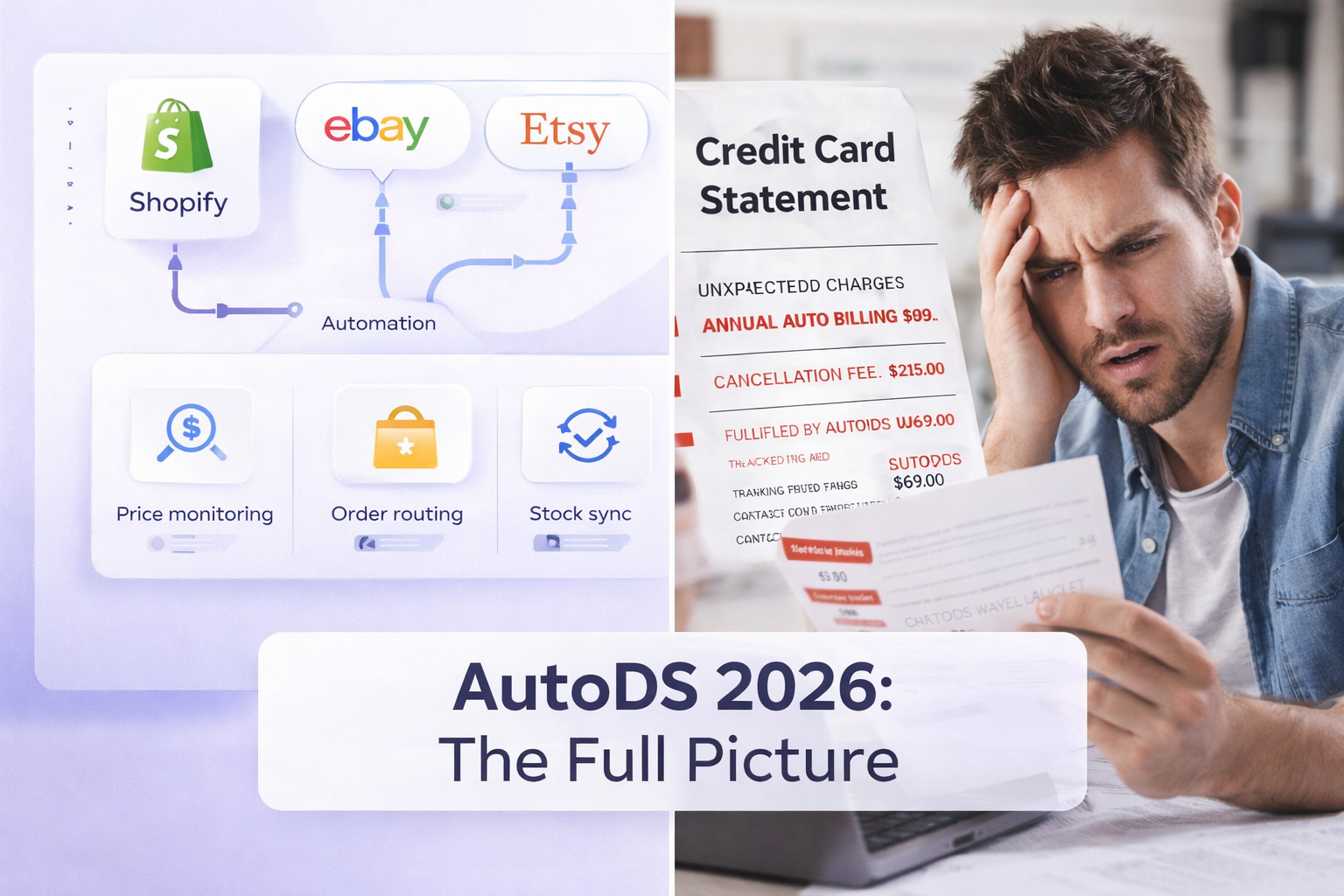
AutoDS is one of the most talked-about dropshipping automation platforms in 2026, and the conversation cuts in two very different directions. On one side: a feature set that genuinely covers more ground than most competitors, with multi-channel support across 8 selling platforms and connections to 25+ suppliers. On the other: a documented billing track record that includes unauthorized annual charges, a 15% cancellation fee, and an “F” rating on the Better Business Bureau with 45 unanswered complaints out of 56 filed.
This review gives equal weight to both sides. If you’re considering AutoDS, the goal here is to give you an accurate picture of what the platform actually delivers – and what risks come with it.
Interesting fact worth noting: AutoDS holds an “F” rating on the Better Business Bureau with 45 unanswered complaints out of 56 total filed. This stands in stark contrast to their 4.8 rating on Trustpilot with 26,000+ reviews – one of the widest rating divergences in the dropshipping software category. Understanding why requires reading both sides carefully.
What AutoDS is and how it positions itself
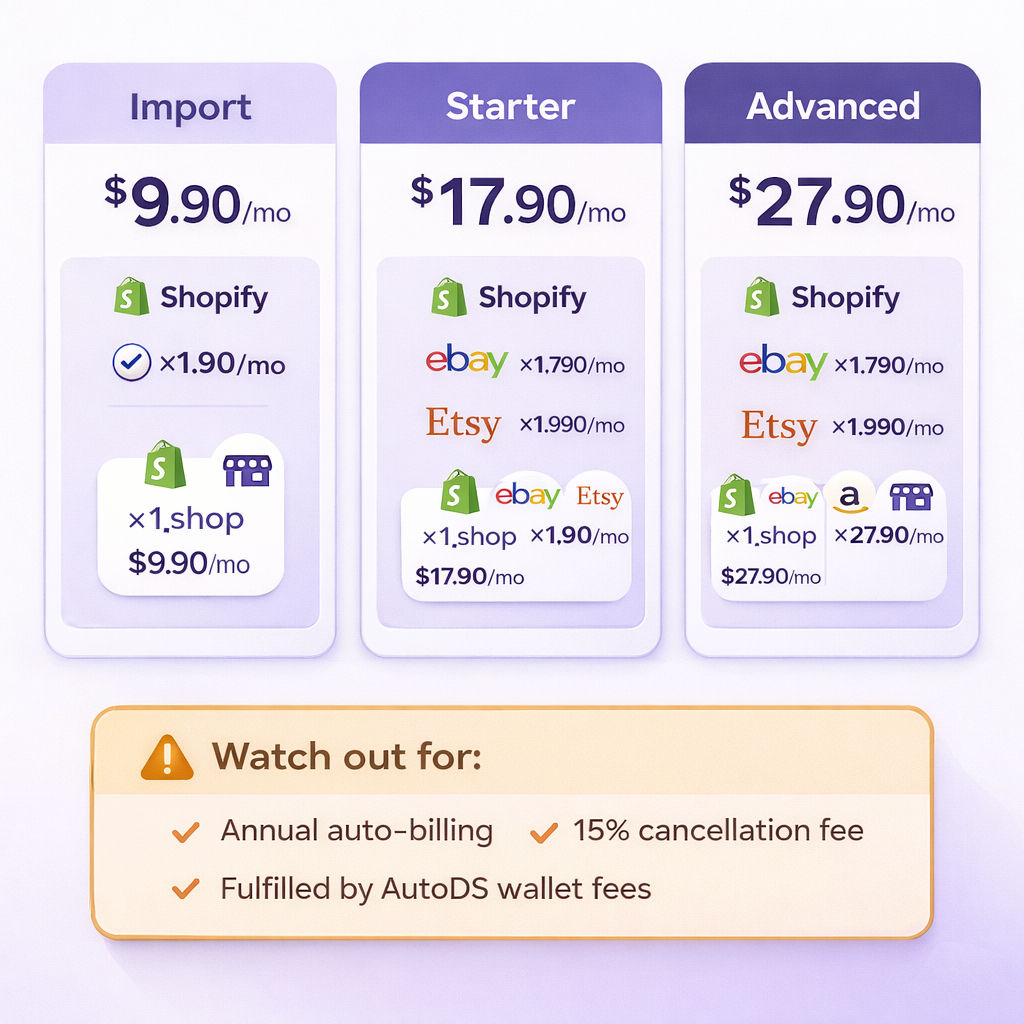
AutoDS, founded in Israel in 2016, describes itself as an all-in-one dropshipping automation platform. The core function is backend automation: connect your selling accounts across Shopify, eBay, Amazon, Etsy, Facebook Marketplace, WooCommerce, Wix, and TikTok Shop, then let the software handle price monitoring, stock updates, order routing, tracking number updates, and customer messaging.
Critically, AutoDS is an automation layer – not a supplier marketplace. It does not source products for you or provide a ready-made catalog. You still need to find products, validate demand, and build your store. What AutoDS handles is the repetitive operational backend that would otherwise consume hours of manual work daily at scale.
Key positioning: AutoDS is an automation and operations layer – not a supplier marketplace. You still need to find and validate your products and source them yourself. AutoDS handles the monitoring, price adjustments, order routing, and tracking – the backend that would otherwise consume hours of manual work daily.
Pricing: more complex than it first appears
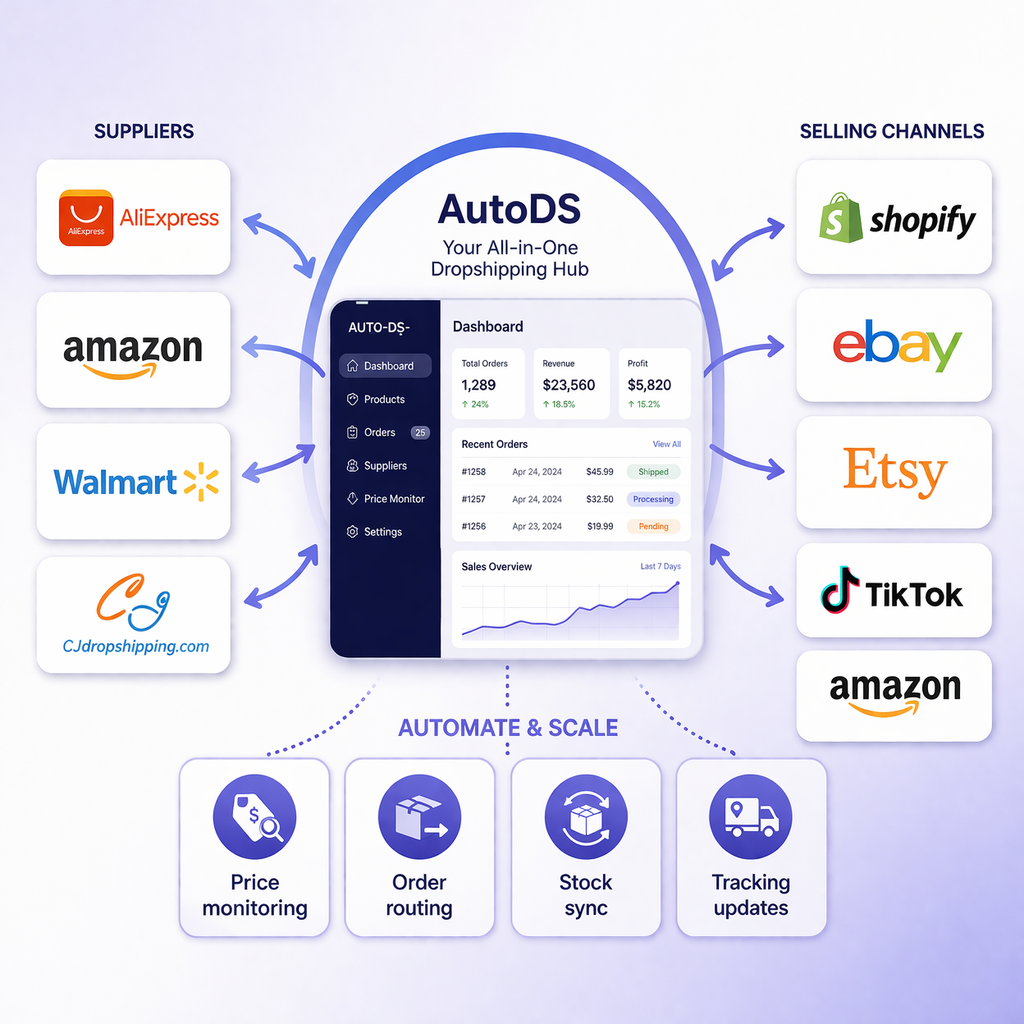
AutoDS pricing has a structure that catches many users off guard. There are three plan tiers – Import, Starter, and Advanced – but prices differ per selling channel. A Shopify plan costs differently from an Amazon plan. Multi-channel sellers therefore pay per marketplace, meaning costs multiply quickly.
Plan
Price range
Products
Key features
Import
~$26.90/mo
200 items
Basic import, manual ordering, price monitoring
Starter
~$39.90/mo
500 items
Auto ordering, smart pricing, full monitoring
Advanced
~$66.90/mo
1,000+
Bulk operations, all automations, priority support
Annual billing
-25% but paid upfront
Same
Significant discount – but see billing warning below
The Import plan’s 200-product limit is a ceiling that active sellers hit quickly. One user documented reaching it within 10 days of starting. Most real operations land on the Starter plan at minimum. A multi-channel seller running Shopify plus eBay pays two separate subscriptions, pushing the real monthly cost to $80-130+ before any other tools.
There is also a “Fulfilled by AutoDS” service – an optional hands-off fulfillment layer where AutoDS processes orders using a prepaid wallet balance. This adds per-transaction costs on top of the subscription that some users report not fully understanding until they see unexpected balance deductions.
The annual billing pattern: Across Capterra, BBB, Software Advice, and PissedConsumer, a consistent complaint pattern emerges. Users select monthly billing, then later discover they were charged for a full annual plan – amounts ranging from $248 to $407. AutoDS’s cancellation terms include a 15% processing fee deducted from any refunds. Critically, canceling the account to stop further charges also removes account access, making it impossible to pursue disputes through the platform itself. This pattern is documented in complaints spanning 2024 through early 2026.
Core features: an objective assessment
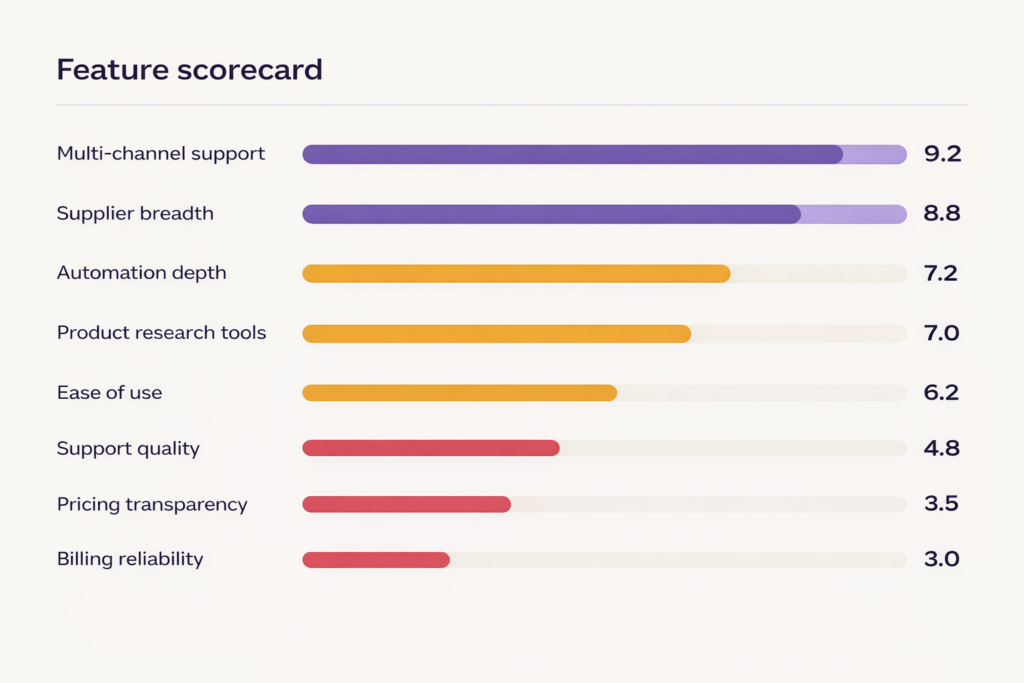
Multi-channel support
Supporting Shopify, eBay, Amazon, Etsy, Facebook Marketplace, WooCommerce, Wix, and TikTok Shop from one dashboard is genuinely uncommon. For sellers managing parallel stores across platforms, consolidating monitoring and order routing in one tool has real operational value. This is the feature that experienced multi-channel sellers most consistently praise – including in reviews on Capterra and G2 where other aspects are criticized.
Price and stock monitoring
AutoDS checks supplier prices and stock levels frequently and updates listings automatically when changes occur. For stores with hundreds of listings this prevents the overselling and margin compression problems that come with manual monitoring. However, users on Trustpilot and the Shopify App Store report inconsistencies – price changes reverting to default settings, stock status showing inaccurate information, and monitoring gaps for certain supplier categories. The feature works well for many users and inconsistently for others.
“AutoDS makes managing eBay listings much easier, especially with automated pricing, stock monitoring, and fast U.S. supplier options. Once set up correctly, it saves a lot of time and helps reduce errors.”
– Verified review, Trustpilot January 2026
“Price monitoring doesn’t work. If you adjust the price it reverts to 10% profit even if it’s set to more. Stock monitoring advises a supplier has no stock even if they have stock. Paying $350 AUD a month for this.”
– Verified review, Trustpilot March 2026
Automatic order fulfillment
On Starter and above, AutoDS routes customer orders to suppliers automatically. This is the core value proposition for high-volume stores. In practice, reports vary. One Shopify App Store review from February 2026 documents a complete failure on a first order – AutoDS accepted the fulfillment request, did nothing for four days, then instructed the user to go to Walmart.com and process the order manually. The user eventually had to refund their customer and cancel the account. This is not a universal experience, but it is a documented one.
Supplier breadth
AutoDS connects to AliExpress, Amazon, Walmart, CJ Dropshipping, Banggood, Home Depot, and 20+ others. This supplier variety is one of the platform’s genuine strengths and exceeds most competitors in sourcing flexibility. For Amazon-to-eBay arbitrage specifically, AutoDS is one of the few tools built to support that use case with supplier accounts.
Product research tools
The platform includes an AutoDS Marketplace with pre-vetted products, trending product tools, and ad spy functionality for TikTok and Facebook. AI-powered product title and description generation is a newer addition. These tools are useful but not unique to AutoDS – similar functionality exists in competing tools.
AI features and store builder
AutoDS added an AI store builder in 2025 that generates a Shopify store with products in under two minutes. For complete beginners this lowers the barrier to entry. For experienced sellers it adds limited value beyond what they already have.
Ratings across platforms: a wide divergence
AutoDS’s scores vary more dramatically than most tools in this category. The gap between platforms is itself informative.
100K+
Active sellers on platform
8
Selling channels supported
$1
Trial entry cost (14-30 days)
26,000+
Trustpilot reviews
F
BBB rating (interesting fact)
15%
Cancellation fee on refunds
The pattern mirrors what is seen with other dropshipping tools: higher scores on high-volume casual platforms, lower scores on verified business user platforms where reviewers have more at stake. One Software Advice review documents AutoDS explicitly prompting users to leave 5-star reviews in exchange for a first-month discount – a practice that, if widespread, would explain part of the Trustpilot score inflation. The BBB “F” rating reflects how billing disputes are handled at the operational level rather than how the product performs technically.
Billing complaints: the documented patterns
Billing-related complaints represent the most consistent negative theme across all independent review platforms. The complaints follow recognizable patterns that appear repeatedly from 2024 through 2026.
“They withdrew $248.70 USD without my consent, without warning, and without any way to contact real support. After I canceled my account out of fear of being charged again, I couldn’t access it anymore – making it impossible to resolve the issue.”
– Verified review, Capterra / Software Advice 2025
“They charged me the full yearly amount even though I canceled the trial on the same day I registered. When I asked for a refund, they provided a form stating that they would deduct a 15% processing fee.”
– Verified review, Capterra September 2024
“I cancelled my account and thought that was it. But after a few months, I saw that they had started to debit my card for no use of their services. When I contacted them they plainly refused to help or refund me because they claimed I had an active account.”
– Verified review, Capterra / Software Advice 2025
Specific charge amounts appearing in multiple independent complaints: $248.70, $368.70, $363, $350, $407 – all corresponding to annual plan billing rather than the monthly billing users believed they had selected. At least one BBB complaint documents AutoDS creating a second account for a user without authorization after they had explicitly requested cancellation, then using that account to continue charging.
If you use AutoDS – practical steps: (1) Sign up with a virtual card that has a spending limit. (2) Screenshot every step of plan selection – document monthly vs annual explicitly. (3) Set a calendar alert 3 days before your trial end date. (4) Cancel through the dashboard AND send a timestamped email to support. (5) Monitor your card for two billing cycles after cancellation. (6) If charged unexpectedly, dispute through your card issuer directly – BBB and direct support resolution have low documented success rates.
Feature scorecard
Pros and cons
Genuine strengths
Documented weaknesses
- Widest multi-channel support in category – 8 platforms
- 25+ supplier connections including Amazon, Walmart, AliExpress
- Strongest option for Amazon-to-eBay arbitrage specifically
- Price and stock monitoring saves real hours at scale
- $1 trial gives genuine full-access testing
- AI product description tools improve listing quality
- Print-on-demand support added 2024
- Active product research and trend tools
- Annual auto-billing pattern documented in 100+ complaints
- 15% fee deducted from refunds even on disputed charges
- BBB “F” rating – 45 of 56 complaints unanswered
- Account lock-out after cancellation blocks dispute resolution
- Per-marketplace pricing – multi-channel costs multiply fast
- 200-product Import limit reached quickly by active sellers
- Automation reliability inconsistent per user reports
- Incentivized review practice documented on Software Advice
- Steep learning curve for beginners
Who AutoDS fits – and who should consider alternatives
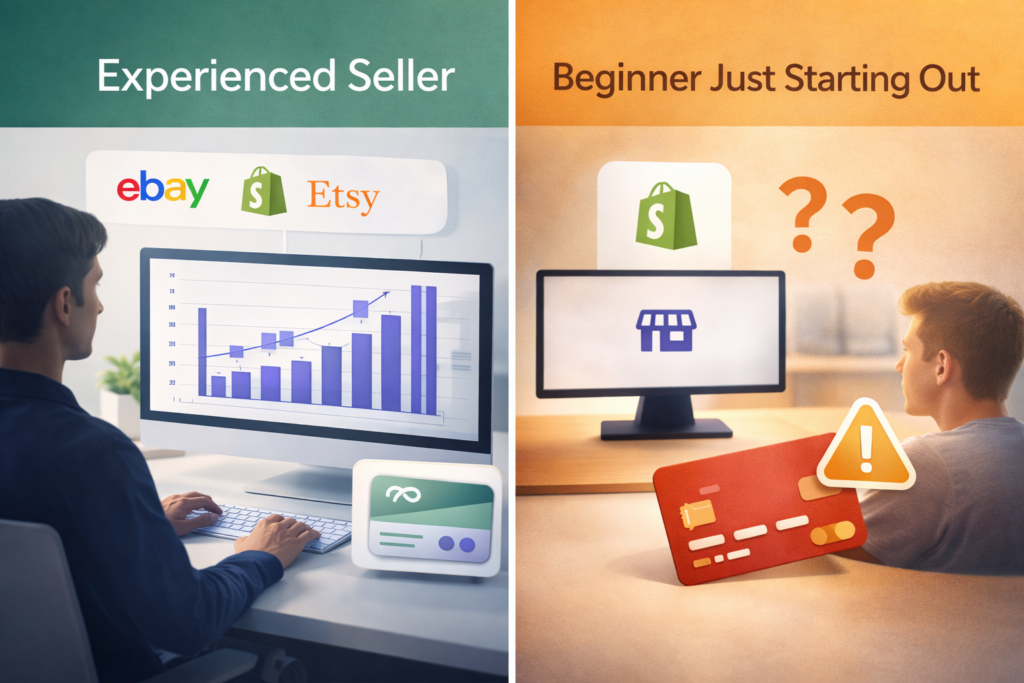
AutoDS fits well if…
Consider alternatives if…
- You manage 500+ products across multiple platforms
- You run eBay and Shopify stores in parallel
- Amazon-to-eBay arbitrage is part of your model
- Automation ROI is clear and measurable in your operation
- You use a virtual card and actively monitor billing
- You have prior SaaS subscription management experience
- You’re building your first store and haven’t made sales yet
- You sell on one platform only – cheaper options exist
- You have a low tolerance for billing complexity
- You need reliable refund access if something goes wrong
- Your budget can’t absorb an unexpected $250-400 charge
- You’re selling on Amazon primarily – IP risk from some suppliers
Alternatives to consider
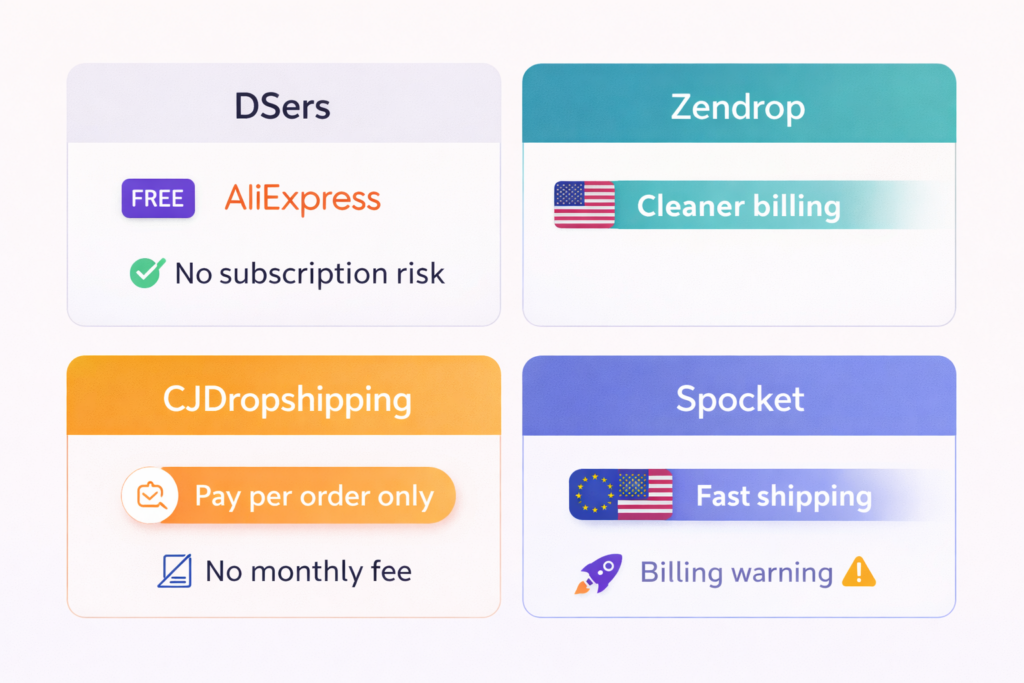
DSers is free for basic use and purpose-built for AliExpress and Shopify. No subscription risk, no billing complexity. The trade-off is limited to AliExpress sourcing and no multi-channel support.
Zendrop focuses on US-based fulfillment with a cleaner billing model and fewer documented complaints. A free plan with limited features makes it lower risk to test.
CJDropshipping charges per order rather than a monthly subscription, eliminating subscription billing risk entirely. Useful for sellers who want supplier access without ongoing fixed costs.
Spocket focuses on US/EU suppliers for faster domestic shipping. Has its own documented billing issues – see separate review for details.
Final assessment
AutoDS delivers on its core technical promise for the right user. Multi-channel automation across 8 platforms with 25+ supplier connections is a genuine capability that competitors do not match. For an experienced seller running parallel eBay and Shopify operations, the time savings from automated price monitoring and order routing are real and measurable.
The platform’s weak points are equally real. Automation reliability is inconsistent across users – some report smooth daily operations, others document fundamental failures on basic tasks. The billing situation is the most significant concern: the pattern of unexpected annual charges, documented across independent platforms spanning two years, is not isolated incidents. The 15% cancellation fee and account lock-out after cancellation compound what would otherwise be resolvable disputes into situations that require bank disputes to resolve.
The picture that emerges is a technically capable tool that requires more careful subscription management than any comparable SaaS product. Whether that trade-off is acceptable depends entirely on your operational situation and risk tolerance.
Bottom line: 6.1 / 10. Best-in-class multi-channel automation and supplier breadth. Undermined by billing practices that are among the most consistently documented complaints in the dropshipping software category. Appropriate for experienced multi-channel sellers who go in with full awareness of the documented risks. Not appropriate as a starting point for new sellers.
5 responses to “AutoDS Review 2026: Powerful Automation, Real Complaints, and What You Need to Know Before Signing Up”
-
Good breakdown, and the practical billing warning steps are genuinely useful. That said, a 6.1/10 feels generous – when you’ve documented an F BBB rating, 45 unanswered complaints, and a two-year pattern of unauthorized charges, that’s not a “subscription management” issue, that’s a structural problem. Framing it as user responsibility quietly lets the platform off the hook.
-
the pricing tiers add up faster than the article makes it sound. base plan is fine until you have any real volume, then you’re at $39+/mo before you’ve thought about ad spend or your Shopify subscription on top. real monthly cost ends up north of $130 for anyone actually running a store properly.
-
solid review but the elephant in the room is AutoDS still ties you to AliExpress sourcing primarily. in 2026 with the tariff situation that’s a structural problem no automation tool can fix. US warehouse stuff helps but doesn’t solve customs exposure for restocking.
-
AutoDS is genuinely good at what it does but it doesn’t solve the hardest problem for beginners – WHICH products to sell. automation only helps after you’ve validated something works. spent $200 on the subscription before realizing I just didn’t know how to pick products in the first place. tool problem? no. user problem? kinda.
-
been using AutoDS 6 months. it’s fine, not magic. saves time on order processing for sure and the price monitoring alone is worth it if you’re sourcing variable-priced stuff. just don’t expect it to do your strategy for you. that part’s still on you no matter what tool you pick.



Jo Carter is an editor and ecommerce researcher at Ecom Reality, where she covers ecommerce platforms, digital selling tools, online business software, pricing models, and emerging industry trends. She focuses on turning complex platform features and costs into clear, practical information for entrepreneurs and digital sellers. Her work combines detailed research with a balanced editorial approach, helping readers compare services, understand potential limitations, and choose tools that fit their business goals.
Comments
Leave a Reply
Related Articles



Leave a Reply