
How Sellvia Market and the Store Reactivation Program work, including eligibility, platform-owned store assets, potential commission and buyer access.
The essential distinction: Sellvia Market gives customers a structured way to access established store opportunities, while Sellvia's current Store Reactivation Program gives existing operators a route to submit a store back to Sellvia's inventory. The reactivation route is not a private sale between two customers. Sellvia controls the store assets, listing price, sale and potential promotional commission. Understanding that distinction is the quickest way to avoid confusing an operational opportunity with ownership of an independent software business.
Why the question of selling a store needs a careful answer
Building a digital-products store is not only about generating commissions this month. Operators also want to know whether the work they put into choosing a niche, building a catalog presentation, and attracting an audience can create something with longer-term value. That makes the question of an exit natural. A store with orderly records, coherent positioning, and repeatable processes is potentially more interesting to another operator than an empty storefront, but a platform-managed store is not necessarily transferable in the same manner as a privately owned website.
Sellvia makes that difference unusually important. Its ecosystem connects the domain, catalog, storefront software, hosting and order-processing functions. The arrangement simplifies setup and day-to-day work. It also means that someone considering a departure needs to read the platform's process rather than assume an account can be independently assigned to an unknown buyer. The relevant September 2026 terms describe a Store Reactivation Program through which Sellvia may accept eligible stores back into inventory and offer them to new customers. A previous operator does not personally sell the underlying proprietary asset to the next customer.
This guide follows two viewpoints. First, what does an existing operator actually submit, and how might the reward be handled? Second, what is a prospective buyer receiving when the store is made available through Sellvia? Keeping those questions separate helps both sides evaluate the service with realistic expectations without making the process unnecessarily complicated.
Sellvia Market and Store Reactivation: two connected perspectives
A buyer sees Sellvia Market as a selection of established online-business opportunities, with published performance information, examples of store categories, onboarding assistance and different ways to pay. The presentation is designed to make an established site easier to evaluate than a completely blank project. Store descriptions can show a niche, pricing, selected statistics and the included operating environment. It is a curated shopping experience, rather than a simple classifieds page where strangers transfer login credentials directly to each other.
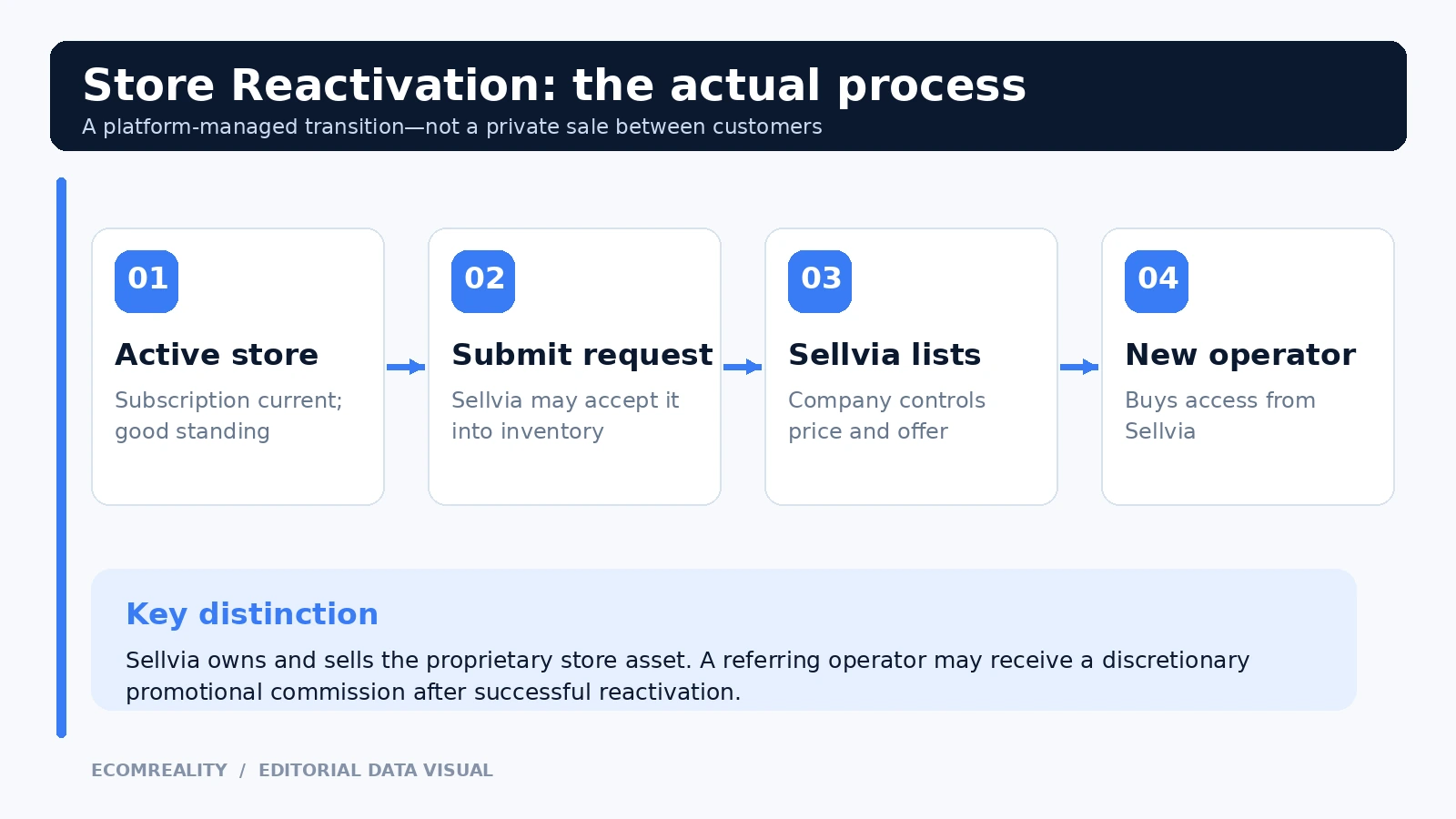
An existing Sellvia operator encounters another part of the arrangement. The current Terms of Use, section 2.17, describe the possibility of submitting a qualifying store to Sellvia for potential reactivation. Sellvia then decides whether to accept it, what value to list it at and whether to offer it to a new customer. It may decline the request or remove the listing; submission is not a guarantee of a transaction. The original operator is referred to as the Referring Customer, and the new one as the Receiving Customer. There is no sale contract or transfer of customer funds between those two people.
These distinctions matter because older informational pages may use language such as "sell your store" or "buyer takes over the business." The practical intention may be similar—an experienced operator leaves and a new operator gets a configured store—but the current legal mechanism is narrower and more specific. For anyone making financial plans, the up-to-date contractual framework should carry more weight than a conversational marketing shorthand.
What makes a store potentially eligible
Under Sellvia's current reactivation terms, the submitting customer needs an active subscription, an operating store in good standing and no outstanding fees, disputes or policy violations. Those conditions are meaningful. An operator cannot reasonably expect a smooth handoff if account access is interrupted, a billing issue is unresolved or the store depends on an incomplete setup. A well-maintained account supports a much cleaner review, even though it does not guarantee approval or a particular listing value.
Performance records also deserve attention. A prospective operator wants to understand patterns, not just a particularly successful day. Useful preparation includes clean monthly summaries, order-processing history, an explanation of expenses and a record of what promotional activity actually produced. A number labeled "revenue" should not be mistaken for net owner earnings. In Sellvia's model, internal commission incentives, platform charges, subscriptions and promotional spending all affect the economics differently. A disciplined operator keeps those categories apart.
The smartest preparation is therefore operational rather than cosmetic. Confirm which products are active, check that navigation makes sense, document support or access issues, and ensure the dashboard provides a consistent picture of activity. A polished design can help presentation, but reliable underlying records are considerably more valuable than a dramatic promise of passive income.
The submission process from an existing operator's point of view
Sellvia's terms allow an eligible customer to request that the active store be returned to the company's inventory. This is a request, not an instruction that obliges the platform to advertise the store. Sellvia reviews the eligibility, may accept the store for inclusion and determines how it will be priced and presented. The operator does not negotiate directly with the incoming customer through the program. That centralized structure is useful for people who do not want to manage independent buyer discovery, contracts and onboarding details themselves.
A distinctive safeguard is that the referring operator may withdraw the submission before the receiving customer's payment is completed, by contacting Sellvia support. After a successful transaction and reactivation, however, the old operating arrangement does not simply continue unchanged. The prior customer receives a new empty turnkey store as a courtesy, under the existing account, while the reactivated store becomes part of the new customer's operating setup. The replacement store does not carry over the previous catalog, performance history, orders, internal balances, paid services or promotional credits.
That replacement matters for planning. Someone who wants to keep operating another project does not necessarily need to rebuild the technical shell manually, but should budget time to configure a new offering and review subscription billing. An operator who intends to leave the platform entirely should examine the cancellation path instead of assuming the courtesy store has no ongoing billing implications.
How the listing price and promotional commission work
One of the largest information gaps in searches about Sellvia Market is the difference between a listing price and what the original operator may ultimately receive. Under the September 2026 terms, Sellvia sets the Listing Price according to its own internal valuation criteria. The Referring Customer cannot set, approve, negotiate or influence that number. The price belongs to Sellvia's proprietary store asset offer, not to a private sales agreement between former and incoming operators.
If the reactivation is completed and Sellvia receives full payment, Sellvia may allocate a promotional commission to the referring customer. The terms say the calculation may reference up to 70% of the Listing Price, but the allocation is discretionary. This is not a contractual guarantee of 70%, a direct split of buyer money, or a claim against proceeds of the purchase. Sellvia describes the commission as a funded incentive from its general operating resources and applies its normal validation and redemption rules.
An illustrative example makes the distinction clear. Suppose Sellvia decides to list an eligible store at a hypothetical $8,000. The phrase "up to 70%" would create an upper reference point of $5,600, not a promised payout of that amount. An approved incentive could be smaller or not allocated. Redemption eligibility, applicable fees and the status of the account would still have to be considered. A business forecast should never treat that upper reference figure as money already earned.
What a buyer is actually receiving
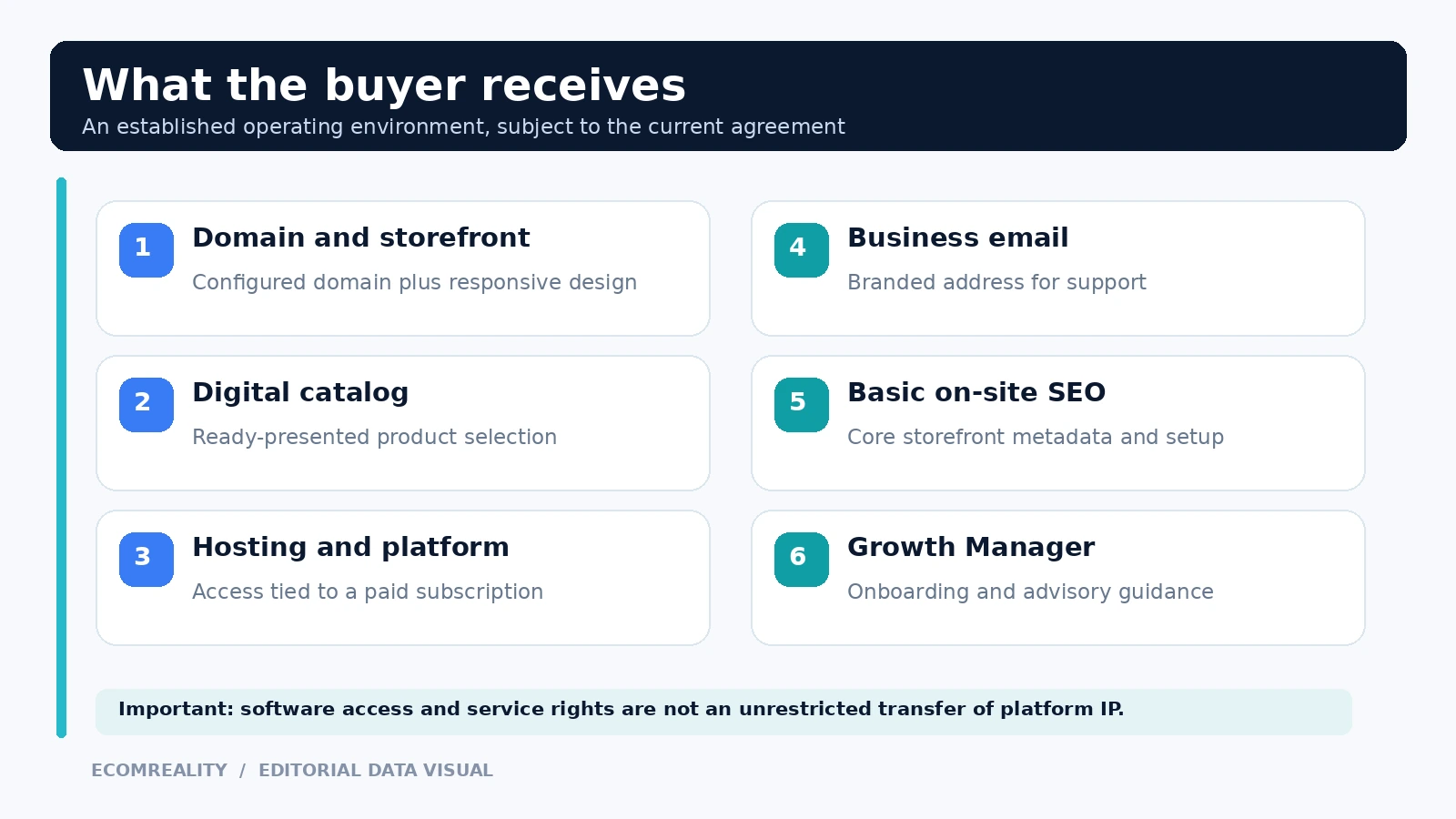
The buyer's experience is the other half of the story. Sellvia's established-store terms identify a configured domain, product catalog, professional responsive design, access to its platform environment, hosting linked to an active subscription, a branded email address, basic on-site SEO configuration and advisory assistance. These components eliminate many initial setup tasks. Rather than spending the first weeks arranging a theme, hosting, a domain and product listings individually, the buyer enters a more developed operational environment.
There is an important distinction between receiving access and receiving unrestricted intellectual-property ownership. Sellvia's current terms state that the store technology, associated assets and proprietary components remain under Sellvia ownership, with the customer using the environment under a limited license. A buyer therefore receives a functioning service-based operating package subject to ongoing terms, not a complete assignment of every source-code and platform right. That is a common source of confusion when comparing managed stores with independent custom-built ecommerce businesses.
For digital-product offers, the catalog and fulfillment workflow should be evaluated within the live platform rather than assumed to be transferable to any outside system. The buyer should establish which catalog items, licenses, account features, operating settings and reporting views will be available from the first day. A demo of the actual store and a clear inventory of included services are more useful than broad phrases like "fully automated business."
Understanding the first days after purchase
Sellvia says a Growth Manager will contact purchasers of established stores shortly after payment, with support around initial setup and operations. The role is advisory: the customer remains responsible for decisions about promotion, management and business activity. That balance is one of the model's practical attractions. New owners are not forced to solve every configuration question alone, but they still retain the role of operator rather than merely watching a guaranteed income stream.
A sensible first-week workflow is straightforward. Verify the credentials and domain, open the dashboard, check the active product catalog, review the storefront as a customer would, inspect the payment and commission sections, and understand how each order enters the processing workflow. Next, reconcile the recurring subscription and any optional promotional expenses with the budget. Finally, create a written operating checklist so that the store does not depend entirely on one introductory call.
Do not confuse the readiness of the website with guaranteed continuity of past performance. Revenue histories demonstrate that activity occurred under prior conditions. They do not show what next month's traffic, conversions or commissions must be. A buyer's management choices, promotional budget and operational consistency still matter.
Recurring expenses beyond the price of the store
A headline purchase price is only one component of total commitment. The September 2026 terms for Established Stores specify a separate $39 monthly Sellvia subscription, hosting while the subscription is active, and potential domain-renewal responsibilities. Advertising costs are excluded from the purchase price. Depending on the products and method of processing, platform service fees and other operating charges may also apply. Buyers should decide which are part of the base package and which require separate approval or additional funds.
Consider an illustrative budget, not a profit forecast: a $39 platform subscription and $150 in chosen promotional spending would produce $189 of monthly outlay before any other applicable service charges. If promotional spending rose to $300, that portion of the budget would change even while the subscription remained fixed. The value of a configured store lies in reducing setup work and providing a coherent ecosystem; it does not remove ongoing management decisions.
Payment timing also deserves close attention. Sellvia's current main terms describe ten weekly installments for Established Store purchases through its dashboard or a one-time full payment arranged with a Growth Manager. Other Sellvia Market pages display alternative payment marketing, including monthly installment messaging. Because those descriptions are not uniform, the purchaser should rely on the final dashboard checkout terms and the applicable written agreement rather than assume every published example is available to every buyer.
The practical meaning of due diligence on a platform-managed store
On an independently transferred online business, due diligence often revolves around access to standalone code, third-party software licenses and ownership of payment accounts. On Sellvia, the most useful questions are framed around rights of use, platform records, ongoing subscription dependencies and the exact operating package delivered. A buyer should ask which historical statistics are visible, whether performance figures are gross or net, which reports can be exported, and what happens to access if the subscription lapses.
Ask for a clear demonstration of the store's real catalog and its order-processing steps. Review the customer-facing pages to make sure descriptions, support information and product access are coherent. Understand the limits of customization and whether a future move to a different technology stack is possible or outside the service arrangement. Those questions do not reduce the value of managed infrastructure; they define it more precisely.
A particularly useful habit is to write the buyer's checklist in terms of deliverables: live domain, working login, editable permitted content areas, catalog access, support contacts, reporting availability, and the recurring charges that begin after onboarding. If the final checklist matches the actual handoff, the acquisition is far easier to manage.
Why the buyer benefits from a controlled transition
A platform-managed transition reduces several forms of friction. Instead of arranging a patchwork of hosting credentials, design files, plugin licenses and access permissions with an unknown private seller, the buyer deals with the provider already operating the store system. Sellvia handles its own sale infrastructure and makes the store available within its normal environment. That can simplify onboarding, particularly for someone without an established technical team.
The buyer also gains a clear support channel and a more predictable software environment. A configured catalog, responsive storefront and integrated dashboard mean the buyer can focus attention on the offer, customer experience and performance records rather than on months of website assembly. These are genuine advantages of the managed model, especially for creators or operators who value speed to launch and one service relationship.
The trade-off is structural rather than necessarily negative: the continued benefits rely on compliance with the platform's terms and an active subscription. For the right buyer, that is preferable to maintaining every component independently. For another, unrestricted control of underlying software would be essential. The point of serious evaluation is to identify that preference before purchase.
A clear framework for comparing two store opportunities
When comparing listings, start with the quality of operating information, not only advertised income. Look at the catalog's relevance, available product categories, customer-facing experience, stated recurring costs, and whether the buyer has access to a realistic demonstration. Next, compare the workload expected after handover. A highly polished store may still need content updates, promotional planning and regular monitoring. Finally, evaluate whether the site's niche aligns with the buyer's ability to explain and market its digital products.
A useful decision matrix scores each option on four independent criteria: clarity of data, fit with the buyer's goals, cost of ongoing operations and ease of working within Sellvia's environment. A store with a higher published income figure can still be a worse match if the catalog is unfamiliar or the operating requirements are misunderstood. Conversely, a smaller niche with coherent presentation and manageable costs may be easier to operate well.
Final assessment: a managed opportunity, not a private asset exchange
Sellvia Market is most compelling when understood as a curated way to enter an existing, platform-supported store environment. For buyers, its appeal comes from preconfiguration, a domain and catalog, hosted infrastructure, an integrated dashboard and guided onboarding. For existing operators, the Store Reactivation Program provides a defined mechanism to request that Sellvia consider returning the store to its inventory, with potential discretionary promotional commission after a successful reactivation.
The important correction is that the two sides are not making an ordinary buyer-to-seller transaction with each other. Sellvia retains control of its proprietary assets and determines the terms of the listing. Reading the current agreement alongside the buyer's exact offer leads to a more accurate decision and a smoother transition. That clarity is a strength, because it allows users to judge the managed-store model on what it genuinely delivers.
Frequently asked questions
Can I set the selling price for my existing Sellvia store?
Under the current Store Reactivation Program, Sellvia alone determines and may revise the Listing Price. Submitting an eligible store does not give the Referring Customer the right to approve or negotiate that figure.
Does an existing operator always receive 70% of the listing price?
No. The terms describe a discretionary promotional commission that may be calculated by reference to up to 70% of the Listing Price. That number is not a guaranteed payout or a direct share of the buyer's payment.
Does the buyer own all the underlying Sellvia software?
No. The current terms treat the platform, associated proprietary store assets and intellectual property as Sellvia property. Buyers receive the contractually defined store access and services under an active subscription.
Can a previous operator withdraw a store after requesting reactivation?
The terms allow the referring customer to withdraw a submitted store before the incoming customer's payment is completed by contacting Sellvia support.
What does a buyer need to budget after purchase?
At minimum, review the separate recurring subscription, domain-renewal responsibilities, any optional promotion budget, and all applicable operational fees shown in the current checkout and platform terms.
Sources and policy references
- Sellvia, Terms of Use, September 2026, Sections 2.15 and 2.17: https://sellvia.com/terms-of-use/
- Sellvia Market, Established Stores: https://market.sellvia.com/
- Sellvia Market, Terms for Established Stores: https://market.sellvia.com/terms-of-use/

Jo Carter is an editor and ecommerce researcher at Ecom Reality, where she covers ecommerce platforms, digital selling tools, online business software, pricing models, and emerging industry trends. She focuses on turning complex platform features and costs into clear, practical information for entrepreneurs and digital sellers. Her work combines detailed research with a balanced editorial approach, helping readers compare services, understand potential limitations, and choose tools that fit their business goals.
Comments
Related Articles

Leave a Reply