
A digital purchase should be simpler than ordering something that has to be shipped. Yet digital storefronts often create a new set of questions: Where does the purchase appear? Do you receive a file or access to an online tool? What happens if the confirmation email goes to spam? Does buying an item once mean it remains available inside an account, or is another subscription required? Ecomzy Mall addresses many of these questions with a browser-based marketplace and a customer account that connects purchases to usable digital products.
The key to understanding the experience is a simple distinction: payment confirmation, account access and downloadable output are different steps. Ecomzy Mall’s official FAQ says that purchased tools become accessible in the user’s account as soon as payment is confirmed, usually with an access email as well. Its tools generally run in the browser, so most customers do not need to install software or download an app merely to use what they bought. Individual product pages may offer checklists, letters, plans or other outputs that can be saved or downloaded, but that does not mean every listing is simply a static PDF file. This guide explains what shoppers actually get and how to recover access when something goes wrong.
What Ecomzy Mall sells
Ecomzy Mall presents a growing catalog of practical digital tools intended to solve specific everyday problems. Browseable categories span work, family, personal finance, planning, consumer rights, health and productivity. A shopper might choose a job-search helper, a household budgeting planner, an escalation-letter tool or a structured guide to a consumer dispute. The distinctive feature is that many products ask for a few details about the shopper’s situation and then produce a relevant result through an interactive workflow.
This differs from a conventional file marketplace where a purchase only provides a download link to a fixed document. A browser-based tool may ask questions, organize information, generate a plan and let the buyer return later. A product listing can also describe a set of downloadable materials or templates. The right way to evaluate the product is to read the individual “What You Get” section rather than assuming all digital products arrive in the same file format.
The purchase journey from listing to account
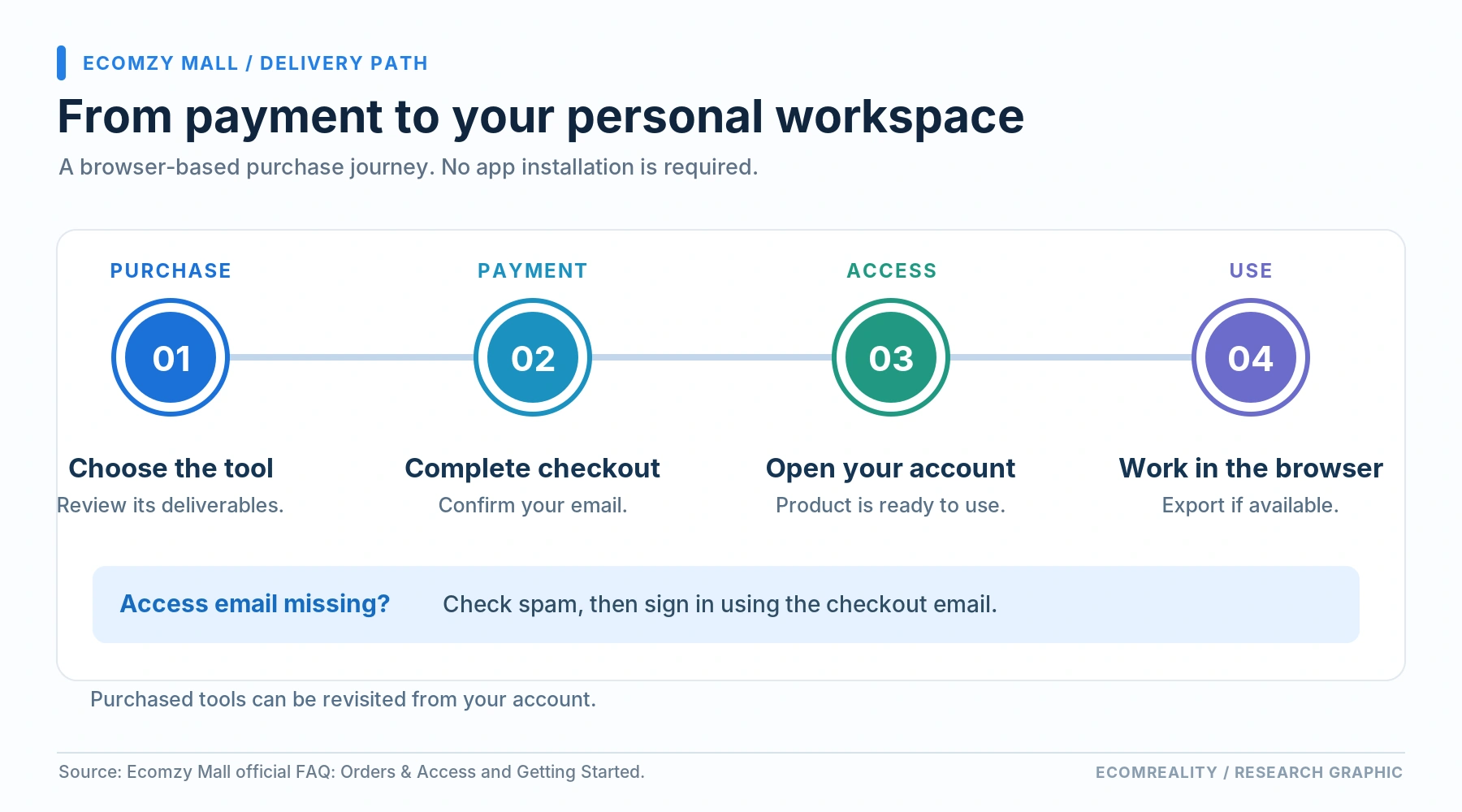
The sequence is straightforward. A customer opens a listing, reads the explanation of the problem and the tools included, checks the visible price, then uses the checkout page. The platform’s product pages describe one-time purchases for many individual tools, and a sample checkout explicitly identifies the item and total before payment. Once payment is confirmed, the FAQ says an access email is sent and the purchased tool becomes available in the buyer’s personal Ecomzy Mall account.
This arrangement is convenient because the user does not have to hunt for a fragile file link every time the tool is needed. The account serves as the central access point. The shopper can return to the same tool from a phone, tablet or computer with an internet connection. For products designed to be reused—such as planners, message builders or structured decision aids—this is often more useful than receiving a single document that cannot adjust to a new situation.
Step one: choose the exact problem, not just the category
Ecomzy Mall’s product pages are generally problem-first. Instead of marketing an entire professional software suite, they explain a familiar situation, the common mistakes people make, and what the tool is intended to produce. Consider a consumer-returns tool. It may help distinguish a change-of-mind return from a faulty or misdescribed product, gather evidence and draft escalation language. A shopper should compare those functions with the specific problem they need to solve before buying.
A useful buying checklist starts with the promised output. Is it a personalized plan, an editable template, an interactive questionnaire or a downloadable document? Does the tool cover the consumer’s jurisdiction or specific circumstances? Is it a general information aid rather than a substitute for regulated professional advice? Strong product selection happens at the listing stage. Spending a few minutes here often prevents disappointment caused by expecting one kind of deliverable and receiving another.
Step two: review pricing before clicking Pay
The marketplace shows individual prices on product listings and checkout pages. Its FAQ says most tools are one-time purchases, while any recurring charge or subscription should be disclosed on the product page before checkout. That is a useful policy for shoppers who want to buy only what they need. A one-time price should still be considered in context: two different products may solve overlapping problems, and bundles or a separately offered pass may make sense for a user who expects to use many tools.
Before completing payment, read the amount in the final checkout, the product title and the purchase model. Do not treat a promotional crossed-out price as the amount that will actually be charged. The final checkout total is the relevant commitment. The platform states that charges are in U.S. dollars, so users paying from another currency should also consider any conversion performed by their card issuer or payment provider.
Step three: the available payment methods
The official FAQ lists Visa, Mastercard, American Express and Discover, as well as Apple Pay, Google Pay and PayPal. Ecomzy Mall says it uses processors such as Stripe and PayPal rather than storing customers’ complete card information directly. That is a familiar and convenient setup: the buyer selects a supported method and completes the payment in a secure checkout flow, without having to install a separate application.
Payment authorization, however, is not identical to account activation. If a card shows a pending bank authorization while the platform has not yet confirmed the order, the shopper should avoid making repeated payments immediately. A duplicate purchase may create unnecessary support work. Check for the confirmation page, order email and account entitlement first. Keep a copy of the order identifier or receipt so support can locate the transaction accurately if needed.
Step four: what happens immediately after payment
According to the Ecomzy Mall FAQ, a confirmed payment is followed by an email with access instructions. The product becomes available inside the customer’s account. This means the buyer has two routes to the next step: follow the email or sign in directly using the email associated with the purchase. The second route is particularly helpful if the email is delayed or filtered into spam.
For shoppers, this is one of the strongest aspects of account-based delivery. The useful thing being delivered is not merely a temporary download URL; it is a recognized purchase connected to an account. In many product categories, that means the user can return later, edit inputs or run the tool again. The FAQ explicitly states that purchased tools can be reused without a general usage limit, although the specific product’s own description should govern what that particular purchase includes.
Account access versus downloads: what is the difference?
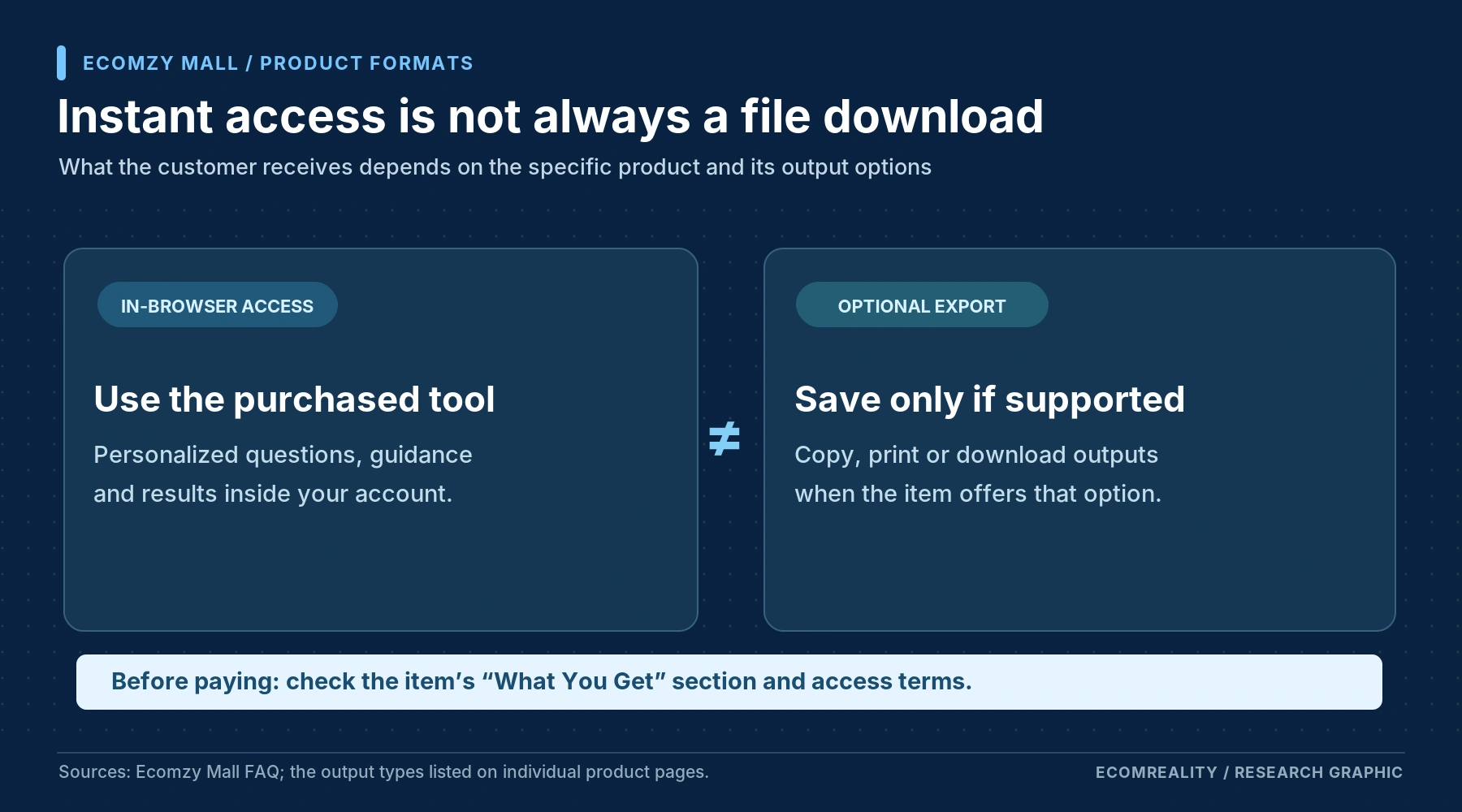
The word “download” can describe at least three different experiences. First, a buyer may download a ready-made document or template. Second, a web tool may generate a personalized result that the buyer then exports, copies or saves. Third, the core service may remain accessible only through the browser, with no local app installation or single master file needed. Ecomzy Mall emphasizes the third experience for many of its interactive tools, even where individual tools offer downloadable outputs.
This distinction matters because a buyer searching Google for “Ecomzy Mall downloads” could assume every order delivers a PDF attachment. The FAQ’s statement that no download is necessary for using tools means precisely that—the tools are usable online. It does not mean every product lacks export options, nor does it promise that every possible result has the same file format. The individual listing determines what a person should expect to receive.
A practical example: a consumer-rights guide
Take a hypothetical shopper buying a consumer-rights tool after a dispute over a return. The relevant product page might describe a case sorter, an evidence checklist, suggested escalation language and a complaint letter. These are distinct deliverables. Some may be interactive prompts in the account; others may be copyable text or files depending on the tool design. The important outcome is not merely downloading a document. It is producing a structured response to the shopper’s own situation.
The same logic applies to a career planning tool or household checklist. A fixed worksheet may be enough for one buyer, while another benefits from answering questions and getting a tailored plan. This is why Ecomzy Mall is best understood as a catalog of digital problem-solving products rather than as one giant ZIP library. The marketplace can provide immediate access to useful outputs while keeping the experience approachable.
Reusing purchased tools later
Ecomzy Mall’s FAQ says that after buying a tool, a customer can return and use it again through the account, without a stated general usage cap on purchased tools. This is valuable for products that address recurring tasks: updating a plan, preparing another message or revisiting a checklist several weeks later. Instead of treating the purchase as a single session, a buyer can treat the account as a place where purchased capabilities live.
There is still a practical difference between continued account access and ownership of downloadable files. A saved PDF can be stored locally, while an interactive tool generally relies on the web service remaining available and the buyer retaining account access. Keeping copies of important generated results is sensible where export options exist. At the same time, the ability to log back into a tool offers flexibility that a static document cannot provide.
What if the access email never arrives?
The platform’s FAQ gives a clear troubleshooting route. Start with the inbox associated with checkout, then check spam and promotions folders. If the message is still missing, go directly to mall.ecomzy.com and sign in using the same email address. The FAQ says the purchases should be visible there. If that does not resolve the problem, contact [email protected] and provide the purchase email and a description of the issue.
Most confusion can be avoided by keeping the payment email and the account email consistent. Buying with one address and attempting to sign in with another is a common reason that an otherwise successful digital purchase appears to be missing. Avoid creating several accounts as a first reaction. Start with the address on the receipt. It is also useful to keep the order number and exact product title handy when writing to support.
What to do if payment succeeded but access is missing
A missing entitlement is more specific than a missing email. In that situation, the shopper has evidence that money was charged but does not see the product in the account. The best first step is to document the payment confirmation, verify the exact email used and refresh the account’s purchase page. If there is still no product, contact support with the transaction reference and product name. A clear message should say that payment appears successful but the purchase does not appear under the account.
Do not assume the problem is best solved by making a second payment. That can cause accidental duplication and complicate refunds. Nor is it necessary to share full card numbers or security codes with ordinary support. The payment provider’s transaction reference, amount, date and purchase email are more useful identifiers. Ecomzy Mall’s account model is intended to reduce these problems by connecting orders to the customer’s login.
Refunds and the thirty-day policy
Ecomzy Mall states in its FAQ that it offers a 30-day money-back guarantee and invites customers to email support within that window. It says its team processes refund requests in approximately one to two business days, while the return of funds to the original payment method can take five to ten business days depending on the provider. These are service-stated timeframes, not promises that every bank settles identically.
The distinction between refund processing and card settlement is useful. A customer may receive confirmation from Ecomzy Mall that a refund has been initiated and still wait for the bank posting to appear. Keeping the relevant emails avoids unnecessary repeat requests. The most helpful support message identifies the product, purchase date, transaction reference and reason for the request. Read the current refund policy for any order-specific conditions rather than relying only on a badge on the product page.
One-time purchase or a pass: choosing the right model
Most individual Ecomzy Mall tools are marketed as one-time purchases. A buyer who wants only one clearly defined product may prefer that simplicity. A different customer who plans to explore many tools may see a separate pass or access offer alongside individual listings. These are different commercial arrangements and should not be confused. A single tool purchase should not automatically be assumed to include access to the entire catalog; likewise, a pass is not necessarily the same as owning each item permanently.
Before choosing, compare the number of products you expect to use, the individual prices, any trial period, the renewal terms and what happens after cancellation. The key question is not which option has the most exciting marketing. It is which one supplies the intended products at an acceptable total cost. For an occasional shopper, paying for a single needed tool can be the cleanest route. For frequent exploration, a broader access model may be worth comparing carefully.
Are there hidden downloads, apps or technical requirements?
The official FAQ says no separate app or software installation is required to use the tools. Customers can work through a supported web browser on a phone, tablet or computer. This is helpful for less technical users, particularly when they want to solve one problem quickly rather than learning an elaborate application. It also means the experience is tied to reliable internet access and a working account login.
Browser delivery can make updates easier because the tool itself can change without requiring users to install a new version. It also simplifies moving between devices. On the other hand, a shopper who needs a fully offline product should check whether the specific listing offers an export or printable output. The FAQ’s “no downloads needed” message is a convenience claim, not a universal guarantee of offline compatibility.
Privacy and using sensitive information
Some Ecomzy Mall tools address personal finance, family, medical billing or consumer disputes. Buyers should be thoughtful about the information they enter. The platform’s privacy policy describes collecting account details, order history and product usage information to deliver the service and provide support. It also says customers can use privacy rights and read the full policy for how their data is handled. This matters particularly for shoppers generating personalized outputs from sensitive context.
The sensible habit is to provide the minimum detail needed to get a useful result, avoid entering secrets unrelated to the task and download or copy important outputs when the product supports it. A tool that helps organize a financial letter or health-related question is not automatically a licensed professional adviser. Ecomzy Mall’s FAQ makes clear that specialized legal, financial or medical questions may warrant professional assistance. Used as a structured first step, these tools can save time without pretending to replace formal expertise.
Final verdict
Ecomzy Mall offers a practical route to buying focused digital tools without installing additional software. Its account-based delivery, one-time purchases on many listings, reusable tools and public guidance on access problems give the buying process useful structure. The most important clarification is that instant access does not always mean an attached downloadable file: many tools work directly in the browser, and the output depends on the product. For shoppers who understand that distinction and check the details before checkout, the experience is straightforward and flexible. The account serves as an organized home for purchases rather than a one-time delivery email.
Frequently asked questions
Do I need to install an app after buying on Ecomzy Mall?
No. The official FAQ says purchased tools generally run directly in the web browser and can be accessed through the customer’s account on common devices.
Is every Ecomzy Mall purchase a PDF download?
No. Many purchases provide browser-based interactive tools. Some listings describe downloadable or copyable outputs, but the exact format depends on the product’s own description.
Where is my purchased product after payment?
After confirmed payment, the platform says the customer receives an access email and the purchased tool becomes available in the account associated with the checkout email.
What if I never receive the email?
Check spam or promotions, then sign in at mall.ecomzy.com using the same email used for checkout. If the item is still missing, contact [email protected] with the purchase details.
Can I request a refund?
The public FAQ describes a 30-day money-back guarantee. Refund processing and the time funds appear at a bank are different stages; review the current policy and contact support within the stated window.
References and current terms

Croom Raymond is an ecommerce writer and digital business researcher at Ecom Reality. He covers online selling platforms, SaaS tools, pricing structures, platform features, and practical strategies for building digital businesses. His articles focus on clear, evidence-based analysis that helps readers understand how different services work, compare their advantages and limitations, and make more informed business decisions.
Comments
Related Articles

Leave a Reply