
Most PrimeXBT reviews start with its ability to trade crypto, forex or indices from a single trading environment. That breadth is useful, but it does not tell a reader whether the platform is economical. A trader entering a Bitcoin perpetual for 30 minutes has a different cost profile from one holding a leveraged position for seven days. Someone trading a forex CFD faces another set of charges again. The same brand can therefore look inexpensive for one trading style and expensive for another without any contradiction. The mistake is treating all those products as if they share one universal fee schedule.
This review focuses on an information gap that matters more than promotional leverage figures: how to calculate the complete trading cost on PrimeXBT before deciding whether a strategy has a chance of surviving it. We examine crypto futures commissions, funding intervals, CFD spreads, overnight swaps, liquidation risk and the legal-entity questions that should be answered before funding an account. Rates and instrument access can vary by region and can change; the company’s live trading platform is the source for a binding current quote.
What PrimeXBT offers, and why the product distinction matters
PrimeXBT markets access to crypto perpetual futures and CFDs on various asset classes, including forex, crypto, commodities, indices and shares. Its public pages also promote a choice of platform experiences and charting tools. There is a broad appeal here: traders who switch between crypto and macro markets may prefer one provider rather than constantly moving collateral or logging into several platforms. The convenience is real, especially for active users who already understand derivatives.
But a perpetual futures position is not a spot Bitcoin holding, and a CFD on a currency pair is not a standard bank-currency exchange. These are derivative products. They create price exposure without requiring the user to own the referenced asset. They can be leveraged, meaning a comparatively small account balance controls a larger notional position. That makes position sizing, margin and financing central to the product, not afterthoughts.
The first practical step on PrimeXBT is therefore to choose the actual product family. If the instrument is a crypto perpetual, check maker/taker fees, its funding rate and the exact funding clock. If it is a CFD, check the bid/ask spread, any explicit commission if applicable, swap direction and overnight rollover conditions. Doing this before opening a trade is much safer than trying to decipher the costs from an account statement afterward.
Crypto futures maker and taker fees
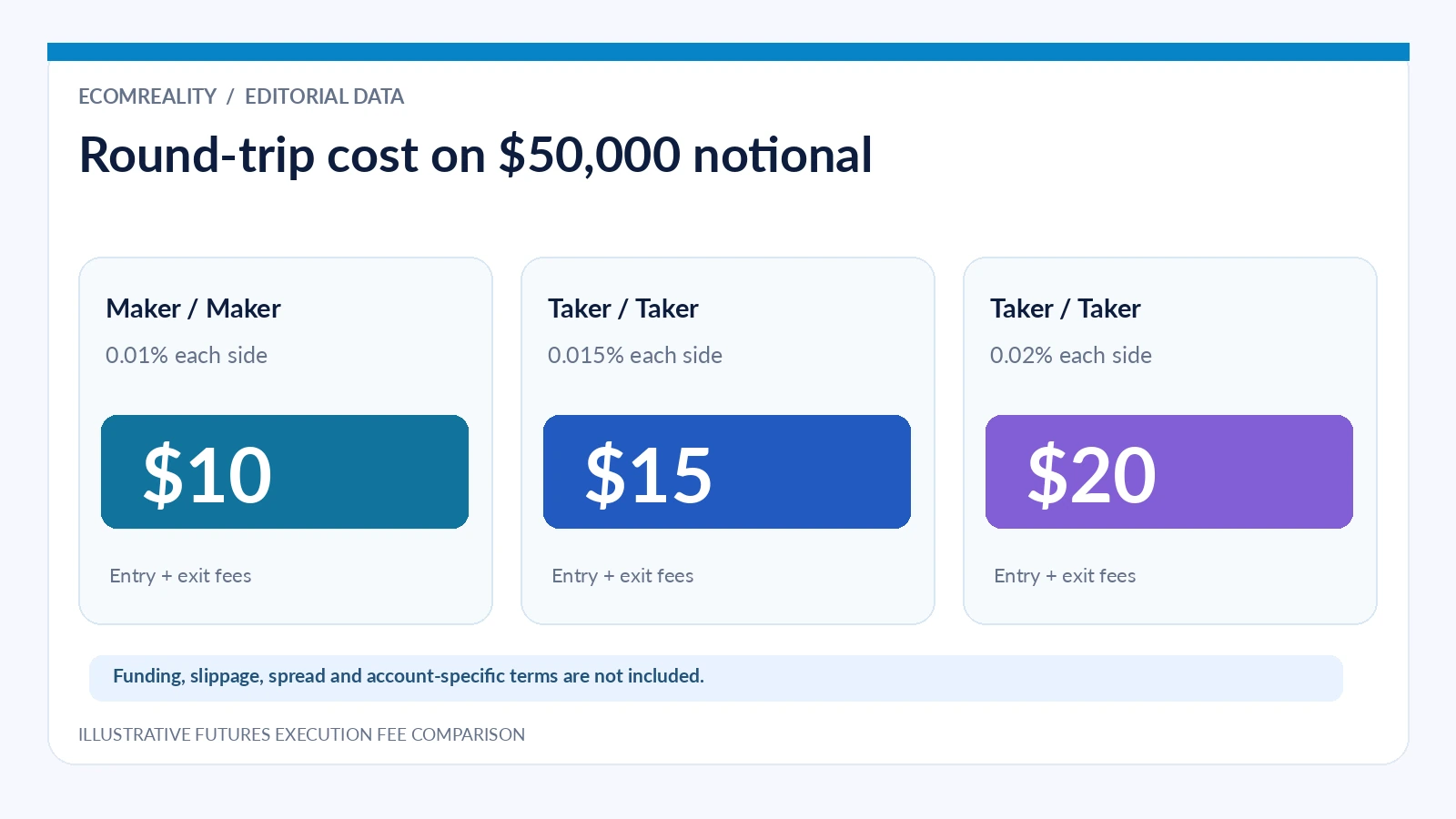
On its public crypto futures page, PrimeXBT advertises a 0.01% maker fee and taker fees starting at 0.015%. The wider fees-and-conditions page also gives a maker example at 0.01% and uses a 0.02% taker-rate illustration for a particular tier. These figures are not identical, and that is a good reason to avoid presenting one quoted rate as universal. The taker fee a user actually pays depends on the relevant product, trading-volume tier, jurisdiction and current account conditions.
A maker order adds liquidity to an order book when it rests rather than immediately matching. A taker order consumes existing liquidity, commonly through a market order or a marketable limit order. This distinction affects cost and execution. A limit order can still be treated as taker if it executes immediately. Conversely, posting an order is no guarantee it will be filled at all. Traders should not base a strategy on maker pricing unless the entry and exit behavior reliably qualifies for it.
Consider a hypothetical $50,000 notional BTC perpetual trade. At a 0.01% maker fee, one side costs $5; if both entry and exit qualify as maker, the two-side fee is $10. At a 0.015% taker rate, one side costs $7.50, and a two-side taker trade costs $15. At a 0.02% taker rate, the round-trip cost would be $20. This illustration excludes slippage, spread effects, funding and other account costs. It is also calculated on notional exposure, not just on the collateral deposited.
The notional distinction matters immensely. A user who deposits $2,500 to control a $50,000 position at 20x leverage does not pay the fee on $2,500 simply because that is the visible margin. A $15 round-trip fee equals 0.03% of notional, but 0.6% of the $2,500 margin. The same nominal fee feels far larger when evaluated against the capital actually supporting the trade.
Funding on perpetual futures: the hidden time dimension
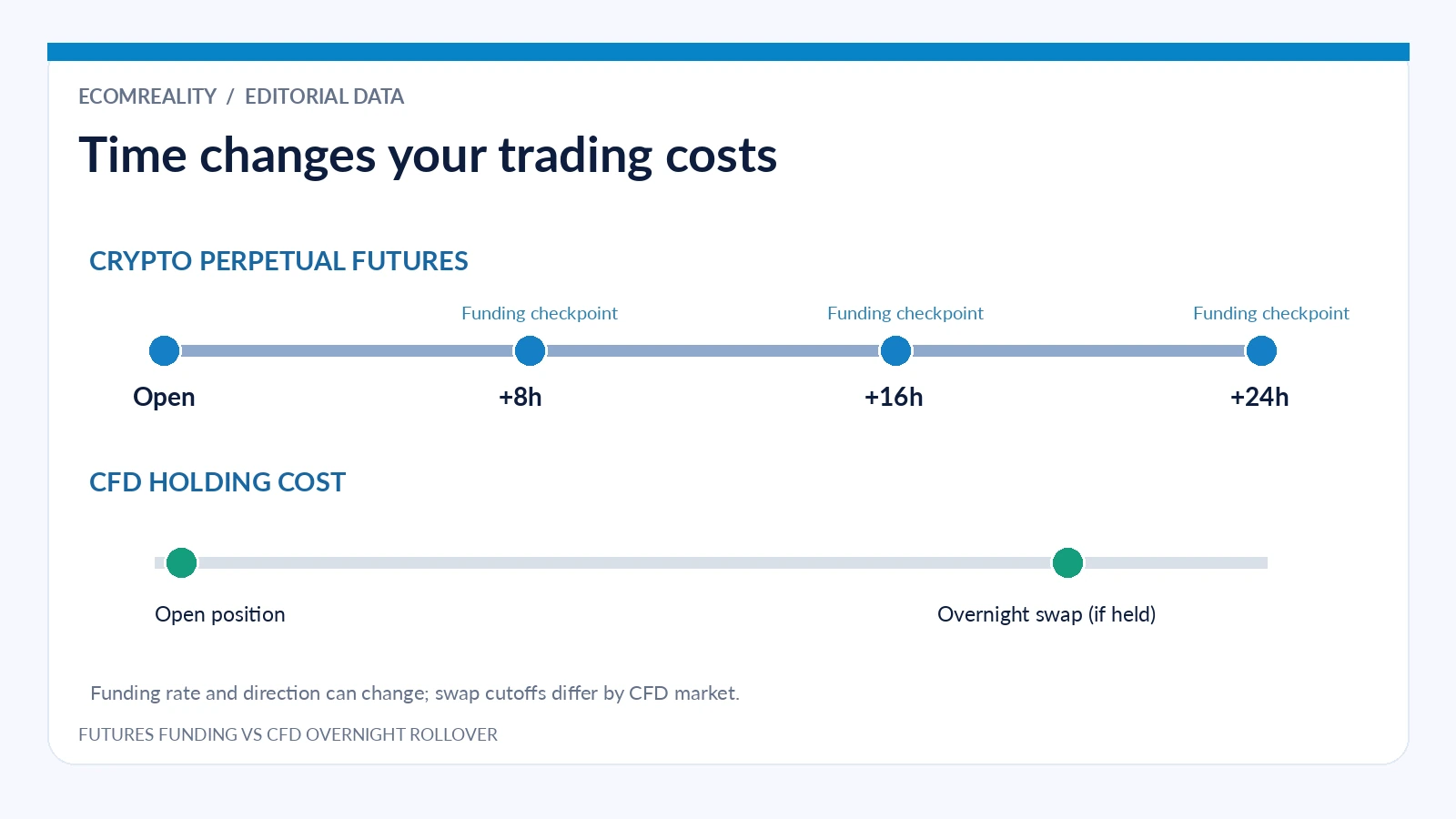
A crypto perpetual contract has no conventional fixed maturity date, so it uses periodic funding to help keep the perpetual’s price related to the underlying market. PrimeXBT’s public fee documentation describes a funding interval of eight hours for open crypto futures positions. Depending on the sign of the rate and the position’s direction, the trader can pay or receive funding. It is not simply a fee that everyone always pays in the same way.
The elementary estimate is funding transfer = position notional × funding rate, applied at the relevant settlement event, with signs determined by product rules. If a $50,000 position faces a hypothetical +0.01% payment in one interval, that is $5. If the same rate applied for three intervals over 24 hours and the trader remained exposed throughout, the illustrative total would be $15. If the applicable rate were +0.03% per interval instead, three identical payments would total $45. These are hypothetical arithmetic examples, not live PrimeXBT funding rates or forecasts.
This is why a supposedly inexpensive commission can be only a small part of the cost for a multi-day position. At $50,000 notional, a $15 entry-and-exit taker example can be overshadowed by several funding events. On the other hand, funding may flow in the trader’s favor during some periods. A responsible calculation needs the actual historical and current rate data for the precise contract, not an assumption that the rate is always a static negative expense.
There is another trap: a trader may check the funding rate at entry, then extrapolate it over several days. Rates can change. A strategy that looks economical at one moment can become more expensive as market positioning changes. Before entering a position intended to last multiple intervals, run a sensitivity analysis with low, central and stressed funding rates and mark the next settlement time on the trading plan.
CFD trading costs are different
PrimeXBT also promotes CFD trading and forex-style instruments. Here, the advertised commission can be zero while the economic cost is carried by the bid/ask spread and overnight swap. A trader who says “CFDs have no fees” because the interface shows no ticket commission is making a basic category error. A spread is a transaction cost: when a position opens and immediately closes at an unchanged market, the price difference generally creates an immediate cost before slippage.
For forex, spreads are often discussed in pips. For other markets, they may be displayed as points or currency increments. Either way, the cost depends on position size and the instrument’s contract specifications. The website’s public fees information also explains that CFD swaps may be charged or credited for holding a position overnight, and that triple-swap treatment on Wednesdays may apply to certain markets to account for weekend financing. Those details belong in any comparison with crypto futures funding.
One company can therefore offer “commission-free CFDs” and still charge meaningful costs through spreads and swaps. This is not inherently deceptive. It is simply a different pricing mechanism. The reader’s job is to convert those terms into a common currency before deciding which instrument is economical for the intended holding period.
Three position lengths, three different fee pictures
A fifteen-minute trade. A crypto futures scalper typically cares first about taker or maker execution, spread and slippage. If the position is closed before the next funding settlement, the funding charge may not enter that trade at all, depending on the contract’s rules. Fast trading still requires careful execution assumptions because a few basis points of adverse fill can erase a very small expected edge.
An overnight CFD. A forex or index trader may enter at a spread-based cost and then incur a rollover charge or credit for holding through the applicable overnight cut-off. Whether it is worth paying depends on expected price movement and risk. A trader who forgets the rollover timestamp can discover that a supposedly intraday strategy was actually exposed to financing costs.
A multi-day crypto perpetual. The entry fee may be tiny relative to several funding events. A position held across three intervals per day for five days could experience fifteen funding events, each potentially different. If the trade has a narrow price target, financing can be a significant part of gross profit. If the trader is using high leverage, funding also affects the remaining margin buffer.
Leverage changes fee impact and liquidation risk
PrimeXBT advertises substantial leverage limits on its trading pages, with crypto futures marketing mentioning availability up to 500x in some contexts. That is an upper bound for eligible products or conditions, not a sensible default for readers. Maximum leverage can vary by instrument, size and jurisdiction, and the platform’s real margin schedule controls actual availability. More important, leverage magnifies both gains and losses relative to posted margin.
Consider a position with $10,000 notional exposure. At 10x, the opening collateral requirement in a simplified model is about $1,000. A 1% adverse price move costs approximately $100, or 10% of that starting margin before costs. At 50x, the same $10,000 exposure requires only about $200 in simplified opening margin; the same $100 loss now consumes about 50% of that margin. Real liquidation and maintenance thresholds make the practical danger more severe and may cause closure before the starting margin is exhausted.
This illustrates why a trader can be “right eventually” and still lose the position. A leveraged trade may be liquidated during a temporary adverse move. Funding, spreads and fees further reduce the available buffer. Maximum allowable leverage is a platform specification. Appropriate leverage is a risk-management decision, and the two should never be confused.
Cross margin versus isolated margin
PrimeXBT’s trading account information refers to cross and isolated margin for crypto futures. Under isolated margin, the amount specifically assigned to a position is the main buffer supporting it, subject to the product’s rules. Under cross margin, a broader account collateral pool can support positions, potentially delaying liquidation of one position but exposing more of the account if several trades deteriorate together.
The practical question is what the user wants to protect. Someone trading several highly correlated crypto positions might underestimate total portfolio exposure under cross margin. A sharp market move can affect them simultaneously. Isolated margin can make position-by-position loss allocation clearer, although it does not make leverage itself safe. The reader should inspect current liquidation rules, maintenance requirements and auto-deleveraging or closeout mechanics for the exact product.
Stop-loss orders help but should not be described as absolute guarantees. In volatile markets, a stop can execute at a worse price than its trigger. Slippage is not a cosmetic caveat on leveraged derivatives. It can materially affect how much collateral remains after a fast move.
A useful trade-cost worksheet
Before opening a PrimeXBT derivatives position, write down the following variables: notional exposure, opening margin, expected entry fee, expected exit fee, estimated spread or execution slippage, holding period, next funding or swap event and stressed financing assumptions. For perpetuals, mark whether the fee qualifies as maker or taker on each side. For CFDs, calculate spread value in the account currency and check whether the intended hold crosses the rollover boundary.
Then compare the combined estimated cost with the trade’s expected price move. If a strategy targets only 0.15% notional but requires 0.03% in commissions and several funding events, the cost headwind can be material. It is even more dangerous if the strategy has a low win rate or requires frequent stop-outs. Good platform pricing cannot rescue a trading plan whose projected edge is smaller than its total friction.
For backtesting, avoid assuming every limit order fills as maker. A backtest that grants the lowest fee to every trade may be unrealistic. Model a mixed execution rate, include stressed slippage and test a range of funding values. The aim is not to produce pessimism for its own sake. It is to discover whether the trading idea still works when real-world costs are included.
Regulation and account terms
PrimeXBT’s public website includes legal disclosures and a South African financial services provider entity on its fees-page footer, while terms and eligibility can vary according to the jurisdiction serving the account. The company specifically cautions that published trading conditions are indicative and that actual conditions may differ by jurisdiction. This is not a footnote to skim. It affects what products can be offered, which entity is the counterparty and what protections or restrictions apply.
Before depositing, check the legal entity named during registration, the client agreement, the specific product terms, permitted residency, and the current margin and liquidation schedules. References to negative balance protection must be checked in the actual terms; they are not permission to use maximum leverage.
Deposits, withdrawals and account administration
Trading fees are only part of an operating budget. A trader also needs to know which funding and withdrawal methods are available for the selected account, the currency in which margin and profits are held, any conversion costs and whether identity verification or withdrawal controls will delay access to funds. Those questions vary by region and payment rail, so a fixed universal table would be misleading without a verified current account context.
Check the live account’s withdrawal costs and timing before moving money. A fee advantage matters less if currency conversions or unavailable payment methods disrupt your trading workflow.
Where PrimeXBT makes sense
PrimeXBT is a plausible option for active derivatives traders who want crypto perpetuals and CFDs under one brand, who already understand how margin works, and who are willing to inspect product-specific pricing. The low published maker rate on crypto futures is relevant for limit-order strategies capable of providing liquidity. The broader market offering is useful for traders who analyze crypto alongside major macro instruments rather than keeping every strategy on a separate venue.
It is less suitable for readers looking for simple ownership of Bitcoin without derivatives risk. It is also a poor fit for someone who assumes that “no commission” means no spread or financing cost, or who sees high leverage as a shortcut to meaningful returns. These are not small misunderstandings. They change the product being purchased and the downside being accepted.
Strengths, limitations and the verdict
The strengths are product breadth, accessible trading tools and a clear public explanation of the major fee families. Maker/taker pricing for crypto futures can be competitive for some trading styles, and a combined venue is attractive to users who actively trade several markets. The public documentation also provides enough funding and swap mechanics for a reader to build a proper cost model instead of relying entirely on marketing.
The limitations come from the same complexity. Fee tiers and jurisdictions differ. Funding can change materially over the life of a trade. CFD spreads and overnight swap rules are easy to overlook. High leverage can rapidly overwhelm a seemingly small fee advantage by magnifying losses and reducing liquidation distance. A casual user who chooses a product by headline commission alone is likely to misunderstand what they are paying for.
Final verdict: PrimeXBT deserves consideration as a multi-market derivatives platform for experienced, cost-aware traders. Its usefulness is strongest when the account holder distinguishes futures commissions and funding from CFD spreads and rollover costs, calculates everything on notional exposure, and applies conservative margin controls. The platform’s advertised fees are the beginning of that analysis, not the conclusion. If you are unwilling to make that calculation before each strategy, leveraged derivatives are unlikely to be the right starting point.
Frequently asked questions
What is the difference between maker and taker fees on PrimeXBT? Maker orders add liquidity; taker orders remove it. The firm’s public crypto futures page advertises 0.01% maker fees and taker fees starting at 0.015%, subject to applicable conditions.
How often is crypto futures funding charged? PrimeXBT’s fee documentation describes eight-hour funding intervals for open crypto futures positions. The actual payment direction and rate depend on the contract and market state.
Are PrimeXBT CFDs commission-free? Some account marketing advertises no separate CFD commission, but spreads and overnight financing can still create trading costs. Always inspect the instrument schedule.
Can funding ever be received rather than paid? Yes. Depending on market conditions, position direction and the sign of funding, a perpetual trader may pay or receive a transfer.
Does high leverage lower trading fees? No. Fees are typically tied to notional position size or instrument pricing. High leverage makes those costs and adverse moves larger relative to the collateral committed.
Sources and methodology
This article uses PrimeXBT’s crypto futures page, fees and conditions, and account types information. Cost examples use explicit hypothetical position sizes and illustrative funding rates. They are not personal trading results or real-time fee quotes. Readers should verify current instrument conditions and their contracting legal entity before trading.

Sylvia Pierce is an editor and ecommerce researcher at Ecom Reality. She specializes in reviewing ecommerce platforms, digital selling tools, pricing models, and online business software. Her work focuses on providing clear, practical, and balanced information that helps entrepreneurs make informed decisions.
Comments
Related Articles

Leave a Reply