

NAGA has spent years positioning itself as more than a plain execution venue. On the surface, it looks like a broker interface with charts, instruments and trade tickets. Underneath that, though, it is trying to answer a different question: what if a user does not want to research every position independently, and instead wants to learn from, follow or mirror more experienced traders? That is where NAGA’s social and copy-trading identity comes in. The platform’s marketing strongly emphasizes its copy-trading community, and that is the right lens for evaluating it. If you assess NAGA only as a low-level spread comparison against every other CFD broker, you miss the reason many people sign up in the first place.
Still, convenience can hide complexity. A trader who copies a high-return account may not be copying the whole story behind that account’s performance, including drawdowns, concentration risk or a strategy that only makes sense for a different balance size. The best way to review NAGA is therefore to split the platform into three practical layers: how Autocopy actually works, what trading costs matter, and which risk controls keep the experience usable. That framework gives a clearer view than marketing slogans or screenshots of top traders with eye-catching percentage returns.
What NAGA is really offering
Official materials describe NAGA as a platform where users can trade across multiple markets and also copy top traders. The company’s copy-trading pages explain that users can browse the leaderboard, choose a trader, set copy preferences, and then mirror eligible trades automatically in real time. The platform also states that users can copy an unlimited number of traders at once, and that copied trades can be monitored through the Autocopy section. This makes NAGA appealing to two groups at the same time: traders who want to place their own positions and traders who want a more passive, portfolio-style workflow built around other people’s strategies.
That dual identity has benefits. It reduces friction, because a user does not need one service for execution and another for copy trading. It also creates a smoother learning environment. A beginner can look at trader profiles, compare performance history, study risk scores and then decide whether to copy at all. A more experienced trader might use the social layer differently, perhaps to monitor sentiment, diversify into external strategies or compare how other traders handle the same instruments. In other words, NAGA’s value is not just “someone trades for you.” The value is the combination of discovery, automation and on-platform risk settings.
What stands out
- Autocopy is built into the platform rather than bolted on as a separate service.
- Users can choose between a fixed amount and a proportional “relative to leader” copy method.
- NAGA lets users customize stop loss and take profit around copied trades.
- The platform supports a broad market list, so copy trading is not limited to one asset class.
What needs caution
- Copying a profitable trader does not guarantee similar results on a smaller account or different risk settings.
- Total costs are broader than spreads; overnight swaps and withdrawal charges can materially change outcomes.
- Performance rankings can attract short-term attention even when the underlying strategy is high risk.
- Investor protection depends on which NAGA entity and jurisdiction the user is onboarded under.
How NAGA Autocopy works in practice
NAGA’s copy-trading documentation lays out a fairly straightforward process. First, you browse the platform’s leaderboard or a specific trader profile. Second, you decide how you want to allocate capital. Third, you set the copy parameters and start Autocopying. After that, the system automatically mirrors eligible trades made by the selected lead trader, unless there are issues such as insufficient funds or another operational constraint. NAGA also notes that missed trades are visible in the Autocopy timeline, which matters because it prevents users from assuming every lead trade will always be mirrored perfectly in every market condition.
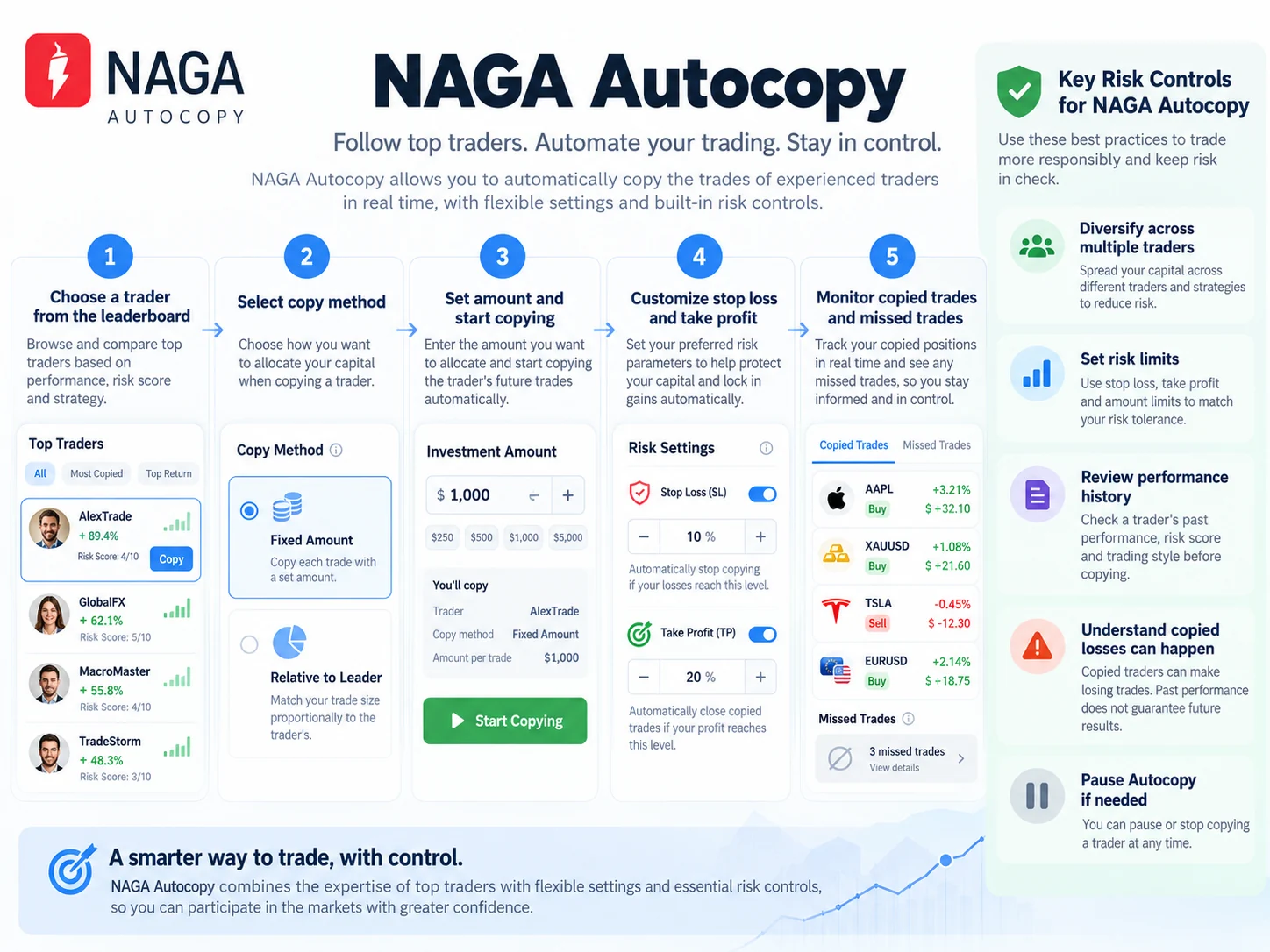
The copy method is one of the most important decisions on the platform. NAGA offers two main approaches. With Fixed Amount, the user allocates a fixed amount for every copied trade, and official materials state that the minimum is equivalent to $50. With Relative to Leader, the trade size is proportional to the leader’s trade size, and the minimum depends on the minimum available position size of the instrument being copied. On paper, that sounds like a technical choice. In practice, it changes the personality of the account. Fixed Amount is easier for budgeting and tends to be simpler for beginners. Relative to Leader is often better aligned with the copied trader’s own sizing logic, but it can also increase account sensitivity if the leader trades aggressively.
NAGA also deserves some credit for not hiding risk controls behind extra menus. The platform states that by default copied trades can follow the lead trader’s stop loss and take profit limits, but the copier can customize those settings. This matters because a copy-trading system is only useful if the user can intervene at the portfolio level. A trader who wants tighter downside limits should be able to impose them. A trader who wants to cap the effect of volatility should be able to do that too. The best copy-trading experiences are not fully passive; they are supervised automation, and NAGA’s control set is strongest when viewed through that lens.
Trading costs: what really changes your result
One reason broker reviews often disappoint readers is that they focus on a single cost number and pretend the rest does not matter. NAGA’s own pricing pages make clear that the reality is broader. The broker publishes market hours, margin requirements, average spreads and other fees, and it also asks users to review deposits, withdrawals and copy-trading conditions on the official schedule. That is the right approach. A trader should think about NAGA costs in four buckets: entry/exit pricing, overnight financing, cash movement costs and account-related fees.
The first bucket is the one most traders look at first: the spread. If someone is opening and closing positions frequently, especially in forex or indices, the spread will be one of the main drivers of cost. But the spread is not the whole story. Overnight swap charges matter a lot for traders who hold positions beyond a day or use copy-trading strategies that remain open for longer periods. Many copy-trading users ignore this until they realize a strategy with attractive gross performance may deliver much lower net performance after financing. Likewise, users who plan to add or remove funds regularly should check withdrawal costs and any bank-intermediary fees mentioned in the payment schedule.
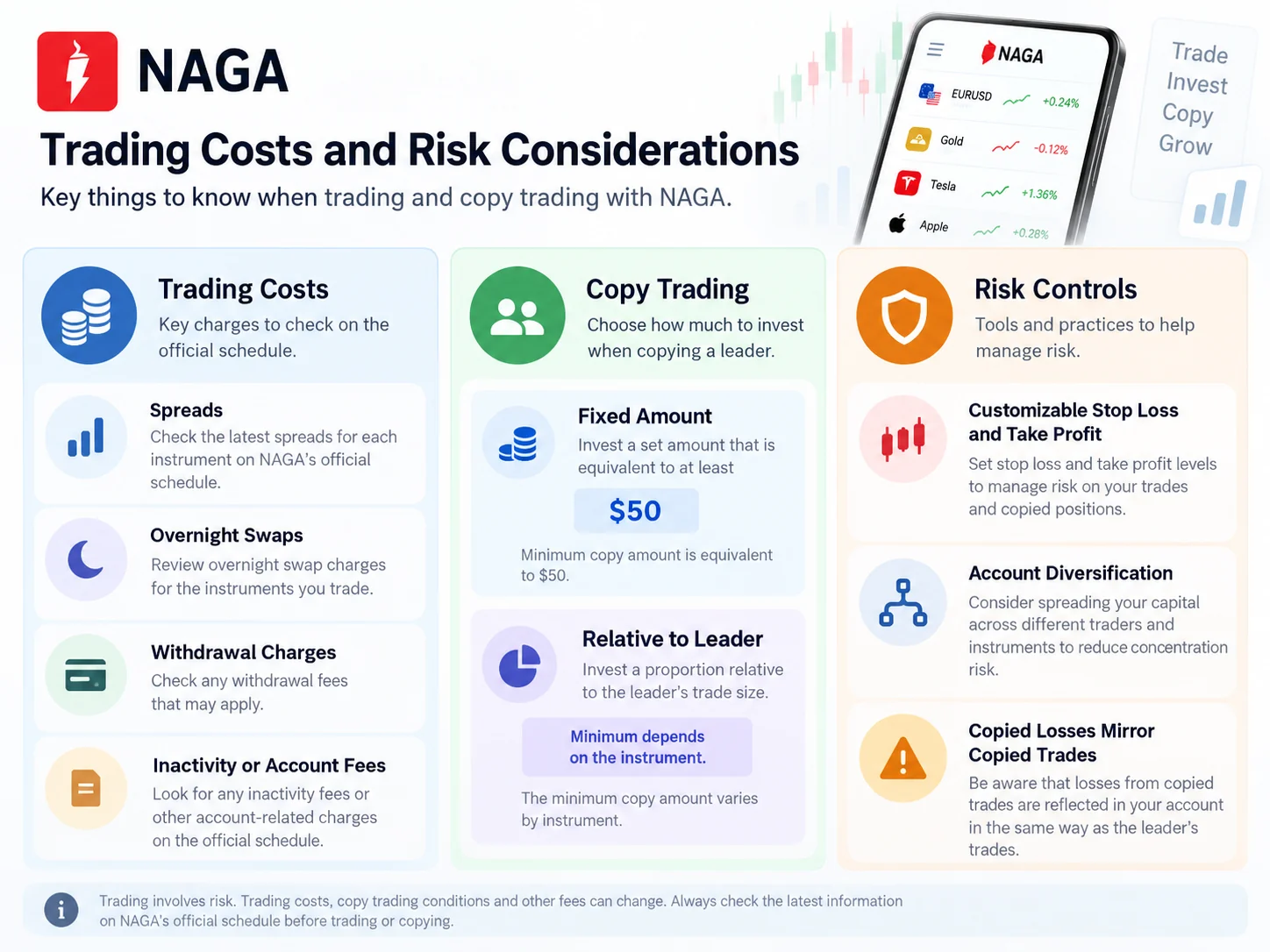
Another subtle issue is that copy trading can make costs feel invisible. When a user presses a normal buy or sell button, the cost is mentally attached to a single trade. When a system opens positions automatically, the cost experience can become diffuse, especially if several copied traders are active at once. That is why the best way to audit NAGA costs is not simply to ask “what is the EURUSD spread?” but to ask “what is my all-in cost across the strategy I am actually using?” A portfolio that copies several active traders, holds some trades overnight, and moves funds in and out regularly can cost more than a simple headline spread comparison suggests.
A practical way to assess NAGA costs
- Check the instruments you actually intend to trade or copy, not only flagship forex pairs.
- Compare how often the strategy holds overnight positions, because swaps can materially alter results.
- Review the withdrawal and payment schedule before the first deposit so there are no surprises later.
- Estimate trading frequency. High-frequency copied strategies magnify transaction costs.
- Reassess costs after a month of real use rather than relying only on pre-account expectations.
Regulatory structure and why entity choice matters
On the corporate side, NAGA identifies itself as part of The NAGA Group AG, a German-listed fintech group. Crucially, the legal operator shown on official pages changes with the regional version of the site. For example, an English-language international fee page identifies NAGA Capital Ltd, authorized by the Seychelles Financial Services Authority under license SD026, while the European regional website describes NAGA Markets Europe LTD, authorized by Cyprus CySEC under license 204/13. NAGA also describes other group entities serving particular markets. Therefore, a review cannot accurately call one operator the universal account provider for every client. The only reliable answer is the contracting entity disclosed at onboarding.
This distinction is substantive. Investor safeguards, leverage limits, complaint mechanisms and regional marketing rules can differ between a European and an offshore entity. Neither the existence of a CySEC-regulated company in the group nor the listing of the parent group in Germany means every NAGA account has identical protection. Before funding an account, a customer should record the precise legal entity, governing client agreement, jurisdiction, applicable complaint route and current instrument-specific costs. This is the operational fact behind a multi-entity brand.
| Evaluation area | What to check | Why it matters |
|---|---|---|
| Autocopy setup | Fixed Amount vs Relative to Leader, number of traders copied, minimum copy amount | These settings shape your risk profile more than the leaderboard alone. |
| Trading costs | Spreads, swaps, withdrawal costs, inactivity/account fees | They determine the difference between gross and net performance. |
| Risk controls | Stop loss, take profit, pause/stop copying, diversification | These tools stop copy trading from becoming unmanaged exposure. |
| Legal framework | Specific entity, jurisdiction, applicable client agreement | Protections and restrictions vary by entity and region. |
Risk controls: the difference between copying and gambling
Many weak broker reviews describe copy trading as passive income. That is a poor and often dangerous framing. Copy trading is still trading. The difference is simply that trade selection is delegated to another person. Losses can therefore be delegated too. NAGA acknowledges this in its risk warnings and copy-trading explanations. The best risk response is not to avoid copy trading altogether, but to use the platform’s tools deliberately.
The first control is diversification. NAGA explicitly says users can copy an unlimited number of traders at once. That does not mean they should copy as many as possible. But it does mean a user is not forced into single-trader concentration. If one copied trader specializes in indices and another takes swing positions in forex, the user can combine strategies rather than relying on a single personality and performance curve. The second control is setting stop loss and take profit parameters that fit the account, not just the copied trader. A copied strategy that is fine for a six-figure account can feel intolerable on a much smaller balance if the copier does not cap the downside.
The third control is performance review. NAGA’s own educational content suggests looking at performance history, risk score, trading style and consistency when choosing a trader. That advice should be taken seriously. One of the easiest traps in social trading is chasing the hottest recent return instead of asking how that return was achieved. Was it steady? Was it concentrated in one market? Did it involve long periods underwater? Were profits driven by unusually large position sizes? These are not academic questions. They are the difference between a copied strategy that is survivable and one that looks great right until it breaks.
Good copy trading should feel supervised, not surrendered. The best NAGA users are usually not the ones who expect the platform to think for them. They are the ones who use its automation tools while still treating risk management as their own responsibility.
Who NAGA is best for
NAGA makes the most sense for traders who value the social layer and want it integrated directly into the broker experience. It can work for a beginner who wants a guided on-ramp, provided that beginner uses small size, studies trader profiles and understands that copied losses are real losses. It can also work for intermediate traders who already know the basics of spreads, swaps and leverage but want to diversify into externally managed ideas without leaving a familiar interface. It is less compelling for traders whose only goal is to find the absolute cheapest execution environment with no interest in social features. Those users may find the broker’s main edge less relevant to them.
A final practical note: if your decision comes down to whether NAGA is “good” or “bad,” you are asking the wrong question. The more useful question is whether NAGA’s blend of copy trading, multi-asset access and user-level risk controls fits the way you want to trade. For the right user, it can be a coherent package. For the wrong user, it can become an overly active, fee-sensitive and emotionally noisy environment.
Final verdict
NAGA’s real strength is not merely access to markets. It is the combination of market access, trader discovery, Autocopy automation and adjustable risk controls. That makes it more interesting than a standard broker dashboard, especially for users who genuinely want a social-trading workflow. But the platform only looks attractive when users evaluate it with both eyes open. Check the official schedule for trading and cash-movement fees. Read the documentation for the specific legal entity serving your region. Treat the leaderboard as a starting point, not a guarantee. And use the risk tools the platform gives you. If you do that, NAGA can be a practical copy-trading platform rather than a roulette wheel with better UX.
FAQ
NAGA’s official copy-trading materials state that with the Fixed Amount method, the minimum is equivalent to $50. Under the Relative to Leader method, the minimum depends on the minimum available position size of the instrument being copied.
Yes. NAGA states that users can customize stop loss and take profit settings. By default, copied trades can follow the lead trader’s parameters, but the copier can adjust them for more personal risk control.
No. Because NAGA operates through multiple regulated entities, protections and regulatory conditions can vary by jurisdiction. Always confirm which entity is onboarding your account.
No. NAGA is a broader trading platform, but the Autocopy feature is one of its most distinctive selling points and the main reason many readers will compare it with other brokers.
Sources and methodology
Primary references: NAGA Autocopy explanation and FAQ, NAGA instrument and fee schedule, and regional legal-entity disclosures. The article is a documentary review, not the record of a funded account or completed withdrawal test. Quoted minimums and fee conditions must be reconfirmed for the reader’s account entity.

Jo Carter is an editor and ecommerce researcher at Ecom Reality, where she covers ecommerce platforms, digital selling tools, online business software, pricing models, and emerging industry trends. She focuses on turning complex platform features and costs into clear, practical information for entrepreneurs and digital sellers. Her work combines detailed research with a balanced editorial approach, helping readers compare services, understand potential limitations, and choose tools that fit their business goals.
Comments
Related Articles



Leave a Reply