

The bottom line. Exnova’s appeal is an approachable interface for short-duration, fixed-outcome trading and access to charting and market information. But the number traders should check first is not the minimum deposit: it is the net payout percentage displayed on the particular trade ticket. A fixed-time contract paying 80% of the stake as profit requires a win rate above 55.56% merely to break even, before any other account costs. Exnova advertises a $10 minimum deposit, trades starting at $1, a free practice account and market-analysis tools. These features lower the barrier to learning the interface; they do not establish that the trades have positive expected value.
Exnova is marketed as a modern trading platform with short learning curves, numerous instruments and a low starting stake. Those are legitimate practical considerations for someone evaluating a dashboard. They are not, however, the best way to decide whether a fixed-time trade is economical. The most useful review question is narrower: how often must the trader be right to overcome the unequal gain and loss on each contract, and how do withdrawal and account conditions affect the money that can eventually be taken out?
This review tackles that missing layer. It separates the public claims that can be verified from the numbers visible only in an actual funded trade ticket. It also treats the word payout carefully. In fixed-time trading it normally refers to a percentage paid on a successful prediction; in payments, it can refer to withdrawal of available funds. Confusing the two obscures both economics and operational risk. The numerical examples below are illustrative, not observed Exnova quotes or a report of trades placed on an account.
What Exnova offers, and what can be verified publicly
The official Exnova website highlights a free demo account, a $10 minimum deposit, a minimum trade size of $1 and access to more than 250 assets. It also promotes price alerts, an economic calendar, a news feed, trader sentiment, chat and general educational materials. For a person testing the workflow, that is a coherent package: chart, instrument selection, order controls and contextual information live in one place. The small minimum trade matters primarily because it permits experimentation at a smaller nominal stake than many conventional investment products.
The site also advertises negative balance protection and trailing-stop functionality as risk tools. That does not mean every feature applies to every instrument or order type. A short-duration fixed-outcome position has a defined settlement mechanism and should be evaluated on that mechanism; a leveraged position with stops is a different risk profile. An investor should confirm what instrument is actually being offered in the account and what settings apply before assuming a tool shown elsewhere in the platform protects that position.
The biggest verification gap is live pricing. A marketing page that talks about fast trading does not establish a universal 80%, 85% or 90% payout. Offered returns may differ by asset, session, volatility or instrument type. This review deliberately avoids assigning a permanent payout to Exnova. Before entering any trade, the displayed profit amount, expiry conditions and full-loss scenario deserve more attention than the platform’s visual polish.
Fixed-time trades are not ordinary share purchases
A conventional investment position can potentially be sold at a range of market prices. A fixed-time prediction, by contrast, generally asks whether a reference price will be above or below a specified level at an agreed expiry. Its outcome is usually much more discontinuous: if the prediction succeeds, the trader receives the predefined profit; if it fails, the amount placed at risk is lost. The contract documentation governs edge cases, such as an exact tie, interruption or early-close option. It is important not to infer those details from another broker’s rules.
This matters because a small favorable price move may pay exactly the same as a large favorable move, while a tiny adverse move can cost the entire stake. A visual chart can look familiar to anyone who has traded forex, but the payoffs are materially different. The stop-loss and risk/reward habits used with CFDs cannot simply be copied onto fixed-time products without adjustment. Your effective loss ceiling is often the entire amount committed to that contract, so stake sizing becomes the immediate practical risk control.
A trader should also check whether an advertised instrument represents an actual asset, a derivative or an over-the-counter reference. The difference determines what the account owns, how prices are determined and what happens during restricted market hours. If the ticket refers to a synthetic or OTC feed, benchmark it as that product, not as direct ownership of the underlying stock or currency.
Why payout percentage is the real transaction price
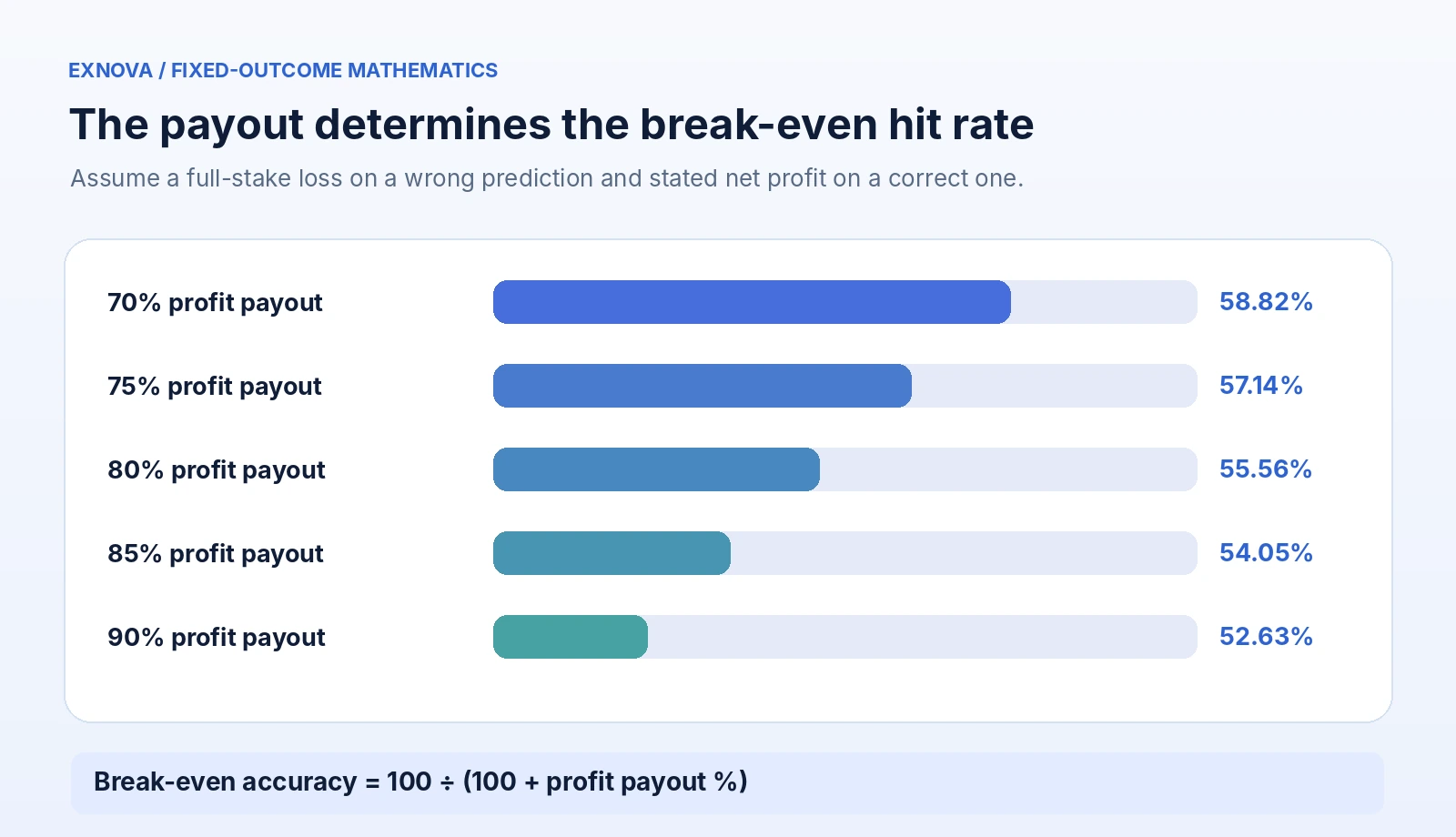
With a fixed-time contract, the payoff percentage performs much of the economic work usually done by spreads and commissions. Suppose the stake is $100 and the quoted net profit on a winning trade is 80%. A correct prediction earns $80; an incorrect prediction loses $100. Winning once and losing once would therefore produce a $20 net loss. The platform need not levy a separate line-item commission for the payout asymmetry to matter financially.
The expected result per trade can be written as stake × [win probability × payout rate − loss probability], provided the contract has exactly those two outcomes and no refund on a tie. For an 80% profit payout, the break-even win probability is 1 ÷ 1.80 = 55.56%. For an 85% profit payout, it is about 54.05%. For 70%, it climbs to 58.82%. Those figures do not forecast anyone’s performance; they tell you how much accuracy a given quote mathematically requires.
This calculation is particularly valuable when comparing assets. A strategy that wins 56% of the time might look acceptable on a chart. At a 70% payout, though, it is negative in expectation. At 85%, the same hypothetical accuracy is positive before other costs. The quoted percentage is therefore not merely a marketing label; it changes whether an otherwise identical prediction process crosses the break-even line.
A 100-trade example reveals the hidden threshold
Consider 100 independent $10 contracts quoted at 80% net profit on a win. If 50 win and 50 lose, the net is 50 × $8 − 50 × $10 = −$100. A 50% hit rate is not enough. If 56 win and 44 lose, net is 56 × $8 − 44 × $10 = +$8. The line between negative and positive in this example is extremely narrow, and ordinary fluctuations can overwhelm a small theoretical advantage.
At the same 80% quote, a 60% win rate would produce 60 × $8 − 40 × $10 = +$80 over 100 trades. This is not an earnings projection. It is an accounting identity under a deliberately simplified payoff structure. It assumes no changed payout quotes, no canceled contracts, no additional costs and an identical $10 stake on every trade. Real trading tends to violate several of those assumptions. A seemingly small decrease in the payout or the percentage of correct predictions can erase the margin.
The role of expiry and market noise
An expiry of a few minutes is not necessarily easier to analyze than a daily or weekly horizon. Over a very short window, the market may react to spread changes, liquidity shifts, random price movement and news releases. Even a directional thesis that becomes correct an hour later may still lose if the fixed-time contract settles at the wrong moment. This is why a visually attractive chart pattern does not translate directly into predictable fixed-time results.
Short durations also generate many opportunities to place another contract. That can be operationally useful for research, but it creates a behavioral risk: users may increase trade count after a losing streak, treating activity as a way to recover losses. Mathematically, each additional negative-expectation trade adds another exposure to an unfavorable payout structure. A pause rule, daily loss cap and predefined maximum number of trades are often more important than an extra indicator.
When evaluating Exnova, inspect whether the account clearly displays the settlement time, reference price, payout and early-exit policy before confirmation. An order review screen that makes these elements explicit improves usability. It cannot remove volatility risk, but it reduces the chance of making an avoidable input error, especially on mobile.
Position sizing: the one risk variable you control immediately
Because an unsuccessful fixed-time contract can lose its full stake, the stake should be treated as capital at risk rather than a refundable deposit. Someone with a $300 speculative trading balance who risks $30 per contract is risking 10% at once. Four consecutive losses remove $120, or 40% of the starting balance. Recovering that requires a 66.7% gain on the remaining $180 even before considering additional expenses.
Reducing the stake does not make the mathematical expectancy positive, but it can slow the pace of losses and make records more meaningful. Some traders use a fixed fraction of account equity; others impose a firm cash ceiling. Whichever method is chosen, it should be decided before opening the ticket. Doubling after every loss is especially fragile: a $5, $10, $20, $40, $80 sequence risks $155 across five outcomes and still needs a favorable payout schedule to recover all prior losses.
The Exnova website advertises $1 trades, which may be helpful for observing order behavior at low nominal cost. Users should not mistake the ability to place a small trade for evidence that the product is appropriate for long-term investing. The economic question remains whether the user has demonstrated a repeatable advantage under the actual quoted payout and settlement rules.
Demo balances are useful, but not evidence of profits
Exnova promotes a free practice account and displays a $10,000 virtual balance in its public marketing. For learning navigation, that is helpful. Traders can explore chart intervals, watch the trade ticket and study how expiry behaves without putting personal capital at risk. The most informative demo activity is often deliberately boring: execute a fixed checklist, record settlement behavior, and discover interface assumptions before they become expensive mistakes.
Yet demo performance has limits. Virtual funds can change psychology. Someone may take trades in a $10,000 demo that would feel reckless with $500 of real money. Live instruments and availability might also vary; a demo account does not prove that withdrawals will go smoothly or that real-money terms will be identical in every respect. The responsible conclusion from a demo is “I understand how to operate this interface,” not “I have proven an income stream.”
A useful test is to reproduce the same small, documented routine across several sessions, with no selective deletion of unsuccessful trades. If the results depend on changing stake amounts, choosing only the best trading periods after the fact, or ignoring expired losing contracts, the evidence is too weak to support conclusions about strategy quality.
Withdrawals: separate request, processing and arrival
Exnova’s homepage advertises convenient funding and withdrawals and explicitly states that deposits carry no platform fee or commission. It does not provide, on that landing page, a universal withdrawal fee, minimum cash-out amount or guaranteed arrival time for every jurisdiction. That absence is important. A reader should not interpret “quick withdrawals” as proof of a specific schedule. Payment-method availability, identity verification, bank processing and account checks may affect the actual experience.
Before funding, look for the currently applicable withdrawal policy in the authenticated account and the official legal documents, confirm the recipient details and save evidence of any stated limits. Check whether the payment method used to deposit is also required for part of the withdrawal. If you encounter conflicting figures on reseller, affiliate or lookalike websites, prefer the agreement available in the actual account. The operator and contractual relationship deserve verification independently of the brand name.
What the regulatory and corporate disclosures mean
The Exnova official privacy policy identifies Digital Smart LLC, registered in St. Kitts and Nevis, as the company operating the brand. It also identifies a Cyprus company in connection with payment transactions. These details matter, but they should not be confused with authorization by a securities regulator or with protection under a particular investor compensation scheme. A payment-processing connection in one jurisdiction does not, by itself, place the trading account under that jurisdiction’s investor-protection framework.
A serious review should therefore avoid the common shortcut of displaying a familiar jurisdiction name and calling the platform fully regulated everywhere. Before depositing, find the precise entity named in the account agreement, the governing law, the forum for disputes and any actual license number that can be independently verified with the relevant authority. If the necessary disclosures cannot be confirmed, that uncertainty is a reason to delay funding, not a detail to gloss over.
Jurisdictional eligibility also deserves attention. Products with fixed or binary-style outcomes face restrictions in a number of markets. Availability of a website or app does not automatically establish that the product can lawfully be offered to a resident of a particular country.
An operational checklist before any live Exnova trade
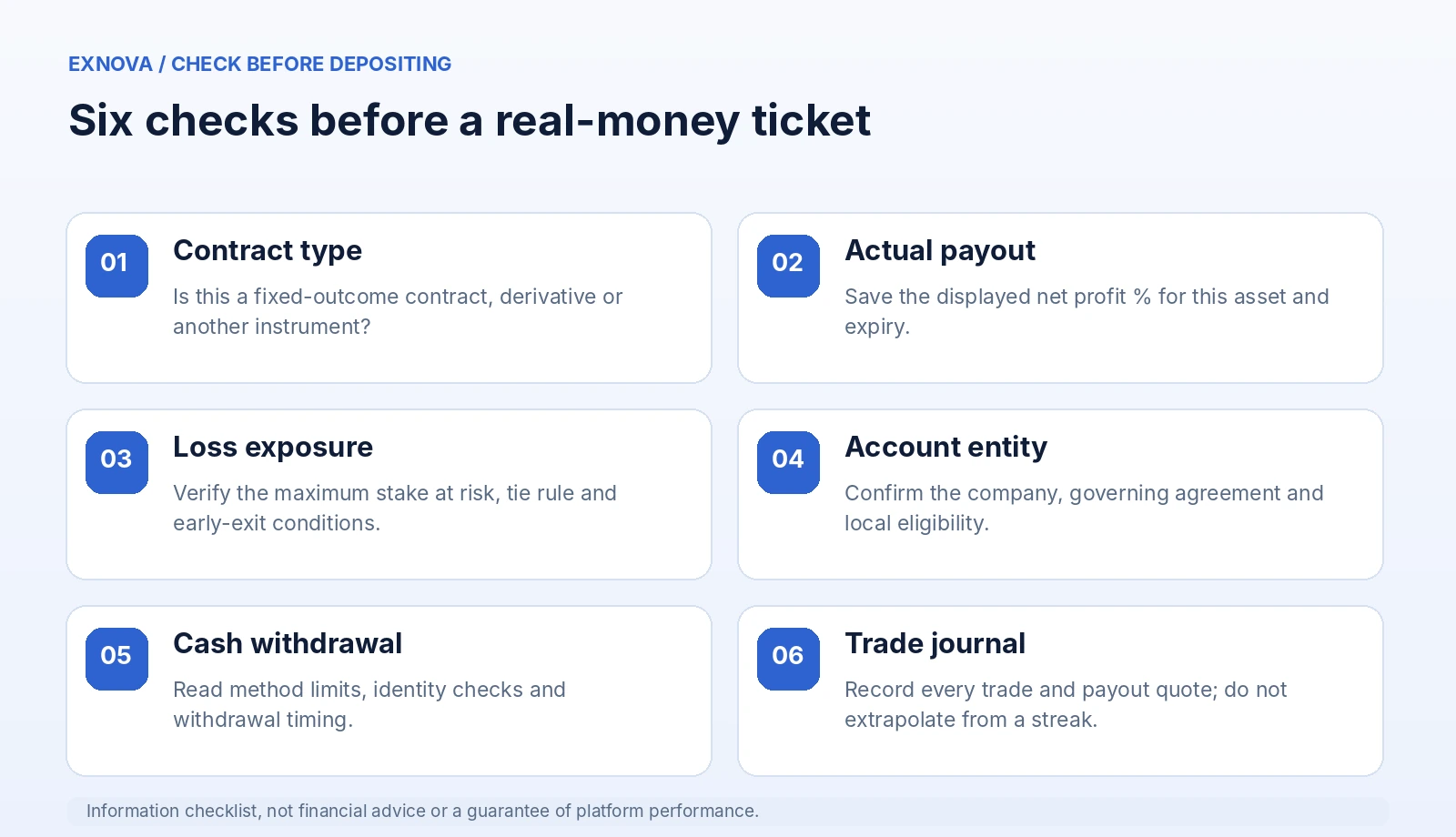
First, save the actual quoted profit percentage and expiry rules, not just a screenshot of a chart. Second, calculate the break-even hit rate from that quote. Third, set a stake limit and a session loss cap. Fourth, identify what happens if the contract expires at exactly the reference price. Fifth, read the applicable account and withdrawal terms and check the operator’s identity. Sixth, use the demo to learn the interface rather than to build confidence from virtual winnings.
It is also worth deciding in advance how long to run an experiment. If you use 20 practice trades, treat them as 20 observations rather than as proof. If you collect 200, record how payout offers changed and whether the strategy survived different hours and market conditions. A trading journal becomes valuable when it reveals the gap between expected and realized behavior. It is much less useful when it exists only to celebrate successful predictions.
Strengths, limitations and who might find Exnova useful
Exnova’s practical strengths are accessibility and an integrated interface. A low advertised deposit threshold, small trade sizes, a free demo, market context and mobile-friendly presentation make it straightforward to inspect. For readers primarily concerned with chart navigation and order entry, that is a meaningful user-experience advantage. The platform does not force an aspiring user to begin by mastering institutional trading software.
The trade-offs sit in the product economics and due diligence. Fixed-time payoffs impose a break-even accuracy above 50% whenever a win pays less than a loss costs. Very short expiries magnify execution discipline and emotional pressure. Public landing-page material does not settle every legal, payment or withdrawal question. Traders who want long-term ownership of securities or transparent exchange execution may prefer products structured differently rather than treating this format as a substitute.
Our assessment is deliberately limited: we reviewed official public materials and performed payoff arithmetic; we did not open a live account, test cash-outs, independently audit price feeds or verify that any user strategy can outperform the contract structure. Those gaps are material and should remain visible in an independent review.
Final assessment
Exnova can be a usable environment for learning what a fixed-outcome trading ticket looks like. Its strongest public claims relate to accessibility, basic tooling and a demo workflow. They do not resolve the harder issue of whether any individual trader can achieve a sufficiently high, repeatable win rate at the payouts actually offered. The clearest way to judge Exnova is therefore to start with the payout calculation, preserve detailed records and treat cash-withdrawal and legal disclosures as part of the product, not as an afterthought. A simple interface should help users understand their risk; it should never make that risk feel smaller than it is.
Frequently asked questions
What is the minimum Exnova deposit?
The official public homepage advertises a $10 minimum deposit and trades starting at $1. Those are marketing-page thresholds, not a guarantee that all instruments, payment methods and jurisdictions share identical conditions.
Is an 80% payout the same as an 80% chance of winning?
No. It describes the profit available after a successful outcome, not the probability of success. An 80% winning payout on a full-loss contract needs a win rate above 55.56% to break even in the simplified two-outcome model.
Does a free demo account prove a strategy works?
No. A demo can teach order entry and reporting, but the balance is virtual and trading psychology differs from live conditions. Keep a journal and avoid equating a short winning streak with statistical evidence.
Does Exnova guarantee withdrawal in a specific number of hours?
No universal schedule was verified on the official public homepage. Check the actual account’s applicable withdrawal terms and payment method before depositing, and do not treat third-party promises as contractual guarantees.
Can fixed-time trading lose more than the amount risked on a ticket?
Under the simplified fixed-outcome example, a losing ticket forfeits its stake; other account products can have different rules. Verify the specific contract before relying on a risk ceiling or platform-wide protection claim.
Is Exnova the same as a regulated stockbroker?
The brand offers different trading functionality and names its operating entity in legal materials. Whether a specific regulated activity, license or investor-protection scheme applies must be verified for the user’s actual account and jurisdiction rather than assumed from the word “investment.”
Source notes and methodology
Sources were checked in October 2026. Examples are mathematical illustrations, not live account tests or guaranteed future results. Fees, eligibility and legal terms can change. Verify the current account-specific documents before making financial decisions.

Croom Raymond is an ecommerce writer and digital business researcher at Ecom Reality. He covers online selling platforms, SaaS tools, pricing structures, platform features, and practical strategies for building digital businesses. His articles focus on clear, evidence-based analysis that helps readers understand how different services work, compare their advantages and limitations, and make more informed business decisions.
Comments
Related Articles


Leave a Reply