
The bottom line. CAPEX.com combines leveraged CFD trading with an unusually visible education and research layer. Its current international website identifies KW Investments Ltd, Seychelles FSA license SD020, as the operator and advertises CAPEX Academy, third-party analyst tools and WebTrader/mobile access. Cost analysis should start with the bid-ask spread but cannot end there: swaps, rollover adjustments, currency conversion and inactivity rules may change the outcome. This review distinguishes a broker’s published capabilities from claims that a prospective client must verify in a live instrument ticket and the legal terms for their own account.
CAPEX.com in context: who the platform is for
CAPEX.com occupies a recognizable position in the retail trading market. It is a multi-asset CFD broker that tries to make research and execution available in the same environment. Rather than offering only an order ticket and a collection of charts, the site talks about education, analyst opinion, charting and trading ideas. That is relevant for a trader who needs context before placing a leveraged position. It is less of a differentiator for a highly technical user who already buys institutional market data and prefers to run everything in a separate terminal. The important question is not simply whether CAPEX has educational content; it is whether its tools meaningfully improve a user’s decision-making process without encouraging excessive trading.
For this reason, this review does not treat the company’s educational catalog as evidence that trading is safe. Research tools can explain an instrument, point out a catalyst or make a chart easier to read. They cannot remove market risk, control slippage, guarantee execution or prevent losses caused by leverage. Readers comparing brokers should assess CAPEX as two related products: a trading venue with explicit legal and pricing terms, and a research workspace intended to support the person using that venue. The combination can be useful, provided the second layer never distracts from the cost and risk of the first.
Who operates CAPEX.com, and why the domain matters
One detail missing from many short broker reviews is that the name CAPEX does not necessarily describe a single legal entity across all websites and regions. On the current international capex.com/en pages, the footer identifies KW Investments Ltd, regulated by the Seychelles Financial Services Authority under license SD020, as the operator. It also refers to other group entities, including NAGA Markets Europe Ltd under CySEC license 204/13. A regulatory logo or group affiliation therefore should not be treated as a promise that every client receives the same protections or contracts with the same company. Read the entity name in the actual sign-up agreement.
The international site also displays restricted-jurisdiction language that includes the European Union, Japan, Canada, Spain and the United States. A visitor finding CAPEX through search results can easily land on a page not intended for their country. The right sequence is to confirm eligibility, then identify the contracting entity, then read the relevant customer agreement and risk disclosure. The distinction matters most when comparing compensation schemes, available leverage, deposit protections and methods of legal recourse. If a review says merely that a brand is “regulated” without the specific company and license, it leaves out the fact a reader most needs.
What markets and interfaces does CAPEX advertise?
The current international site advertises access to thousands of trading opportunities across asset classes such as forex, commodities, shares, indices and other leveraged instruments. Those counts are marketing-level descriptions rather than a guarantee that every asset is available under every entity, in every country, every day. The effective catalog is the list available inside the platform at the time of trading. Market hours, margin rates, contract specifications and spreads can all change by instrument. CAPEX offers WebTrader and a mobile interface, and its account pages describe research-oriented account packages with different levels of access to analysis resources.
For a practical evaluation, start with five contracts you actually care about: perhaps one major currency pair, one stock index, gold, an equity CFD and an energy contract. Record each instrument’s current spread, minimum trade size, margin requirement, overnight rate and market-hours restrictions. This small test is more revealing than scanning an enormous instrument count. It also helps a user find a mismatch early, such as a preferred instrument trading in an unexpected contract size or a financing rate that makes holding it overnight expensive.
The CAPEX Academy: education versus execution
CAPEX Academy is a genuine part of the product’s public positioning. Official pages refer to tutorials, news, analysis, webinars and broader educational material. CAPEX also highlights research inputs such as Trading Central and TipRanks-related analyst information, including analyst ratings, news sentiment and other third-party research categories. The key benefit is convenience: a user can move from a learning article to a market view without building an entire information stack elsewhere. For someone learning what spreads, market sessions or technical indicators mean, that integration has value.
However, educational depth should be measured by whether it answers operational questions, not by how many courses are displayed. A good beginner workflow would cover the difference between an underlying asset and a CFD, explain how margin changes a loss, show how overnight financing accumulates and demonstrate a stop order’s limitations in a gapping market. The reader should then be able to rehearse those ideas on a demo account. If the material helps users avoid mistakes, it deserves credit. If an article merely introduces a potentially exciting instrument and funnels readers into the trade ticket, its educational value is far lower.
It is worth separating analysis from advice. A third-party “buy” rating or sentiment dashboard summarizes someone else’s model, assumptions and time horizon. A CFD trader still faces position-specific financing, spread and leverage exposure. The same bullish research idea can be suitable for a long-term shareholder and unsuitable for someone holding a highly leveraged short-term derivative. CAPEX’s research collection is an advantage when treated as a source of perspectives, not as an instruction engine.
The five-part cost stack nobody should skip
The headline sales message on parts of CAPEX’s website emphasizes no fixed transaction commission for opening and closing certain trades. That does not mean total trading cost is zero. Its published trading conditions describe a spread, overnight swaps, CFD rollover adjustments and inactivity charges; its fee documents also discuss currency conversion. These are different economic events, so combining them under a vague “commission-free” label would mislead readers. Each item should be tracked independently.
1. Spread. The spread is the gap between buying at the ask and selling at the bid. CAPEX’s official trading-conditions page defines it explicitly. At a two-pip EUR/USD spread and a standard illustrative pip value of $10, opening and immediately closing one standard lot would create a roughly $20 spread cost before any additional price movement, subject to the instrument’s actual specifications. This is an educational example, not a live CAPEX spread quotation. The price gap may widen around volatile announcements and less liquid hours. For frequent traders, even a modest spread difference accumulates quickly.
2. Overnight swap. A CFD position maintained beyond the daily cut-off may generate a financing credit or debit. The amount depends on contract size, instrument, prevailing rates and the provider’s schedule. A trader holding a directional position for several weeks must model this separately from the entry spread. A correct forecast of the underlying price does not guarantee a net profit after financing. Some markets also apply a triple adjustment on a specified weekday to account for weekend financing.
3. Rollover adjustments. Instruments tied to expiring futures may be rolled into a new contract. CAPEX describes a rollover adjustment involving the difference in contract price and the relevant spread. Such adjustments can make a longer-held CFD position behave differently from a simple cash-market chart. A user trading an index or commodity across expiration should check the exact contract rules, not assume they can hold indefinitely without changes.
4. Currency conversion. When the account currency and instrument settlement currency differ, conversions may be applied to margin, profit and loss, swaps or other cash movements. An official CAPEX charges-and-fees document describes a fixed conversion rate for a particular WebTrader context, but documents across entities and dates differ. Do not assume one historical percentage applies universally. Look up the current schedule connected to the entity and platform used for the account.
5. Inactivity and cash handling. The live trading-conditions page states that inactivity is triggered after a defined period without activity and points users to the fee schedule. CAPEX’s public materials contain inconsistent descriptions of exact inactivity timing or amounts across FAQ and legacy PDF documents. That means a precise universal monthly figure would be unreliable. The prudent step is to obtain the current, entity-specific charges document before leaving cash in an unused account. Bank transfer intermediaries and currency conversion may also impose third-party costs even where the broker does not charge its own deposit fee.
A realistic example: profitable trade, disappointing net result
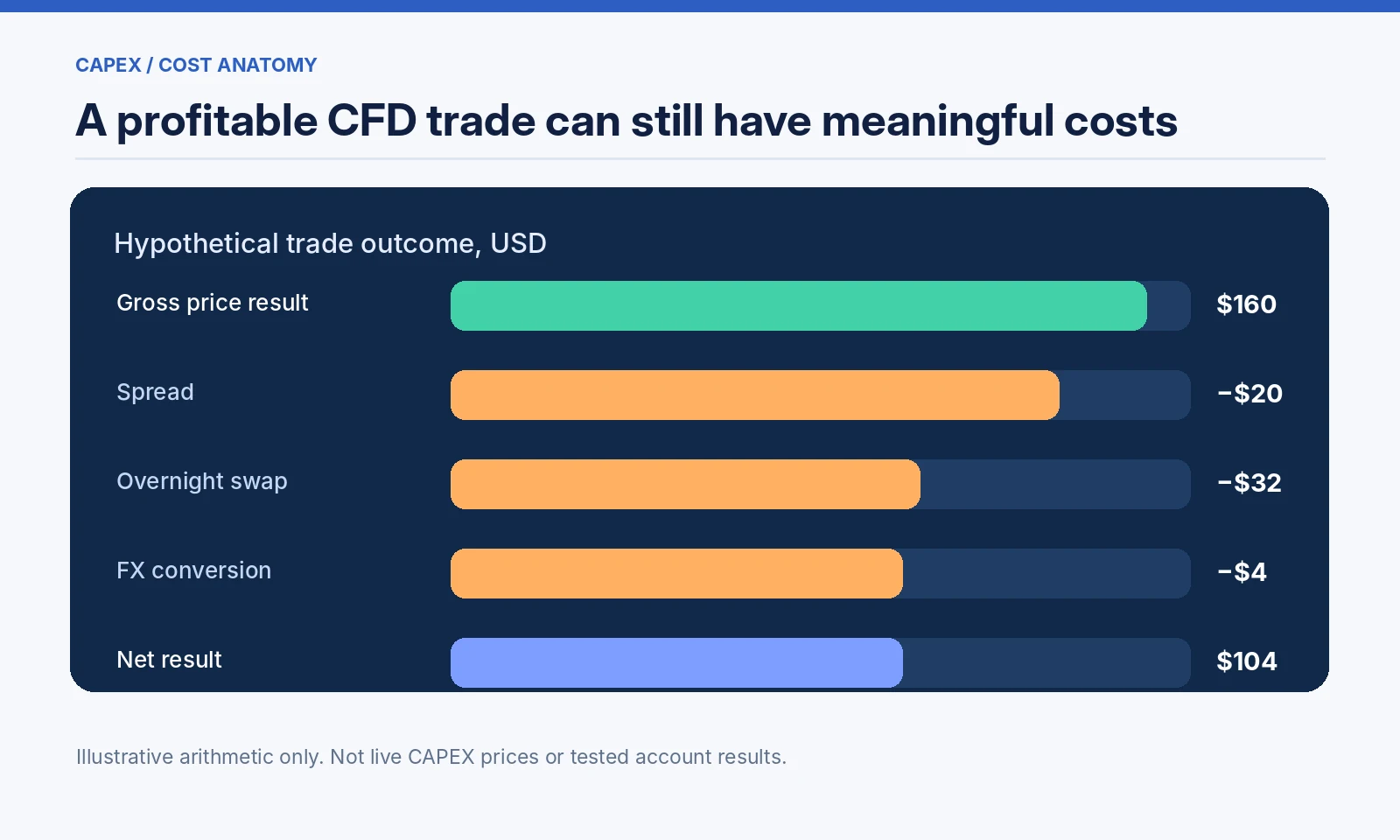
Consider a hypothetical position whose market movement produces $160 in gross profit. Suppose the opening spread creates $20 of cost, swaps across the holding period total $32, and a currency-related charge adds $4. The estimated result is $104, not $160. The arithmetic is $160 − $20 − $32 − $4 = $104. This is not a CAPEX quotation or forecast; it shows why an all-in comparison matters. A second trader entering the same market with a different position size or holding period could face a meaningfully different total.
Now change only the holding time. If swaps rise from $32 to $80, that $160 gross result falls to $56 with the other assumptions unchanged. If the trade closes at a loss, the same costs deepen that loss. Traders who hold for days or weeks therefore should treat the swap schedule as seriously as the spread. A short-term trader will generally focus more attention on spread consistency and execution. Neither approach is cost-free; the cost mix changes with behavior. That is why CAPEX’s official per-instrument trading-conditions pages matter more than any single promotional adjective.
Account packages: benefits are not guaranteed returns
CAPEX advertises different account packages with varying access to account representatives, tutorials and premium research. On the current account-types page, examples of packages begin at different funding bands, while the site also states a separate minimum required to open a trading account. The distinction is important: a promotional package starting point should not be confused with the lowest possible first deposit. Higher account packages may provide additional research access or account-service time, but the material does not establish that a higher package yields better investment results.
A professional way to evaluate those tiers is to price the research features as if purchased separately. Do you actually watch webinars? Do you use analyst rating dashboards? Do you want a dedicated representative, and if so, for which specific tasks? If the answer is no, higher-tier perks can be a distraction. If the answer is yes, compare access restrictions, suitability and support against your trading style. The most expensive tier is not necessarily the best value, particularly when the trader’s position sizing and risk plan are still basic.
Risk controls and the danger of apparently small margin
Leverage is one of the biggest ways a broker’s marketing headline and a customer’s experience can diverge. Putting down a relatively small margin does not limit a position’s exposure to that margin alone; it means a larger underlying notional value is being controlled with less deposited collateral. A one-percent underlying move on a $20,000 notional position represents about $200 in price change before costs, regardless of whether the trader committed $20,000 or a smaller margin deposit. The cash impact relative to the actual funds put aside can therefore be much larger than a beginner expects.
The site’s own risk warning describes CFDs as speculative and acknowledges substantial loss potential. Before using CAPEX, a sensible user should know the maintenance-margin level, how stop orders behave in volatile markets, what happens if an instrument gaps and whether negative-balance provisions apply to the particular entity and client category. General statements about risk controls are insufficient unless they are confirmed in the governing account documentation. The same goes for any promotion using “risk-free” wording: read the offer’s conditions and maximum eligible loss rather than treating the phrase as a promise that trading itself carries no risk.
How to evaluate CAPEX without placing a live trade
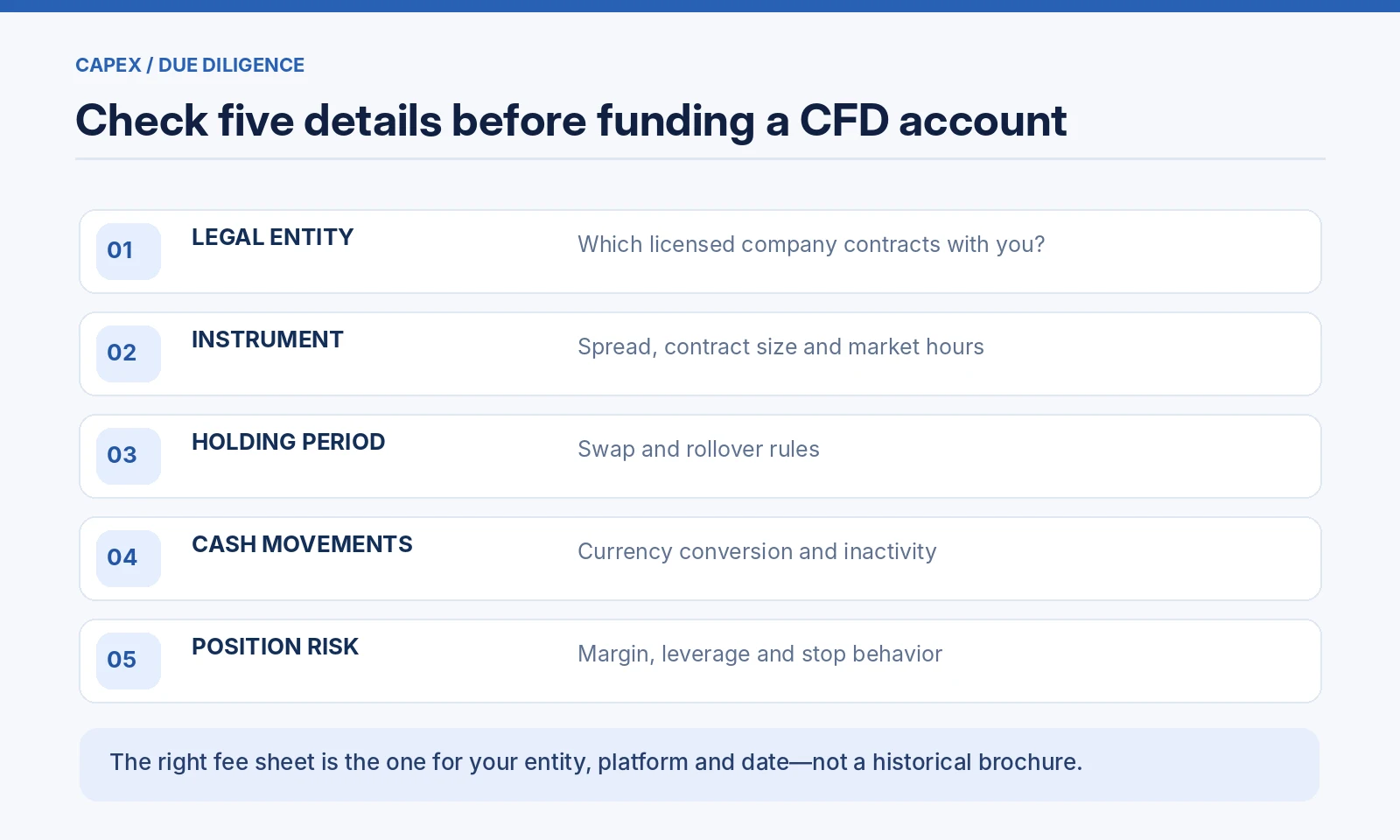
A good first session on CAPEX is a checklist, not a deposit. Check the entity details on the footer and confirm your eligibility. Read the current charges document for that entity. Select instruments you may actually trade and record the spread, swap, minimum size and margin shown in the platform. Open the Academy materials that explain those exact concepts. Then use a demo account, if available for your region, to practice the full cycle: opening a position, placing a stop, adjusting position size and closing it. Record the experience in a small journal.
The more revealing test comes after a week. Did the platform make contract costs obvious before submission? Were analysis links useful or distracting? Could you export an understandable transaction history? Was there an unexpected exchange-rate difference or overnight adjustment? Could you find a human support path when documentation was unclear? These questions identify the day-to-day strengths of the service better than simply praising an attractive terminal. A review should help readers avoid surprises, not encourage them to trade faster.
Strengths, trade-offs and the final judgment
CAPEX’s strongest proposition is the combination of multi-asset CFD access, research dashboards and structured learning resources. For a reader who wants analysis and execution close together, that is a real convenience advantage. The Academy gives less experienced users a route into understanding trading terminology, and the broker’s published instrument conditions provide a starting point for informed comparison. Its official site is also transparent about the international operating entity, which is essential when coverage spans several countries and group relationships.
The trade-offs are equally concrete. The headline absence of fixed transaction commissions can obscure swaps, conversion adjustments and inactivity rules. Website and historical document language is not fully consistent about certain charges, so exact terms require confirmation. Jurisdictional restrictions prevent the international site from being a universal option. Finally, combining engaging research with leveraged trading requires self-discipline; interesting market commentary does not make any position safe. CAPEX deserves consideration from users who want an education-oriented CFD workspace, but the best decision depends on the current fee document, legal entity, instruments and realistic trading horizon.
Frequently asked questions
Is CAPEX.com a regulated broker?
The international capex.com/en site identifies KW Investments Ltd as its operator and cites the Seychelles FSA license SD020. Other entities are mentioned in group disclosures. Verify the legal entity and protections in your own application documents rather than assuming all clients share one regulatory framework.
Does CAPEX really charge zero commissions?
Official pages describe commission-free dealing for certain trading contexts, but users still face bid-ask spreads and may incur overnight swaps, rollover or conversion charges. A transaction-commission headline is not the same as zero total cost.
Is CAPEX Academy available to everyone?
CAPEX publicly promotes the Academy and educational materials, but some research resources or account-service perks may vary by package. Check access requirements for the specific feature you want rather than assuming every account includes every tool.
How much is the inactivity fee?
Published CAPEX pages and documents do not present a consistently universal amount or waiting period across time and entities. Consult the current fee schedule for the exact contracting entity before assuming a number from an older review.
Is CAPEX suitable for beginners?
Its tutorials and research access may help beginners learn concepts, but CFDs and leverage are high-risk instruments. Suitability depends on experience, personal finances, region and understanding of trading costs. Education should come before a live deposit.
Official sources and methodology
This editorial review uses the international CAPEX.com licenses and regulations, trading conditions, Academy positioning, account packages, deposit FAQ and general FAQ, consulted October 2026. Monetary calculations are explicitly hypothetical. No real-money trades or proprietary CAPEX account were tested for this article.

Sylvia Pierce is an editor and ecommerce researcher at Ecom Reality. She specializes in reviewing ecommerce platforms, digital selling tools, pricing models, and online business software. Her work focuses on providing clear, practical, and balanced information that helps entrepreneurs make informed decisions.
Comments
Related Articles


Leave a Reply