
The bottom line. Ecomzy Mall gives buyers two paths: purchase selected digital toolkits individually or subscribe to Ecomzy Pass for recurring toolkit credits and AI tokens. The current public pricing lists a seven-day trial that renews to Starter at $8.99/month, plus Pro at $19.99/month and Power at $49.99/month. Pass is not an unlimited-download subscription: credits unlock tools, tokens power AI use, and unused allowances expire each billing cycle. One-time purchases remain available in the account after cancellation. The best deal depends on what you actually use, not on the highest advertised credit allowance.
The buying decision is more complicated than the headline price
Ecomzy Mall sells a broad collection of practical digital tools: budgeting helpers, career planners, family and household checklists, learning guides and AI-assisted products that produce personalized recommendations. A visitor may see an individual product with a one-time price, then notice a prominent invitation to try it through Ecomzy Pass. The temptation is to compare the product’s retail price with the monthly subscription fee and assume the subscription always wins. That misses the mechanics of the platform. Pass gives access through a credit-based model, and its AI features are metered separately through tokens. A one-time purchase works differently: it purchases that item without requiring the user to maintain a recurring subscription for future billing cycles.
The real comparison therefore has three dimensions. First, how many toolkits are you realistically going to unlock this month? Second, how intensively will you use AI inside them? Third, will you still want access in six months if you cancel the subscription? Someone who needs a single well-defined guide to solve an immediate problem faces a different decision from a household juggling budget planning, a relocation, children’s schedules and career documents over several weeks. The details matter because a large monthly credit allowance can be impressive on a pricing page but worthless if it expires before you use it.
What Ecomzy Mall sells: a toolkit is not necessarily a download
The current catalog mixes products that resemble reusable guides and planners with browser-based personalized tools. Its FAQ explains that after a confirmed purchase, access instructions arrive by email and the customer can use the purchased tool through an Ecomzy Mall account. Many products are meant to be returned to repeatedly. A guided questionnaire that produces a tailored action plan is a different product from a static PDF containing generic suggestions. The first may depend on an AI session, while the second may be primarily material to read or print. Buyers should therefore check each product page for exactly what is delivered, how it is accessed and whether a file can be saved separately.
That distinction matters for cancellation. The Ecomzy Mall pricing FAQ explicitly says that toolkits already purchased individually remain in the account even if the user later leaves a subscription. Pass purchases and credit unlocks, however, should not be casually described as identical to separately paid one-time purchases; the applicable entitlement and product terms should be checked. A user who expects an exported file should confirm that the specific toolkit actually offers export or a downloadable format. It would be inaccurate to assume that every item is a permanently downloadable guide merely because the marketplace describes its catalog as digital products.
Ecomzy Pass prices and allowances, verified
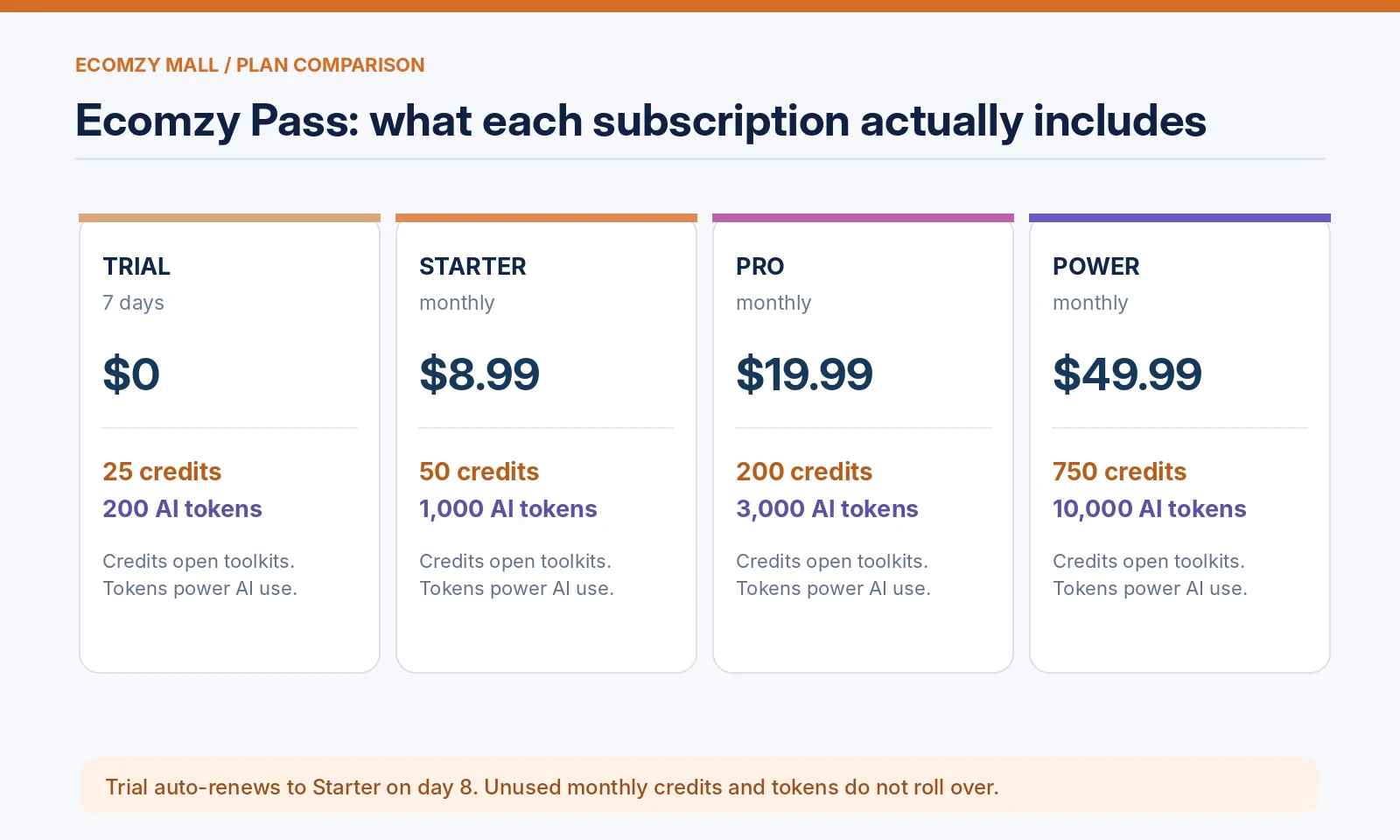
The official Ecomzy Mall pricing page breaks its Pass offer into four stages. The seven-day trial is advertised at $0, with 25 toolkit credits and 200 AI tokens; it automatically converts to Starter on day eight unless canceled. Starter costs $8.99 per month, includes 50 credits and 1,000 AI tokens. Pro costs $19.99 per month, with 200 credits and 3,000 AI tokens. Power costs $49.99 per month, with 750 credits and 10,000 AI tokens. These are monthly subscription prices from the public page as checked in October 2026, not quotes for an individual customer’s taxes or payment-method circumstances.
The apparently large credit numbers need interpretation. Ecomzy states that 1 credit equals $1 of toolkit-unlock value. Small toolkits may use 7–19 credits and larger systems may use 29–69 credits, depending on the product. A subscription member does not automatically receive the dollar credit amount as money, a refundable balance or a cash-out right. It is a restricted allowance for unlocking eligible content inside the product catalog. The same pricing page explains that the credits and AI tokens reset every billing cycle and do not roll over. An account carrying 142 unused credits at the end of the month does not thereby get 342 credits next month. Unused value is lost rather than banked.
The two allowances also interact. Credits are used to open a toolkit. AI tokens pay for its generative actions, such as producing a plan, auditing information or composing a response. According to the official explanation, a typical full AI toolkit run may use roughly 500–2,000 tokens, and an individual chat message may use about 50–200 tokens. Those figures are examples, not a fixed universal cost for every tool. They demonstrate why a person with 200 credits might still run out of AI tokens before the credits are fully used. Conversely, someone using mainly non-generative guides may not need the largest token pool at all.
First cost trap: confusing credits with unlimited use
Marketing a $19.99 plan with 200 credits makes the value proposition look obvious. But suppose a shopper unlocks one 9-credit checklist, one 19-credit planner and one 39-credit system during a month. That is 67 credits consumed, leaving 133 that expire if they are not used before renewal. The user has paid $19.99 to receive access to those three purchases during the period, plus whatever AI use occurred. That may still be good value. It is not the same as spending $200 of cash or owning every product in the catalog.
Now imagine a buyer who uses an AI-heavy 39-credit toolkit and runs it three times, each hypothetical full run costing 1,200 tokens. The total would be 3,600 AI tokens. On Pro, the monthly allowance is 3,000 tokens, so the buyer could exhaust the token pool even while having unused toolkit credits. The example is intentionally simplified and should not be mistaken for a guaranteed token charge on that particular product. Its point is operational: buyers need to budget both currencies independently. A comparison that quotes only credits produces an incomplete estimate of Pass value.
Individual purchase: the better choice for occasional needs
Many Ecomzy Mall product pages display a one-time price next to the invitation to try Ecomzy Pass. The FAQ says most tools are one-time purchases that can be accessed through the account without an automatic subscription, with recurring fees disclosed for products that actually use a subscription model. A one-time purchase is especially rational when the user knows exactly which tool they need and does not expect to explore the catalog again soon. A one-off rental-dispute checklist, a specific study planner or a personal expense tracker may not justify adding a new monthly financial commitment, even if the subscription looks inexpensive.
The advantages are straightforward. You pay for the selected item, your billing decision ends there, and you do not need to remember another renewal date. A buyer can also compare the item’s own features against a generic alternative without forcing the decision into a membership calculation. That matters for digital goods because value often comes from solving one immediate problem. If a product provides a strong answer in ten minutes, the buyer’s outcome may be excellent even if they never become a repeat customer. Subscriptions should not be a default purchase simply because recurring access is fashionable.
Individual buying does have limits. Repeatedly purchasing one toolkit after another can become more expensive than a subscription for someone with sustained needs. Ecomzy Pass can make sense if a user has a realistic plan to unlock multiple eligible tools each month and will actually consume enough of the monthly allowance. It also offers the convenience of browsing the catalog under one recurring relationship. The right lesson is not to dismiss the subscription; it is to choose it based on observed usage rather than on an inflated theoretical discount.
Concrete buying scenarios: one tool, a household project, a heavy user
Scenario A: one tool this month. Suppose the buyer wants a toolkit listed at $19 as a standalone purchase and does not plan to use anything else. Paying $19 once is easy to understand. A $8.99 Starter subscription could have enough credits to unlock the tool, but renewal and token limits now become relevant. If the buyer cancels immediately after obtaining the intended result, the short-term price may be lower, but they should check the precise post-cancellation entitlement and applicable subscription terms. If they forget to cancel, even one extra month changes the comparison.
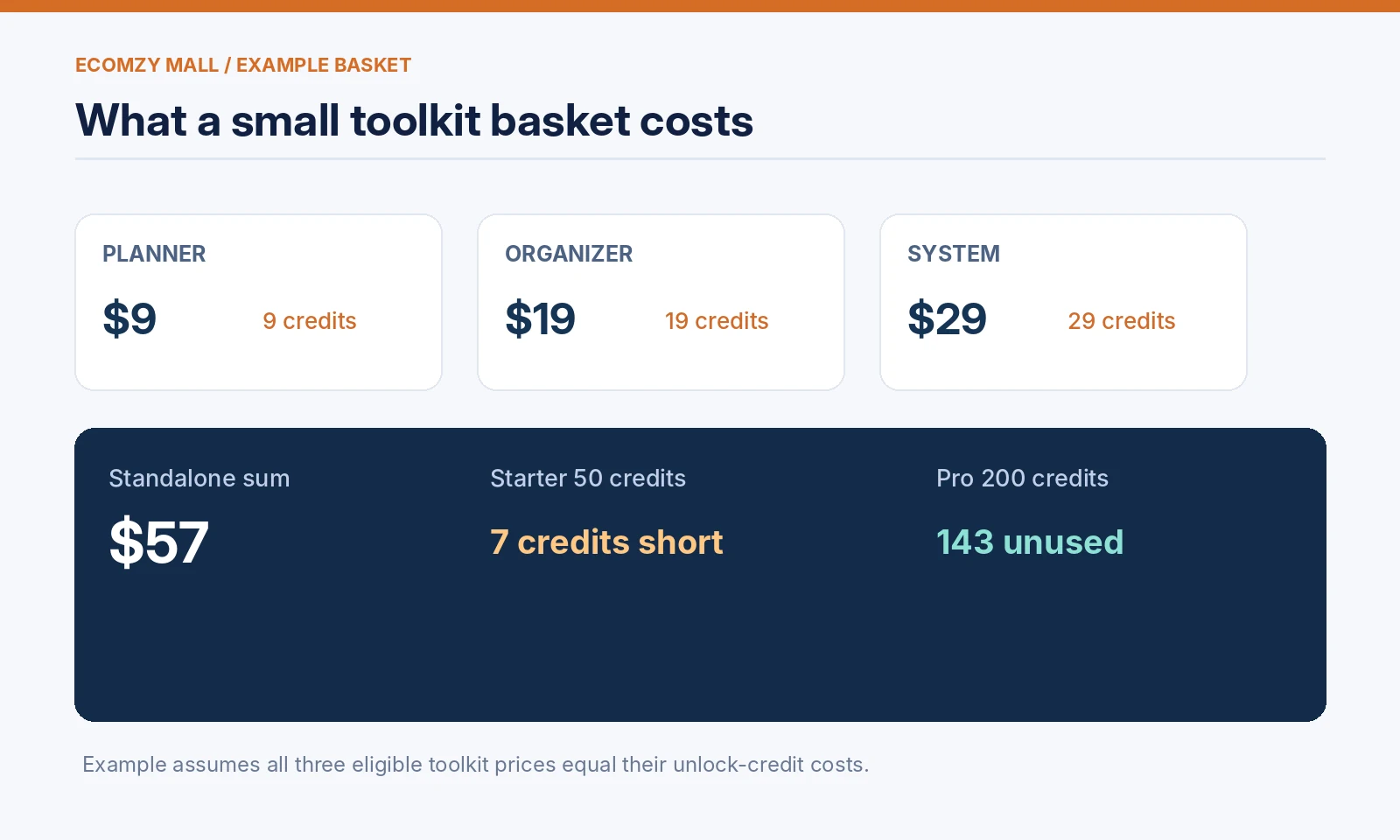
Scenario B: a short household project. A buyer plans to use a $9 planner, a $19 organizer and a $29 toolkit in the same billing cycle. The standalone total is $57. If all three are eligible for Pass and their credit costs match those displayed prices, the combined unlock requirement is 57 credits. Starter provides only 50 monthly credits; Pro provides 200. That makes Pro the simpler fit for a single-cycle package, provided the available AI tokens are adequate. The user could then weigh $19.99 in subscription cost against $57 of one-time prices, while remembering that leftover credits expire. This is a genuinely plausible case for Pass value, not a claim that every subscriber saves the same amount.
Scenario C: a recurring planner user. Someone working through ongoing household budgeting, education planning, career development and home maintenance may consistently unlock several items every month. This customer is closer to the subscription’s intended use case. Pro or Power might fit, depending on toolkit sizes and AI intensity. But it still helps to review actual usage after the first cycle. A user who repeatedly leaves most credits unused should downgrade or stop paying rather than retaining a higher tier for a theoretical need. A monthly screenshot of credits spent, tokens spent and problems solved is a better metric than the headline allowance.
Second trap: subscription value is not cash value
A tempting way to market the Pro plan is to say it provides $200 worth of access for $19.99. The official page itself uses a similar framing. For a consumer comparison, though, the credit face value should not be treated as an investment return or unrestricted savings. It is a coupon-like internal entitlement to unlock eligible tools at listed catalog values. If the customer would not otherwise buy the tools, there may be little economic benefit from unlocking them just to use expiring credits. The correct value question is: what would you willingly pay for the exact tools you actually used?
This is the same problem seen in streaming services, software bundles and digital membership clubs. A catalog can contain more theoretical value than any subscriber could consume. The subscription becomes worthwhile through use, not through the size of the library. Ecomzy’s unusually explicit separation of tokens and credits is helpful, but it also increases the cognitive load. Buyers should not mistake the two budgets for one unrestricted pool or assume that one can be converted into the other. They are designed for different parts of the product workflow.
Trial, cancellation and the day-eight renewal
The free trial deserves its own paragraph because its timing has a real cash consequence. Ecomzy Mall says the seven-day trial includes 25 credits and 200 tokens and automatically renews to Starter at $8.99 on day eight unless canceled. The company says it sends a reminder on day five. A buyer who only wants to test the catalog should record the renewal date at sign-up. Waiting until the final minute invites unnecessary stress, especially if account access or payment authorization must be resolved.
After the trial, official pricing states that subscriptions can be canceled from the account page and that cancellation stops future billing while access continues through the current paid period. Upgrades take effect immediately with prorated credits, and downgrades begin at the next billing cycle. These are useful flexibility features, but they do not make a subscription costless. Unused credits and tokens expire at the next cycle, so a buyer should use available allowances before expiration rather than assume they accumulate while the subscription is paused or canceled. The company advertises a 30-day money-back guarantee on paid tiers; eligibility should be checked in the current refund terms and relevant transaction details.
What happens to a toolkit after cancellation?
This question has two distinct answers that should not be collapsed. Individually purchased tools: Ecomzy’s published pricing FAQ says they remain in the account forever, even if the buyer cancels Pass. That is a concrete consumer-friendly point. Pass-unlocked content: the precise scope of post-cancellation access should be confirmed from the subscription agreement and the product’s entitlement description. The public pricing page clearly says cancellation stops future billing and the customer retains access until the end of the paid period; it does not mean that unused credits survive cancellation or that every AI function can continue indefinitely without tokens.
The safest approach is to keep copies of purchase confirmations and to export any permitted outputs that matter to you. A generated weekly plan, a resume draft or a household checklist may be more useful as a saved personal document than as something you must rediscover in an account. Before buying, check whether the tool includes downloads, printable HTML, saved history or account-only access. These details are especially important for anything the customer expects to use long after the initial problem is solved.
An efficient first-month test
To test Ecomzy Mall without overspending, start by listing the exact problems you want to solve. Put a conservative one-time price next to each toolkit you would genuinely purchase. Then estimate the credit cost of unlocking those products and the AI token budget for any full runs you expect to complete. If your list uses only one or two tools, a one-time purchase may still be preferable. If it includes several eligible toolkits in the same month, compare the matching tier’s monthly subscription against the purchase total. Finally, set a cancellation reminder before the next renewal and record what you actually used.
This simple process closes a major information gap in most membership comparisons: projected savings often assume full use of every allowance, but real people leave benefits unused. Instead of using Ecomzy’s nominal “credit value” as the denominator, use the catalog items you truly needed. That allows a shopper to judge the subscription by its contribution to household convenience, time saved and problem solving rather than by its maximum theoretical benefit. It also prevents buying extra digital tools simply because credits are about to expire.
Verdict: which payment route makes sense?
Ecomzy Mall’s strongest advantage is choice. Someone who needs one well-defined digital tool can often buy it once and keep access. Someone with recurring planning needs can subscribe to a generous toolkit-credit package and pair it with AI tokens. The Pass tiers are straightforward when read carefully: $8.99 Starter, $19.99 Pro, $49.99 Power, each with separate allowances that reset monthly. The disadvantages are not hidden in an obscure formula; they are the familiar trade-offs of expiring credits, metered AI runs and automatic renewals.
My practical recommendation is to treat one-time purchasing as the default for a single known need, and Pass as the stronger candidate for multiple eligible tools used within one billing cycle. Review both the actual credit requirement and the expected AI workload before selecting a plan. Do not equate unused credits with savings, and do not assume every product is a downloadable file. That approach makes the Ecomzy Mall decision substantially more precise than a superficial comparison of $19.99 with the retail sticker prices of everything in the catalog.
Frequently asked questions
How much is Ecomzy Pass?
The official pricing lists Starter at $8.99/month, Pro at $19.99/month and Power at $49.99/month. A seven-day $0 trial is also offered and automatically renews to Starter on day eight unless canceled. Check live checkout for any changes.
Are credits and AI tokens the same thing?
No. Credits unlock toolkit access at a published one-credit-to-one-dollar unlock ratio. Tokens are consumed by AI interactions, with usage varying by tool and task. The two allowances are separate.
Do unused credits carry over?
No. According to the current pricing FAQ, unused credits and tokens reset when a new billing cycle begins. Budget for what you will actually use that month.
Does canceling Pass delete toolkits bought individually?
The public Ecomzy Mall pricing FAQ says individually purchased toolkits remain in the account. For items unlocked through Pass credits, review the current entitlement rules and do not assume they work exactly like separate purchases.
Is there a refund policy?
Ecomzy Mall advertises a 30-day money-back guarantee for paid Pass tiers and separate refund information for one-time purchases. The applicable terms and processing route should be checked before payment.
Sources and review method
This review is based on the official Ecomzy Mall pricing page, FAQ, main catalog and sample listings for Passive Income Stream Builder and Side Income Finder, reviewed October 2026. All example baskets are hypothetical and are not claims about individual customers or guaranteed savings. We did not make a live purchase for this review.

Jo Carter is an editor and ecommerce researcher at Ecom Reality, where she covers ecommerce platforms, digital selling tools, online business software, pricing models, and emerging industry trends. She focuses on turning complex platform features and costs into clear, practical information for entrepreneurs and digital sellers. Her work combines detailed research with a balanced editorial approach, helping readers compare services, understand potential limitations, and choose tools that fit their business goals.
Comments
Related Articles


Leave a Reply