
Hash Hedge Review: Crypto Prop Challenges, Profit Targets and Payout Conditions

Hash Hedge markets a distinctive version of the prop-trading challenge: cryptocurrency markets available around the clock, access to a broad collection of other instruments and the prospect of receiving a share of qualifying gains after passing an evaluation. Its homepage advertises accounts up to $200,000 and a reward share of up to 90%. It also promotes both one-stage and two-stage routes. These are attractive headlines for traders who want a defined risk framework and do not want to place a large conventional brokerage balance at risk. But the real offer is governed by the challenge rules, and those rules deserve more scrutiny than a typical crypto-exchange fee schedule.
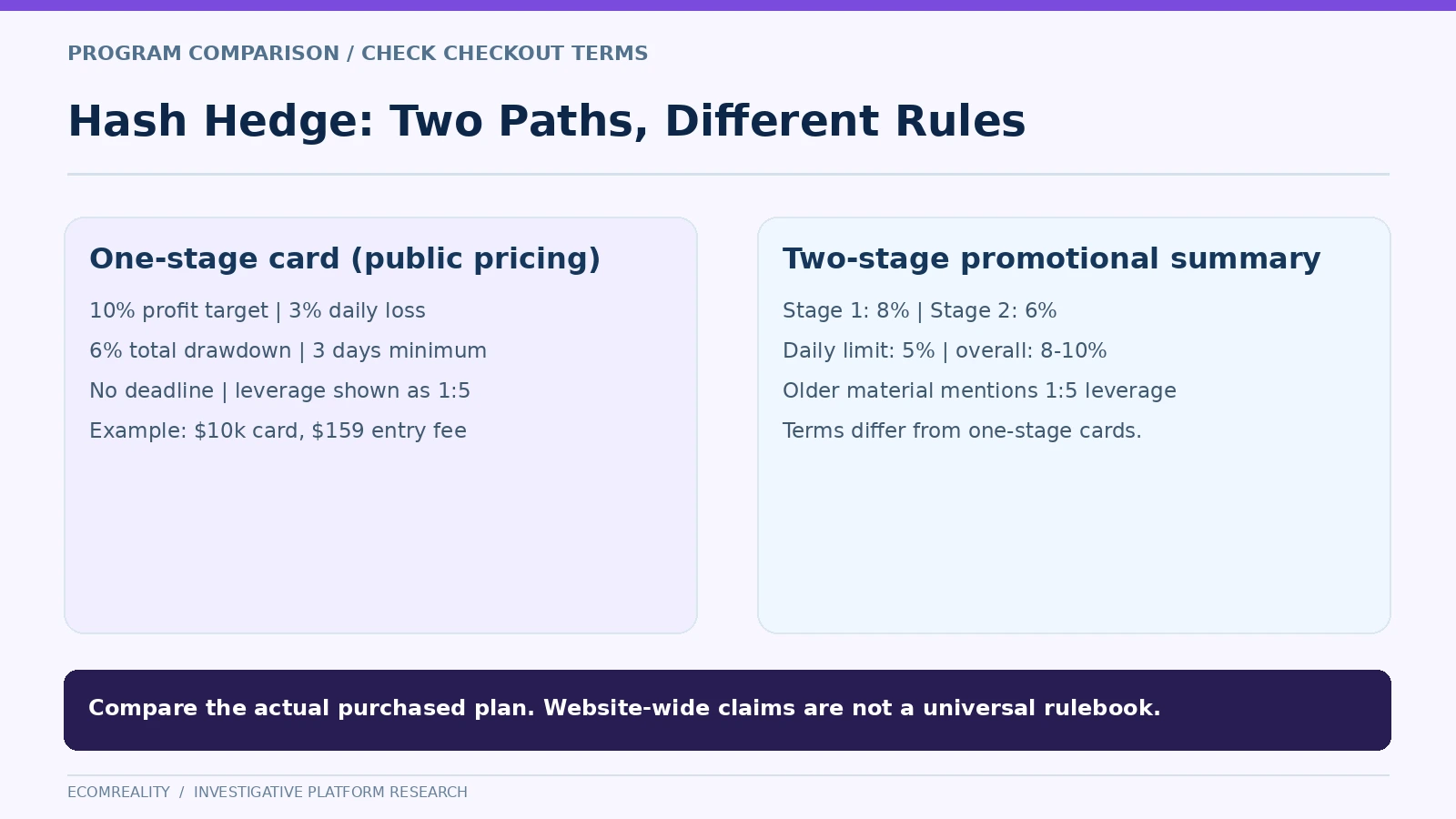
Several pages on the public site use different sets of numbers. The one-stage purchase cards show a 10% profit target, 3% daily loss limit and 6% overall drawdown, while promotional summaries elsewhere discuss an 8% target followed by 6%, a 5% daily limit and an 8–10% overall allowance. Both combinations can describe real products, but they should not be silently merged into a single account. A user must identify the precise route, checkout terms and account-specific dashboard. This review examines those differences, the arithmetic of loss limits, the reward process, and the practical question of whether Hash Hedge’s proposed crypto-oriented assessment suits a trader’s actual strategy.
Understanding the product: a challenge before a reward account
In a conventional crypto account, a user deposits funds and trades assets directly through a broker or exchange. A prop-style challenge works differently. The trader pays a one-time assessment fee, receives a permitted notional or simulated account size and tries to meet objectives without crossing predefined risk limits. Passing the evaluation can make the trader eligible for a trader-stage arrangement, but the qualification is not equivalent to ownership of the headline capital allocation. The nominal $50,000 or $100,000 balance is principally the denominator for evaluating targets and loss limits. It should not be confused with a recoverable customer deposit.
Hash Hedge offers a trading terminal and promotes access to crypto perpetual markets as well as categories it describes as real-world-asset or TradFi markets, including indices, commodities and equities. The broader asset menu could be a strength for a trader who wants one evaluation environment instead of separate crypto and CFD accounts. Yet access to more symbols creates complexity: spreads, leverage, funding or financing, trading hours and gap exposure can differ sharply between markets. The marketing claim of around-the-clock access should therefore be checked against instrument-specific sessions and the particular market the trader intends to use. A product described as an ‘index’ may not have the same trading mechanics as spot cryptocurrency.
What the one-stage cards currently show
The live main-site purchase cards provide a tangible starting point for comparing cost. At the time of review, the example one-stage offering lists $5,000 of nominal account size for $99, $10,000 for $159, $25,000 for $349, $50,000 for $599 and $100,000 for $999 as one-time challenge fees. The cards show a 10% profit target, a 3% maximum daily loss, a 6% maximum overall drawdown and at least three trading days, with no maximum calendar duration. A leverage value of 1:5 is shown in the detailed one-stage terms on the principal site, although some promotional copy elsewhere uses a different number. These specifics are more relevant than the generic phrase ‘get funded fast’.
For a $10,000 example, a 10% target means producing $1,000 in qualifying profit. A 3% daily loss allowance represents $300, while a 6% overall drawdown corresponds to $600 if calculated from the initial balance. This is a tight relationship: one day’s theoretical loss capacity already represents half of the simple overall allowance. It would be reckless to treat the entire daily limit as a normal risk-per-trade amount. Because both realized and unrealized P&L may count, traders must account for open positions and possible intraday slippage, not merely their closed-trade performance.
Why two-stage figures cannot be pasted into one-stage comparisons
Other official promotional sections present a two-stage path with Stage 1 at 8%, Stage 2 at 6%, daily limits of 5% and an overall allowance in the 8–10% range. That scheme is not the same as the 10% / 3% / 6% one-stage card. A trader comparing offers might reasonably see two-stage as the slower route with lower percentage targets, but that conclusion is incomplete without checking each stage’s loss rules, permitted trading activity and transition requirements. If a trader uses the softer two-stage daily limit while paying for the tighter one-stage package, the practical risk plan will be wrong from day one.
The site also contains copy about up to $200,000 in capital, while some currently visible individual cards stop at a smaller amount. Availability may depend on the account selector, offer version or route. The responsible way to resolve the difference is to read the checkout summary for the selected plan. A plan should be evaluated as a bundle of conditions, not assembled from the most attractive fragments on separate screens. This is one reason Hash Hedge deserves a more critical review than a standard ‘ten reasons to join’ article: documentation consistency is itself an important part of the user experience.
Profit targets do not express the whole difficulty
Targets are easy to understand in isolation. A trader with a $25,000 evaluation account and a 10% target must produce $2,500 in qualifying gains. But a target only says where the trader wants to finish; loss limits define the path that is allowed. Suppose a strategy alternates a 2% drawdown with a 3% recovery while aiming for a 10% gain over several weeks. On a 6% overall cap, that may be survivable if the peaks and troughs are controlled. On a 3% daily limit, however, a rapid unfavorable market move can end the challenge long before the profit objective is reached. The route’s definition of daily reset and equity matters enormously.
The minimum trading-day requirement also changes the evaluation process. Some cards show a three-day minimum. That means one lucky session need not be enough even if it surpasses the target. A trader still has to meet any required number of qualifying days and complete the compliance review. The lack of a deadline can help disciplined strategies, but ‘unlimited time’ should not be confused with a guarantee that unattended accounts stay valid indefinitely. The agreement may have activity or conduct rules not summarized in the large headline. Look for the rulebook that is incorporated into the particular purchase.
Daily loss: the danger of open-position equity
Many users think of a daily drawdown as the amount they have already lost on closed trades. That can be a dangerous simplification. Hash Hedge’s published FAQs explain that limits are monitored against account equity and that open trades affect the calculation. Consider a $10,000 account at the beginning of a session with a 3% daily cap. If three open positions temporarily show a combined loss of $310, the equity may have crossed the $300 allowance even if no trade has yet been closed. A later recovery or winning session does not necessarily erase a rule breach that has already been recorded.
This feature makes trade sizing especially important in volatile crypto markets. Cryptocurrencies can move sharply outside the main hours of traditional equities, when liquidity is thinner and funding dynamics become more visible. Traders should plan combined exposure and not assume five small positions create diversification if all are effectively long the same risk factor. A single market reversal can push all five into loss simultaneously. Setting an internal maximum exposure well below the formal daily cap is more practical than hoping the system gives a few seconds to recover after the threshold is touched.
Maximum overall drawdown and the high-water question
The overall limit is a separate boundary from the daily one. Depending on a plan, it may be described as an initial-balance threshold or in terms of peak-to-trough movements. Those mechanisms behave differently. An initial-balance rule might keep a fixed floor; a trailing drawdown rule can move upward as the trader makes gains. Hash Hedge’s published descriptions are not equally explicit across every plan screen, so the buyer should ask whether the overall limit is fixed, static until a milestone, or trailing. The difference determines whether banking an early profit actually expands the risk cushion.
Trading costs within a challenge
Hash Hedge is a crypto-oriented prop platform, so a trader should think about trading cost in several layers. There is the entry fee paid to participate, execution cost or spread on the selected market, possible maker/taker charges, funding on perpetual positions where applicable and the effect of slippage during volatile periods. The homepage highlights market access, not a comprehensive universal fee schedule for every asset and contract. Anyone making frequent trades should open the contract specifications for the exact symbols rather than assume all crypto markets have identical cost profiles.
A practical method is to estimate a sample strategy’s net performance after trading friction before choosing an assessment. Suppose a high-turnover strategy expects 100 round trips in a month and pays even a modest amount per round trip in spread and fees. Those costs directly reduce the chance of reaching a nominal target. More important, they create immediate unrealized or realized equity drag under tight drawdown limits. A strategy that looks profitable without costs can become incompatible with the risk ceiling once the real execution model is included. That is a cost problem and a qualification problem at the same time.
What the advertised 90% reward share means
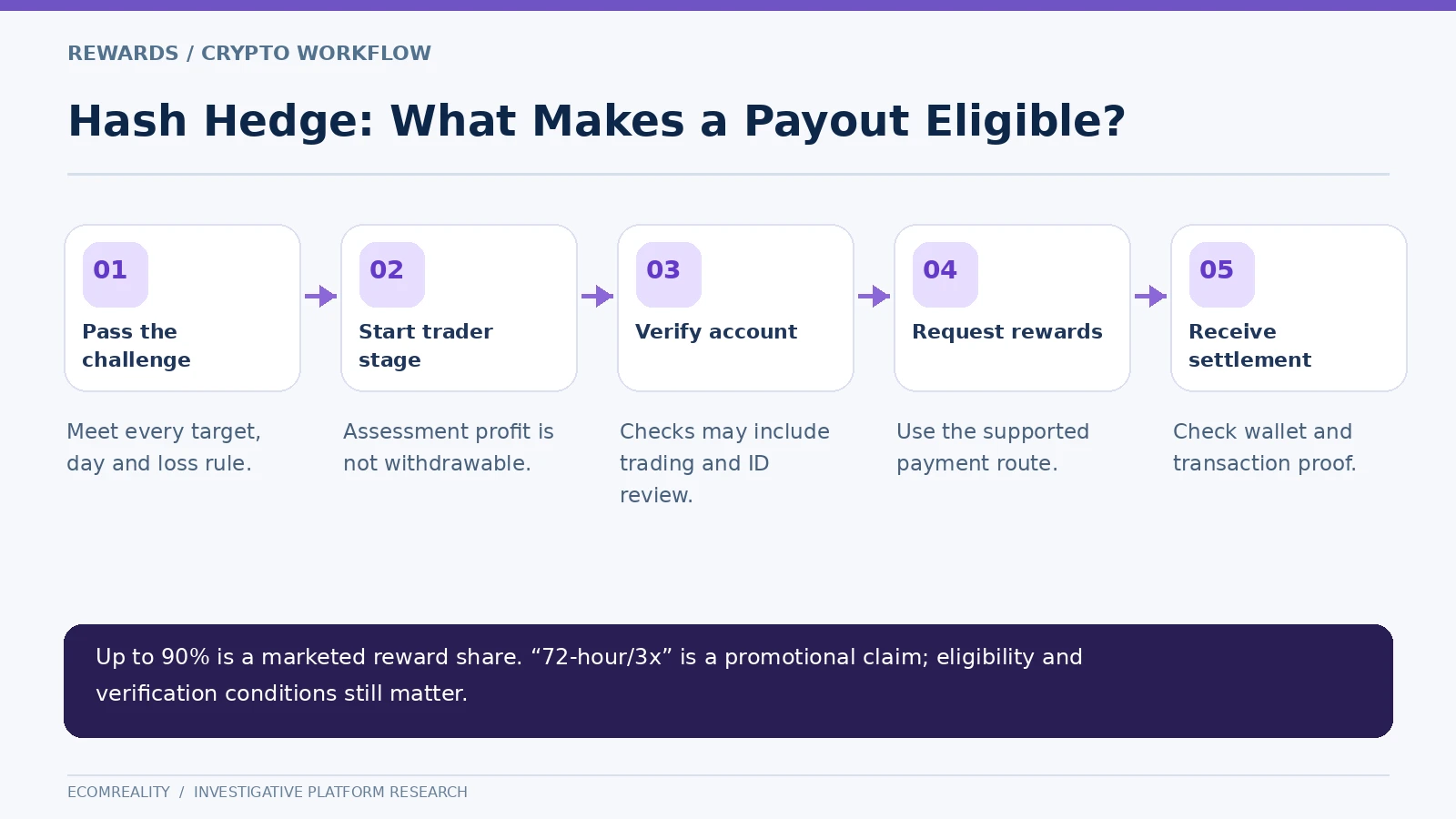
The main website promotes a share of up to 90% of eligible profit. ‘Up to’ matters. Reward percentages can depend on plan, stage, successful verification and contract terms. Older or parallel promotional material has used lower shares, including 80%, which should not be assumed to have been automatically replaced for every account ever purchased. The relevant number is the one attached to the purchased plan and the actual trader-stage agreement. A reward split is not applied to the nominal account balance, and it should not be applied to evaluation-stage profit that the program does not designate as withdrawable.
To illustrate, a $2,000 eligible trader-stage gain at a confirmed 90% share would generate $1,800 before any applicable third-party receipt or currency costs. At 80%, it would generate $1,600. The gap is significant, but neither calculation means the trader will necessarily achieve the gain or pass the required checks. The firm may review identity, account behavior, permitted trading practices and compliance with the drawdown framework before authorizing a request. Successful evaluation is a gateway to this process, not a promise of automatic withdrawal on the next day.
From payout request to wallet receipt
The company emphasizes cryptocurrency settlement and a relatively quick request process. Publicly available material describes choosing an eligible amount and supported network, submitting it from the account, passing security checks, and then receiving cryptocurrency. Some pages focus on USDT rails and list networks such as TRC20, ERC20, BEP20, Solana, Arbitrum and Optimism. Other marketing pages discuss a range of currencies and wallets more broadly. The actual payment options should therefore be confirmed in the current checkout or payout interface rather than assumed from a promotional illustration.
The site also promotes a 72-hour payout commitment and a multiple-of-payout compensation promise if the deadline is missed. A promise this strong requires attention to its conditions. When does the clock start: on the first submitted request, after approval, or after completed verification? Which delays are excluded? Does the guarantee apply to every account and payment method? How is compensation calculated? These questions matter before a trader uses the slogan as a reason to pay for a challenge. A fast marketing message is helpful for setting expectations, but the legal terms determine the enforceable obligation.
The simulated-versus-live terminology problem
Different materials around the Hash Hedge brand describe evaluation and trader-stage activity in ways that may sound like a switch from virtual funds into real firm capital. Some official-looking documentation describes simulated funded environments, while the principal site’s purchase interface can refer to a ‘funded live account’. Those phrases should not be treated as equivalent. A simulated account can still underpin a real contractual performance reward, but that is different from the trader holding legal title to the advertised capital or receiving access to an independently segregated brokerage deposit.
When comparing documents, make sure the domain, contracting company and purchased program are actually the same. There are similarly spelled websites in circulation, and assumptions based on a lookalike domain can lead to incorrect conclusions. The appropriate questions are straightforward: who provides the evaluation, who owes an approved reward, who operates the trading infrastructure, which contractual document controls disputes, and what evidence of payout approval will be provided? None of those questions is answered by a high nominal account balance or a picture of a cryptocurrency wallet.
What makes Hash Hedge appealing
The biggest advantage is a well-defined basic proposition: buy a challenge, satisfy an objective, keep within risk limits and seek an eligible performance reward. The one-stage cards make the main percentage thresholds visible, and the range of account sizes lets a trader avoid paying for the largest plan immediately. Continuous crypto market access can suit schedules that do not fit the traditional nine-to-five trading day. An unlimited stated challenge period can also reduce the temptation to force trades merely because an arbitrary deadline is approaching.
A second benefit is the inclusion of non-crypto market categories. For traders who understand correlations and cost structures, the ability to assess one strategy across different markets may improve flexibility. But these strengths require disciplined use. The platform is not a shortcut around trading skill, and the evaluation fee should not be treated as money that buys guaranteed access to profit. The strongest users will be those who can already manage drawdown, document trades and ignore marketing projections about average monthly earnings.
The weaknesses that deserve weight in a buying decision
The first weakness is inconsistency across public product descriptions. A reader may encounter 10% / 3% / 6% on one-stage cards, then 8% / 6% and 5% daily in a generic program summary. The difference is too large to be dismissed as cosmetic. Second, the marketing emphasizes rewards and generous guarantees but requires a careful reading of verification and payment eligibility. Third, extremely volatile crypto markets can strain a tight daily risk limit even when the underlying strategy is sensible over longer horizons. Those risks should shape a plan’s value more than a nominal 90% split.
There is also a more subtle economic drawback: a one-time challenge fee is not a one-time cost if the trader repeatedly fails and repurchases. The $159 example may look affordable against $10,000 of simulated exposure, but three failed attempts mean $477 spent before a successful fourth attempt even begins. The user should establish a fixed assessment budget and maintain records of why each failure occurred. A loss caused by an incompatible rule set is not solved by automatically buying a bigger challenge.
A practical checklist before purchasing
Pick one specific card and record the product name, account size, fee, stage count, target, daily loss allowance, maximum drawdown type, minimum trading days, leverage ceiling, payout share and payout method. Next, read any linked program terms and save the version shown at checkout. Finally, model the largest likely adverse equity movement of the actual strategy, including spreads and funding, and compare it with the tighter of the daily and overall limits. If a strategy regularly approaches that limit in normal conditions, the program is probably unsuitable regardless of the potential reward share.
Ask support to clarify any contradiction in writing, especially if the website uses both a one-stage and two-stage description near the same purchasing flow. Verify what constitutes a trading day, whether news and weekend positions are allowed, whether hedging is permitted, how the equity threshold is rounded and whether funded-stage rules change. Also confirm supported cryptocurrency networks and the steps needed before the first withdrawal. This checklist is less exciting than a payout calculator, but it is much closer to the questions that determine whether an evaluation purchase produces value.
Final verdict
Hash Hedge offers a potentially interesting crypto-oriented prop evaluation with clear headline account sizes and accessible one-stage entry pricing. The available 24/7 markets and advertised flexible timelines may appeal to disciplined traders. But the company does not earn a strong editorial assessment merely by offering a high profit split. Material inconsistencies across its public program figures, the complexity of equity-based drawdowns and the need to verify payout guarantees create real due-diligence work. The responsible choice is to evaluate a specific purchased challenge as a contract with a very limited loss budget, not as an investment account or a shortcut to guaranteed payouts.
Frequently asked questions
No. Its principal offer is an assessment or prop-trading style program. The simulated challenge balance is not an ordinary withdrawable exchange deposit.
Current main-site one-stage purchase cards show 10%, while other materials describe two-stage targets of 8% and 6%. The selected account’s terms control.
Yes. Published rules refer to equity and count unrealized losses when checking applicable daily and overall thresholds.
No. It refers to a share of qualifying reward-stage profit under the applicable agreement, not a percentage of advertised simulated capital.
The website markets a 72-hour commitment, but the start time, review requirements, exclusions and remedy should be verified in the signed terms.
Original sources and reference pages
https://hashhedge.com/ · https://hashhedge.com/faq/ · https://hashhedgeapp.com/faq/ · https://pro.hashhedge.com/

Jo Carter is an editor and ecommerce researcher at Ecom Reality, where she covers ecommerce platforms, digital selling tools, online business software, pricing models, and emerging industry trends. She focuses on turning complex platform features and costs into clear, practical information for entrepreneurs and digital sellers. Her work combines detailed research with a balanced editorial approach, helping readers compare services, understand potential limitations, and choose tools that fit their business goals.
Comments
Related Articles



Leave a Reply