
Sellvia Mall for Online Sellers: SEO, Content and Marketing Tools
Running an online business means producing more than a good offer. Sellers need clear product explanations, useful customer education, email ideas, search-friendly articles and campaign materials that stay consistent across channels. The work can be repetitive, particularly for a small team without dedicated writers or designers. Sellvia Mall addresses part of that problem through a digital catalog of guides, checklists, templates and AI-powered tools that people can adapt for their own work. For an online seller, the attraction is not that Sellvia Mall replaces an ecommerce platform. It is that practical resources can shorten the distance between an idea and a useful draft, plan or creative asset.
That distinction is essential. Sellvia Mall is a separate service from Sellvia’s ecommerce platform. It is not a store-hosting dashboard, payment processor, SEO crawler or automatic publishing plugin. Its own terms describe downloadable and AI-generated products, with access through Infinity Pass membership and individual purchase for selected premium items. Some resources are directly relevant to marketing, search visibility, communication and organization. This guide shows how to turn those resources into a disciplined workflow for an existing digital business, including what a seller can keep, what requires AI tokens and how to avoid mistaking generated material for finished, verified content.
What an online seller can actually use
The public Sellvia Mall catalog includes practical material around business planning, work systems, learning, communication and AI-assisted tasks. Examples visible in the catalog include business marketing plans, search-visibility plans, AI copywriting systems and operating playbooks. The value of those products comes from the format: instead of beginning with an empty document, a seller can start with an outline, checklist or guided sequence of questions. For someone responsible for several campaigns or product pages, reducing the initial planning effort can be worthwhile even before any automation is involved.
It is useful to separate finished resources from generative tools. A downloadable checklist may be ready for immediate use or adaptation, with no model generation step. A tool that asks questions and produces a letter, outline, plan or image is an interactive experience whose output depends on the answers supplied. Sellvia Mall’s terms cover both forms. This distinction matters for budgeting: downloading a product does not use AI tokens, whereas certain content-generating actions do. Sellers who only need templates may get value from the included library without consuming many tokens at all.
How Sellvia Mall differs from an ecommerce platform
The most common category mistake is to treat a digital-resource marketplace as if it were the commerce software itself. Sellvia Mall does not automatically manage a separate store’s checkout, inventory records, conversion tracking or payment settlements. A seller can use ideas, copy and planning assets produced through Mall alongside a website or another ecommerce platform, but publication and implementation still happen in that store’s actual tools. If a product requires a technical integration, that should be evaluated separately. A downloadable plan is a starting document, not evidence that a campaign has been launched.
This is a positive distinction when understood correctly. It means Mall can serve as a supporting library rather than requiring a seller to migrate the core business. The operator can keep the checkout and customer experience already in use and apply resources to the parts of the workflow that need improvement. A solo creator, for example, might use a business content plan while retaining an existing sales page. A small team might keep the same email service but develop more structured message templates. There is no reason to force a platform migration simply to improve planning and content quality.
A practical SEO workflow using guides and templates
Search visibility is not created by placing a keyword in a title one time. Useful SEO content begins with a specific customer question and a page that answers it completely. A Sellvia Mall resource about building a search-visibility plan can help structure that work. Start by collecting questions customers ask before buying, after buying and while comparing alternatives. Group related questions so each page has a clear purpose. Decide which belong on a product page, a help page or a longer explanatory article. Then identify the facts, examples and screenshots needed to make the answer genuinely useful.
The next step is mapping intent to format. A query such as ‘how to use a digital planner on a phone’ may call for a step-by-step guide. A query comparing two approaches may need a table with real limitations. An informational query about costs may deserve a worked example. Templates can help keep these pages organized: consistent titles, short introductions, logical headings, examples, clear definitions and links to related content. But the seller must still verify product details, eligibility, terms, compatibility and any figures. Content that reads smoothly while saying nothing specific will not close an informational gap.
Once the draft is accurate, the seller can improve technical presentation in the actual content management system. Keep URLs concise, include an informative page title and description, give illustrations meaningful alt text and use internal links to connect relevant articles. A resource can help plan those steps, but it does not submit sitemaps, resolve server errors or guarantee Google rankings. Those functions belong to search tools and the website itself. A reliable SEO workflow combines useful editorial work, sound site operations and ongoing review of search performance rather than promising one-click rankings.
Product-page writing without generic filler
For online sellers, product descriptions are often the first content bottleneck. A catalog with several offers can become monotonous when every page begins with ‘discover the ultimate solution’. The better method is to prepare a compact product brief: what the customer receives, the problem it addresses, the intended audience, compatible formats, access method and any meaningful limitations. From that brief, a copywriting guide or AI tool can help prepare several versions of the description. The human editor then chooses the clearest version, removes unsupported claims and checks that delivery details are accurate.
A useful product page should answer questions in the order a shopper is likely to ask them. What is this? Who is it for? What does the buyer get immediately after payment? What must they provide or install? Is access ongoing or tied to a subscription? What are the permitted uses? A short FAQ can answer the remaining edge cases. Seller-created marketing material works best when these facts appear before decorative persuasion. A clear product page often improves support efficiency simply because customers understand what they are purchasing.
Sellvia Mall’s ready-to-use plans and AI-assisted content products can support the writing process, but they should not be described as an automated product-feed system. A seller still needs to place approved copy in the appropriate storefront and ensure that product titles, prices, screenshots and policy statements match the current offer. A template is valuable precisely because it gives the editor a consistent checklist while leaving final responsibility with the business owner.
AI-generated output: useful drafts, not automatic truth
The platform’s terms allow qualifying AI-generated output to be used for personal, household and business purposes, subject to compliance with the agreement. That can make these tools practical for writing emails, creating social content, developing plans or exploring visual concepts. However, the same terms say the output may contain errors and should be reviewed before use. This is not a reason to avoid AI assistance. It is a reason to build a quality-control step into the workflow, especially for content with prices, legal conditions, medical claims, financial statements or other sensitive specifics.
A reliable editing pass checks five things. First, does the draft answer the intended question? Second, are product names, numbers and promises correct? Third, does it sound like the business rather than an interchangeable advertisement? Fourth, are there claims that require a source or a demonstration? Fifth, does it tell the reader what to do next? A model can produce attractive prose with faulty logic. A quick editorial check may be the difference between a helpful article and a customer-service problem.
It is equally important to distinguish a generated result from a ready-made product. The Mall license allows a person to use outputs they create in their business in accordance with the terms. That does not automatically grant a right to resell the underlying templates, distribute the original files as a competing catalog or share access to the tool itself. Sellers should keep the original resource, their own edited derivative material and the final published content clearly separated in their internal records.
Marketing assets for email, social media and campaigns
Marketing work benefits from repeatable structures. Instead of writing each message from scratch, a seller can create a campaign brief with a defined audience, one customer problem, the product’s strongest verified benefit, supporting evidence and a clear call to action. Tools and guides around message systems, AI-assisted workdays or social content planning can help turn that brief into a series of drafts. The resulting messages should share an underlying proposition but be adapted to the channel. An email can explain one issue in detail; a short social post often needs a sharper opening and a single point.
The most useful outcome is not an unlimited pile of generated text. It is a content system with reusable research, an editorial calendar and examples of what worked. A business might prepare one in-depth help article, a short newsletter explaining the same issue, two social summaries and a downloadable checklist. That creates genuine consistency across channels without copying an identical paragraph everywhere. It also reduces the chance of conflicting promises on a landing page and in promotional messages. Sellvia Mall can contribute the planning materials; the seller’s own audience insights and publishing tools complete the job.
A good campaign workflow includes post-publication measurement. Record which page or message generated visits, qualified inquiries or purchases, then return to the source material with concrete observations. Do not measure success solely by how many drafts an AI tool can produce. Ten generic posts may be less valuable than one carefully researched comparison that answers an overlooked customer question. Speed matters only when the output remains useful.
Infinity Pass economics for working sellers
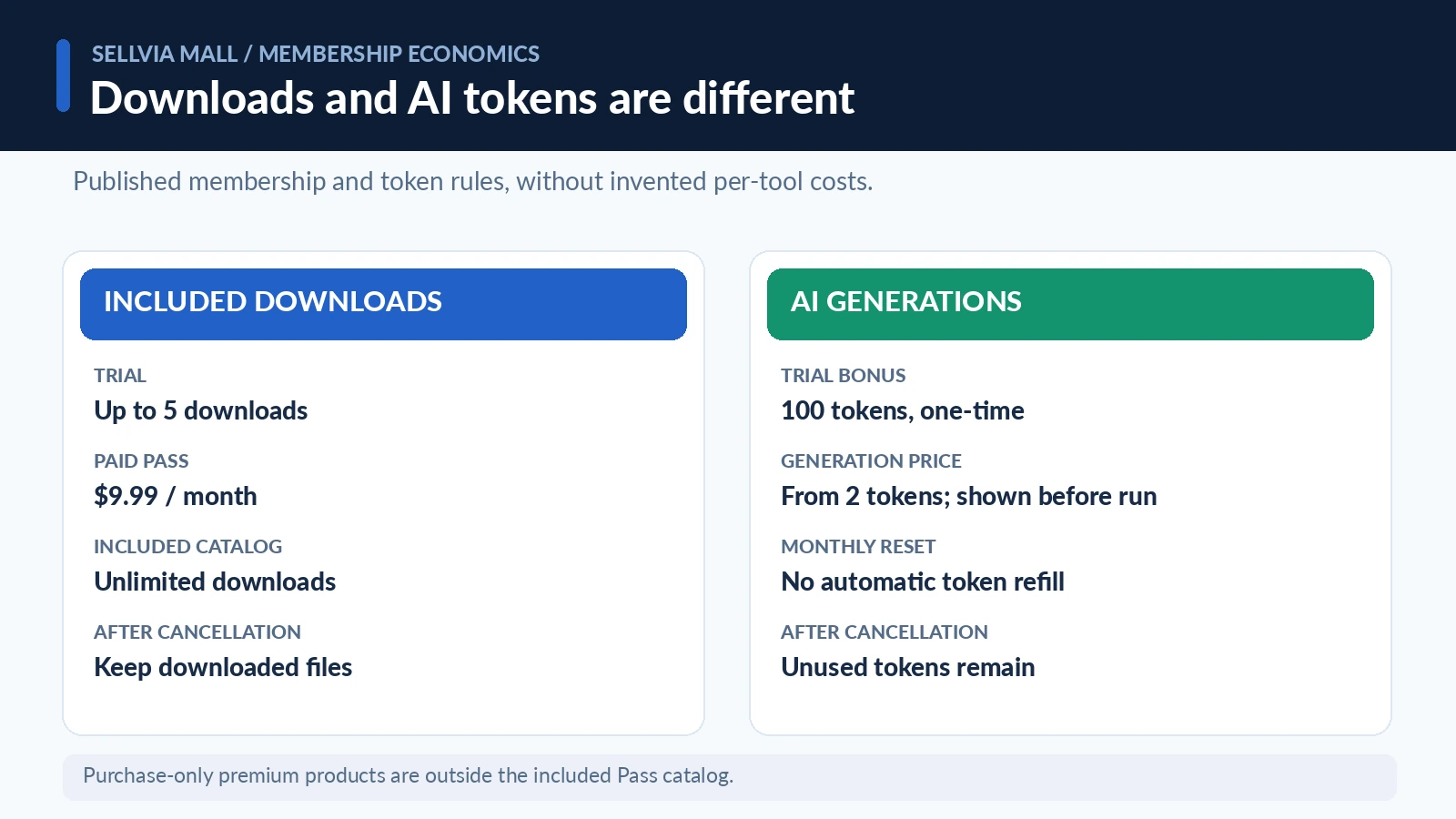
Sellvia Mall advertises the Infinity Pass at $9.99 per month after a seven-day trial. According to the current membership page, the trial includes access to up to five downloads and a one-time welcome bonus of 100 AI tokens. During a paid membership, included catalog products can be downloaded without a monthly count limit. However, selected premium products are purchase-only and are not included in ordinary membership access. Those exceptions are marked at the product level. A seller should check which resources are included before planning a workflow around them.
The business calculation is simple. If a seller needs several useful guides or templates in one month, the subscription can be a convenient way to explore the included catalog. If they only need one specific premium resource, the individual purchase price may be more relevant. The right choice depends on the resources the seller will actually use, not a theoretical claim that a large catalog guarantees savings. A downloaded guide has value when it helps complete work; downloading hundreds of untouched files does not create a marketing advantage.
AI tokens require a separate budget. The terms say generation costs begin at two tokens, with the actual cost shown before a run. The starting 100 tokens are not replenished automatically every month. Tokens remain available until spent and do not expire simply because a membership is canceled. Additional tokens can be purchased. Since different tools may use different amounts, a seller should look at the displayed price before launching an action rather than assuming all generated images, scripts or plans cost the same number of tokens.
Rights to downloaded content and created material
This matters for online sellers. Sellvia Mall’s terms provide a limited, non-exclusive and non-transferable license to use downloaded content for personal and business projects, including adapting it to the user’s situation. That is helpful for internal planning, communications and work with customers. The terms also prohibit reselling, redistributing, sublicensing, repackaging or publishing the purchased files themselves as standalone downloads. In other words, the license is designed for using a tool, not for copying the Mall catalog into another business.
Suppose a seller downloads a business planning worksheet. They can use it to organize their own marketing activity or adapt its ideas to guide internal work, within the license. They should not simply upload the unchanged worksheet to their own store and sell it as their original asset. Similarly, a person who uses an AI tool to draft promotional text can edit and use the resulting copy for their business, but should not resell access to the underlying tool. Keeping this boundary clear protects the seller’s content operation from avoidable licensing mistakes.
The terms also address AI personas and generated likenesses, requiring disclosure when those virtual characters are published. That is particularly relevant in creator marketing, where audiences may mistake synthetic endorsements for real customer experiences. Businesses should follow the platform’s disclosure requirements and relevant advertising rules, and should never fabricate reviews, testimonials or results. A professional content workflow depends on trust as much as production speed.
What cancellation means for a seller’s library
A subscription is easier to evaluate when its exit rules are clear. Sellvia Mall’s current terms say users can cancel the Infinity Pass from their account. When the paid period ends, access to additional included downloads stops, but materials already downloaded remain theirs under the stated license. Unused AI tokens also remain in the account, subject to the terms. This matters for someone who collects tools during a busy campaign month and later pauses membership. They can retain downloaded resources and continue working with them, rather than losing all prior files because billing has stopped.
There is an important operational difference between keeping a download and retaining live access to a hosted generator. A saved PDF, guide or template is a file. A tool that produces a new answer when prompted requires an active service interaction and may have separate access or token conditions. Sellers should save the outputs they intend to reuse and avoid assuming that every online function will remain available exactly as it was during membership. Good file organization makes an online business less dependent on memory, browser tabs or subscription status.
The refund policy treats digital sales as generally final, subject to limited exceptions such as duplicate purchases or defective files that cannot be replaced. Paid membership periods are generally non-refundable after the trial converts. These are ordinary commercial terms to account for when deciding whether a subscription is worthwhile. The seven-day trial is therefore best used to test the content categories and identify useful resources before the first paid renewal.
A five-day content production plan
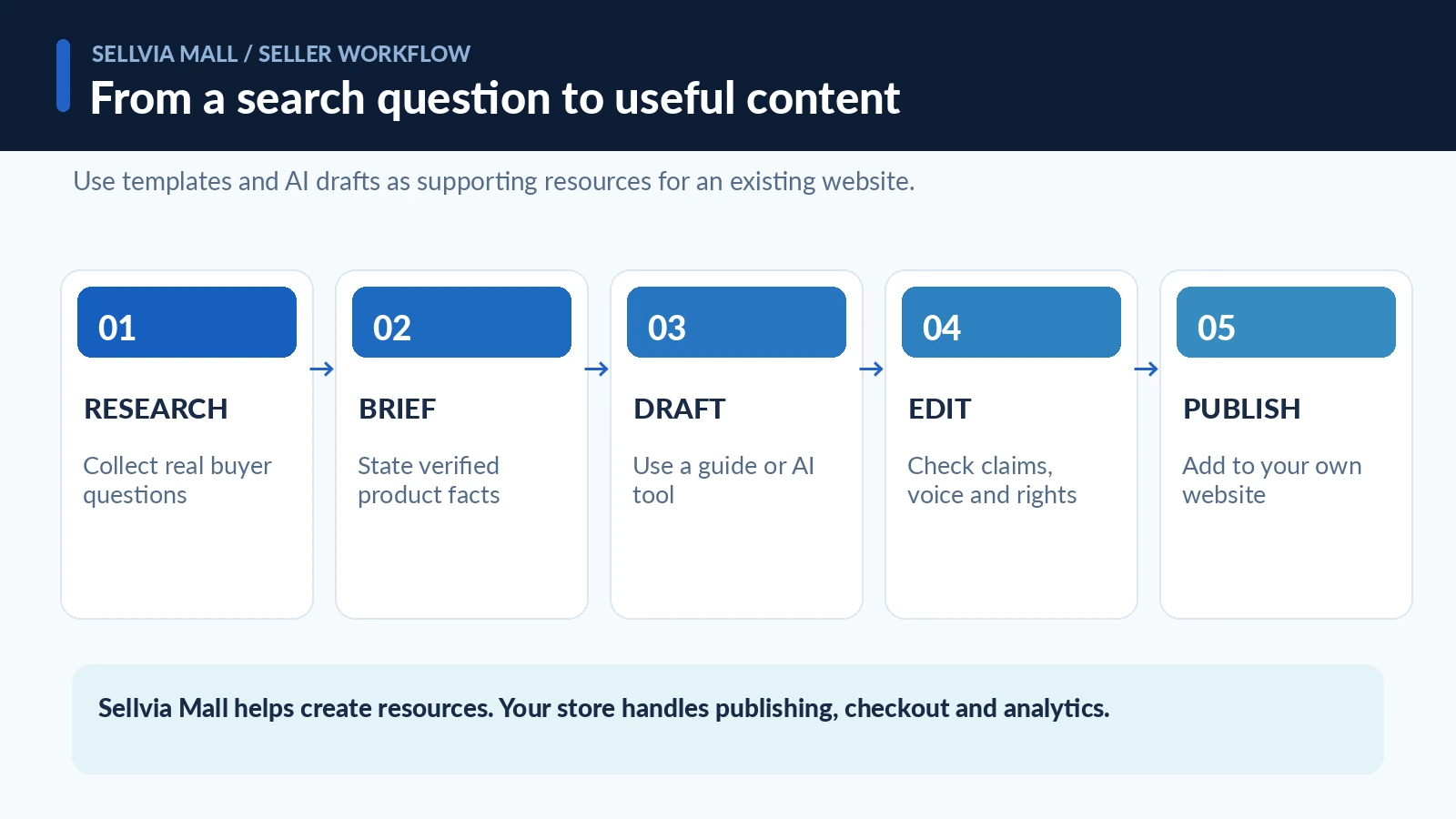
A practical way to test the service is to choose one genuine content problem. On day one, collect questions from customer emails, search queries, comments and product documentation. On day two, identify one Sellvia Mall guide or tool that can help structure an answer, and create a factual product brief. On day three, draft a detailed article or help page, verifying every important claim and explaining the customer’s next action. On day four, adapt the article into an email and two shorter campaign assets. On day five, publish through the seller’s existing platform and set up tracking so the next revision can be based on actual results.
Verdict: a useful content layer for existing online businesses
Sellvia Mall offers online sellers a convenient supporting library for planning, writing and creating marketing materials. The combination of downloadable guides, editable templates and token-based AI tools makes it flexible: a seller can use a static resource, request a tailored draft or combine both. Its membership terms are reasonably straightforward once the difference between included downloads, premium purchases and token-based generation is understood. The strongest use case is a seller who already operates a storefront and wants to improve the quality and consistency of the content surrounding it.
The platform is not an automated SEO system, and it should not be marketed as one. Its value comes from reducing blank-page friction and organizing useful work, while the business owner remains responsible for accuracy, rights, publishing and measurement. Used with that expectation, Sellvia Mall can become a practical part of a repeatable content workflow rather than another collection of unused digital files.
Frequently asked questions
Can Sellvia Mall publish articles directly to my website?
It is primarily a catalog of digital resources and AI tools. It is not presented as a universal WordPress or ecommerce publishing integration. Sellers should publish edited outputs through their own site or marketing systems.
Do downloads consume AI tokens?
No. The published terms say downloading a digital product does not consume tokens. Certain AI-generation actions do, with the token cost shown before the generation runs.
Does the Infinity Pass include every product?
Most of the included catalog is covered by the membership, but some premium purchase-only products are separate. Check the individual listing before planning to use an item.
Can I resell a downloaded template unchanged?
No. The license allows use and adaptation for business projects but prohibits reselling or redistributing the original files as standalone products or as part of a competing catalog.
Can I keep downloaded material after canceling?
Yes, the terms say downloads already obtained remain yours under the license. New included catalog downloads end when membership access expires, while unused tokens remain in the account under the published rules.
Sources and further reading

Jo Carter is an editor and ecommerce researcher at Ecom Reality, where she covers ecommerce platforms, digital selling tools, online business software, pricing models, and emerging industry trends. She focuses on turning complex platform features and costs into clear, practical information for entrepreneurs and digital sellers. Her work combines detailed research with a balanced editorial approach, helping readers compare services, understand potential limitations, and choose tools that fit their business goals.
Comments
Related Articles
Leave a Reply