
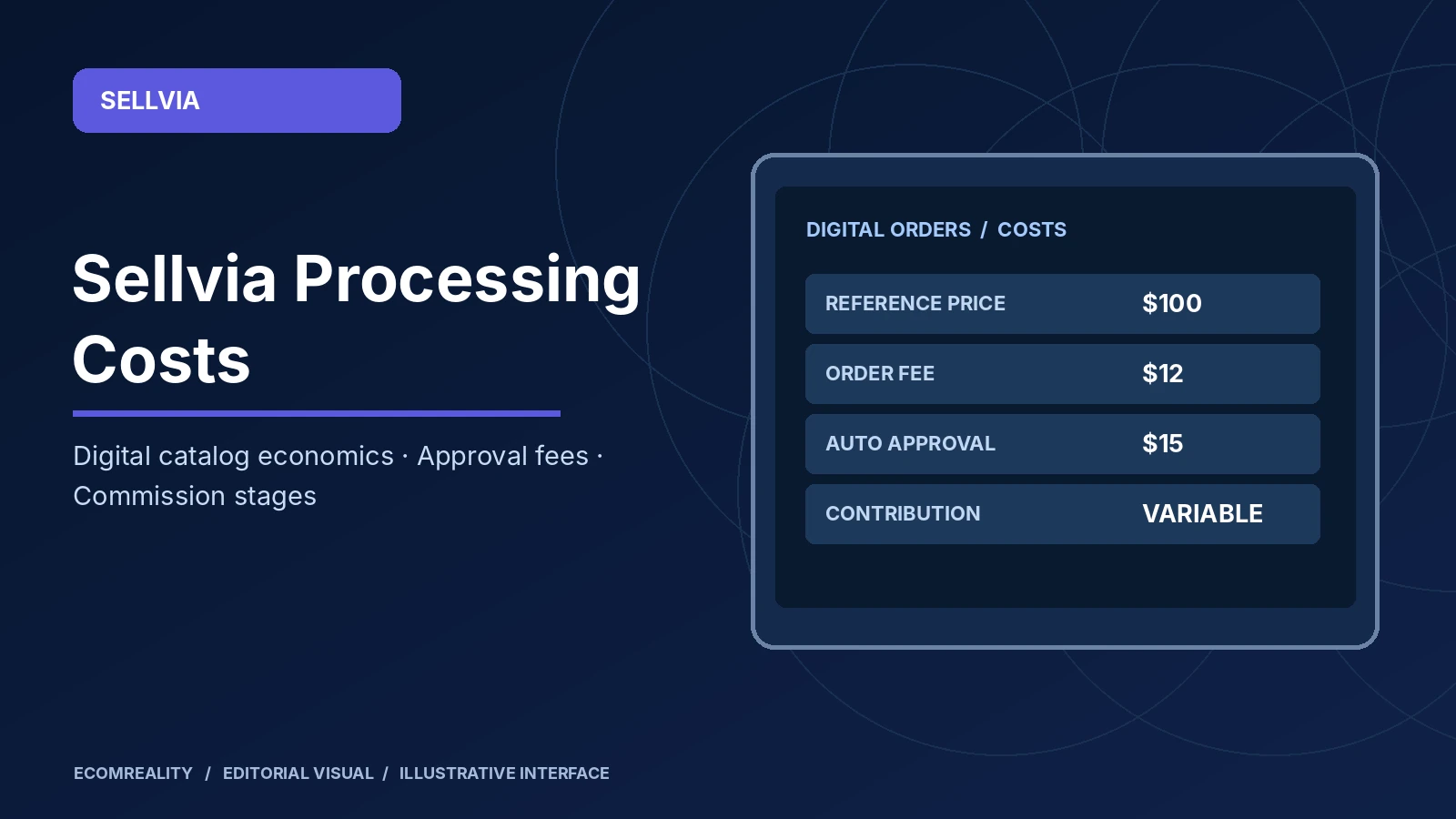
The bottom line. For a Sellvia digital-product order, the amount displayed as a product price is not automatically the store operator’s earnings. Under Sellvia’s September 2026 terms, the economics depend on the order’s source, the Catalog Retail Price, the commission Sellvia may allocate under its program, the charges required to approve an order, the chosen approval method, and eventually the cost of redeeming available commission. Digital-product orders specifically have no Product Cost Charge, but an Order Service Fee of 10%–18% can apply; bulk approval adds 7%, automatic approval adds 15%, and specified late approval circumstances can add another 9%. These charges must not be confused with commission eligibility or guaranteed cash income.
Many ecommerce cost calculators assume a simple flow: a buyer pays $50, a processor deducts a card fee, and the merchant keeps the rest. That is not an adequate explanation of Sellvia’s current digital-product model. The platform’s published terms distinguish orders routed through Sellvia’s ecosystem from cases where a merchant uses an independently managed payment system. They also distinguish Sellvia-funded promotional commission from the amount a customer pays to acquire a product. Those distinctions may sound legalistic, but they directly change what a person should put into a profitability worksheet.
This guide turns the current fee clauses into a practical order-level calculation. It focuses on Sellvia’s digital catalog—courses, guides, templates and related downloadable materials—and does not assume that a buyer payment automatically belongs to the store operator. Figures in the worked examples are explicitly hypothetical unless identified as published rates. A genuine order can have different commission allocation, campaign cost and applicable fee details from the simplified scenarios here.
Begin with the three amounts users often combine incorrectly
The first number is the Catalog Retail Price, the reference price used by Sellvia for certain order fees and for its internal commission calculations. The second number is the order approval charge that the operator must pay or fund using eligible credits before the order moves through processing. The third number is the Commission that Sellvia may allocate under its own program. The published terms say the latter is a company-funded promotional incentive rather than the buyer’s payment, a bank balance or a direct split of sales revenue.
This difference explains why a dashboard can show pending commission before that amount is available to redeem. A qualifying order may create a Pending entry, but completing the approval step is necessary before commission can progress to Incoming. Verification and later allocation then determine what becomes Available. Neither the catalog price nor a Pending figure proves how much cash can eventually be withdrawn.
For useful accounting, keep those numbers in separate columns. Treat all approval charges as actual cash outlays when paid. Track commission by state rather than recording Pending as if it were settled income. This produces a more conservative and transparent picture than labeling the difference between a displayed price and a quoted fee “net profit.”
Which digital orders carry which charges?
Sellvia’s official terms identify an Order Service Fee for eligible non-promoted order types. The rate is between 10% and 18% of Catalog Retail Price. For digital products, the terms specifically state that no Product Cost Charge is due, because the digital item does not need the sourcing and delivery operation covered by that separate charge. The relevant Order Service Fee and any method-of-approval add-on still apply.
A different structure applies to a Promoted Order. Instead of an ordinary Product Cost Charge, its published schedule refers to a CPA Fee for the relevant unit, plus a CPA Service Fee at 10%–18%, again calculated on Catalog Retail Price. The CPA amount is not a universal fixed percentage readers can safely invent: it must be obtained from the relevant campaign or order information. The article therefore treats it as a separate variable.
Manual, bulk and automatic approval are not priced identically
The current agreement distinguishes three ways of approving a pending order. Individual manual approval does not add the special 7% bulk fee or the 15% automatic fee. Bulk approval of two or more orders in one operation carries a 7% additional fee calculated on the Catalog Retail Price for each included order. Automatic approval carries a 15% additional fee calculated on that same reference price. The two additional fees are alternatives, not cumulative charges on the same normal approval event.
This is a material operational trade-off. Automatic approval can reduce manual work and help prevent unprocessed orders from lingering, but it has a stated extra cost. Bulk approval provides a middle ground for sellers working through several orders at once, at a lower listed surcharge than fully automatic approval but above individual approval. A business should choose based on both the cost and its ability to handle orders reliably, rather than assuming automation is economically neutral.
There is also a late-approval provision. Sellvia says an order not approved within seven days may be canceled. Under specified circumstances near that deadline, the company may apply available commission to approve an order and charge a 9% Late Approval Fee plus the 15% Automatic Approval Fee, in addition to the other applicable order charges. This is an unusual but important exception. It means that neglecting a queue can produce a different cost outcome from intentionally choosing normal manual approval.
A $100 digital-order example: the cleanest comparison
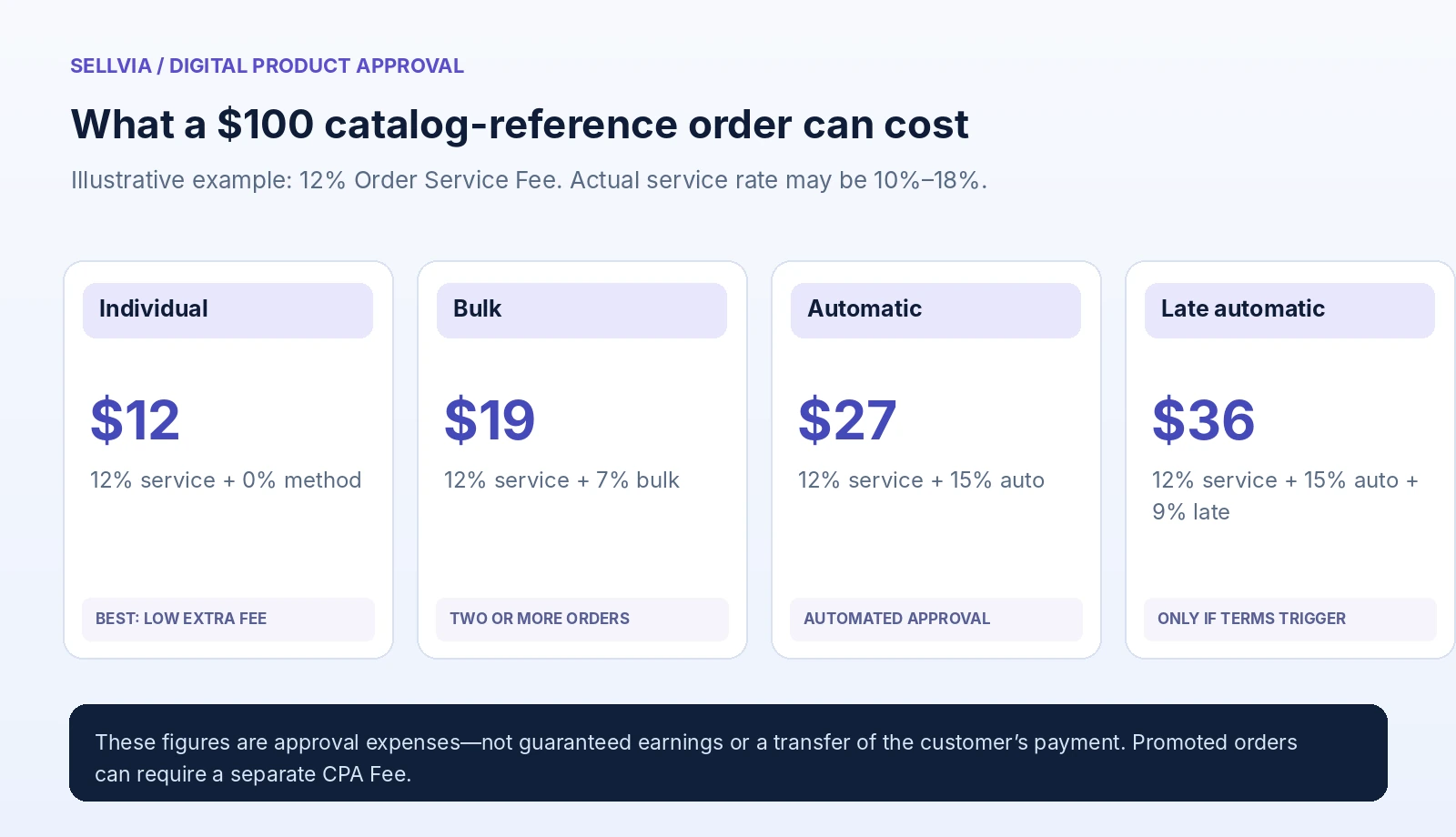
Imagine an eligible digital order with a $100 Catalog Retail Price. To keep the comparison simple, assume its actual Order Service Fee rate is 12%, which lies inside the published 10%–18% range. Under normal individual approval, the service fee is $12 and there is no extra method surcharge, so the modeled approval outlay is $12. Under bulk approval, the added 7% equals $7, raising the outlay to $19. Under automatic approval, the added 15% equals $15, raising the outlay to $27.
These are approval outlays, not claims about commission earned or gross sale revenue. The legal text does not say that the account automatically receives $100. It says qualifying commission, if allocated, depends on Sellvia’s own program and verification. If an order is promoted, an additional CPA Fee would also be needed and the example would not be complete without it.
Suppose, purely as an illustration, the program eventually allocated $55 of commission on that order and the full amount became eligible. Before other expenses, the difference between that hypothetical allocation and the example approval charges would be $43 with individual approval, $36 with bulk approval and $28 with automatic approval. These differences are useful for cost sensitivity; they are not guaranteed profits, earnings promises or an estimate of how Sellvia allocates real commissions.
The late-approval scenario changes the answer again
Return to the hypothetical $100 digital order with a 12% service fee. If a late approval event triggers the published 9% charge and is treated as automatic, the simplified calculation becomes $12 service fee + $15 automatic fee + $9 late fee = $36. Against a hypothetical $55 eventual commission allocation, only $19 remains before marketing, subscription, redemption charges and other costs.
At the same time, users should not interpret the seven-day clause as a promise that the company will always rescue an unprocessed order. The terms say orders may be canceled and the additional company-led procedure applies only under defined circumstances. A cost model should include the possibility of cancellation or an order remaining ineligible, rather than assuming every pending entry will eventually generate a commission payment.
Commission allocation is not a fixed percentage of a buyer payment
The agreement explains that Sellvia may calculate commission by reference to the Catalog Retail Price, with figures that can reference up to 80% depending on its own internal process. It expressly reserves discretion over allocation. “Up to” is an upper reference used in describing the program, not a rate that can be entered as guaranteed earnings per order. It is not the same as receiving a fixed percentage of whatever a particular buyer paid.
The publication also distinguishes orders where the merchant independently manages checkout from the program’s commission-bearing order pathways. Where a merchant handles their own customer payments, the revenue arrangement differs and the agreement says Sellvia-funded commission does not arise for that order type. This article’s worked examples focus on eligible commission-bearing digital orders and should not be copied unchanged into a direct-merchant checkout model.
From Pending to Incoming to Available: the time dimension
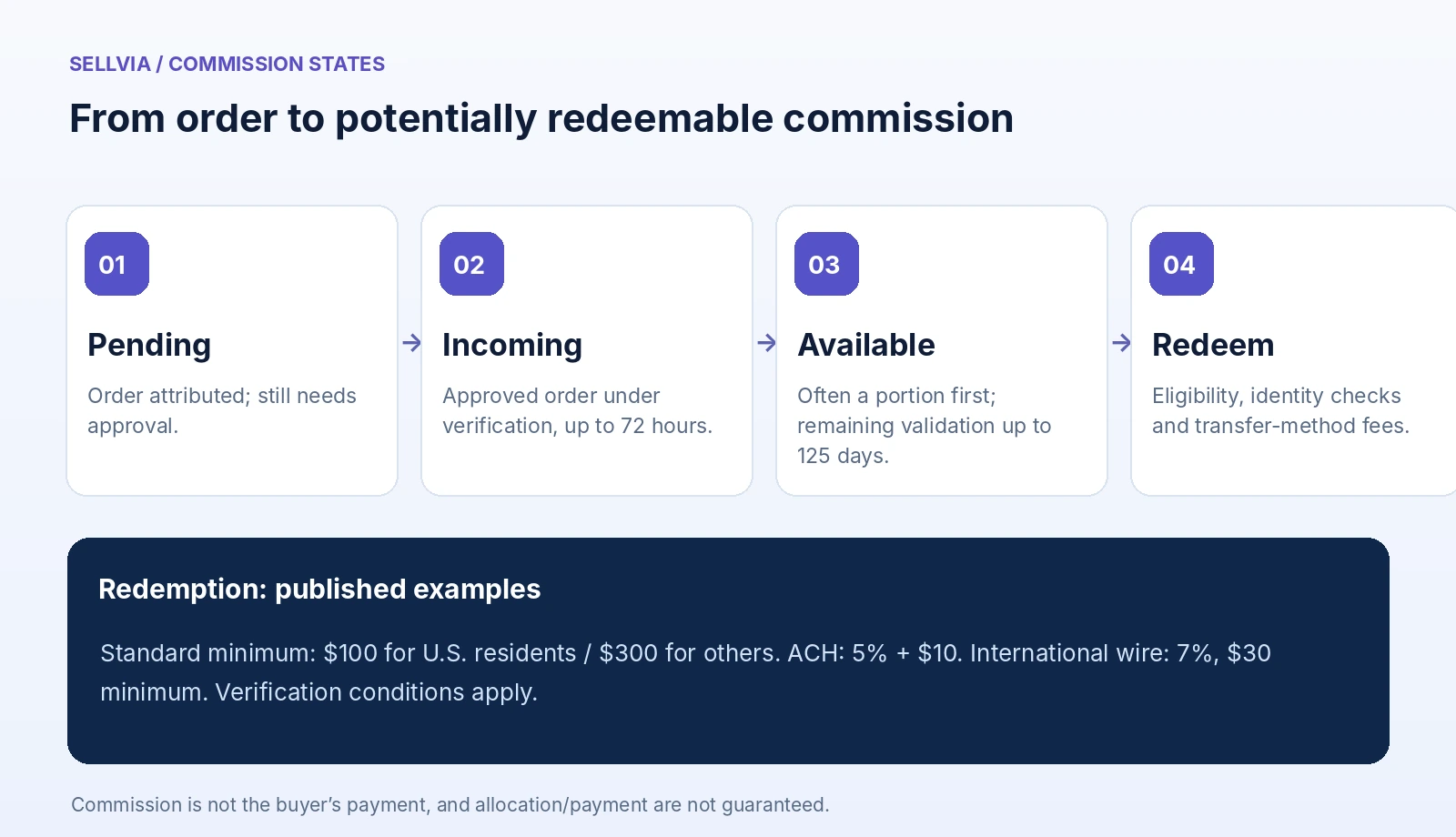
After an eligible order is approved for processing, commission can move from Pending to Incoming and then through verification into Available. The current terms describe an Incoming period of up to 72 hours, but that does not necessarily unlock the entire allocated amount. The agreement says typically up to 75% may become available after that initial period, with the remaining portion potentially subject to a validation window of up to 125 days from the relevant event, depending on the program’s conditions.
It is worth making the distinction visible with a timeline. Order creation is not approval. Approval is not final allocation. Final allocation is not automatically a payment transfer. Each stage may have its own eligibility or compliance checks. Treating the entire chain as a single instantaneous transaction creates unrealistic expectations about how many new orders can be supported from money already held in an account.
Prepaid Order Processing Credits: convenience is not a cash balance
Sellvia allows eligible approval charges to be funded through a payment card or Order Processing Credits acquired in advance. These credits are non-cash service units. The agreement states that they cannot be withdrawn, transferred or converted into cash and are generally non-refundable. An unused balance therefore needs to be interpreted as prepaid purchasing capacity for eligible platform charges, not as savings available for an unrelated business expense.
A good month-end reconciliation tracks opening credit balance, new credit purchases, charges applied to approved orders, adjustments and closing balance. Keep that separate from Pending, Incoming and Available commission. They are different instruments with different restrictions and should never be combined into one “wallet total.”
Marketing costs belong in a different column
Sellvia’s Promotion Service operates within its own ecosystem of promoted placements and managed channels, rather than as a promise to buy traffic for any external site a user happens to own. Under the published terms, the promotion management fee is 28% of Ads Credits applied to delivery, charged in addition to the amount used for delivery. The clause explicitly says it is not charged at the moment credits are purchased or topped up.
This means that when $100 of Ads Credits is applied to actual promotional delivery, the described calculation would deduct $128 from the Ads Credits balance: $100 for the delivered activity plus $28 as the associated management fee. That is different from imagining that topping up $100 immediately incurs an extra $28. It also means marketing spend should be recorded at the point and amount actually consumed rather than casually allocated as if every order has identical advertising cost.
Redemption fees determine the final amount received
Commission that becomes Available is still subject to redemption rules. The current terms show a $100 minimum for United States residents and a $300 minimum for residents of other countries under standard active-account conditions. Verification requirements include identity and phone checks; the published policy describes a $4.50 non-refundable identity-verification attempt fee with specified exceptions. These are separate from the order approval fees that occur earlier.
The agreement lists several redemption methods and charges. For an ACH transfer, it gives 5% plus $10. For an international wire, it gives 7%, with a $30 minimum fee. Express transfer methods cost more. Redeeming to Ads Credits or Order Processing Credits has its own percentage schedule. These method-specific costs should not be added to every order at the moment of creation; they belong to the eventual redemption choice and to the amount selected for redemption.
For example, if an eligible US user redeems $400 of Available commission by ACH, the listed fee calculation is $20 plus $10 = $30, leaving $370 before any external bank deductions, if applicable. At the same $400, an international wire fee of 7% is $28, but the minimum raises it to $30, also leaving $370 on the published fee alone. These examples use a withdrawal amount above the standard minimum for both residency groups. They do not imply that every account will be approved to redeem exactly that amount.
A practical per-order contribution worksheet
For a commission-bearing digital order, record at least ten fields: order identifier, order type, Catalog Retail Price, actual allocated commission, order service or CPA service rate, any separate CPA amount, approval method, additional approval fees, marketing spend allocated to the order cohort and the current commission status. Put subscription and credit balances in separate monthly schedules. When redemption happens, record the gross Available amount and the actual transfer-method fee.
A conservative provisional contribution formula is commission actually allocated − order approval charges − attributable promotional cost − attributable recurring overhead − eventual redemption costs. But this is a management estimate, not a statement that allocated commission is immediately owned or withdrawable. Before the commission passes the applicable verification and validation conditions, cash forecasting should use the Available figure rather than the gross provisional allocation.
What changes for orders from an independently operated checkout?
A seller who connects an independently operated payment system stands in a different position from a user whose qualifying activity is attributed within Sellvia’s commission program. The current terms say that in the independent-checkout case the customer pays that seller directly, and no Sellvia program commission is allocated for that order type. The seller must then calculate their own payment processing, refunds, taxes, order-related Sellvia charges and service expenses under the governing arrangement.
The monthly subscription and the break-even point
Sellvia’s current terms describe a $39 monthly Basic plan after a 14-day trial, with additional subscription levels at higher prices. A subscription is a fixed operating expense, not part of the approval fee on each individual order. One can spread it across the month’s successfully monetized activity for management purposes, but only if the worksheet makes that allocation explicit.
Suppose a user models an average $15 of eligible, eventual contribution per order after approval charges and separately attributed campaign expense, but before subscription and redemption costs. At $39 monthly, the base fee alone would require at least three such orders to cover it in this simplified illustration. That is a budgeting threshold, not a forecast and not a guarantee that any particular number of orders will generate such contribution. If average contribution is $5 instead, the same monthly fee requires eight orders to exceed the subscription cost. Small changes in method fees can therefore materially alter the implied break-even volume.
Frequent accounting mistakes worth avoiding
The first error is counting a customer-facing price as the operator’s revenue when the current program terms describe a different commission arrangement. The second is claiming a fixed commission rate without checking actual allocation. The third is missing the 7% or 15% surcharge when comparing bulk and automatic approval. The fourth is treating prepaid Order Processing Credits as withdrawable money. The fifth is forgetting that redemption charges are separate from order fees.
Final assessment
Sellvia order processing is not accurately described by the formula “selling price minus product cost equals net earnings.” For its digital catalog, the current rules are more specific: no Product Cost Charge, service charges that vary by order source, additional costs tied to approval method, commission allocation controlled by a separate program and redemption conditions that affect the ultimate cash result. Those mechanics can be modeled transparently, and the platform provides published ranges for several inputs. But the review cannot turn hypothetical allocations into guaranteed cash flows. A good operator keeps charges, commission states and redemptions distinct and reconciles them against actual account records before making any profitability claim.
Frequently asked questions
Is there a separate Product Cost Charge on Sellvia digital products?
The September 2026 terms explicitly state that digital products described in the agreement do not incur that charge. Other applicable service and approval fees can still apply.
What does individual manual approval cost beyond the basic service fee?
Under the normal schedule, individual approval does not add the special 7% bulk or 15% automatic surcharge. The applicable 10%–18% service fee and, for promoted orders, the relevant CPA amount still need to be considered.
Does the 15% automatic approval fee replace the 10%–18% service fee?
No. The agreement lists them as separate charges. The normal bulk and automatic method surcharges are alternatives to one another, not substitutes for the service fee.
Are Sellvia commission and the customer’s checkout payment the same money?
No. The published terms describe commission as Sellvia-funded promotional incentives under an eligibility and verification process, not the distribution of customer payment proceeds.
When is allocated commission withdrawable?
Only after it becomes Available and the account satisfies applicable redemption and verification conditions. The terms describe an initial Incoming review and possible longer validation of a portion of the commission.
What if I use my own checkout payment system?
The revenue model differs. The terms say the merchant receives customer payments directly under that arrangement and the separate Sellvia commission program does not allocate commission on those order types. Account-specific processing charges still require review.
Source notes and methodology
Sources were checked in October 2026. Examples are mathematical illustrations, not live account tests or guaranteed future results. Fees, eligibility and legal terms can change. Verify the current account-specific documents before making financial decisions.

Sylvia Pierce is an editor and ecommerce researcher at Ecom Reality. She specializes in reviewing ecommerce platforms, digital selling tools, pricing models, and online business software. Her work focuses on providing clear, practical, and balanced information that helps entrepreneurs make informed decisions.
Comments
Related Articles


Leave a Reply