
The bottom line. Olymptrade makes Fixed Time Trades easy to understand at order-entry level: choose an asset, decide whether its price will rise or fall by a particular expiry, and see the quoted net profit before confirming. The difficult part is the arithmetic. If a successful $10 trade pays $8.20, one loss erases more than one win. The break-even accuracy is roughly 54.95%, not 50%. Withdrawals are a separate operational question: the platform usually advertises no withdrawal fee for ordinary methods, with exceptions for cryptocurrency and certain non-trading behavior, while verification and payment-rail timing still matter. This review evaluates those conditions rather than treating quick trade entry as a profitability claim.
Olymptrade operates in a category that can be difficult to review fairly. Short-term, fixed-outcome trading looks simple on a screen, and the platform puts a clear return percentage next to an instrument. That clarity is useful. Yet it also encourages a misleading shortcut: the more straightforward the interface, the easier a user may assume earning money must be. In practice, the fixed payout rate, duration, changing market conditions and sequence of losses determine the economics. A disciplined review has to make those elements visible without exaggerating either the platform’s features or a user’s prospects.
There is a second problem with many Olymptrade articles online: they mix what happens to a trade with what happens to a withdrawal. A quoted 82% fixed-time profitability figure is not the same thing as an 82% account return, and a rapid withdrawal-processing claim is not a guarantee that a recipient bank credits the money immediately. This guide separates those ideas and uses official Olymptrade help documentation to explain the process step by step.
What Fixed Time mode actually does
Olymptrade’s official help center describes Fixed Time Trades, or FTT, as positions with a predefined duration, commonly from one to sixty minutes. The user selects a trading asset, chooses whether the price will be higher or lower when that duration expires, enters a stake and confirms the trade. The percentage shown for the instrument indicates the potential profit on a correct forecast. If the forecast is wrong, the committed amount is lost under the standard example described in the help center.
A key feature is that the result is tied to the direction at expiry rather than to the size of the price movement. A tiny move in the predicted direction can produce the contracted profit, while a tiny move the other way can cost the full stake. That asymmetry changes how traditional market analysis should be used. A valid long-term thesis about a currency or index does not necessarily tell you whether it will be a fraction of a point higher at the end of the next five minutes.
The help center also says a trade may sometimes be closed before expiration, potentially with a reduced result. That exception should not be converted into a blanket claim that every position has a conventional stop loss. The user needs to inspect the actual ticket and policy for the instrument being traded. Fixed Time mode is one of several trading modes on the site; do not automatically apply its payout formula to another account product.
The 82% example, explained without marketing spin
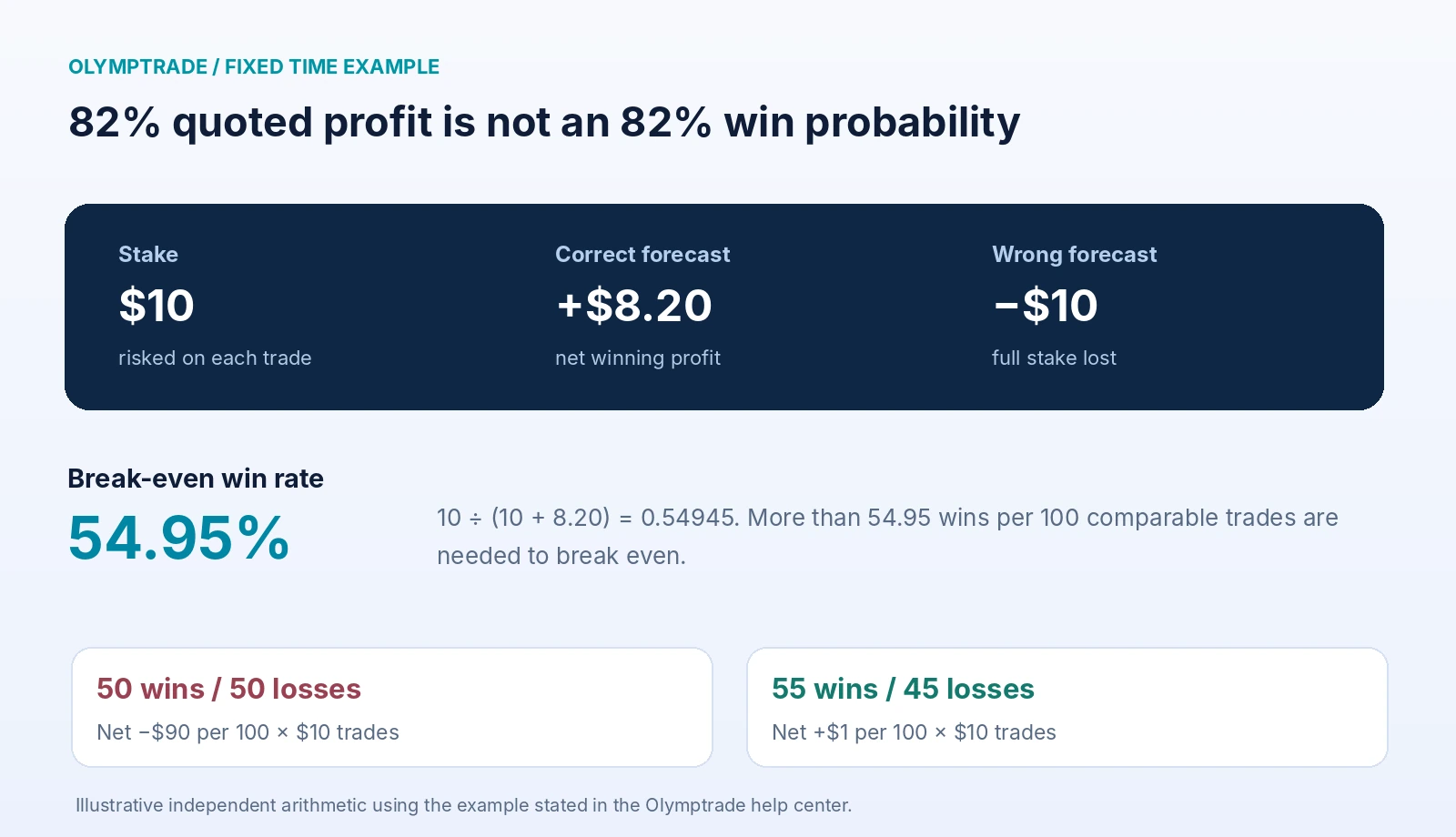
Olymptrade’s own educational material gives a concrete example: a $10 stake at an 82% quoted profit rate earns $8.20 in profit when the prediction is right, while an unsuccessful prediction loses $10. The returning amount after a win is therefore $18.20 including the original stake, but the net gain is only $8.20. This distinction often disappears in promotional summaries that talk about “payouts” without clarifying whether they mean total returned funds or pure profit.
The break-even win rate is the loss divided by the sum of the loss and winning profit. For this example it is $10 ÷ ($10 + $8.20) = 54.945%. A trader who is correct exactly half the time loses money over a sufficiently large series of comparable trades. With 50 wins and 50 losses at $10 per ticket, profit totals $410 and losses total $500, leaving −$90 over 100 trades. With 55 wins and 45 losses, the result becomes 55 × $8.20 − 45 × $10 = +$1. That is a tiny mathematical margin and could disappear if the quoted profitability changes.
This example is not evidence about typical Olymptrade customer results. It is a way to evaluate any offered FTT percentage. At 75%, break-even requires 57.14% accuracy; at 90%, it requires 52.63%. A supposedly impressive 53% strategy may therefore be losing money at one quote and barely positive at another. The proper data set records the payout rate of each contract alongside the result.
Why the advertised maximum is not your personal payout
Olymptrade’s public status page lists different maximum profitability levels across account statuses. Basic is shown with up to 85% for fixed-time trading, while other statuses display higher maxima on selected assets. This is an important distinction. “Up to” is not a universal rate, and the page itself limits certain elevated percentages to a stated number of instruments. A headline about the highest possible percentage is therefore not a reliable estimate of what a typical user will see on a particular asset at a particular hour.
To compare conditions fairly, record the asset, current session, status, duration and payout percentage on the actual ticket. Repeat the observation across several hours before forming an opinion. If a trading method depends on consistently obtaining 90% returns but the preferred instrument typically shows a lower number when you intend to trade, the model is not realistically grounded. The correct quote is the one visible just before commitment.
Account status features can also affect withdrawal prioritization and other aspects of the user experience. They should not encourage users to add money simply to chase a better percentage without weighing the additional exposure. Higher advertised return per successful trade does not automatically translate into better realized results if the trader’s accuracy or discipline deteriorates.
Short expiries create a different kind of market risk
The help center notes that one- to fifteen-minute durations are especially exposed to short-term market noise. That is not merely an educational footnote. When expiry is fixed, price volatility just before settlement matters disproportionately. A correct assessment of the broader trend may still settle as a loss if a brief counter-move occurs at the wrong moment. The shorter the horizon, the more tempting it is to confuse a clean chart with a predictable endpoint.
Another operational factor is frequency. A one-minute contract makes it technically possible to trade dozens of times in a short session. But if the average payout produces negative expectation for the user’s actual accuracy, adding frequency simply produces more chances to realize that disadvantage. This is why evaluating Olymptrade should involve not only features and indicators, but a rule for when to stop trading.
Why position sizing cannot rescue negative expectancy
Consider two traders with the same $500 account. One risks $5 per fixed-time contract; the other risks $50. If both lose four consecutive trades, the first loses $20, or 4% of the account, while the second loses $200, or 40%. The underlying odds and payout do not improve for the cautious trader, but their capital survives more unfavorable outcomes, making it possible to gather information without immediate exhaustion.
Martingale-style doubling is even more dangerous in this format. Starting from a $5 stake, five successive losses at $5, $10, $20, $40 and $80 cost $155. At an 82% payout, winning the sixth trade is not automatically a magic reset, because the amount won is only a fraction of the stake and the required sequence grows quickly. Trade limits, not reactive stake escalation, should drive decisions. A useful rule is to judge a strategy on a fixed-stake sample before experimenting with any money-management changes.
It is also wise to distinguish perceived certainty from tested accuracy. The excitement of having made three correct predictions in a row may feel like evidence, but three outcomes cannot establish a durable edge. Recording a broad, representative sample is tedious; it is also one of the only ways to see whether the real numbers support the story a chart seems to tell.
Demo trading is for workflow validation
Olymptrade’s help center recommends starting with a free demo account. That is useful advice when interpreted narrowly. The demo can help users find the Fixed Time tab, set a duration, learn how order confirmations work and observe expiration without risking cash. It can also make mistakes visible: choosing the wrong asset, forgetting the time horizon or assuming a percentage applies unchanged to a different ticket.
What it cannot establish is reliable live performance. Virtual balances reduce fear and make a loss feel abstract. Some users take risks in a demo that they would not tolerate in a funded account. A better exercise is to use the demo under a written rule set, never alter results retrospectively and calculate net profit rather than counting wins. If the results are weak even in that environment, there is no sound basis for assuming real money will solve the problem.
Withdrawal rules: the method you paid with matters
Olymptrade’s official withdrawal guide states that users should generally withdraw through the same payment method used for deposits. It gives an example where deposits through a bank card and an electronic wallet are returned proportionally to those methods, while resulting profit may be eligible for another permitted route. This is the sort of detail users often discover too late, after they have already decided which account should receive the money.
The practical lesson is to plan the exit route before making the first deposit. Confirm that the chosen card or wallet can receive money, that the account is in the correct name and that the service is supported where you live. If several payment methods are used, retain records of the funding split. A legitimate withdrawal procedure may require more than simply selecting a convenient destination on the day of cash-out.
The official help center identifies bank cards, supported e-payment systems and cryptocurrency as potential methods, subject to conditions. A card withdrawal is described with a starting minimum of $10, while a USDT guide presents a separate minimum for that method. These are method-specific examples rather than one universal account rule. Verify the current limit in the live withdrawal screen.
How much does Olymptrade charge to withdraw?
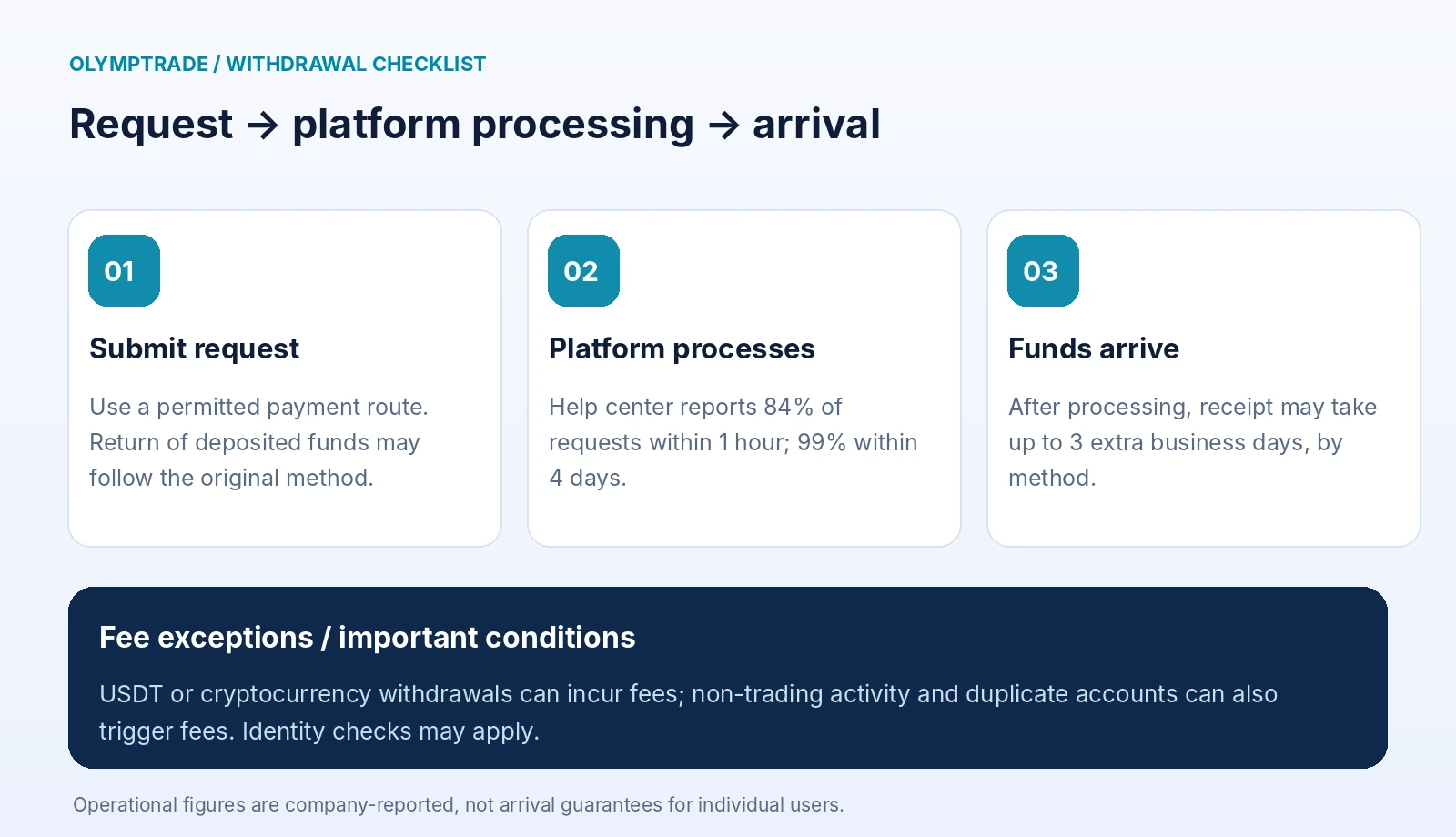
The company’s withdrawal information normally presents fees as zero for conventional withdrawals. The official exceptions matter: USDT withdrawals can carry charges, other cryptocurrency payouts can incur network or processing commissions, and certain non-trading or duplicate-account activity can lead to fees under the relevant policies. Calling withdrawals unconditionally “free” would therefore misrepresent the published conditions.
There is also a conceptual difference between a platform fee and a bank or network charge. A payment network may deduct an amount that is not displayed as an Olymptrade commission. A bank may apply its own receiving rules. If exact settlement matters, verify the net amount expected to arrive under the selected method, not just the headline fee label.
Withdrawal procedures may also require identity checks. Olymptrade’s guidance says verification is not always requested in advance but may be required for security. That means a request can involve documentation even if routine trading did not. Preparing accurate account information and retaining payment records is less exciting than watching a chart, but it is part of treating an account professionally.
Withdrawal speed: read the stages, not one headline
Olymptrade publishes useful processing statistics in its help center. One current page reports that 84% of requests are processed within an hour, 93% within four hours, 97% within 24 hours and 99% within four days. The company also says payment may take up to three additional business days to reach the receiving account after processing, depending on the method. These are reported historical or operational figures, not a personal service-level guarantee.
This makes the widely used phrase “instant withdrawal” especially misleading. A platform can complete its review and dispatch the payment quickly while a bank, card network or intermediary takes longer to credit it. Weekend cutoffs, additional compliance steps and the selected payment rail can change the timeline. A fair review should distinguish processing at Olymptrade from arrival in the user’s account, because they are separate events.
If a request takes longer than expected, start with the operations history, the exact requested amount, the payment method and any support notification. The useful question is “Which stage is pending?” rather than the less informative “Why is my money not here?” Good documentation makes this easier to resolve.
Account status and priority do not eliminate procedural checks
Olymptrade’s public account-status page includes Basic, Smart, Pro and Elite levels and advertises different support and withdrawal priorities. That can improve convenience for qualifying users, but it should not be interpreted as bypassing legal, anti-fraud or identity checks. Even the most favorable status does not guarantee that every destination bank or cryptocurrency network responds on a specific schedule.
From a consumer perspective, status comparisons should be grounded in features one will actually use. A trader who rarely withdraws small amounts may obtain limited real benefit from a priority feature. The advertised maximum fixed-time return may apply only to selected assets. Paying attention to such restrictions protects readers from treating the top tier as a universal solution to every trading or withdrawal concern.
A useful due-diligence routine for real accounts
A responsible evaluation starts with the exact operator and agreement applicable to your jurisdiction, then moves to the trading instrument and the payment arrangements. Confirm local eligibility rather than assuming access through a website proves that a fixed-time product may legally be offered where you live. Read terms for bonus promotions carefully: an incentive can have separate eligibility, turnover or cancellation rules, and should not be mistaken for immediately withdrawable cash.
Next, verify the actual quote on your preferred instruments and calculate its break-even accuracy. Use a demo to confirm your workflow, choose a maximum stake, and decide when to stop. Finally, check the withdrawal screen before depositing, including method-specific limits, verification obligations and any possible third-party fees. This sequence is more informative than choosing a platform because a review says the interface looks simple.
Our research uses official public help materials and independently checked arithmetic. We have not placed trades, tested the platform’s price feed or executed a live withdrawal. It would be inaccurate to turn the published processing statistics into a claim about what every individual receives.
Who Olymptrade is and is not suited to
Olymptrade may appeal to readers who want a visually straightforward introduction to fixed-time contract mechanics and who are willing to study the payoff before committing capital. Its official documentation is relatively clear about selecting assets, understanding the 82% example, and the multiple stages of withdrawals. That transparency is useful even when the product itself remains speculative.
It is less suitable for anyone who expects a fixed-time payout to function like deposit interest, predictable salary or long-term ownership of an asset. The possibility of losing the entire stake on an incorrect short-term prediction is central, not incidental. Investors seeking ownership, conventional portfolio construction or diversified long-term saving should evaluate instruments with those characteristics instead.
Final assessment
The fairest view of Olymptrade is that it makes fixed-time mechanics accessible but cannot make their arithmetic favorable by simplifying the interface. The most valuable step a user can take is to calculate the required win rate at the actual quoted profit percentage, then apply disciplined size and frequency limits. On the operational side, the help center provides meaningful withdrawal detail, including no-fee exceptions, same-method rules and processing-versus-arrival timing. These are useful disclosures, but they need to be checked for the specific account. A good user decision rests on the math and the governing terms, not on the speed of the buttons.
Frequently asked questions
Does an 82% Olymptrade quote mean I get $82 back from a $100 trade?
For the standard example, it means $82 in profit if the prediction is correct; the initial $100 stake is returned separately, for a $182 total return. A loss consumes the $100 stake. Read the exact ticket for applicable exceptions.
What win rate breaks even at an 82% profit payout?
About 54.95%, assuming every winning trade earns 82% of stake, every losing trade forfeits the full stake, and no other costs or settlement outcomes apply.
Are withdrawals free at Olymptrade?
Many ordinary withdrawals are advertised without a platform fee, but the help center lists exceptions for crypto and certain non-trading activity. Payment intermediaries can add their own costs.
How long does withdrawal take?
Official statistics describe platform processing, while delivery to the receiving account may take up to three additional business days depending on the payment method. A published percentage is not a guarantee for an individual request.
Do I have to withdraw through my deposit method?
The official guide says the deposit method generally governs the return of deposited funds, and multiple deposit methods may require proportional withdrawals. Check any flexibility for withdrawing profits in the live account.
Can an account status guarantee a high payout or quick cash-out?
No. Status pages display conditional maxima and service priorities, not guaranteed trade outcomes or exemptions from verification and payment processing.
Source notes and methodology
Sources were checked in October 2026. Examples are mathematical illustrations, not live account tests or guaranteed future results. Fees, eligibility and legal terms can change. Verify the current account-specific documents before making financial decisions.

Jo Carter is an editor and ecommerce researcher at Ecom Reality, where she covers ecommerce platforms, digital selling tools, online business software, pricing models, and emerging industry trends. She focuses on turning complex platform features and costs into clear, practical information for entrepreneurs and digital sellers. Her work combines detailed research with a balanced editorial approach, helping readers compare services, understand potential limitations, and choose tools that fit their business goals.
Comments
Related Articles



Leave a Reply