

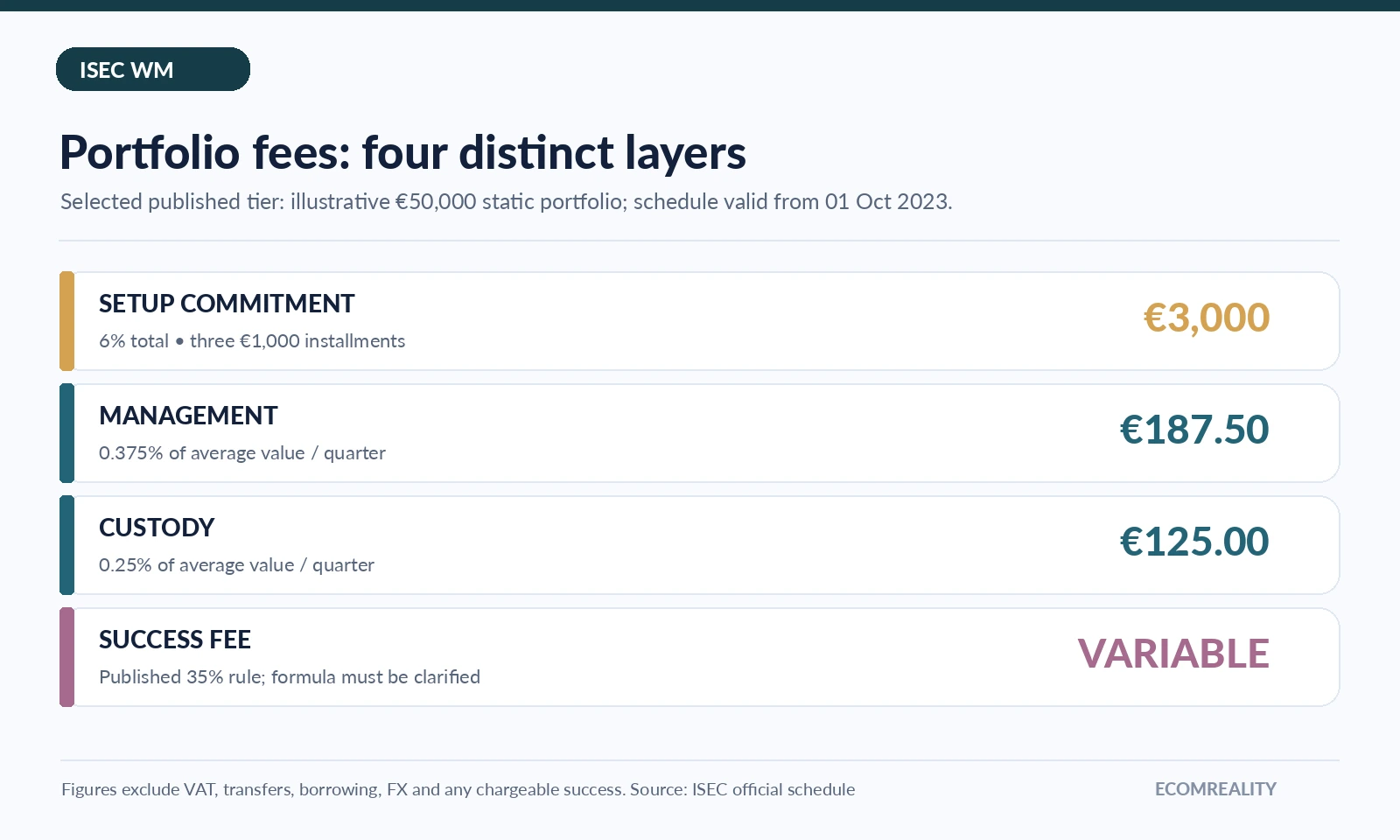
The short answer: ISEC Wealth Management has a multi-layer fee schedule, and the advertised or remembered “management fee” is only one component. Its publicly posted schedule, marked effective October 1, 2023, describes a 6% portfolio setup charge for relevant balances, paid in three 2% installments; a tiered quarterly management fee; a separate safekeeping/custodian fee; and a success fee whose treatment depends on portfolio size. Foreign-exchange services, borrowing, transfers, and applicable VAT may add further costs. The crucial task is to model all layers together against the specific signed client agreement, not to compare one isolated percentage with another firm’s annual management fee.
Wealth management pricing is often harder to understand than retail trading pricing because a single account may trigger several different invoices for several different services. A setup charge can be deducted on one timeline, ongoing management fees on another, custody costs on a third, and a performance-based or success fee only under particular conditions. Each component can be legitimate within its stated contractual purpose, yet the combined cost can differ sharply from the headline figure a prospective client remembers from an introductory conversation.
ISEC Wealth Management offers an unusually specific public commission-and-charges schedule, which makes a careful breakdown possible. The firm identifies itself as a Cyprus Investment Firm supervised by the Cyprus Securities and Exchange Commission (CySEC) under license 356/18. The website lists the operating company as ISEC Wealth Management Limited, rather than an unrelated business using a similar abbreviation. For readers researching an investment manager, establishing the exact legal entity is the first step: fees have little meaning if they are attributed to the wrong company or agreement.
This review focuses on the published schedule currently accessible from ISEC’s website. It is marked valid from October 1, 2023 and explicitly states that the changes do not affect clients who entered investment service agreements before that date. We have not examined any reader’s private contract. We do not assume that a newer agreement, negotiated pricing, or legacy arrangement matches every figure on the public page. That caveat is particularly important here because fee timing and high-water-mark language require careful interpretation before any money changes hands.
The four layers that define the total bill
A prospective client should begin with four separate lines: setup, management, safekeeping/custody, and success fee. Setup is an onboarding and relationship charge calculated with reference to deposits. Management compensates the firm for portfolio-management service and is based on portfolio valuation over time. Safekeeping/custody is a distinct ongoing charge, also related to portfolio value. The success fee is linked to investment performance according to the stated method. Those layers are not alternatives from which the client chooses one; depending on the agreement, more than one can apply to the same account.
The first consequence is that an annual percentage comparison can be misleading. A firm charging an annual management fee of 1.5% plus a custody charge of 1% is not equivalent to one charging 1.5% all-in. Likewise, a 35% success fee cannot be evaluated without knowing what counts as success, the measurement period, how losses carry forward, and whether other charges are deducted first. These questions should be answered with the actual contract and a worked illustration, preferably in writing.
The 6% portfolio setup fee: why three installments matter
The official schedule states that for portfolios from EUR/USD 10,000 to 300,000, the total portfolio setup fee is 6%, taken in three installments: 2% upfront, 2% after 12 months, and 2% after 24 months. It lists a minimum of EUR/USD 600 and maximum of EUR/USD 18,000 for the total setup fee. For deposits above 300,001 in the schedule, it lists a maximum of 18,000. The exact application of the cap and multiple deposits should be checked with the firm in advance.
On a simple hypothetical €50,000 initial deposit, a 6% setup charge is €3,000, divided into three €1,000 installments on the listed timetable. That timing can make the first deduction look smaller than the total commitment. It does not erase the later charges. Nor should the buyer assume that closing the account early automatically cancels remaining installments: the published footnote says that if the portfolio is fully liquidated before two years, the outstanding setup commission is applied to the total deposited amount on the day of actual withdrawal.
This early-exit treatment is a particularly important search-information gap. A customer might think, “I’ll try the service for six months and see how it goes.” But if the agreement incorporates the stated accelerated setup rule, an early full liquidation can bring forward charges that otherwise would have been spread across future dates. Before investing, ask for a concrete cost example showing the amount withdrawn after six months or one year, including any remaining setup installment and transfer expense.
Management fees: quarterly percentages, not annual ones
For portfolio amounts between EUR/USD 10,000 and 100,000, the published management rate is 0.375% of average portfolio value for the quarter, calculated using daily balances. For 100,001 to 1,000,000, the stated quarterly rate is 0.3125%. Above 1,000,001, the firm describes negotiable terms with a minimum equivalent to 1% per year, or 0.25% per quarter. The bracket presentation should not be interpreted as a universal marginal formula without confirmation; ask whether the rate applies to the entire qualifying portfolio value or only the amount inside a band.
To put the smallest standard tier into everyday terms, four quarters at 0.375% correspond to a simple annualized rate of 1.5% if the average portfolio value stays unchanged and the same percentage applies in every quarter. That is not the same as saying the annual fee is automatically a fixed 1.5% of the starting deposit. Daily portfolio values may change during each quarter; deposits, withdrawals, and market movements can change the actual charge. This is one reason a quarterly statement is essential for reconciling the numbers.
For a static illustrative €50,000 balance, one quarter of management cost at 0.375% would be €187.50. Across four unchanged quarters, the sum would be €750, before custody, setup, success fees, and applicable taxes. A client who reads only “0.375% management fee” and treats it as an annual charge would underestimate this example by a factor of four.
Safekeeping and custodian charges are separate
The published schedule lists a quarterly safekeeping/custodian charge of 0.25% of average portfolio value for the EUR/USD 10,000–100,000 tier. For 100,001–1,000,000, the stated rate is 0.1875% per quarter, while the highest tier is negotiable subject to a published minimum annual equivalent. This category is not the same as the management fee. A customer receiving investment oversight and asset safekeeping can therefore face two value-based charges during the same reporting period.
At a hypothetical constant €50,000 portfolio value, a 0.25% quarterly custody charge equals €125. Added to the €187.50 management example, that gives €312.50 per quarter in these two categories, or €1,250 per year if the same balance and rates persist for four quarters. That simple annualized combined rate is 2.5%, not counting setup, success fees, withdrawal costs, FX, or VAT. It is an illustration, not a quote for an actual account, because the schedule’s exact definitions and contractual application need confirmation.
Success fees: the most important definition to verify
ISEC’s public schedule includes a 35% success fee for portfolio balances from EUR/USD 10,000 to 1,000,000, described in the table as “per month – Flat.” For the highest bracket, it also refers to 35% with a high-water-mark method. The accompanying footnote defines the high-water mark with reference to the highest historical net asset value and a positive difference at a calculation date; that note also refers to quarterly fee calculation. Because the table and explanatory note use different timing language, the published page does not by itself provide a perfectly unambiguous calculation protocol.
That ambiguity must be identified rather than papered over. Before relying on a projected return, obtain written clarification about the performance base, observation period, whether gains are realized or unrealized, whether a hurdle applies, and whether prior losses must be recovered. Ask specifically whether the high-water-mark provision applies to the proposed account and how a flat success fee operates when performance is negative, zero, or recovers from a previous drawdown.
As a purely mathematical example, a 35% charge on €2,000 of chargeable success would be €700. But the real question is whether the contract defines that €2,000 as chargeable success in the first place. A portfolio that gains €2,000 after having lost €5,000 previously is not in the same economic position as one that reaches a new high. A high-water-mark rule may treat those cases differently from a flat method. The exact client contract matters more than any isolated percentage.
A two-year cost illustration on a €50,000 portfolio
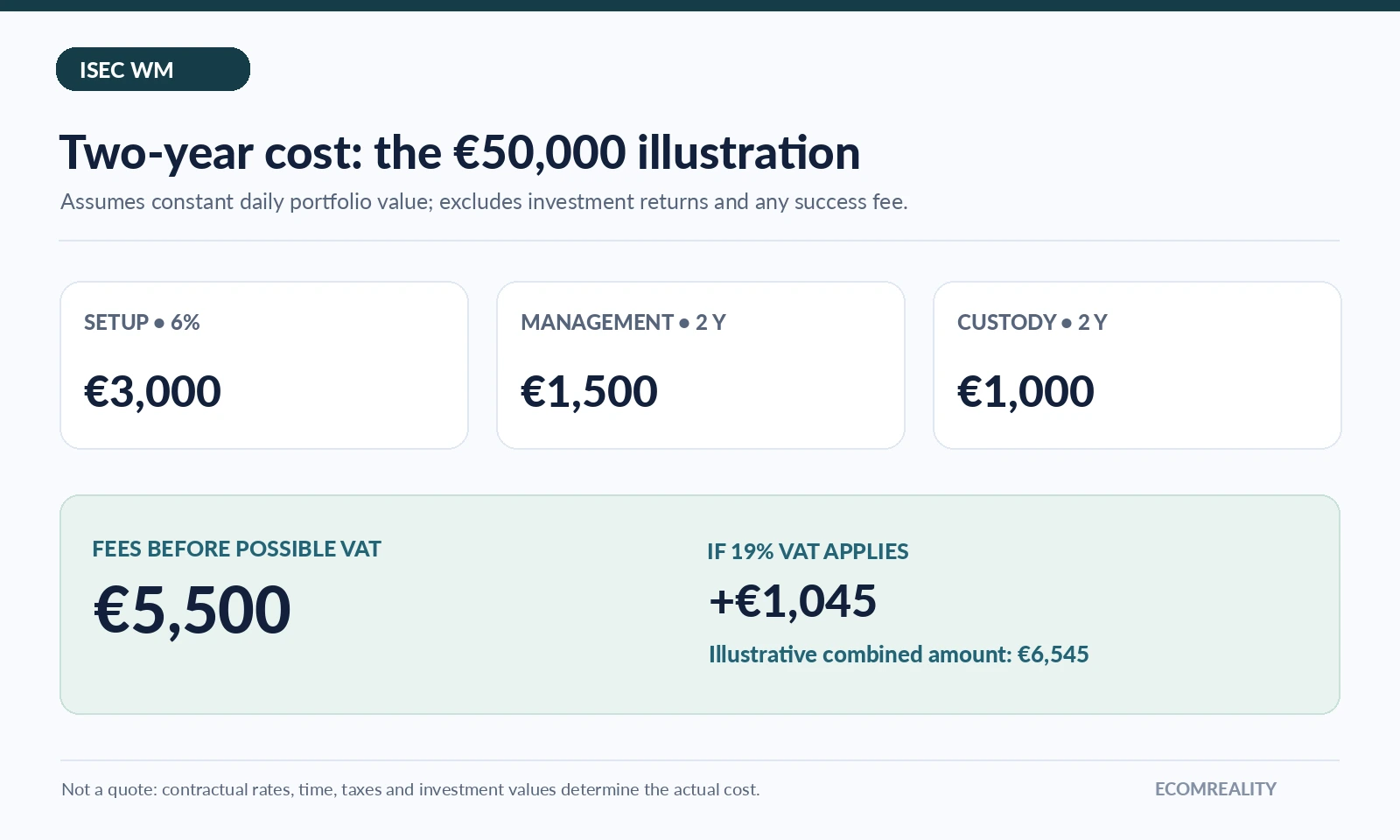
Consider a fictional client funding an eligible portfolio with €50,000 and holding a constant average balance for illustration. The initial setup fee commitment is €3,000, potentially spread as €1,000 at inception, €1,000 after twelve months, and €1,000 after twenty-four months. At the published first-tier management and custody rates, recurring charges would total €1,250 for each steady-value year. Combining the setup commitment and two full years of those recurring charges gives €5,500, before any success fee, bank transfer, FX, borrowing fee, taxes, and any other contractual items.
This figure needs careful labeling. It is a simplified two-year fee commitment and accrual illustration, not an exact cash-flow calendar or a real investment return. The third 2% setup installment falls at the twenty-four-month milestone, and the timing of account closure could influence which deductions are made when. The model deliberately assumes no market change, no additional deposits, no withdrawals, and no success fee. A real investor should expect the actual charges to change with portfolio valuation and contractual events.
Now consider the effect of VAT. The posted schedule says amounts exclude 19% VAT, and it describes VAT application to EU residents, subject to its published exclusions. If a particular client and charge are subject to 19% VAT, €5,500 of taxable charges would correspond to €1,045 of VAT, bringing the illustrative total to €6,545. That number is not a prediction of a specific investor’s invoice: tax treatment must be determined from residence, status, applicable law, and the actual fee items billed. Its purpose is to show why VAT cannot be ignored when comparing two pricing proposals.
FX conversion, borrowing, and transfer charges
The fee schedule also includes foreign-exchange markups for some size bands. It lists 1.5% above the market exchange rate for EUR/USD 100–10,000 and 1.0% for 10,001–100,000, along with another published bracket for larger conversions. The posted table leaves a range that should not be silently interpolated. If a portfolio is funded in one currency and invests in another, conversion costs can become a real drag, especially when repeated. Ask which rates and spreads apply to inbound conversion, trading, and eventual withdrawals.
For portfolio margin borrowing above the specified threshold, the document references a rate of 4.5% plus a benchmark, with benchmark methodology explained in a footnote. Borrowing creates additional risk because financing costs continue while investment returns can be negative. A client who intends an unleveraged portfolio may never use this service; a client considering borrowing should model it separately rather than assuming it is included in management charges.
Transfer fees are also tiered. The public table indicates, for example, a €2 SEPA withdrawal for €100–€5,000 and a €5 SEPA withdrawal for €5,001–€10,000, with higher charges for larger transfers. It lists different amounts for SWIFT transfers, such as 20 EUR/USD in the first withdrawal bracket. Intermediary and receiving banks can add their own charges. These numbers are not the largest fee components for a long-term portfolio, but they can affect account exit and cross-border cash planning.
The overlooked risk: withdrawing early can change the fee picture
The schedule specifically states that certain lower-balance fee rates can apply when withdrawals reduce the invested amount below €10,000, and its footnote distinguishes that situation from a decline caused by market fluctuations or fee deductions. This is an important distinction because an account can fall below a threshold for very different reasons. A voluntary withdrawal may trigger the stated fee treatment while an investment loss may not. Do not infer how the rule applies to a particular case without consulting the full agreement.
How to compare ISEC with another wealth manager
An appropriate comparison needs a consistent denominator and time horizon. Compare both providers over the same account size, expected investment mix, and two- or three-year horizon. Include setup charges, recurring management, custody, success fees, taxes, and likely transfers. If one firm includes custody in its management rate while the other bills it separately, normalize the result. If one firm uses a high-water mark and the other a flat performance charge, compare drawdown-recovery scenarios rather than just profitable years.
You should also compare the service received. Does the manager provide discretionary portfolio management, advice, or both? How often are portfolios reviewed? What investment universe, reporting cadence, and contact channels are included? Fees do not exist independently of service scope. Still, a well-delivered service has to justify its cost through suitability, operations, communication, and risk management—not simply through optimistic return illustrations.
Questions to send before signing
Ask for the applicable signed fee schedule and confirm whether your agreement falls under the October 2023 terms or an earlier arrangement. Request the setup-fee deduction calendar on your intended deposit. Ask whether future deposits create additional setup charges. Require an illustration of quarterly management and custody charges using fluctuating daily balances. Request the exact success-fee formula, period, and high-water-mark status. Ask whether performance calculations are gross or net of other fees and how negative periods affect later success fees.
Finally, ask for a worked full-withdrawal example after nine months, including any remaining setup obligation, transfer cost, FX, and tax. Verify the onboarding entity against the firm’s official disclosures and the Cyprus regulator’s public records. None of these requests is unreasonable. They are basic due diligence for a service whose pricing is deliberately multi-layered.
Strengths, limitations, and our verdict
The strength of ISEC Wealth Management’s public pricing approach is that it actually publishes meaningful numbers: setup percentages, quarterly rate tiers, a separate custody schedule, a stated success-fee framework, and transfer charges. That gives a prospective client more material to analyze than a vague “contact us for fees” page. The fee structure may suit clients who value a managed relationship and are comfortable evaluating it over an extended horizon, provided the expected service and investment approach justify the total cost.
The main limitation is complexity. A 6% setup commitment, recurring portfolio-based charges, a success-fee layer, potential VAT, and early-exit treatment make simple headline comparisons unreliable. The success-fee timing language deserves direct clarification. The schedule explicitly preserves separate treatment for older agreements, so the published page may not match every existing client. Those are reasons to demand an exact written illustration, not reasons to guess.
Bottom line: ISEC WM should be assessed as a full fee stack, not as a single management percentage. For a prospective investor, the most valuable next step is to request a personalized two-year and early-exit calculation before funding the account. If the firm can clearly explain those numbers against the signed contract, the decision becomes far more informed. If the full cost remains unclear, the uncertainty itself is part of the risk.
Frequently asked questions
Is the ISEC setup fee 6%?
The public schedule effective October 1, 2023 lists a total 6% setup fee for the relevant portfolio range, paid in three installments of 2% each, subject to stated minimums and maximums. Older agreements may be governed by different terms.
Is the 0.375% management fee annual?
No. The published standard first-tier management rate is 0.375% per quarter on the average daily portfolio value in that quarter. Under a hypothetical unchanged portfolio, that corresponds to 1.5% summed across four quarters before other fees.
Is custody included in management?
The official schedule lists management and safekeeping/custodian fees separately. Investors should ask for both to appear in a worked total-cost example.
Does the 35% success fee apply after a loss?
That cannot be determined from the percentage alone. The schedule describes different flat and high-water-mark approaches and includes timing language requiring clarification. Obtain the contractual definition and examples for drawdowns and recovery periods.
What if I close the portfolio before two years?
The public footnote states that outstanding setup commission may be applied to the total deposits on full liquidation before two years. Confirm the exact effect with ISEC before signing.
Sources and editorial method
Based on ISEC Wealth Management’s Commission and Charges Schedule, company information, and terms and conditions, accessed in October 2026. Illustrative calculations assume static balances for clarity, exclude returns, and are not personalized investment advice or evidence of actual customer billing.

Sylvia Pierce is an editor and ecommerce researcher at Ecom Reality. She specializes in reviewing ecommerce platforms, digital selling tools, pricing models, and online business software. Her work focuses on providing clear, practical, and balanced information that helps entrepreneurs make informed decisions.
Comments
Related Articles


Leave a Reply