
GoMining is an unusual product because it sits between several familiar categories. There is mining hardware behind its offering, a digital asset used to represent a claim to mining-related capacity, an online marketplace, a token used in the maintenance system, and a game mode with separate rewards. Each category changes what “return” means. Someone comparing GoMining with a simple Bitcoin purchase must consider a hardware-backed revenue stream and its expenses. Someone comparing it with home mining must consider avoided electricity, noise and equipment management, but also operator dependence and the price paid for the digital miner.
This review focuses on the mechanics that most promotional descriptions leave unexplained: how TH/s and W/TH interact, how the platform converts costs into BTC, why gross rewards differ from net rewards, what maintenance discounts actually change, and how to assess break-even without assuming tomorrow’s mining conditions will resemble today’s. It also explains why Mining Mode and Miner Wars should not be merged into a single earnings claim.
What are GoMining digital miners?
According to GoMining’s product documentation, digital miners are backed by computing power provided by physical mining equipment in company data centers. Holding one gives the user a share of the fleet’s mining capacity and the ability to receive rewards associated with that capacity. The platform expresses computing power in terahashes per second (TH/s). It also shows energy efficiency in watts per terahash (W/TH). The two figures must be read together because they have opposite effects on net results.
More TH/s means a larger participation in mining output, all else equal. Lower W/TH means less electricity is required for that power, which reduces the electricity component of maintenance costs. A 20 TH miner at 25 W/TH can therefore have a very different net result from a 20 TH miner at 12 W/TH. Both have the same nominal hashing power. Their operating economics are not the same.
GoMining says these digital miners may be sold on the platform’s marketplace or certain external marketplaces. Some collections are issued on blockchains such as Ethereum, BSC, Solana and TON. That makes the digital miner a tradable item, but it should not be confused with owning a specific ASIC sitting in the purchaser’s home. The user depends on the provider’s equipment, allocation, accounting and continued service. Nor does marketplace tradability guarantee that a resale buyer will be available at a satisfactory price.
From pool reward to net Bitcoin
The platform’s maintenance documentation describes the core equation: net reward = pool reward − (electricity + service) after applicable maintenance discounts. Pool output starts with Bitcoin mining results. The platform then allocates that output in proportion to the user’s relevant capacity. Electricity and servicing reduce what remains. A net number may be small even when the gross pool reward looks encouraging, because revenue and operating costs move for different reasons.
Electricity depends on power, efficiency and the provider’s energy price. Service is an additional amount per TH of capacity. GoMining’s published formula for electricity in USD is equivalent to:
Electricity cost per day (USD) = TH/s × W/TH × 24 ÷ 1,000 × electricity price per kWh.
Its documentation has cited an operating electricity-price range of roughly $0.05–$0.07/kWh and a service-cost parameter of approximately $0.0089 per TH per day. These are published model inputs, not an assurance of immutable tariffs. GoMining says costs are reviewed, and the BTC value used to settle dollar-denominated costs changes with Bitcoin’s price. Check the current dashboard before making a purchase.
A worked cost example with transparent assumptions
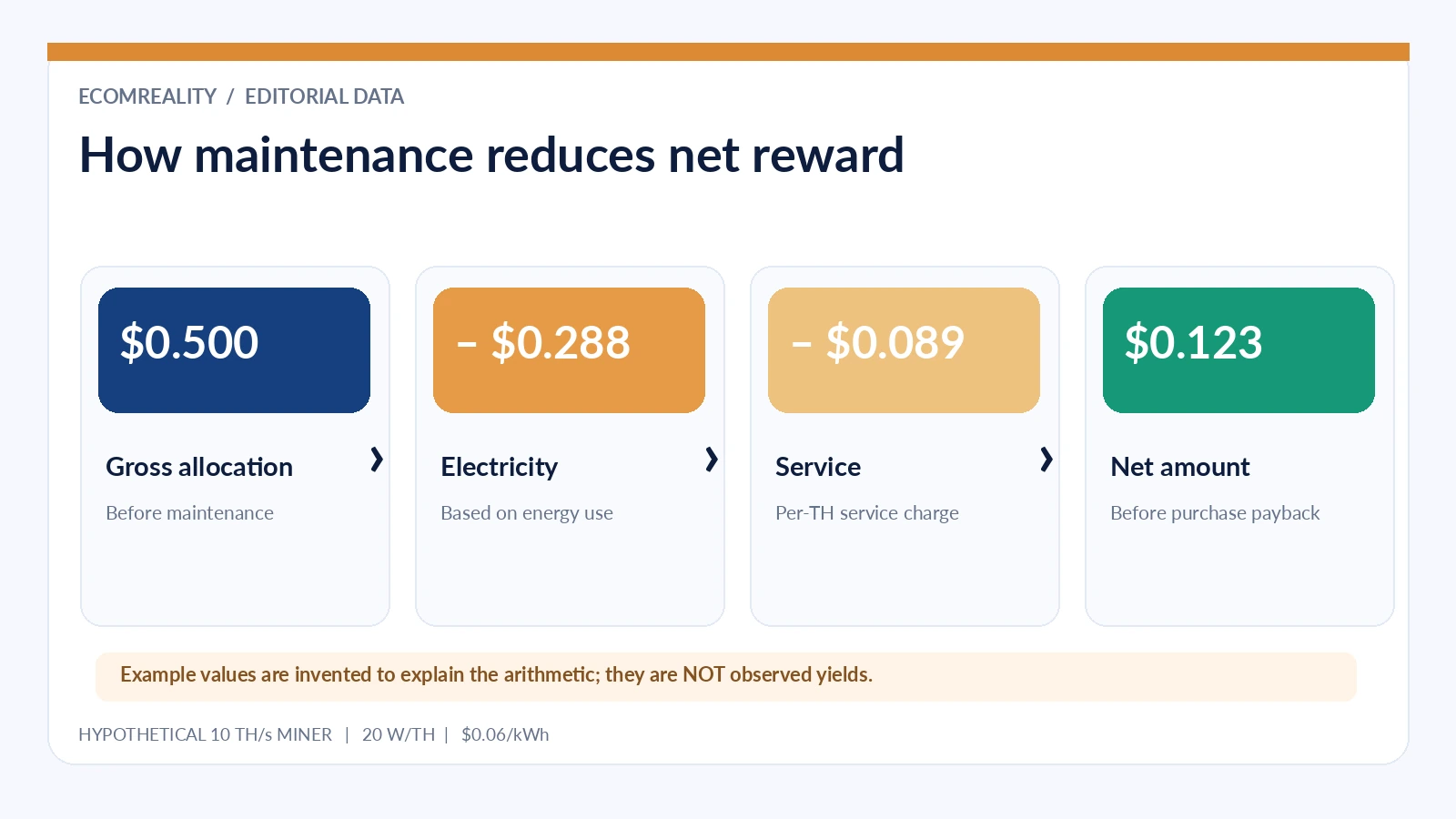
Take a hypothetical 10 TH/s digital miner rated at 20 W/TH. Use an electricity price of $0.06/kWh and the published $0.0089 per-TH service parameter. Daily electricity would be 10 × 20 × 24 ÷ 1,000 × $0.06 = $0.288. Daily service would be 10 × $0.0089 = $0.089. Before discounts, the combined operating charge is $0.377 per day. That number does not tell us the miner’s revenue. It only tells us the estimated cost side of the equation under the stated assumptions.
If the gross pool allocation were hypothetically $0.50 in a day, net reward before discounts would be $0.123. If gross output were only $0.30, it would not cover the assumed $0.377 cost. In the platform’s reward mechanics, protection against negative daily rewards may result in zero payout rather than a negative user reward balance, but this does not erase the economic fact that the equipment earned less than its operating cost. The original digital miner purchase still has to be recovered, and that can take much longer or fail altogether.
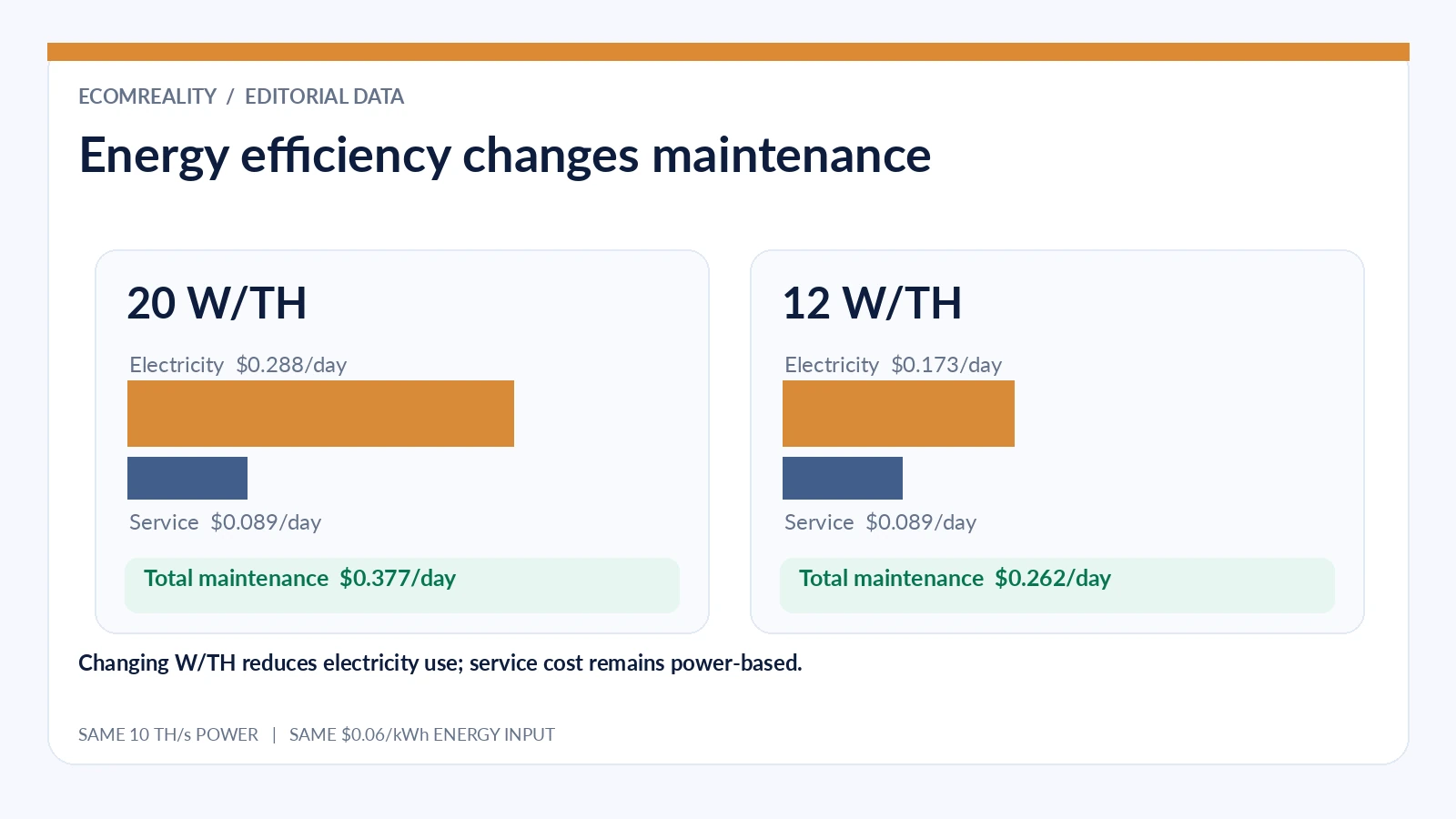
Now hold TH/s fixed and improve efficiency to 12 W/TH. The same illustrative electricity cost falls to $0.1728 per day, while service remains $0.089. Total maintenance is then about $0.262 per day, compared with $0.377 at 20 W/TH. The difference of $0.115 per day, or about $3.46 over 30 identical days, is meaningful. It shows why looking only at a miner’s TH number is a poor comparison method. But it is not a profit projection, because pool rewards, BTC prices and tariffs do not remain constant for a month by assumption.
Bitcoin price, difficulty and halving: three separate variables
GoMining’s documentation explains that reward size depends heavily on the Bitcoin network’s mining difficulty and the amount of computing power competing to create blocks. A user’s digital miner may keep the same TH/s while receiving fewer BTC over time if the network’s total hashrate grows faster. This is the central economic risk that “earn daily Bitcoin” descriptions often understate. Daily distribution is a payout cadence, not an earnings guarantee.
Bitcoin’s market price affects the calculation in a different way. The gross reward is denominated in BTC, while operating costs are commonly referenced in dollars and translated into BTC. When BTC rises, the same dollar operating charge consumes fewer BTC units; when BTC falls, it consumes more. That may help or hurt net BTC, even before considering any changes in mining difficulty. Then there is the Bitcoin halving cycle, which reduces the block subsidy at protocol-defined intervals. A robust forecast must model the possibility that gross reward per unit of hashpower falls after a halving or a difficulty increase.
A useful sensitivity analysis therefore changes the gross pool reward, the electricity price and the BTC conversion rate separately. Do not take a screenshot of a strong reward day and multiply it by 365 as if it were a contractual annuity. That is precisely the assumption that makes many mining profitability calculations fragile.
Maintenance discounts: useful, but conditional
GoMining publishes several mechanisms that can lower maintenance deductions. Its documentation describes a GOMINING-token maintenance payment discount of up to 20%, depending on how many days of fees the user’s liquid and eligible locked token position can cover. It also describes a VIP discount tied to account status, a daily Service button mechanic that can build a discount by consistent use, and mode-specific discounts subject to changing tokenomics. Exact stacking rules and current levels should be checked rather than assumed from a promotional headline.
The token-based discount is not equivalent to a free coupon. The user must hold or buy enough GOMINING tokens to satisfy the maintenance coverage requirement and enable the relevant payment setting. The token has its own market-price risk. If the wallet balance is inadequate, the documentation says fees may revert to BTC and the token discount will not apply. A user should calculate the dollar value of the required tokens, the discount actually received and the opportunity cost of holding those tokens. Otherwise a lower displayed maintenance charge can conceal a larger capital commitment.
The daily Service button has a different trade-off: a small discount earned through attention and consistency. GoMining says it refreshes on the UTC day boundary, with a progression that can reset if a day is missed. For an owner with many miners, a few percentage points may matter. For a small account, the absolute dollar saving may be tiny. That is an important difference between percentage savings and material earnings.
Mining Mode versus Miner Wars
GoMining has more than one reward structure. In Mining Mode, the straightforward concept is pool-backed mining rewards distributed daily, after relevant maintenance rules. A user trying to value a digital miner as an investment should start here because the revenue logic can be connected to TH/s, W/TH and network economics.
Miner Wars is a separate competitive game mode built around clans, rounds, league rules and weekly settlement. It can pay BTC and GOMINING rewards based on the competition’s mechanics. The docs also describe distinct maintenance allocations and protection floors for those rewards. Earnings in game mode should not be advertised or modeled as a stable daily mining yield. The outcome can depend on the clan’s relative performance, which is a different type of uncertainty from changes in network difficulty.
Confusing the modes causes misleading comparisons. A weekly prize from Miner Wars should not be added to seven days of theoretical Mining Mode rewards as if both are simultaneously guaranteed. GoMining’s documentation explains how mode changes affect accounting days and weekly cycles. Users considering the competitive system should read those rules separately and treat game-related spending, if any, as part of their total economics.
Buying power versus upgrading efficiency
The platform lets users upgrade both computing power and efficiency, according to its documentation. A power upgrade increases TH/s, which can raise gross reward participation but also raises electricity and service cost. An efficiency upgrade lowers W/TH, which primarily reduces electricity cost at a given TH/s. These are economically different decisions. Before choosing one, calculate the marginal cost and the marginal benefit separately.
Suppose a 10 TH miner generates a positive net reward under current conditions. Increasing it to 20 TH roughly doubles power-related gross exposure but also scales operating charges. An efficiency improvement at unchanged power, by contrast, does not create extra hashing power; it reduces the maintenance burden. The better upgrade depends on the purchase price of each improvement and how long the improved net reward would take to recover that expense. If the upgrade costs more than the realistic discounted value of future savings, the upgrade is not attractive no matter how colorful the dashboard looks.
The resale value of an upgraded miner is another uncertainty. A more efficient unit might be more desirable to secondary buyers, but marketplace prices depend on demand and current economics. GoMining states miners can be traded, not that every upgrade will be recovered in the resale price. Treat potential resale proceeds as a sensitivity scenario rather than an assured exit.
The break-even calculation people forget
A genuine profitability model has two levels. Operating break-even asks whether the gross pool reward exceeds ongoing electricity and service deductions. Investment break-even asks whether accumulated net BTC, valued in a consistent currency, eventually covers the purchase price of the digital miner and any upgrade costs, trading costs or token acquisition expenses. The first may be positive while the second remains far away.
For a simple forecast, estimate net reward under conservative, central and optimistic network scenarios. Convert each to a common reporting currency, recognizing that Bitcoin’s price can change. Subtract any further costs associated with selling, transferring or accessing funds. Then calculate payback time only if the scenario produces a positive net amount. If the net amount is near zero, writing “payback in X months” becomes almost meaningless because tiny changes in difficulty can change the denominator dramatically.
Also recognize timing. A miner might earn BTC daily, but external wallet transfers can depend on thresholds and processing schedules. The rewards being shown on a dashboard are not the same as instantly spendable dollars. Review withdrawal mechanics and any identity checks before committing capital, particularly if the account holder needs frequent cash access.
Is a digital miner safer than owning Bitcoin?
Not necessarily. Holding BTC outright exposes the holder primarily to Bitcoin price movements and custody risks. Holding a GoMining digital miner adds business and operational dependencies: physical mining uptime, cost accounting, the relationship between the tokenized representation and infrastructure, secondary-market liquidity, and the platform’s continued functioning. It may provide a stream of mined BTC, but the acquisition price can still decline and net rewards can shrink.
That distinction is why GoMining should not be sold to readers as a risk-free way to “earn passive income.” The company’s published formulas are a positive transparency feature. They give users enough information to build a better model. But formulas cannot eliminate unknown future network conditions, price changes or platform risk. A reviewer should separate what the company documents from what an investor can independently verify.
The same principle applies to apparent hardware backing. The docs say the digital miners correspond to real computing resources and identify data centers and fleets as the operating infrastructure. That is a material description of the model, not an independent audit by this publication. Users should verify service terms, asset rights, custody arrangements and available evidence before purchasing, especially if they plan to hold substantial value on the platform.
Five questions to ask before spending money
- What is the real entry price per TH? Compare miner purchase prices with market offers, not simply the depicted collection rarity.
- What is W/TH? A low purchase price can be offset by poor energy efficiency and higher ongoing deductions.
- What are current pool rewards and costs? Take the real numbers from the dashboard and documentation on the decision date.
- Which discounts require additional capital? Token-maintenance discounts may involve buying or retaining GOMINING tokens.
- What is the exit path? Check marketplace depth, possible selling fees, wallet transfer processes and account restrictions.
Keep the answers in a worksheet. Update them after network difficulty changes, maintenance tariff updates or a major move in BTC’s price. The goal is not to predict the future perfectly. It is to avoid making a permanent capital decision based on a temporary headline yield.
Strengths and weaknesses
The strongest part of the GoMining model is accessibility. A user does not need to operate a noisy machine, arrange an electricity contract, manage heat or maintain physical ASIC hardware. The company publishes a concrete explanation of the two main equipment metrics and the maintenance formula, which makes more rigorous analysis possible. A secondary market and upgrade options add flexibility that a basic cloud-mining subscription may not offer.
The disadvantages follow directly from the structure. The miner price is paid upfront and can be hard to recover. The platform and its operators are additional counterparties between the user and physical mining activity. Maintenance discounts can create token exposure, and competitive game rewards can complicate claims about regular earnings. Most importantly, daily payouts do not equal a guaranteed positive investment return. Any review that omits that sentence is missing the essential economics.
Final verdict
GoMining is worth examining for users who want exposure to mining economics without running hardware, particularly if they are comfortable building a spreadsheet around TH/s, W/TH, electricity, service fees and possible resale. It provides more operational detail than many vague “cloud mining” offers, and the ability to upgrade efficiency is a genuinely useful lever. But it should be evaluated as a variable-return product with real capital risk, not as a fixed-yield account.
The most important number is net BTC after maintenance, followed closely by the amount paid to acquire that stream. If either is ignored, the review is incomplete. Readers who prefer direct, simpler BTC exposure may find that buying Bitcoin itself is easier to understand. Readers who want a mining-linked digital asset should use GoMining’s own formulas, conservative assumptions and an honest exit plan before deciding.
Frequently asked questions
Do GoMining digital miners represent real hashing power? GoMining’s documentation says its miners are backed by real data-center capacity. This review has not independently audited that allocation.
Are GoMining BTC rewards guaranteed? No. Rewards depend on pool output, mining difficulty, BTC price and maintenance. A daily payout mechanism does not guarantee a profitable day or payback.
Does higher TH/s always mean higher profit? Not by itself. The cost of power, energy efficiency, miner purchase price and current mining rewards all affect net returns.
Can paying maintenance in GOMINING tokens help? The platform documents a conditional discount of up to 20% for eligible token-funded maintenance, but holding tokens introduces additional risks and capital requirements.
Is Miner Wars the same as Mining Mode? No. Mining Mode uses daily mining-related rewards, while Miner Wars uses competition rules and weekly settlement. They should be evaluated separately.
Sources and methodology
This review draws on GoMining’s miner overview, the digital miner and cost formulas, energy-efficiency documentation, maintenance discounts, and Mining Mode documentation. Examples are constructed for education and are not historical GoMining account results or forward-looking return forecasts. This publication has not independently audited physical hardware backing or operating figures.

Jo Carter is an editor and ecommerce researcher at Ecom Reality, where she covers ecommerce platforms, digital selling tools, online business software, pricing models, and emerging industry trends. She focuses on turning complex platform features and costs into clear, practical information for entrepreneurs and digital sellers. Her work combines detailed research with a balanced editorial approach, helping readers compare services, understand potential limitations, and choose tools that fit their business goals.
Comments
Related Articles
Leave a Reply