
XS.com positions itself as a global broker rather than a local niche brand. That framing is visible from the first interaction with the website. The homepage highlights multiple licenses, dynamic leverage, platform access and broader group infrastructure. That marketing approach matters, because readers evaluating XS should not think only in terms of a single spread quote or a single jurisdiction. The more relevant question is how the broker’s regulatory structure, account architecture and cost model fit the kind of trading a person actually does. A day trader, a copy-trading user and a medium-term CFD trader may all land on very different conclusions while looking at the same brand.
There are three reasons XS.com deserves a closer look. First, the brand has accumulated a meaningful list of regulated entities. Second, it segments account types in a way that is relatively clear, especially around the spread-versus-commission decision. Third, it publicly emphasizes product breadth and institutional-style infrastructure, including additional insurance marketing and advanced execution claims. None of those items automatically makes XS the right broker for every trader. But together they do make it more than a generic offshore sign-up page with a dark trading interface and little else behind it.
Why the regulatory structure is the starting point
Many broker reviews make regulation sound like a formality. With XS, it is the backbone of the whole analysis. Official materials from the company’s help center and regulations pages describe several group entities and licenses, including XS Ltd under the Financial Services Authority of Seychelles, XS Prime Ltd under ASIC in Australia, XS Markets Ltd under CySEC in Cyprus, XS Finance Ltd under the Labuan Financial Services Authority in Malaysia, and XS ZA (Pty) Ltd under South Africa’s FSCA. Company materials also reference additional group or alliance entities in other markets.
The practical implication is simple: not every client relationship on XS.com is identical. The brand may be one, but the rulebook is not. This affects matters such as client protections, complaints handling, marketing permissions, available leverage and the exact documents that govern the account. For some readers, that level of legal detail may seem excessive. It is not. When a broker operates across multiple jurisdictions, the onboarding entity becomes one of the most important facts in the entire review. It determines which promises on the front page actually translate into enforceable client rights.
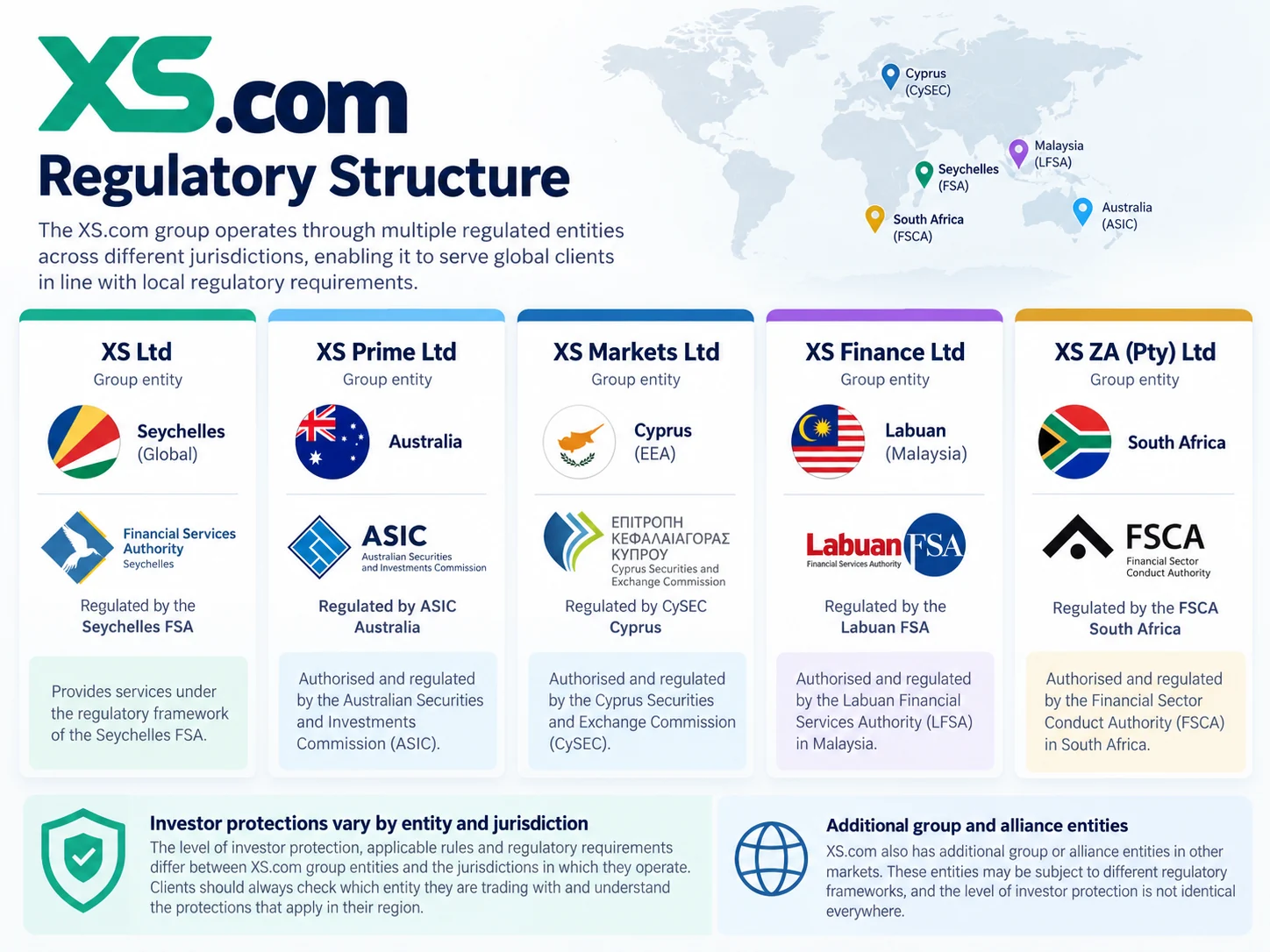
In short, a trader evaluating XS.com should not stop at “multi-regulated.” The better habit is to ask five follow-up questions: Which entity will open my account? Which protections apply to that entity? Are the trading conditions on this page universal or entity-specific? Am I being marketed the same account type available to clients in other jurisdictions? And what restrictions or disclaimers appear for my region? On the public site, XS notes that certain jurisdictions are restricted and that services are not directed at some markets, including the United States and parts of the European Union. That alone is a reminder that eligibility and conditions are not uniform.
Account tiers: where XS becomes easier to compare
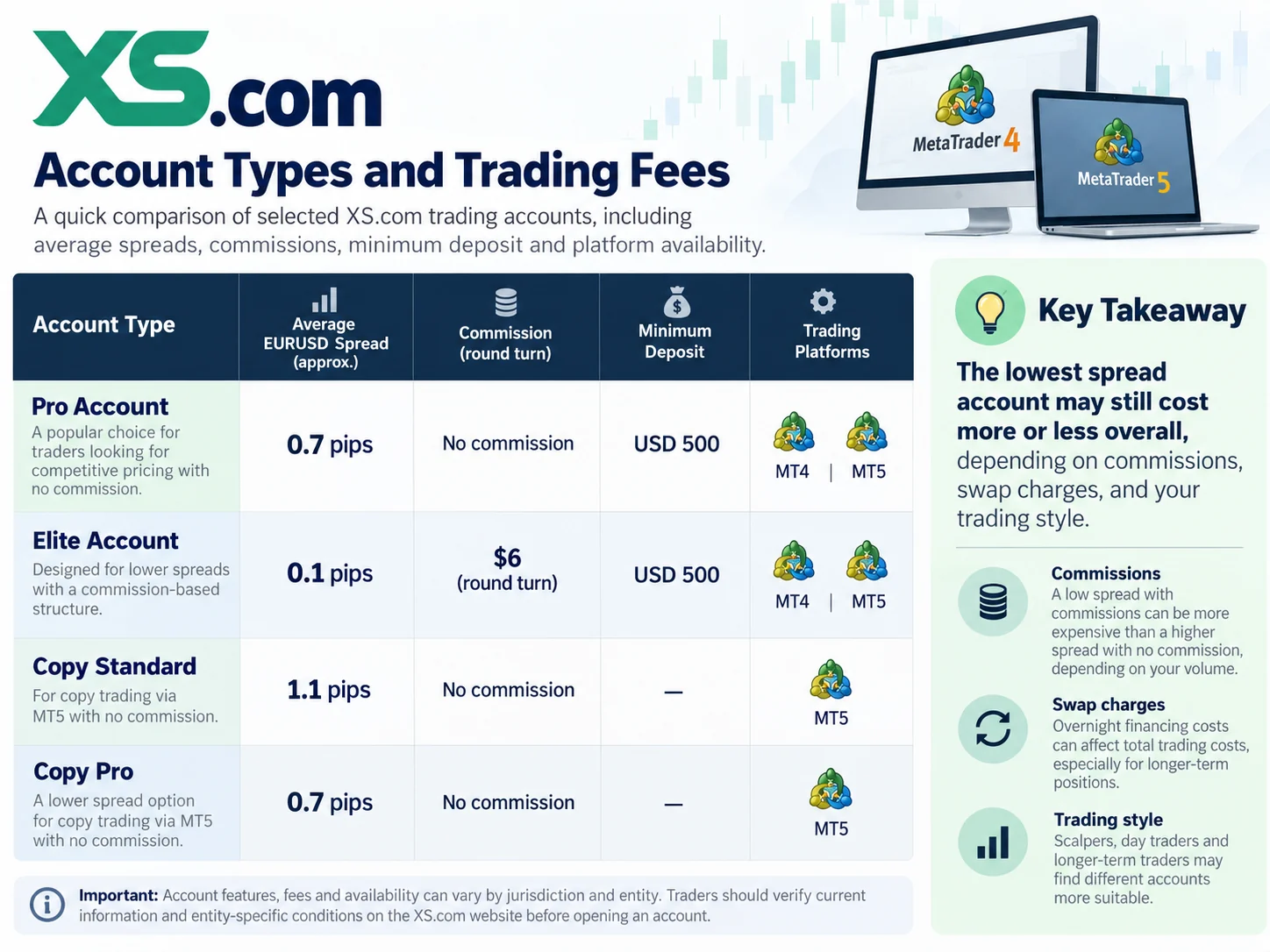
One of the stronger aspects of XS.com is that its account pages explain the logic of several account types without hiding the key numbers. Among the selected account options, the Pro Account is presented as a lower-spread, zero-commission option with a minimum deposit of USD 500 and support for both MT4 and MT5. Official materials list an average EURUSD spread of about 0.7 for that account. By contrast, the Elite Account is built for traders who want raw spreads and are willing to pay a $6 round-turn commission, also with a USD 500 minimum deposit and MT4/MT5 availability. Official materials list an average EURUSD spread of about 0.1 there.
Those two account types create a classic fork in the road. If a trader prefers the simplicity of no ticket commission and does not need the tightest possible spread, the Pro Account is easier to understand. If a trader cares more about rawer pricing and is comfortable evaluating all-in cost after commission, the Elite Account becomes the more interesting option. There is no universally “better” choice. The answer depends on trading style, frequency and instrument mix. Scalpers and highly active intraday traders often care far more about the underlying spread than occasional swing traders do. On the other hand, a trader who opens fewer positions may be perfectly satisfied with a slightly wider spread if the account experience is simpler and commission-free.
XS also separates out copy-trading related account types. Public account pages show Copy Standard as an MT5 account with an average EURUSD spread around 1.1 and no commission, while Copy Pro is also an MT5 account with an average EURUSD spread around 0.7 and no commission. That provides a reasonably intuitive ladder for copy-trading users: choose the easier, more standard option, or step into a tighter-spread version if your activity justifies it. The presentation is more helpful than the usual broker habit of drowning readers in brand names without explaining who each account is for.
Trading fees: the all-in view matters more than one headline number
XS.com’s account structure is easiest to understand if you think in all-in cost rather than in isolated numbers. A trader who looks only at the Elite Account’s 0.1 spread might assume it is automatically cheaper than the Pro Account. But that ignores the $6 round-turn commission. A trader who looks only at the Pro Account’s zero-commission label might assume it is automatically cheaper. But that ignores the wider spread. The honest way to compare them is to combine both pieces and then layer in any relevant overnight financing or other charges.
This is where too many reviews become lazy. They repeat the broker’s own spread marketing without testing what that means for real usage. Suppose a trader opens and closes positions rapidly throughout the day. On that profile, a lower spread plus a clear commission may be easier to price and potentially more attractive. Suppose a trader is less active or trades sizes where the commission does not meaningfully improve the final outcome. On that profile, the commission-free route may be perfectly adequate. The right account is therefore not the one with the lowest advertised figure; it is the one with the lowest realistic cost for the behavior you actually have.
| Selected account | Officially highlighted pricing | Best fit | Main caution |
|---|---|---|---|
| Pro | Approx. 0.7 EURUSD spread, no commission, USD 500 minimum | Active traders who want competitive pricing without per-trade commission math | A tighter raw-spread account may still be cheaper for very active trading. |
| Elite | Approx. 0.1 EURUSD spread, $6 round-turn commission, USD 500 minimum | Traders prioritizing lower raw spreads and clearer execution-cost benchmarking | The low spread should always be judged together with commission and swaps. |
| Copy Standard | Approx. 1.1 EURUSD spread, no commission, MT5 | Copy-trading users who want a straightforward cost model | Wider spreads can weigh more heavily on very active copied strategies. |
| Copy Pro | Approx. 0.7 EURUSD spread, no commission, MT5 | Copy-trading users seeking a lower-spread option | Users still need to consider swap costs and the trading behavior of copied strategies. |
Another cost layer is overnight financing. Official account pages for specific tiers mention swap-free options in some cases, while broader marketing across the site also references zero-swap messaging. Traders should be careful here. Swap-free availability often depends on account type, region, eligibility or instrument. It should never be assumed universally. A swing trader or position trader should therefore verify actual financing conditions on the specific account documentation rather than treating a marketing headline as a blanket rule.
Platforms, product range and execution positioning
The platform side of XS.com is relatively conventional in a good way. Public materials show support for both MetaTrader 4 and MetaTrader 5 across important account types, and the firm markets a broad multi-asset product list, including forex, metals, shares, energies, indices, futures and crypto CFDs. That breadth is useful because it means the account-type decision is not siloed to just one niche market. If a trader expects to move across asset classes, account selection remains relevant across a wider product universe.
Execution branding on the site aims at a more advanced audience. The company talks about tighter spreads, raw pricing and fast market access. There is also headline marketing around dynamic leverage up to 1:2000 and civil liability insurance up to $5,000,000 on the homepage. Those are attention-grabbing claims, but they should be treated carefully. High leverage can increase flexibility, but it also increases the speed at which losses can compound. Insurance headlines can sound comforting, but they do not replace understanding the legal entity, the account agreement and the limits of actual client protection. In other words, these features may be positives, but they are supporting details, not substitutes for due diligence.
Where XS.com looks strongest
First, the broker is easier to evaluate than many rivals because it puts more structural information into public view. Readers can find entity names, license references and core account specifications without fighting through a maze of generic copy. Second, the account menu is not just branding theater; it communicates meaningful differences in spread, commission, minimum deposit and platform support. Third, the broker’s broad regulation footprint will appeal to traders who prefer to see more than one oversight regime connected to a group brand.
Where traders should stay cautious
The main caution is that a large group footprint does not make all onboarding experiences equal. A reader cannot assume that ASIC-style expectations apply to every jurisdiction the brand serves. Another caution is that spread numbers without context can be misleading. The Elite Account’s lower spread is not automatically cheaper if the trader ignores commission, just as the Pro Account’s zero-commission label is not automatically cheaper if wider spreads are a constant drag. Finally, leverage and copy-trading style account options may invite overtrading if the user mistakes flexibility for safety.
Why some traders will like XS.com
- Clear public disclosure of multiple regulated entities and jurisdictions.
- Useful differentiation between account types rather than meaningless renaming.
- MT4 and MT5 support on important account tiers.
- Broad market access across several CFD categories.
What should be verified before funding
- Which legal entity will hold the account and what protections apply there.
- The current spread, commission and swap rules for the specific account type and region.
- Whether “swap-free” or similar features are universally available or conditional.
- Whether leverage and copy-trading options match your risk tolerance, not just your curiosity.
Which XS account type fits which trader?
One useful way to simplify the XS.com menu is to stop thinking in brand labels and start thinking in behaviors. A trader who opens a moderate number of positions and values a straightforward cost model will generally understand the Pro Account faster than the Elite Account. The absence of a ticket commission makes record-keeping easier, and for some traders the slightly wider spread is a fair trade for simplicity. By contrast, a trader who measures performance to the decimal point, tests strategies rigorously and places enough volume for raw pricing to matter will often be more comfortable comparing results on an Elite-style structure.
Copy-trading users have a similar decision. Copy Standard is easier to digest because the pricing story is simpler. That matters when a user’s main job is already monitoring trader selection and portfolio behavior. Copy Pro makes more sense for users who want tighter spreads while still staying inside the copy-trading framework. Neither account removes the need to evaluate the strategy being copied. In fact, copy users should be extra cautious, because their costs interact with another layer: the trading frequency and holding time of the copied strategy itself.
The larger point is that XS.com’s account architecture is only useful if the trader matches it to a real use case. The wrong habit is to pick the account with the most sophisticated-sounding name. The better habit is to decide what matters most: low raw spread, no commission, copy-trading convenience, lower friction, or a particular platform workflow. When the selection process starts there, the account menu becomes much less intimidating.
A smart due-diligence checklist before opening an XS.com account
Readers who want a practical conclusion can reduce the whole review to a short checklist. First, confirm the exact legal entity that will open the account. Second, compare the spread and commission structure of the two or three accounts you are realistically considering rather than scanning the entire catalog. Third, review swap policy if you ever hold positions overnight. Fourth, verify platform availability, especially if your workflow depends on MT4 or MT5. Fifth, read the regional risk warning and restrictions that apply to your jurisdiction. And sixth, keep leverage expectations realistic. A broker can offer very high leverage, but that does not mean using it heavily is a good idea.
This checklist may sound basic, yet it is exactly what separates a good broker choice from a rushed one. Brokers often look similar in ads and very different in real-life use. XS.com gives traders enough public information to make an informed decision, which is a positive. But the responsibility for turning that information into a smart decision still belongs to the trader.
Final verdict
XS.com is most convincing when viewed as a structured broker group rather than as a single pricing slogan. The brand offers a meaningful regulatory footprint, a sensible range of account types and enough fee transparency to make useful comparisons. That is a stronger starting point than many retail traders get elsewhere. But the broker only remains attractive if the user does the last layer of work: confirm the onboarding entity, compare all-in trading costs instead of isolated numbers, and choose an account type that matches actual behavior. Traders who do that may find XS.com more thoughtful than its marketing competitors. Traders who skip that work may still end up with the wrong entity, the wrong account tier and the wrong cost expectations.
FAQ
Yes. Official company materials reference regulated entities in Seychelles, Australia, Cyprus, Labuan in Malaysia and South Africa, among others. The exact client experience depends on which entity opens the account.
Based on official account pages, the Pro Account is positioned as a lower-spread, zero-commission option with an average EURUSD spread around 0.7 and a USD 500 minimum deposit. The Elite Account is a lower-spread, commission-based account with an average EURUSD spread around 0.1, a $6 round-turn commission and the same USD 500 minimum deposit.
Yes. Selected professional account types shown in official materials, including Pro and Elite, are available on both MetaTrader 4 and MetaTrader 5.
Yes. Public XS.com account materials show dedicated copy-trading options such as Copy Standard and Copy Pro, with their own spread profiles and MT5 availability.
Sources and methodology
Primary references: XS Group regulations and legal-entity disclosures, XS professional account comparison, and XS copy-account overview. Spreads are advertised averages rather than guaranteed live fills. Account availability, financial protections and terms depend on jurisdiction.

Croom Raymond is an ecommerce writer and digital business researcher at Ecom Reality. He covers online selling platforms, SaaS tools, pricing structures, platform features, and practical strategies for building digital businesses. His articles focus on clear, evidence-based analysis that helps readers understand how different services work, compare their advantages and limitations, and make more informed business decisions.
Comments
Related Articles


Leave a Reply