

Quick answer: ATFX is not a single, uniform brokerage contract. Its group includes companies overseen by regulators in the UK, Cyprus, Mauritius, Seychelles and other markets. Before judging a quoted spread or withdrawal promise, confirm which legal company would actually accept your account. The account entity determines the governing agreement, eligibility, dispute route and potentially the protections available to you. Trading costs then depend on the instrument, position size, execution and holding period. ATFX’s published payment page gives useful withdrawal benchmarks, but a broker’s processing period is not a guarantee of when money reaches your bank.
A broker review needs to start with the contract
A trader comparing ATFX with another broker will usually see familiar marketing claims: multiple asset classes, trading technology, competitive costs and convenient funding methods. Those features matter. They are not enough to evaluate an account. Two people who encounter the same logo may be directed to different legal entities and presented with materially different documents.
The practical first step is to look at the entity named in the registration flow and customer agreement. Ask whether it is the UK company, the Cyprus company or another group member. Then identify the relevant regulator, client classification and fee schedule. A page listing licenses held by several companies cannot answer those questions on behalf of a particular trader.
It matters especially for CFDs. A CFD gives exposure to movements in an underlying instrument without necessarily giving ownership of the underlying asset. Leverage magnifies the impact of price changes relative to account equity; overnight financing can turn an apparently inexpensive intraday position into a costly multiday trade.
This review uses published ATFX materials and explains how to evaluate them. It is not a first-hand account-opening, execution-quality or withdrawal test. Where the company does not publicly establish an account-specific figure, that uncertainty remains explicit.
ATFX operates through multiple legal companies
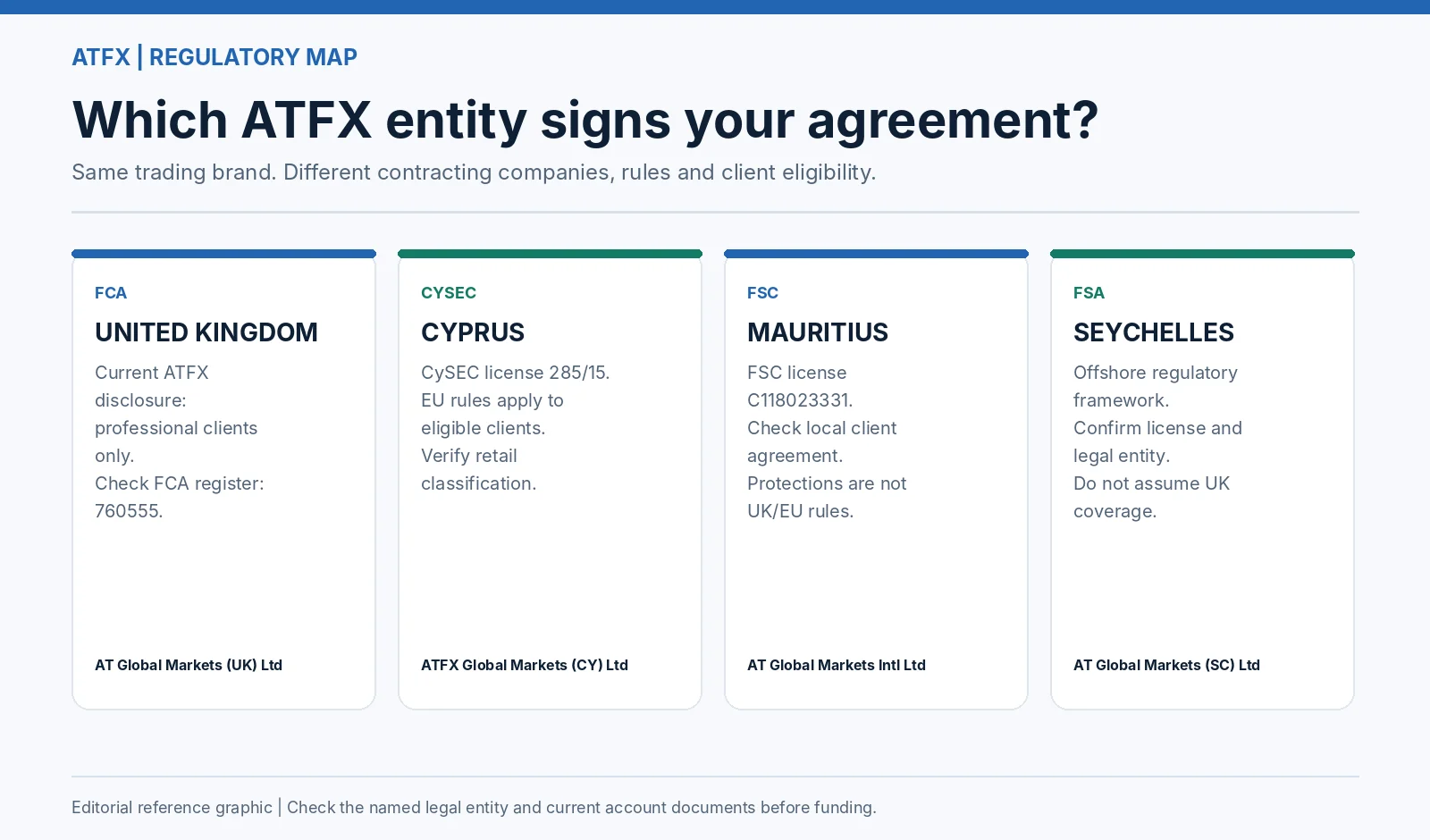
ATFX’s current regulator page identifies several group companies. The UK company, AT Global Markets (UK) Limited, appears under Financial Conduct Authority registration number 760555. Its current website disclosure marks the UK entity professional clients only. That detail matters more than a generic statement that the group has a UK license. A UK resident looking for a regular retail CFD account should not assume that this entity will accept them.
The Cyprus entity, ATFX Global Markets (CY) Ltd, cites Cyprus Securities and Exchange Commission license 285/15. AT Global Markets Intl Ltd is associated with Mauritius Financial Services Commission authorization, including license C118023331 in ATFX’s current disclosures. AT Global Markets (SC) Limited is listed with the Seychelles Financial Services Authority. The group also lists other regulated operations, including Australia, South Africa and the United Arab Emirates.
The presence of several regulators is not a shared umbrella. A customer contracted with a Mauritius entity does not automatically become a UK FCA client merely because the UK company belongs to the same group. Nor does a regulator’s oversight amount to an assurance against market losses. The investor should match the exact name, jurisdiction and license in the onboarding documents against the regulator’s register when feasible.
Why professional and retail classifications matter
Retail and professional status can change access to leverage, risk warnings and specific statutory protections. Eligibility tests and consequences differ by jurisdiction. In some regions professional classification can mean access to more flexible products but fewer protections intended for ordinary retail clients. The correct question is not whether one classification is universally better. It is which account category the broker is actually offering, and what the client would give up or retain.
The UK professional-only disclosure is a useful illustration. An infographic that simply says ATFX serves both retail and professional clients in the UK would be misleading for the current UK offering. Likewise, compensation arrangements should not be quoted from a different entity’s terms or described as covering investment losses caused by market movements.
A license is not the same as a verified withdrawal record
Regulatory authorization can provide mechanisms for conduct supervision, disclosures and complaints. It does not prove that a particular withdrawal request will be processed at a particular speed. That claim would need transaction-level evidence. Conversely, anecdotal reports of a delay cannot by themselves demonstrate misconduct. A reader should separate the legal safeguards of an entity from operational claims, published service levels and independent transaction evidence.
What products does the broker provide?
ATFX markets trading in forex and CFDs tied to instruments such as indices, commodities and other markets, with availability varying by entity and platform. Readers should distinguish underlying assets from derivative contracts. Buying a share through a traditional custody broker and taking a CFD position linked to the share price are different arrangements. In the latter case, the trader is generally dealing with the CFD contract under the broker’s terms rather than becoming a shareholder.
Instrument specifications are more useful than a high-level count of tradable assets. For each proposed position, the trader should find the contract size, minimum trade increment, quotation currency, typical or current spread, applicable commission, financing rate and margin schedule. They should also check market hours and whether the broker can change margin requirements ahead of volatile events.
How spread costs work
The spread is the difference between the buy price and the sell price. If the market were unchanged and a position opened and closed immediately, a trader would ordinarily absorb the quoted spread before considering any other charge or slippage. Variable spreads widen and narrow with liquidity, volatility and the conditions of the pricing venue.
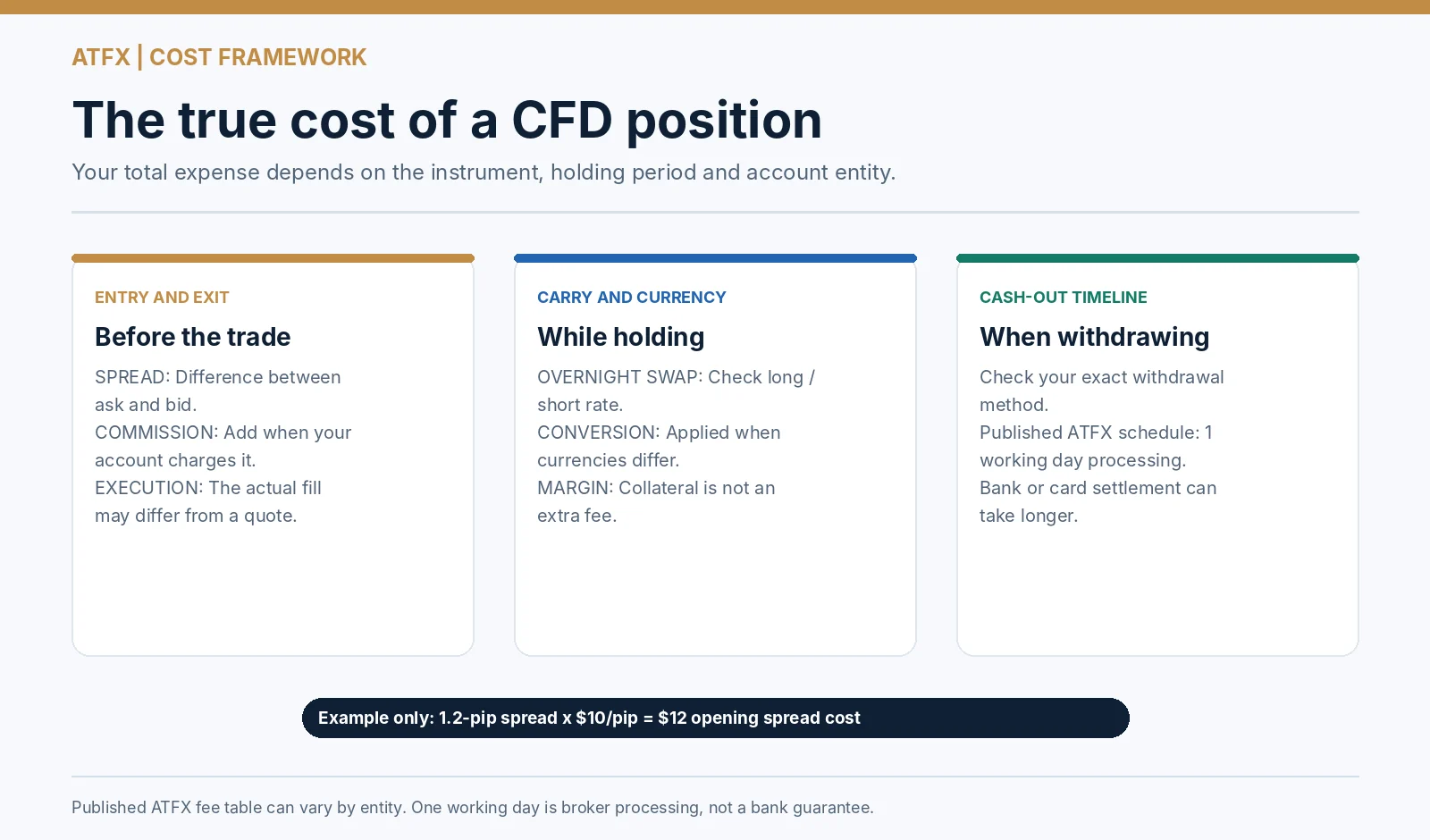
Consider a hypothetical EUR/USD CFD whose specification gives a pip value of $10 for a particular position size. At a 1.2-pip spread, the spread component would be roughly $12 for that notional position. At 2.0 pips it would be $20. These are arithmetic illustrations, not live ATFX quotes, and they assume the stated pip value and no other costs. A different contract size produces a different dollar amount.
Traders making many short-duration trades need to study actual bid-ask pricing during the hours they trade, not just the lowest rate in an advertisement. A few tenths of a pip can be important to a strategy seeking small average price movements. An investor holding positions for weeks may be more sensitive to financing and currency effects.
Commission and spread-only arrangements
Some brokerage accounts recover their economics mainly through the bid-ask spread, while other offerings use tighter spreads with an explicit per-lot commission. The comparison must convert both into the same unit. A $7 round-trip commission on a position with a $10 pip value is equivalent to 0.7 pip before any separate spread is added. If the account also has a 0.5-pip spread, the combined illustrative execution cost is 1.2 pips, again before slippage.
A fee described as ‘per side’ must be counted twice for a round trip. A fee described as ’round turn’ normally already includes both directions. Confusing these labels produces a misleading comparison. The same is true if a broker quotes a minimum spread under exceptional conditions and a rival’s average spread across a normal trading session.
Overnight financing can outweigh the opening spread
CFD positions carried beyond a specified cutoff can incur swaps or other financing adjustments. The amount may depend on instrument, direction, position size, rate environment and the broker’s calculation method. Some positions generate a credit rather than a debit, but that should not be presumed. Changes in underlying rates can alter the economics even when market prices do not move significantly.
There may also be days when several days of financing are booked together to account for weekend settlement conventions. Before opening a multiday position, inspect the swap-long and swap-short values shown in the trading specification and understand how they are quoted. Are they measured in points, currency units or percentages? Does the platform show the next rollover amount? Can the rate change?
For a simple illustration, suppose an account incurs a $4 equivalent financing cost on each of five relevant holding nights. A $12 opening spread cost plus $20 of financing makes $32 before any commission, conversion charge or price movement. The example is intentionally hypothetical; the ATFX rate for a particular instrument must be taken from the live specification.
Execution is a separate element of total cost
An order request is not the same as an executed trade. During fast markets, the eventual fill can differ from the price visible when the user clicked. Price gaps, thin liquidity, order type and market conditions matter. Slippage is not necessarily negative: better prices are possible too. A review cannot establish execution quality from marketing claims.
Read the relevant entity’s order execution policy, including how orders are routed, whether there are execution restrictions, and how best-execution considerations are described. For stop orders, verify whether a trigger creates a market order or a limit order, because that determines the balance between getting out and controlling the price. A stop-loss instruction is not an absolute loss ceiling in a sharply gapping market.
Readers assessing an account for active strategies should test on a demo or a suitably small live position only if they accept the associated risk. Record quoted and executed prices, order timestamps and spreads under comparable conditions. Such testing produces evidence tailored to a strategy; this article does not claim to have carried it out.
Leverage is access to exposure, not a benefit in itself
Leverage allows an account to control exposure larger than its posted margin. If a trader has $1,000 of equity and controls a $10,000 position, a 1% price movement in the underlying corresponds to roughly a $100 change in the position’s value before fees and currency effects. That is 10% of the starting equity. The arithmetic works in both directions.
Margin is collateral for the open exposure, not a payment that purchases the underlying asset. The broker may demand additional margin or liquidate exposure if account metrics reach a stop-out threshold. Which rules apply should come from the client’s entity-specific schedule.
The maximum leverage advertised anywhere in a broker group is not necessarily available on every asset or to every customer. Local regulation, professional classification, exposure concentration and market events can produce much lower effective limits. A trader should plan risk based on actual position notional and stop-loss assumptions rather than maximizing available leverage.
Deposits: available methods and realistic timing
ATFX’s published deposit and withdrawal page lists payment cards, bank transfers and e-wallets, including recognizable providers such as Skrill and Neteller. It also presents a funding table with zero listed deposit fees for particular methods and currencies and a displayed minimum of 100 currency units in that table. It should not be read as a universal minimum across every ATFX legal entity and account.
Card or e-wallet funding may be credited relatively quickly after provider confirmation. Bank transfers depend on banking networks and the broker receiving the money. A customer should verify whether their preferred method is displayed after their account entity and residence are established. Available funding rails can change due to local payments regulation or service-provider coverage.
A ‘zero broker fee’ statement does not eliminate foreign-exchange conversion, correspondent-bank charges or other costs imposed by a payment provider. Someone depositing in a currency other than the trading account’s base currency should request or inspect the conversion rate. A seemingly free transfer can still carry a spread in the exchange conversion.
Withdrawals: how to read ATFX’s published policy
The ATFX payment page shows a one-working-day processing benchmark in its withdrawal table for displayed methods, with a fee footnote that merits close attention. It states that withdrawals are free when equal to or above 100 in the applicable EUR, USD or GBP currency, or when the full account balance is withdrawn. Otherwise, a fee of 5 in the relevant currency applies. This is a description of the published table; verify its applicability to your contracting entity and actual available payment method.
The key distinction is between broker processing and payment arrival. Processing describes internal review and release of a request. Settlement through a card issuer, intermediary or receiving bank may take additional time. A bank transfer submitted late on Friday may cross weekends, holidays or correspondent banking procedures. A review should not promise funds will be in the recipient’s account within one day merely because a broker lists one working day in its table.
Why a withdrawal request can require further review
Identity verification, matching the recipient details and source-of-funds checks are common compliance steps in the financial sector. A change of banking details or an unusual transaction pattern can require additional information. The existence of a review does not establish that every delay is appropriate; it means readers should understand what the agreement authorizes and how support handles requests.
Before initiating a withdrawal, check that the trading account is verified, available free margin supports the requested amount, no positions or unsettled obligations block it, and the recipient method follows the broker’s policy. Keep the confirmation and any transaction reference. If the request is not resolved within the stated procedure, request a written explanation and the entity-specific complaints route.
A practical withdrawal example
Suppose a trader has no open positions and wishes to withdraw $80 without closing the entire account balance. Under the published small-withdrawal footnote, a $5 broker fee could apply if that policy governs the account. At $150, the same footnote suggests no ATFX withdrawal fee. This does not address intermediary fees or an account-specific exception. It also does not predict the final exchange rate if funds arrive in a different currency.
A sensible comparison is therefore the amount initiated, broker charge, conversion cost, recipient-bank deductions and amount ultimately credited. Treat them as separate line items rather than collapsing everything into a claim that a broker has ‘free withdrawals.’
How to check the trading agreement before funding
The safest due-diligence process is not complicated, but it is specific. Capture the exact legal-company name presented in onboarding. Follow the license number to the regulator. Read the client agreement, risk disclosures, order execution policy, deposit and withdrawal rules, and product specifications for the intended asset. Record the links or copies as of the day the account is opened.
If the registration interface redirects between regional websites, do not assume the first page’s legal footer still applies. If the payment table and contract disagree, ask the broker in writing which document governs. Terms sometimes include discretion to alter margin, pricing or available payment methods, and it is useful to understand the notification mechanism before an event creates a problem.
The questions to ask support should be precise: ‘What legal entity will contract with me?’ ‘Is my classification retail or professional?’ ‘Which fee table applies to my account currency and chosen funding method?’ ‘What is the broker’s normal processing time versus external settlement?’ A response naming the correct document is more useful than a reassuring marketing phrase.
Where the ATFX offering may make sense
ATFX deserves consideration from a trader seeking CFD-market access through a group that publishes multiple regulatory relationships and detailed legal documentation. Its payment page provides a starting point for checking funding methods and withdrawal charges. The existence of several entities can support regional business coverage. For users whose location and account type match a suitable regulated offering, a side-by-side fee comparison may be worthwhile.
The complications are equally concrete. Legal protection and retail eligibility are not uniform. CFDs carry leverage, financing and execution risk. The company-level regulator list is not a substitute for verifying the account contract. And published withdrawal processing times are not independent evidence of successful settlement into a customer’s bank account.
For readers who intend to buy and hold shares outright, an ownership-based stock broker may better fit the objective than a CFD arrangement. For those who prefer avoiding leveraged exposure, broker spreads and high maximum leverage are not compelling reasons to change the strategy.
The decision checklist
Before comparing ATFX with another provider, build a short sheet containing the legal entity, license, account classification, actual tradable instruments, spread observations, commission, overnight charges, conversion terms, margin and stop-out rules, deposit methods, withdrawal threshold and complaints process. Apply the same sheet to each rival broker.
The resulting choice may look less dramatic than a list of advertised features, but it will be more defensible. A broker is not ‘cheap’ merely because its opening spread is low, and it is not ‘well protected’ merely because another company sharing its brand has a license in a well-known jurisdiction. The relevant offering is the combination of the contract, operational rules and the trade a customer actually intends to place.
FAQ
Is ATFX regulated by the FCA?
One ATFX group company, AT Global Markets (UK) Limited, is identified as FCA-authorized. The current ATFX disclosure describes the UK entity as professional-clients-only. Whether a particular customer contracts with that entity must be established during onboarding, not assumed from the shared brand.
Does ATFX charge for withdrawals?
The public ATFX table describes free withdrawals at or above 100 units of the relevant currency, or for the full remaining balance, and a 5-unit fee below that level otherwise. Check the contract and payment terms for your actual ATFX entity. Banks and conversion providers may add their own charges.
Can ATFX guarantee funds will arrive within one working day?
No such guarantee is established by the broker’s published processing table. One working day concerns the indicated broker processing period. External banks, cards, holidays and review steps can affect final receipt.
Sources and editorial method
This article reviewed ATFX’s regulator and company disclosure, legal documents portal, and deposit and withdrawal conditions. Regulatory permissions, charges and available markets can change. The review explains official disclosures and uses labeled hypothetical calculations; it does not claim live execution testing or a completed withdrawal.
Read the ATFX company profile for the site’s customer-review section, or compare the structure of different trading platforms in the site’s FBS profile.

Croom Raymond is an ecommerce writer and digital business researcher at Ecom Reality. He covers online selling platforms, SaaS tools, pricing structures, platform features, and practical strategies for building digital businesses. His articles focus on clear, evidence-based analysis that helps readers understand how different services work, compare their advantages and limitations, and make more informed business decisions.
Comments
Related Articles



Leave a Reply