
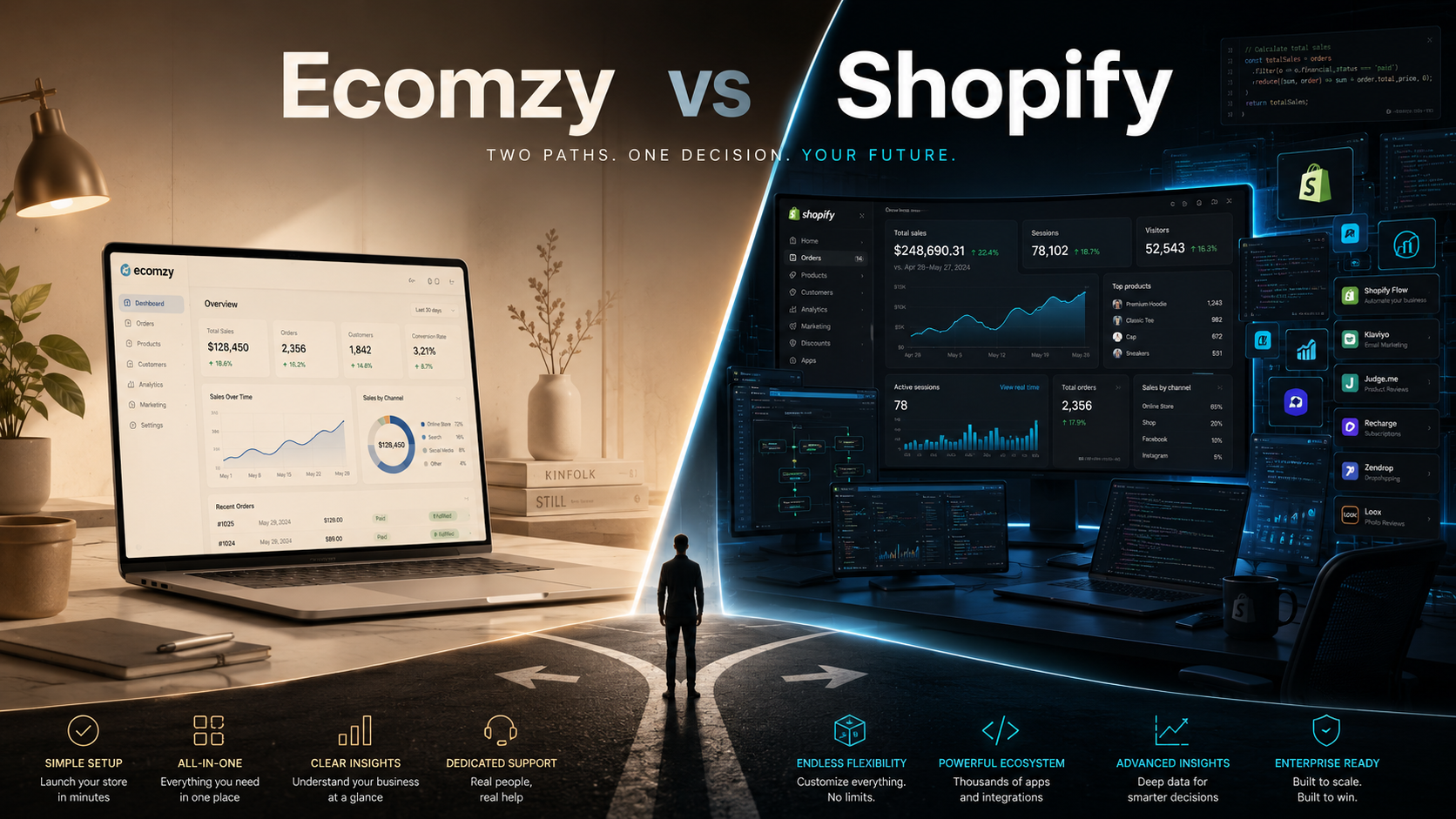
Ecomzy vs Shopify is not just a comparison between two ecommerce platforms – it is a comparison between two different ways of starting and managing an online business. The features, the tools, the pricing tiers – those matter, but they are secondary to a more fundamental question: how much responsibility does each platform hand to you on day one, and are you ready for it?
Shopify gives you a highly flexible, deeply customizable system. That is genuinely powerful. But flexibility means decisions, and decisions mean time, money, and the very real risk of building something elaborate before you have confirmed that anyone wants to buy it. Ecomzy approaches the problem differently. It offers a more guided starting point – less open-ended, more structured – designed to reduce the early friction that causes so many first-time ecommerce operators to stall before they ever make a sale.
Neither platform removes the need to understand traffic, cost margins, customer acquisition, or business fundamentals. No platform does that. But the starting experience, the default complexity, and the type of operator each platform suits best are meaningfully different.
What Ecomzy and Shopify Are Actually Built For
Shopify
Shopify launched in 2006 after its founder, frustrated with existing tools, built his own store software to sell snowboards online. That origin story is telling. It was built by someone who wanted control – and it has always prioritized giving users control. Today, Shopify is one of the most widely used ecommerce platforms in the world, with a mature ecosystem of themes, apps, developers, agencies, and integrations. It is a broad ecommerce platform: flexible, app-rich, and mature.
That maturity comes with complexity. To run a Shopify store well, you need to make decisions about themes, apps, payment gateways, checkout flows, navigation structure, SEO settings, email integrations, analytics tools, and marketing channels. None of these decisions are particularly difficult in isolation, but for someone brand new to ecommerce, the sheer number of them creates what product designers call decision fatigue. The platform works best for users who already know what they are building and how they plan to drive traffic to it.
Ecomzy
Ecomzy takes a different approach. Rather than handing you a blank canvas and a set of tools, it offers a more structured starting environment – one where the initial setup choices are narrowed, the path is clearer, and the early overwhelm that often accompanies a Shopify launch is reduced.
For solopreneurs and first-time operators who do not want to spend three weeks configuring apps before they make their first sale, this distinction matters. Ecomzy’s value is not in raw power. It is in reducing the distance between “I want to start” and “I am actually running a store.”
Shopify is a flexible toolbox. Ecomzy is a guided starting system.
Both descriptions are compliments. They just suit different users at different stages.
Ecomzy vs Shopify at a Glance
| Category | Ecomzy | Shopify |
|---|---|---|
| Best for | Beginners and solopreneurs | Experienced builders and scaling teams |
| Setup style | Guided, more structured | DIY, open-ended |
| Learning curve | Lower | Higher |
| Customization | Structured, practical | Deep, highly flexible |
| App ecosystem | Simpler, more focused toolset | Very large, but complex to navigate |
| Built-in guidance | Stronger | Limited – user decides everything |
| Traffic responsibility | Still required – guided start helps | Still required – fully on the user |
| Cost predictability | More contained early on | Can expand quickly with apps |
| Beginner risk | Lower setup overwhelm | Higher decision overload |
| Control | Sufficient for most early-stage stores | Stronger long-term control |
| Scalability | Solid for solopreneurs | Strong for larger operations |
| Best overall fit | First-time users who want guidance | Advanced users who want maximum control |
Setup and Launch Experience

Here is where the two platforms diverge most clearly for beginners.
Opening a Shopify store for the first time is genuinely manageable if you already have a clear picture of what you are building. You choose a theme from a library of hundreds. You install apps for email capture, reviews, analytics, upsells, abandoned cart recovery, and any other function not natively included. You configure payment settings, tax settings, checkout settings, store policies, and product delivery rules. You build out pages, write product descriptions, set up navigation, and then – somewhere in week two – you realize you have built a complete-looking store but have not yet thought carefully about where your first customer is coming from.
This is not a knock on Shopify. It is an accurate description of the experience for a significant portion of new users.
Ecomzy’s setup is more guided. There are fewer decision points in the early stages, which means less time spent configuring and more focus on the actual business. For someone who is not sure which apps they need, does not have a background in web design, and simply wants to get a structured store running without a three-week setup phase, this is a genuine advantage.
A simpler setup does not mean the business work disappears. Pricing, positioning, content, traffic, and offer testing still require effort. But reducing setup friction in the early weeks can be the difference between someone who launches and someone who keeps “working on their store” for months without publishing anything.
Control and Customization
Shopify’s customization depth is one of its most legitimate strengths. You can edit theme code, build custom landing pages, integrate virtually any third-party tool, control every aspect of your checkout experience (on higher plans), and shape a brand that is distinctively yours. For someone building a long-term ecommerce brand with specific design requirements and a clear product strategy, this depth is genuinely valuable.
Ecomzy trades some of that depth for clarity. The tradeoff is intentional. A more structured environment means you give up some flexibility in exchange for a cleaner, less intimidating starting point. For most solopreneurs in their first year of ecommerce, this is a reasonable trade. The goal at that stage is not to build the most customized store possible – it is to validate an offer, understand your customers, and reach a point where the business actually generates revenue.
The important thing to understand about control is this: more of it also means more responsibility. Every degree of freedom in Shopify requires a corresponding decision. For users who are not yet sure what they are building, those decisions can accumulate into a real barrier to launch.
Costs and Pricing Risk
One of the most common surprises for new Shopify users is discovering that the monthly platform fee is not the real cost. It is the starting cost.
A typical Shopify store run by a beginner who wants reasonable functionality might include: the base platform plan, a premium theme, three to six apps covering email marketing, review collection, analytics, upsell tools, and possibly a landing page builder. Add payment processing fees, any advertising spend, and the occasional tool upgrade, and the monthly overhead of running a Shopify store can be meaningfully higher than the plan price suggests.
This is not a Shopify-specific problem. It is an ecommerce reality. But because Shopify is so app-dependent, the cost ceiling is less predictable for users who do not know in advance exactly which tools they need.
Ecomzy’s model may offer a more contained cost structure in the early stages, particularly if the platform bundles tools that Shopify users would need to source and pay for separately. For a beginner trying to understand and control their fixed monthly overhead before the store is generating consistent revenue, predictability has real value.
The honest framing: the cheapest version of Shopify is very cheap. The realistic version of Shopify, with tools that actually support a functioning ecommerce operation, often costs more than new users expect. Factor that into any cost comparison.
Traffic Responsibility

This is the variable that platform comparison articles most consistently underemphasize – and it is arguably the one that matters most.
Neither Ecomzy nor Shopify brings you customers. No ecommerce platform does. Traffic is a business function, not a platform feature. You get it through paid advertising, organic content, SEO, email marketing, social media, partnerships, referrals, or some combination of these. All of those channels require time, skill, money, or all three.
Shopify gives you full control over which traffic channels you pursue and how you build them, but it offers no guidance on where to start. For experienced operators who already have a clear channel strategy, that is fine. For beginners who are still figuring out whether their product has a market, it can mean spending months building a store with no clear plan for reaching customers.
Ecomzy may offer more structured guidance around early marketing steps, reducing the confusion around where to begin. This does not remove the traffic problem – it just makes the first moves less overwhelming.
The mental model that matters: acquiring a customer costs money. Understanding what it costs to acquire a customer, and what margin you retain after that cost, is the central economics of any ecommerce business. No platform decision changes that math. What Ecomzy can do is help you understand and navigate those decisions faster.
Tools and App Ecosystem
Shopify’s app marketplace has over 8,000 apps. That is both a strength and, for beginners, a genuine problem.
New Shopify users frequently over-install. They add an app for every problem they anticipate, many of which they will never actually encounter at their current scale. The result is subscription stacking – paying for multiple tools monthly before the store generates enough revenue to justify them – and a dashboard that becomes difficult to manage.
Ecomzy’s tool environment is more focused. Fewer options means less time deciding, less risk of installing things you do not need, and a cleaner operational picture. The trade-off is that users who eventually want deep, custom integrations may outgrow the toolset. But for the majority of early-stage solopreneurs, the right three tools used well outperform ten tools used badly.
Learning Curve
The Shopify learning curve is real. Not because the platform is badly designed – it is well-designed – but because it hands you so many variables to manage simultaneously.
Understanding how to edit a theme, which apps to install and in what order, how to set up tracking correctly, how to structure your store for SEO, how to configure an email sequence, how to read your analytics and act on them – these are all learnable skills, but they take time. Beginners who underestimate this often find themselves in month three still “setting up” rather than testing and iterating.
Ecomzy’s learning curve is gentler at the start. Fewer decisions means faster orientation, and faster orientation means you get to the real business questions – what to sell, who to sell it to, and how to reach them – sooner.
The important caveat: the learning curve of running an ecommerce business is not eliminated by either platform. Understanding margins, customer acquisition cost, conversion rate, and offer positioning requires real effort regardless of which tool you use.
Beginner Risk
The risks are different on each platform, not absent on either.
Shopify’s specific risks for beginners tend to be: spending too much time customizing before validating; over-installing apps before revenue justifies the cost; building an aesthetically polished store with no traffic strategy; and reaching month two with significant sunk cost and no clear path forward.
Ecomzy’s specific risks tend to be different: assuming that a simpler setup means a simpler business; underestimating the traffic and marketing work still required; not understanding margins or break-even; and potentially finding the platform limiting if the user’s business evolves toward highly custom operations.
For most first-time operators, Ecomzy’s risk profile is easier to manage. The risks are less about structural overwhelm and more about the fundamental business work – which is harder to avoid but at least clearly in front of you from the start.
Scalability and Long-Term Control
Shopify is the stronger platform for long-term scalability if your goal is to build a highly customized, app-integrated ecommerce operation over several years. Its ecosystem is deep, its developer community is large, and it handles significant transaction volume reliably. For businesses that grow into needing advanced analytics, complex automation, custom checkout experiences, or multi-channel selling at scale, Shopify’s infrastructure is the right fit.
Ecomzy is better positioned as a first ecommerce platform – one that gets you operational quickly and keeps early complexity manageable. How far it scales depends on the specific features and upgrade paths available, but for solopreneurs building a focused, manageable digital product or service business, it offers a practical long-term home.
The question to ask yourself is: how complex do I expect my ecommerce operation to be in two years? If the answer involves a large app stack, custom development, and advanced automation, Shopify may be the better long-term foundation. If the answer is a focused, well-run store that generates consistent revenue without becoming a full-time technical project, Ecomzy may be the more practical fit.
Which Platform Is Better for Digital Products?
Digital products – guides, tools, templates, interactive resources – represent one of the highest-margin categories in ecommerce. Zero inventory, zero shipping, automated delivery, and near-100% gross margin on each unit sold.
Shopify can handle digital products, typically through native digital delivery options or third-party apps. It gives sellers strong branding control and flexible store structure. For experienced operators building a digital product brand with a clear audience and traffic strategy, Shopify’s customization depth is an advantage.
Ecomzy’s approach to digital products – particularly its newer AI-powered toolkit model – is worth understanding here. Rather than selling static files, the Ecomzy model positions products as interactive tools: the customer answers questions, the AI generates a personalized output. This is meaningfully different from a PDF guide. It can deliver more immediate, visible value than a static download and may support a stronger price point when the output is genuinely useful. For solopreneurs who want to sell digital products without needing to build that kind of functionality from scratch on Shopify, Ecomzy’s structured approach may remove significant development work.
For beginners entering digital products, Ecomzy may offer a more direct path to a functioning, differentiated product. For advanced digital brands wanting full control over their storefront and product delivery, Shopify remains a viable option.
Which Platform Is Better for Beginners?
Ecomzy may be the better fit if:
- You want a more guided starting experience
- You do not want to assemble a full app stack before making your first sale
- You are operating as a solopreneur and want to minimize early complexity
- You want predictable early costs without app subscription stacking
- You have limited time and want to move from setup to selling quickly
- You are selling digital products and want a structured, differentiated product model
Shopify may be the better fit if:
- You want maximum flexibility and deep customization
- You are comfortable selecting and managing your own app stack
- You already have a clear traffic strategy and channel plan
- You want full long-term control over your store’s structure and integrations
- You are building a business that will eventually require advanced ecommerce infrastructure
- You have prior experience with ecommerce platforms and know what you are building
For most first-time operators, Ecomzy is the more practical starting point. For users who already know how to build and run an ecommerce operation, Shopify may be the stronger long-term platform.
Cost Checklist Before Choosing
Before committing to either platform, work through these questions:
- What is the monthly platform cost, and what is included at that tier?
- Which tools are built in, and which require paid upgrades or apps?
- What apps will I realistically need in the first 90 days?
- How will I get traffic, and what is my realistic test budget?
- What are the payment processing fees per transaction?
- What are my total fixed monthly costs before the store generates revenue?
- What is my break-even point in monthly sales?
- How much technical setup complexity can I realistically handle?
- Am I choosing this platform because it suits my business, or because I recognize the brand name?
- Do I need guidance and structure, or do I already know exactly what I am building?
- What happens financially if the store does not generate sales in the first 60 days?
- Am I optimizing for customization, or for getting to a first sale as quickly as possible?
Ecomzy vs Shopify: Final Verdict
Ecomzy and Shopify are solving related but distinct problems.
Shopify is the more powerful platform for users who want maximum flexibility, deep customization, and full long-term control. It has earned its market position. Its ecosystem is mature, its developer community is large, and its infrastructure handles serious ecommerce volume. If you are an experienced operator who knows what you are building and how you will drive traffic to it, Shopify gives you more room to build.
But that flexibility costs something. It costs decisions, configuration time, app selection, ongoing optimization, and a level of ecommerce literacy that takes most people longer to develop than they expect. Beginners who underestimate this often end up with a well-built store and no customers – which is not Shopify’s fault, but it is a predictable outcome when a powerful open-ended tool is handed to someone who is still learning the fundamentals.
Ecomzy’s advantage for beginners is not that it removes the business work. It is that it reduces the setup friction and decision overhead that prevent many first-time operators from getting to the business work at all. A more guided starting point, a more contained early cost structure, and a product model – particularly its AI toolkit approach – that gives sellers a genuinely differentiated offer rather than another static file in an overcrowded marketplace.
The choice, ultimately, depends on where you are. If you are starting from scratch and want a simpler, more directed path, Ecomzy is the stronger beginner-friendly option. If you are ready to manage more complexity in exchange for more long-term control, Shopify is worth the investment in setup time.
Neither choice removes the requirement to understand your customers, build traffic, manage costs, and execute consistently. That part belongs to you regardless of which platform you pick.
Frequently Asked Questions
Is Ecomzy better than Shopify? Ecomzy may be better for beginners who want a guided setup and less early complexity. Shopify may be better for experienced users who want deeper customization and long-term control. Neither platform is universally superior – the right answer depends on your experience level, business goals, and how much setup complexity you can manage effectively.
Is Shopify better for long-term control? Generally, yes. Shopify’s app ecosystem, developer community, and infrastructure depth give experienced operators more room to build and customize over time. For users who need advanced integrations, custom checkout experiences, or complex automation at scale, Shopify’s long-term architecture is stronger.
Which is easier for beginners – Ecomzy or Shopify? Ecomzy is likely easier for beginners because it is more structured and less open-ended. Fewer setup decisions, a more guided onboarding experience, and a more contained early cost structure make it a more accessible starting point for first-time ecommerce operators.
Which platform has lower costs? Both platforms have visible subscription costs and less visible operational costs. Shopify can start cheaply but tends to grow in cost as users add apps, premium themes, and marketing tools. Ecomzy may offer more predictable early costs. The real cost of either platform depends heavily on what tools you need, how much you spend on traffic, and how your business scales.
Do Ecomzy and Shopify bring traffic automatically? No. Neither platform generates traffic for you. Customer acquisition through paid advertising, SEO, content marketing, social media, or other channels is a business responsibility that exists entirely outside the platform. This is one of the most commonly underestimated aspects of ecommerce for beginners, and it applies equally to both platforms.
Which platform is better for digital products? For beginners selling digital products, Ecomzy may offer a more direct path – particularly through its AI-powered toolkit model, which positions products as interactive personalized tools rather than static downloads. For advanced digital product brands that want full storefront customization and complete control over their delivery infrastructure, Shopify remains a capable option with the right app setup.
EcomReality.com is an independent editorial website. This article was written without sponsorship, paid placement, or commercial relationship with Ecomzy, Shopify, or any other platform mentioned.
7 responses to “Ecomzy vs Shopify: Costs, Control, Setup and Beginner Risk”
-
The part about digital products being “another static file in an overcrowded marketplace” is what finally made me understand why I kept struggling to differentiate – and honestly, Ecomzy’s AI toolkit approach is the thing that changed that for me, because customers aren’t downloading a PDF they’ll forget about, they’re getting a personalized output generated in about 5 minutes based on their specific answers, which is a completely different value proposition. I tested it on a Tuesday evening after work just to see how it actually felt from the customer side, and the difference between receiving something that feels built for you versus a generic document is genuinely hard to overstate. Going to set up my second toolkit product this weekend to see if the conversion rate holds across different niches.
-
The part about reducing the distance between wanting to start and actually running a store is exactly what pulled me toward Ecomzy three weeks ago when I was between jobs and needed something that could move fast without burning my runway on setup. I am a digital marketer by trade so I knew traffic and margins, but I had zero patience for configuring a dozen tools before making a single sale – and Ecomzy’s guided structure genuinely delivered on that promise, with my first digital product sale coming before I had even finished exploring the dashboard. The AI toolkit products were already there, the ads automation kicked in without me building campaigns from scratch, and I just focused on understanding the audience side of things rather than the infrastructure side. That said, I will be honest – the structured approach does mean you are working within a defined lane, and if you are someone who wants to customize every pixel of the experience, you might hit a ceiling faster than you expect. For anyone else here who came in as a solopreneur with some marketing knowledge but limited time – what part of the setup actually took you the longest to feel confident about?
-
This isn’t the review I expected to write, because four months ago I was the person who found a negative review of what I’m using and almost let it stop me – except the logic in that review didn’t hold up when I actually looked at how the ad system interacts with the SEO package, which your article skims past but which is honestly the thing that surprised me most. What I didn’t expect was waking up one morning to a sale that happened while I slept, then watching my paid ad dependency slowly shrink over the following weeks as organic traffic started pulling real weight – tbh I convinced myself it was a fluke for almost two weeks before the pattern became undeniable. Someone at work paid nearly double for a tool that never reduced what they were spending on traffic, and I kept comparing that quietly every time my numbers moved in the right direction. Worth it. Completely.
-
The “flexibility means decisions” part hit differently for me because that exact thing stalled me for almost two weeks before I found the setup (second-guessed literally every config choice before anything was even live). What actually unstuck me was the deposit mechanic – once I understood that it auto-processes orders without me manually approving each one, the math around time cost changed completely. Around day 12 I cancelled a tool I was paying more for that couldn’t do that one thing reliably. Cautiously running it forward from here, but the deposit structure is the specific reason I told a family member to try it first.
-
The “flexibility means decisions” part is exactly what stalled me – I spent weeks in settings before I ever tested whether anyone would actually buy. Around day 77 I ran the numbers properly and the margin math – well, not exactly a revelation but close enough – came out to 60-65% consistently, which is what made me stop second-guessing the service and just keep going. Three people asked me this week what I’m using, and the honest answer is I cancelled two separate tools I was paying for before this because they were doing the same job worse. Cheap doesn’t mean anything if you’re burning time instead of money.
-
[…] is also worth comparing the architecture with conventional platforms. Our Ecomzy vs Shopify comparison looks at the broader differences in setup, cost, and control. The core distinction is that a […]
-
[…] workflow or other operating pieces are deliberately packaged into a more guided system. Our Ecomzy vs Shopify comparison looks at one version of that managed-versus-configurable […]



Croom Raymond is an ecommerce writer and digital business researcher at Ecom Reality. He covers online selling platforms, SaaS tools, pricing structures, platform features, and practical strategies for building digital businesses. His articles focus on clear, evidence-based analysis that helps readers understand how different services work, compare their advantages and limitations, and make more informed business decisions.
Comments
Leave a Reply
Related Articles



Leave a Reply