
Introduction: The Two Philosophies That Define Modern Dropshipping
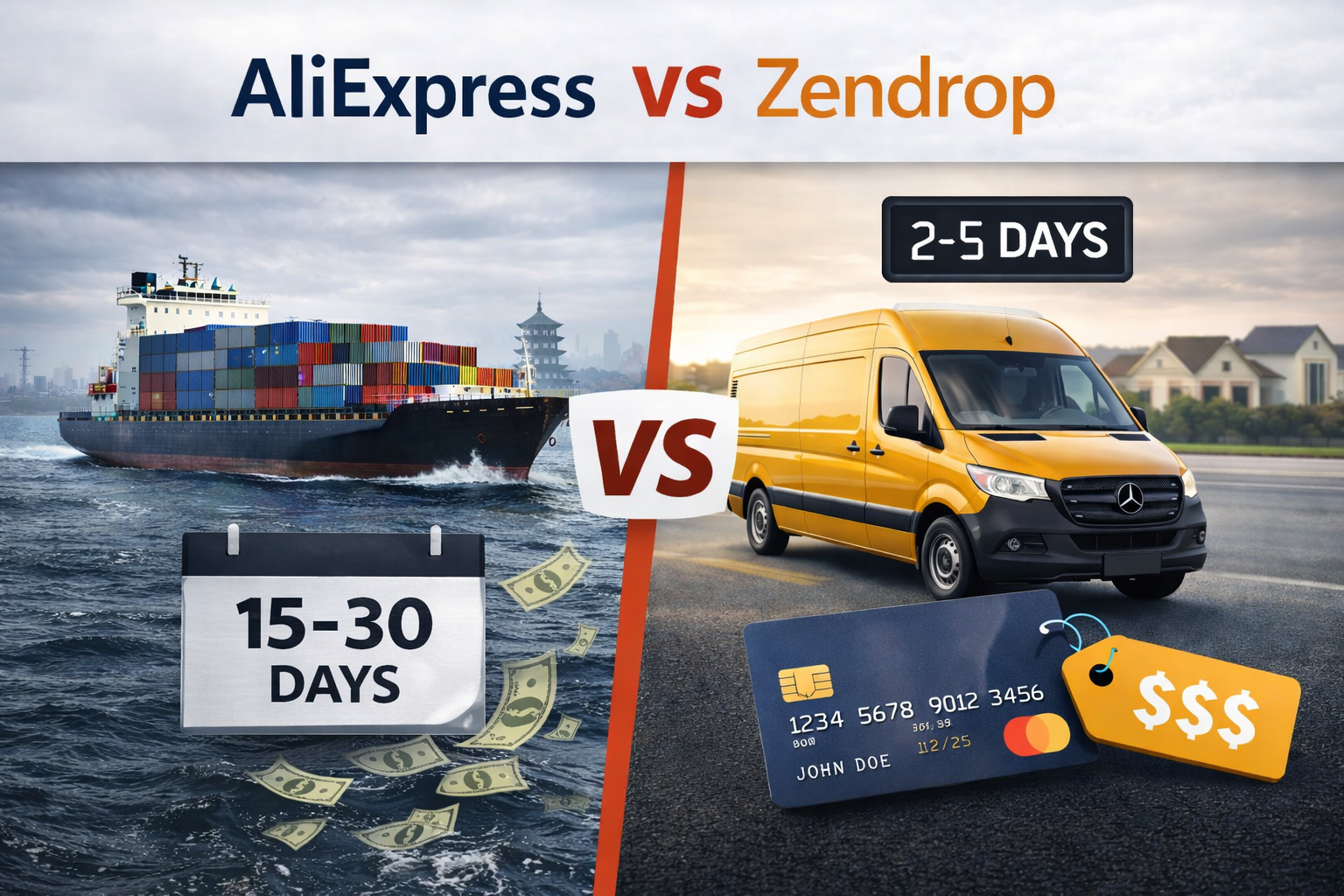
Every dropshipping business eventually arrives at the same strategic fork in the road. On one side sits AliExpress – the sprawling, Chinese-owned marketplace that helped launch the dropshipping revolution and still offers arguably the largest product catalog on the planet. On the other side sits Zendrop – a platform founded in 2019 specifically to solve the problems that AliExpress created: slow shipping, inconsistent suppliers, and a customer service experience that leaves merchants without leverage when things go wrong.
This is not a comparison of two platforms doing the same thing. AliExpress and Zendrop represent two fundamentally different philosophies about how a dropshipping business should operate. AliExpress is the low-cost entry point – a marketplace model where price discovery is transparent, product variety is nearly unlimited, and monthly overhead is zero. Zendrop is the premium service layer – a curated fulfillment platform built for merchants who are willing to pay more per unit in exchange for automation, speed, and accountability.
In 2026, the stakes are higher than ever. Consumer expectations have been permanently reset by Amazon Prime. Shoppers who once accepted two-week delivery windows now abandon carts when they see estimated arrival dates beyond a week. Meanwhile, US import tariffs have reshuffled cost calculations that many AliExpress-dependent merchants built their business around. The question is no longer which platform costs less to use – it is which platform gives you the best chance of building a business that survives and scales.
This analysis examines both platforms across six dimensions: shipping speed and reliability, product cost and margin structure, catalog depth, automation capability, branding potential, and risk profile. The goal is not to declare a winner but to help you understand which tool matches which business model – and which choice is likely to hurt you.
Shipping Speed – The Variable That Breaks Businesses
Shipping speed is where the AliExpress vs Zendrop comparison becomes most stark – and where the consequences for getting it wrong are most severe.
AliExpress Shipping Reality in 2026
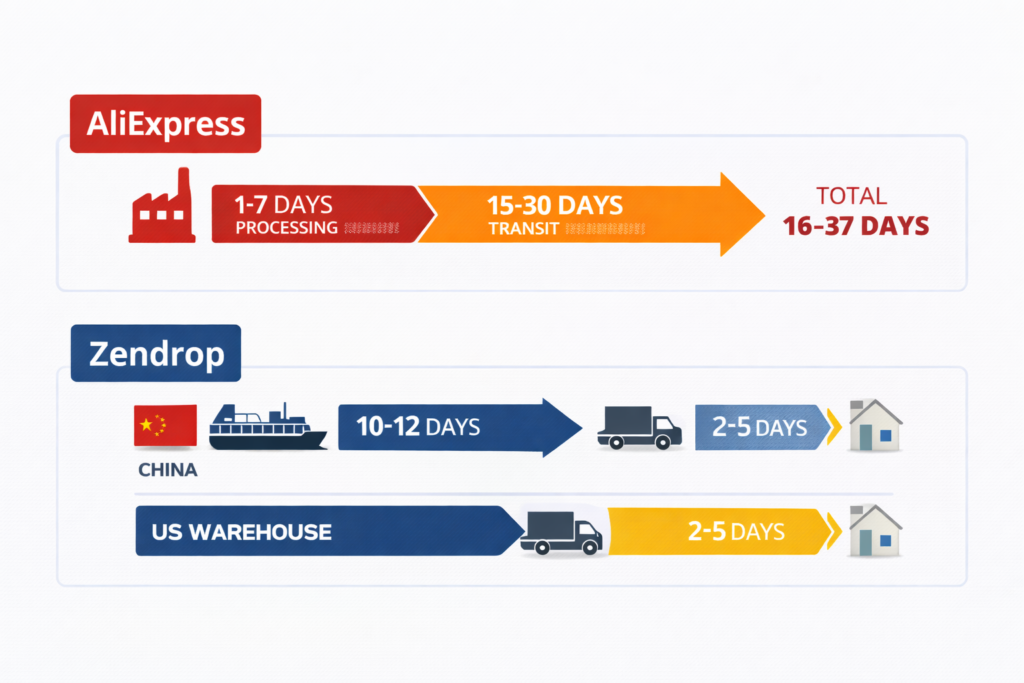
AliExpress shipping has improved meaningfully since the chaos of 2020-2022, but the range of possible outcomes remains wide enough to cause real damage to customer relationships. Standard shipping from China to the US currently runs 15-30 days in typical conditions. AliExpress Standard Shipping averages around 19 days to the US, while free shipping options can stretch beyond 30 days depending on origin province and logistics congestion.
The faster options come with significantly higher price tags. ePacket, once the gold standard for budget-conscious dropshippers, is no longer widely available following post-COVID logistics restructuring. AliExpress Premium Shipping – the fastest option short of DHL or FedEx – runs 5-10 days but costs $15-30 per shipment, which can eliminate margins on lower-ticket products entirely. DHL from AliExpress suppliers typically delivers in 1-4 days but at costs that only work for high-margin, high-price products.
There is also a processing time layer that many merchants overlook. Before AliExpress shipping even begins, supplier processing adds 1-7 days depending on the vendor. A supplier with a 5-day processing window and 19-day standard shipping delivers the customer’s order in 24 days minimum – well outside the tolerance threshold for most modern buyers.
The bright spot for AliExpress merchants in 2026 is the growing availability of US and EU warehouse inventory among top-rated suppliers. Some AliExpress sellers have pre-stocked goods in American fulfillment centers, offering 7-15 day delivery from a China-based storefront. This hybrid approach narrows the gap with dedicated US-focused platforms, but availability is inconsistent and product selection from these local warehouses is narrower.
Zendrop Shipping Reality in 2026
Zendrop was built specifically to solve the AliExpress shipping problem, and this is where its value proposition is most concrete. The platform operates through two primary fulfillment channels: US-based partner warehouses and Chinese fulfillment centers.
From US warehouses, Zendrop delivers in 2-5 business days – speeds that are genuinely comparable to Amazon Prime and that represent a substantial competitive advantage for merchants selling to American customers. Orders are processed same-day or next-day, with a reported 99.98% confirmed delivery rate from US facilities. For dropshippers who have pre-stocked popular products in Zendrop’s US partner 3PL facilities, there are no additional storage fees, which makes the economics more attractive than they might initially appear.
From Chinese fulfillment centers, Zendrop averages 10-12 days to the US – meaningfully faster than AliExpress’s 15-30 day standard, and without the supplier processing uncertainty. Zendrop’s direct relationships with manufacturers and its own warehouse operations give it more control over processing times than a marketplace model like AliExpress can offer.
The honest caveat is that shipping reliability at Zendrop is not uniformly excellent. Independent reviews document a specific failure pattern: stock-outs discovered after orders have been confirmed and tracking numbers issued. This means customers can receive shipping notifications for orders that cannot actually be fulfilled, creating a trust crisis at exactly the wrong moment. These failures appear more common with Chinese-sourced products than with US-warehoused inventory.
The verdict on shipping: Zendrop wins on speed and predictability for US-focused merchants who build their catalog around US-warehoused products. AliExpress offers a wider range of shipping options but exposes merchants to a much wider range of outcomes, many of which are outside the merchant’s control.
Cost Structure – What You Pay Versus What You Think You Pay
The cost comparison between AliExpress and Zendrop is less straightforward than it appears, and this is where many merchants make decisions they later regret.
AliExpress Cost Structure
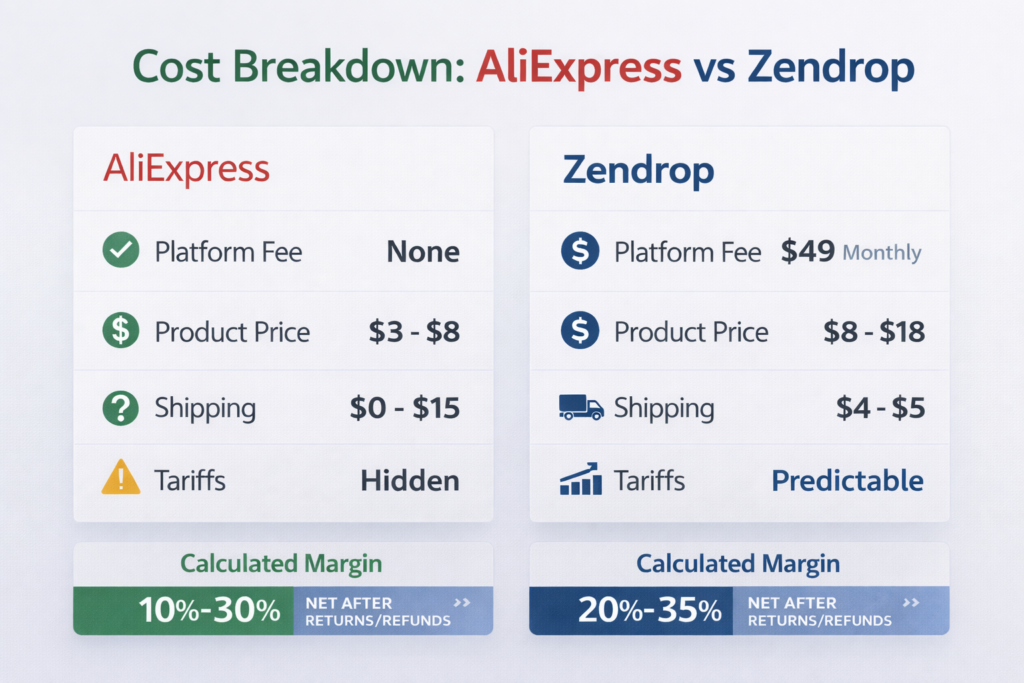
AliExpress charges no monthly platform fee. You pay for products at the listed wholesale price plus shipping per order. This zero-overhead entry point is its primary appeal for new merchants who need to test products without committing to a subscription. Product prices on AliExpress are genuinely lower at the unit level – often significantly lower than equivalent items on Zendrop or other curated platforms.
However, the total cost picture on AliExpress is more complicated. Shipping costs vary significantly by supplier, method, and destination – and these variations are not always apparent before you commit to a product listing strategy. Payment processing fees apply to each transaction. Perhaps most significantly in 2026, US import tariffs on Chinese goods have added a material cost layer that can compress or eliminate margins on products in certain categories. Merchants who built their pricing models before the tariff adjustments found their cost structures suddenly unworkable.
Margin compression is a real risk with AliExpress. Most merchants operating through standard AliExpress sourcing report profit margins between 10% and 30% on product cost – workable at volume but vulnerable to any negative variable. A higher-than-expected return rate, a bad batch from a supplier, or a shipping delay that triggers customer disputes can turn a profitable month into a loss.
Zendrop Cost Structure
Zendrop’s pricing is layered across subscription tiers. The Free plan allows up to 50 monthly orders with basic features and 24/7 email support – adequate for testing but not for a functioning business. The Pro plan runs $49 per month (or $41.58/month billed annually) and unlocks automated order fulfillment, unlimited orders, live chat support, subscription boxes, and instant product sourcing. The Plus plan at $79 per month adds a dedicated account manager and advanced branding features.
On top of the subscription, merchants pay product costs and per-order shipping fees. Zendrop’s product prices are higher than direct AliExpress sourcing – sometimes significantly so. Negative reviews frequently cite this as the primary frustration: products priced at $20-30 on Zendrop that appear to be available on AliExpress for $5-10, with the price difference eating into margins before advertising costs are even considered.
Shipping costs on Zendrop are more transparent and predictable than AliExpress. For US delivery, per-order shipping runs approximately $4-5. International shipping varies by destination. What Zendrop offers that AliExpress does not is cost predictability – merchants can calculate margins with reasonable confidence before scaling, rather than discovering cost variables mid-campaign.
The honest cost analysis: AliExpress wins on raw unit cost. Zendrop wins on cost predictability and total business efficiency. Whether the premium is worth paying depends entirely on your margin structure and your tolerance for fulfillment variability.
Product Catalog – Breadth vs Curation
Product selection represents one of the clearest differences between the two platforms – and the tradeoff is not simply a matter of more being better.
AliExpress hosts hundreds of millions of product listings from tens of thousands of suppliers. This scale gives merchants access to virtually any product category imaginable and enables aggressive niche testing without committing to a supplier relationship. The downside is that AliExpress’s catalog is unfiltered – product quality, supplier reliability, and listing accuracy vary enormously. Finding a trustworthy supplier for any given product requires due diligence: reviewing order counts, seller ratings, reading photo-verified reviews, and ideally ordering samples before scaling.
Zendrop’s catalog of over one million products is considerably smaller than AliExpress, but meaningfully curated. Products come from vetted manufacturers with whom Zendrop maintains direct relationships, removing the intermediary layer that creates much of AliExpress’s quality inconsistency. For beginners who lack the experience to evaluate supplier credibility themselves, this curation has real value.
Zendrop also provides weekly-updated trending products lists and AI-powered product recommendations – tools that help new merchants avoid the paralysis of infinite AliExpress options. The product sourcing request feature allows merchants to submit items not currently in the catalog, with Zendrop typically sourcing requested products within 24-48 hours. The limitation is a cap of 20 sourcing requests per month on Pro plans, which constrains active product testers.
High-performing categories on Zendrop in 2026 include beauty and personal care, home gadgets, fitness accessories, and pet products – categories where US consumers are willing to pay a premium and where product quality consistency directly affects repeat purchase rates. For merchants in niche categories with unusual sourcing requirements, AliExpress remains the only viable option simply because its catalog depth has no comparison.
Automation and Operations
The operational overhead difference between AliExpress and Zendrop is substantial and tends to grow more significant as order volume increases.
AliExpress is a marketplace, not a fulfillment platform. Automation requires third-party tools – DSers (the official AliExpress partner), AutoDS, or similar services – layered on top of AliExpress sourcing. These tools handle order forwarding, tracking synchronization, and pricing alerts, but they add another subscription fee and another potential point of failure. Communication with AliExpress suppliers typically happens through the platform’s messaging system and requires navigating language barriers. When problems occur – late shipments, quality issues, supplier stockouts – resolution requires manual intervention and is governed by AliExpress’s dispute system rather than a dedicated support relationship.
Zendrop builds automation into the platform rather than requiring it to be assembled from third-party tools. When an order comes in, Zendrop automatically forwards it to the appropriate supplier, processes payment, generates tracking numbers, and syncs tracking information back to the merchant’s Shopify store. This end-to-end automation eliminates the manual order processing that consumes hours daily for high-volume AliExpress merchants. The Shopify integration is described by most users as seamless and well-maintained.
Customer support is another meaningful operational difference. Zendrop offers 24/7 live chat support on paid plans, with user reviews frequently praising response quality and problem resolution speed. AliExpress’s support structure is designed for end consumers rather than dropshipping merchants, which means supplier disputes must be navigated through a system that does not prioritize merchant needs.
Branding Potential
Branding capability separates merchants who build lasting businesses from those who are perpetually competing on price.
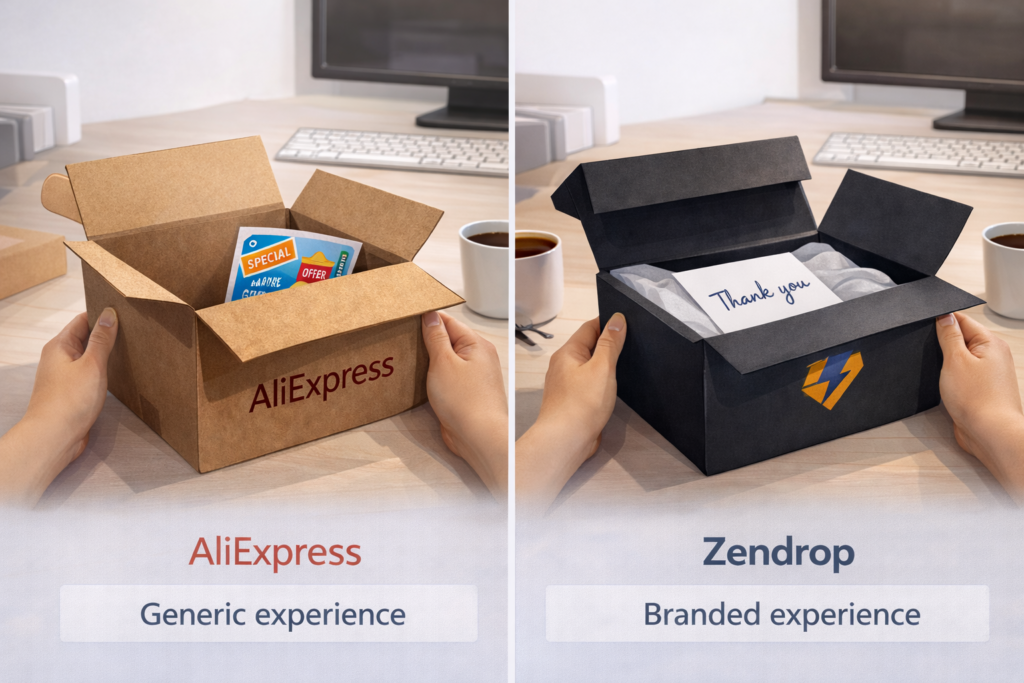
AliExpress offers minimal native branding support. Packages typically arrive in generic or supplier-branded packaging, occasionally with AliExpress promotional materials included – the opposite of brand building. Some suppliers will honor requests for neutral packaging if asked, but there is no systematic enforcement mechanism. The customer’s unboxing experience on AliExpress-sourced orders is generally indistinguishable from any other generic Chinese import, making differentiation difficult.
Zendrop has invested significantly in branding infrastructure as a competitive differentiator. Merchants on paid plans can add custom thank-you cards to orders, use private labeling on products, design custom packaging, and access print-on-demand services – all within the same platform. These features allow a Zendrop-based business to deliver an unboxing experience that feels like a branded product company rather than a dropshipping operation. For merchants building toward a brand acquisition, private label, or repeat-purchase model, this is not a cosmetic feature – it is fundamental to the business strategy.
Zendrop also reports a 99.98% confirmed delivery rate, which feeds brand trust. Consistent fulfillment is itself a branding tool – customers who receive orders on time and in good condition are significantly more likely to return and to leave positive reviews.
Risk Profile – What Can Go Wrong, and How Badly
Understanding the failure modes of each platform is as important as understanding their capabilities.
AliExpress’s primary risks are quality inconsistency and shipping unpredictability. A supplier that performed reliably for six months can change product specifications without notice, leading to a wave of customer complaints about items that do not match the listing. Shipping times can extend dramatically during peak seasons, Chinese national holidays, or logistics disruptions. Since the merchant has no contractual relationship with the supplier – only an order history – there is limited recourse when problems arise at scale.
The 2026 tariff landscape adds a regulatory risk layer. Goods imported from China now face additional duties in many product categories, and the tariff structure is subject to policy changes outside any merchant’s control. Businesses with AliExpress-dependent cost structures are exposed to this regulatory risk in a way that merchants using US-warehoused inventory are not.
Zendrop’s primary risk is the stock-out-after-confirmation pattern documented in independent reviews – a failure mode where customers receive shipping notifications for orders that cannot actually be fulfilled. This is a trust-damaging failure because it creates a situation where the merchant must contact a customer who believes their order is on its way to inform them it is not. At scale, this can trigger Shopify payment holds or account reviews.
Billing issues documented in BBB and Trustpilot reviews also represent a risk. One documented case involved a merchant who purchased a Zendrop Plus subscription based on promotional terms that were later changed, with credits that were advertised as covering 100% of order costs subsequently modified to apply as a 10% discount per order. Merchants evaluating Zendrop should read subscription terms carefully and maintain documentation of any promotional offers.
Who Should Use What – Matching Platform to Business Model
The right choice between AliExpress and Zendrop is not universal – it depends on where you are in your business development and what you are trying to build.
When AliExpress Makes Sense
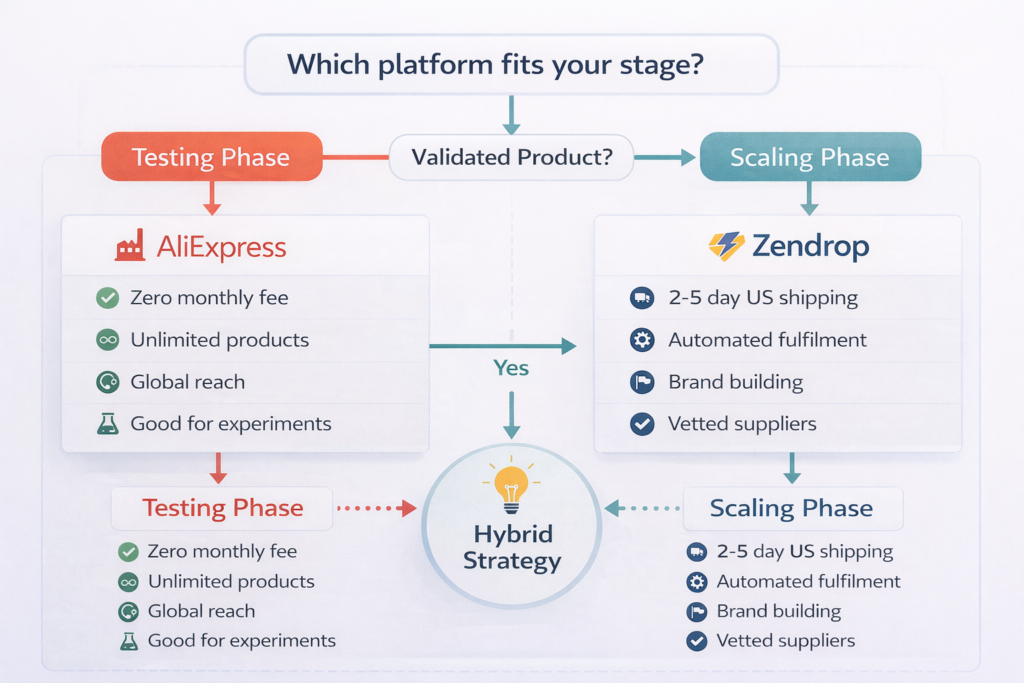
- You are in the product testing phase and need to validate demand before committing to a platform subscription. AliExpress’s zero monthly fee lets you run multiple experiments cheaply.
- You are selling globally, not US-primarily. AliExpress has supplier networks and shipping options for markets that Zendrop does not prioritize.
- You are in a niche so specific that Zendrop’s catalog cannot cover it. If you need 500 product variations in an unusual category, AliExpress’s depth is irreplaceable.
- You have low-ticket products where a $49/month platform fee would represent a material portion of your margin. At very low volumes, the zero-overhead AliExpress model has genuine advantages.
When Zendrop Makes Sense
- Your primary customer base is in the US and they expect delivery within a week. The 2-5 day US warehouse option is Zendrop’s strongest selling point and a genuine conversion driver.
- You are building a brand, not just a store. Private labeling, custom packaging, and consistent fulfillment standards make brand building feasible in a way that raw AliExpress sourcing does not.
- You have experienced AliExpress fulfillment failures. Merchants who have lost significant revenue to AliExpress supplier problems consistently report that Zendrop’s vetted network and responsive support justify the premium.
- You are ready to stop trading time for orders. Zendrop’s automation eliminates hours of manual processing that AliExpress-based operations typically require, which frees capacity for marketing and growth.
- You are targeting high-margin product categories where Zendrop’s slightly higher unit prices are easily absorbed. Beauty, wellness, and premium gadgets are categories where the speed-quality premium pays off.
The 2026 Tariff Earthquake – How Policy Killed the Old AliExpress Math
If shipping speed is the strategic argument against AliExpress, tariff policy is the structural one. Between April 2025 and April 2026, the US trade environment changed so dramatically that entire dropshipping cost models built on AliExpress were rendered nonviable overnight – not by market competition, but by executive orders.
The Death of De Minimis
For over a decade, AliExpress-based dropshipping operated on a simple legal foundation: the de minimis exemption. Under this US customs rule, any package valued under $800 entered the country duty-free, with minimal documentation. That single rule is what made the economics of shipping a $6 gadget from Shenzhen directly to a customer in Ohio viable. Remove it, and the entire cost structure collapses.
On May 2, 2025, the Trump administration eliminated the de minimis exemption for all goods from China and Hong Kong. The move was part of a broader tariff escalation: by April 2025, the effective tariff rate on Chinese imports had reached 145% on most product categories. A $10 product from an AliExpress supplier now carried up to $14.50 in duties before it reached the customer. For commercial carriers like FedEx and UPS, the full 145% applied. For postal shipments, a flat fee of $100 per item applied initially, rising to $200 on June 1, 2025.
By August 29, 2025, the de minimis suspension was extended to all countries globally – not just China. The era of duty-free low-value international parcel shipping was over. From that date, every sub-$800 import required full customs documentation, HTS classification codes, and applicable duty payment. The administrative burden alone added costs and delays that many AliExpress-based merchants were structurally unprepared to absorb.
The Supreme Court Disruption and What Came Next
February 2026 brought a new layer of uncertainty. The Supreme Court ruled 6-3 in Learning Resources, Inc. v. Trump that the IEEPA tariffs were unconstitutional – invalidating $166 billion in duties collected from over 330,000 businesses. Trump immediately responded by invoking Section 122 of the Trade Act of 1974 to impose a 10% universal import surcharge, effective February 24, 2026, for 150 days. The effective tariff rate on Chinese goods settled at approximately 13.7% in February 2026 following the court ruling and subsequent policy adjustments – dramatically lower than the 145% peak of April 2025, but still a far cry from the zero-duty regime that built the AliExpress dropshipping model.
What this political volatility means for dropshippers is arguably more damaging than any specific tariff rate: you cannot price-plan around policy that changes by executive order. A merchant who recalibrated their margins in January 2025 found their model destroyed by May. A merchant who rebuilt around the May 2025 reality found it reshaped again by the Supreme Court ruling in February 2026. And the 150-day Section 122 tariff expires in July 2026, with no clarity on what replaces it.
How This Splits AliExpress and Zendrop Users
AliExpress merchants who source and ship direct from Chinese suppliers bear the full weight of this policy volatility. Every order placed from a Chinese supplier in 2026 must pass through US customs with formal entry documentation, pay applicable duties, and survive CBP inspection – a process that did not exist at scale for sub-$800 orders before 2025. CBP collected over $216 billion in total duties, taxes, and fees in fiscal year 2025, and the agency is now deploying data analytics tools specifically designed to catch undervaluation and misclassification in the high-volume parcel stream that dropshipping generates.
Zendrop merchants who use US-warehoused inventory sidestep this problem entirely. Products pre-stocked in Zendrop’s US partner fulfillment centers cleared customs when they were imported in bulk – that tariff cost was already absorbed into Zendrop’s unit pricing when you looked it up in the catalog. The per-order customs exposure is zero. Customer packages ship domestically, never touching international customs. For categories where duty rates are significant – apparel, electronics accessories, home goods – this structural difference can determine whether a product is profitable at all.
The irony is that Zendrop’s US-warehouse premium pricing – the feature most frequently criticized in user reviews – now looks different through a tariff lens. A product that costs $8 on Zendrop versus $4 on AliExpress appears to be a 100% premium. But if the AliExpress product now carries a 10-15% duty plus customs brokerage and documentation fees per order, the real gap narrows considerably. And if tariff rates spike again under a future executive order, the AliExpress math can turn negative while the Zendrop number stays flat.
The EU is moving in the same direction: the European Commission announced a 3 euro customs duty per item on parcels valued below 150 euros, effective July 1, 2026. Dropshippers selling to European customers face a parallel structural shift to the US situation. For any merchant building a transatlantic business, the era of arbitraging cheap Chinese goods into Western markets through direct parcel shipping is contracting on both sides of the Atlantic simultaneously.
Conclusion: Speed and Cost Are Both Right Answers
The AliExpress vs Zendrop question does not have a universal answer because it is not really a question about which platform is better. It is a question about which type of dropshipping business you are building.
AliExpress remains the world’s most accessible entry point to product-based ecommerce. Its zero monthly fee, unlimited catalog depth, and global supplier network make it the logical starting point for merchants who are testing, experimenting, or operating in markets and niches that more curated platforms cannot serve. The model works – but it works best for merchants who understand its limitations and build operations that account for shipping variability, supplier inconsistency, and the manual overhead it requires.
Zendrop is a premium layer built on top of the same underlying supply chain, priced to appeal to merchants who have decided that reliability, speed, and operational efficiency are worth paying for. Its US fulfillment speeds are genuine, its automation works, and its branding tools create possibilities that raw AliExpress sourcing cannot match. The margin compression from higher unit prices is real, but for merchants in the right categories with sufficient pricing power, the total economics can be more favorable than the headline unit cost comparison suggests.
The most sophisticated merchants in 2026 are not choosing one platform and staying loyal to it. They are using AliExpress for product discovery and initial testing, then transitioning proven winners to Zendrop or similar platforms for reliable US fulfillment at scale. This hybrid approach captures the cost advantages of the open marketplace at the testing phase while capturing the speed and reliability advantages of a managed platform when it matters most – when real customers with real expectations are placing real orders.
The fundamental tension between speed and cost will not be resolved by any single platform. But understanding where each platform sits in that tension – and matching platform choice to business phase and target customer – is the difference between a dropshipping business that compounds and one that churns.
This analysis was prepared independently by ecomreality.com. We have no affiliate relationship with AliExpress, Zendrop, or any supplier platform referenced in this article. Pricing and shipping data was sourced from official platform documentation, independent user reviews on Trustpilot and Reddit, and direct platform research conducted in April 2026. Figures may change; always verify current pricing on official platform websites.
8 responses to “AliExpress vs Zendrop: Speed vs Cost”
-
This is a fair breakdown, especially the part about how the decision shifts once you move from testing to actual scale. A lot of people treat this like a one-time choice, but in reality it’s more of a phase decision. AliExpress makes sense when you’re still figuring out what works, but once you start dealing with real volume and real customer expectations, the tradeoffs become much more visible. The hybrid approach mentioned at the end is probably closer to how most sustainable setups actually evolve.
-
ngl this finally explained the tariff stuff in a way that made sense 🙏 been on AliExpress since 2022 and may 2025 wrecked me – went from 28% margins to negative overnight when de minimis got killed. anyone else moved their winners to Zendrop’s US warehouse this year? 📦
-
ok wait I’m new to this in 2026 and this kinda confirmed my gut. friend tested AliExpress and it took 23 days. TWENTY THREE 💀 nobody waits that long anymore. but $49/mo for Zendrop feels like a lot pre-validation. anyone actually do the hybrid thing or is it just theory? 🤔
-
Solid breakdown 👏 switched my beauty store from AliExpress to Zendrop’s US warehouse in summer 2025. unit cost higher fr, but refund rate dropped 40% and repeats doubled. for anyone googling “zendrop vs aliexpress 2026” – run the FULL math, not just cost-per-unit. hidden costs of slow shipping are huge 💸
-
-
ran AliExpress 2022-2024, switched to zendrop 2024-2025, shut both down by end of 2025 ngl 📉 unsexy truth – physical goods in the US in 2026 is way harder than 2 years ago between tariff chaos, customer service overhead, and rising ad costs. moved into digital products entirely now and the difference is night and day. no shipping, no returns, no customs ever. if you’re starting fresh in 2026 worth seriously asking whether physical is even worth the headache anymore 🤷
-
I really resonated with that point about the tariff situation because it totally changed my thinking about where to source from. I spent my first few months as a stay-at-home parent chasing the cheapest options, assuming higher volume would make up for razor-thin margins, and then 2025 hit and suddenly that math made no sense anymore. What I wish I’d done from the start was what you described – test products on one platform, then move winners somewhere more reliable once I knew they actually sold. The premium option’s monthly fee felt like a barrier to me initially, but I realized I was wasting that money anyway on failed experiments and customer service headaches. Now I’m focusing on digital products and automation tools where I don’t have to worry about any of those supply chain issues, and honestly it’s such a relief to just focus on marketing what works rather than playing logistics games.
-
I didn’t realize tariffs hit direct imports that hard – 145% is wild. So basically the whole “cheap dropshipping from overseas” model got destroyed overnight for anyone not already set up domestically? That makes sense why people are pivoting to platforms with local infrastructure, but I’m curious if there are other ways to start small without that $49 monthly fee while you’re still testing what works.
-
The tariff angle is what finally makes sense of why so many sellers got crushed in 2025 – I remember watching people panic when those postal fees kicked in and realized their entire margin was gone overnight. The hybrid strategy of testing on the open marketplace then scaling through a managed platform sounds smart in theory, but honestly it requires the discipline most sellers don’t have to actually make that transition work.



Jo Carter is an editor and ecommerce researcher at Ecom Reality, where she covers ecommerce platforms, digital selling tools, online business software, pricing models, and emerging industry trends. She focuses on turning complex platform features and costs into clear, practical information for entrepreneurs and digital sellers. Her work combines detailed research with a balanced editorial approach, helping readers compare services, understand potential limitations, and choose tools that fit their business goals.
Comments
Leave a Reply
Related Articles



Leave a Reply