

Quick answer: FBS offers MetaTrader 4 and MetaTrader 5 access, floating spreads advertised from 0.7 pip, and leverage advertised as high as 1:3000 under some conditions. Those figures are not universal trading terms. The operating entity behind FBS.com identifies itself as FBS Markets Inc. in Belize, and its website excludes residents of several markets, including the United States, the EU and the UK. Your decision should be based on the applicable entity, the instruments and spreads actually offered, the margin rules at your equity level, and the practical differences between MT4 and MT5.
Look beyond the headline trading terms
FBS marketing draws attention to high leverage, low starting spreads and access to popular MetaTrader platforms. There is nothing unusual about promoting those features: they are among the variables active traders compare first. The problem is that each depends on the underlying contract or account circumstances. A displayed minimum spread is not the same as the average spread paid. Maximum leverage is not the ratio available for every instrument, every equity balance or every country. And choosing MT5 instead of MT4 does not magically improve a weak trading strategy.
This review focuses on verifiable platform functions, trading arithmetic and the legal structure relevant to the FBS.com offering. It is based on public company documents and software specifications rather than a claimed live deposit, transaction or withdrawal test. Those distinctions matter because brokerage claims should not be converted into unearned editorial endorsements.
The comparison begins with the contracting company, the fee schedule, the platform and leverage risk.
Who operates the FBS.com service?
FBS.com’s current footer and recent published legal documentation identify FBS Markets Inc., incorporated in Belize, with Financial Services Commission license 4077102. Its posted terms and trading conditions provide the most relevant starting point for this service. Some older pages and search results still show a previous license number or older address. A reader should use the current legal document and verify the entity’s status from the appropriate regulator rather than copy a figure from an archived review.
FBS.com also states that FBS Markets Inc. does not offer financial services to residents of certain jurisdictions, including the United States, European Union and United Kingdom. The current website additionally lists other restricted markets. This is not a small footnote: a review aimed at a US or EU audience must not imply residents can automatically sign up with the global FBS.com entity.
FBS is a shared brand with a wider commercial history, but a license or policy attached to a different entity cannot be grafted onto the Belize contract. If another regional service uses the FBS name, investigate its own legal-company name, regulator and eligibility rules. A reader’s residence can change the entire set of terms under discussion.
What can clients trade?
FBS advertises hundreds of CFD instruments through its current trading-conditions page. Forex pairs are a central part of the offering, while the supported markets may also include other derivative categories. The important distinction is between instruments visible in a promotion and contracts actually enabled for the user’s account. Product availability and leverage can depend on the jurisdiction and platform.
A currency pair, metals CFD or index contract can have a different contract size, minimum increment, trading schedule, margin tier and financing calculation. Even a trader using the same MetaTrader terminal should not transfer a risk assumption from one instrument to another. Look at the symbol specification within the platform, and compare it to the written product terms.
For example, a traditional cash investment in an exchange-listed share is not the same as a CFD linked to its price. The latter can introduce counterparty exposure, financing and automatic liquidation terms. Readers focused on long-term ownership should check product type before comparing what look like similar tickers.
MetaTrader 4 versus MetaTrader 5 at FBS
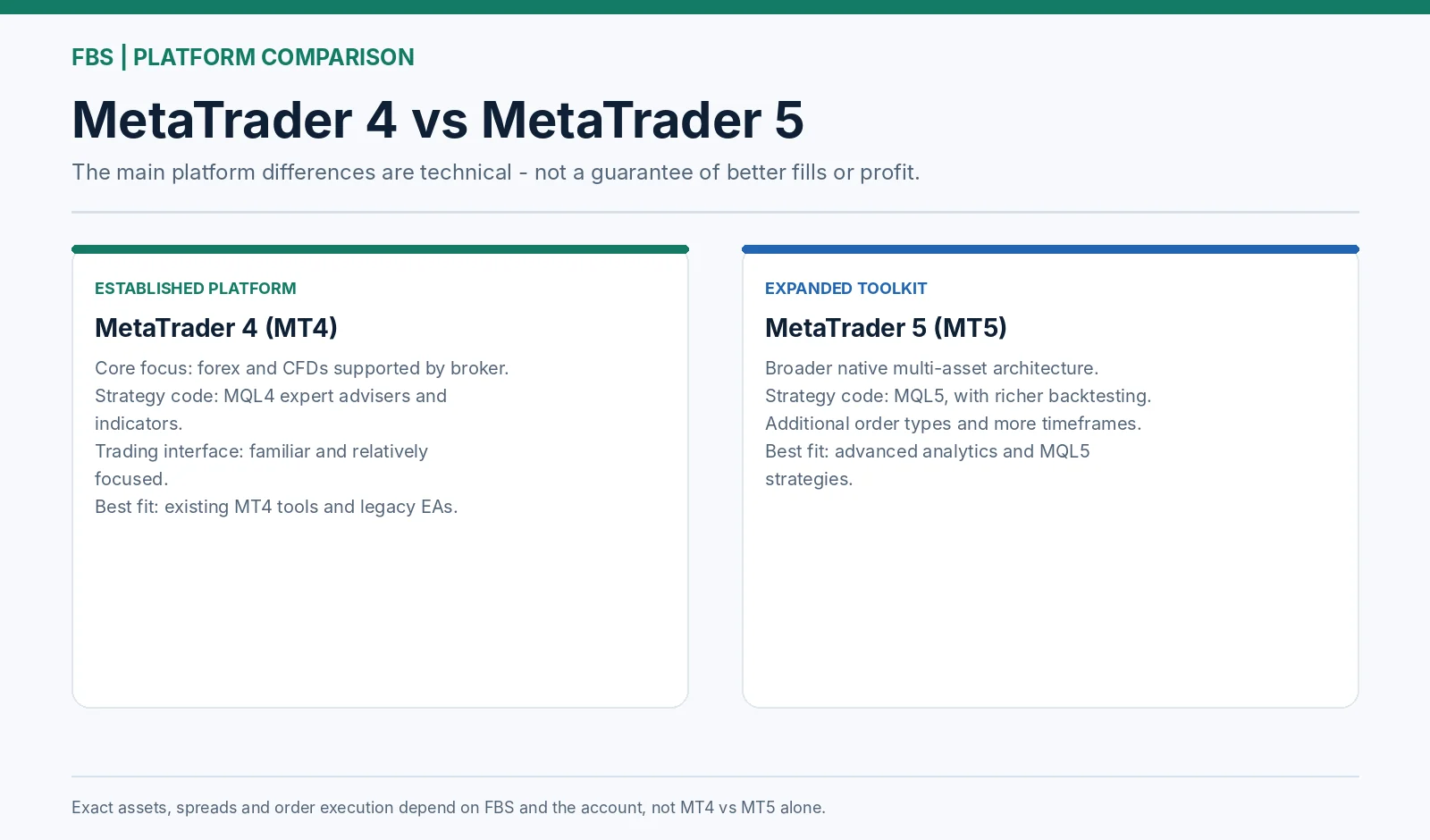
Both MetaTrader platforms allow charts, order entry, indicators and automated trading. Their similarities can hide technical differences that become important after a trader builds a strategy or buys a third-party expert adviser. The choice is often less about which version is ‘better’ in the abstract and more about compatibility, instruments, analytics and workflow.
MetaTrader 4 (MT4) is a long-established environment associated closely with forex and CFDs. It supports indicators and expert advisers written for MQL4. A trader already using a tested MT4 workflow may value continuity over additional terminal features. Existing scripts, indicators and template files do not automatically migrate to MT5 as functional equivalents.
MetaTrader 5 (MT5) uses MQL5 and a different architecture, with expanded analytical features, more native timeframes and more sophisticated strategy-testing options. Its design can support broader multi-asset use, although the instruments a customer can access still depend on the broker. Some traders prefer MT5 for research and automation; others choose MT4 because an essential tool has no reliable MQL5 replacement.
Platform choice does not set the spread by itself
A reader might assume that the newer software version guarantees lower spreads or faster trading. That conclusion does not follow. MT4 and MT5 are trading terminals; the broker determines account pricing, product coverage and execution arrangements. Two differently configured accounts can offer different prices on the same platform, and two software platforms can show similar economics for an equivalent instrument.
Ask whether the same account type exists on both platforms. Then compare the same symbol at the same time, using the same position size and recognizing differences in displayed contracts. If spreads or swaps differ, identify whether the explanation is the product specification, the account or the platform’s symbol mapping.
Automation needs its own due diligence
An expert adviser can submit orders automatically, but it cannot override market structure. Slippage, temporary market closures, spread widening and failed connectivity remain practical concerns. Test a strategy’s behavior around those conditions rather than relying on a favorable backtest. Check whether an EA was built for MQL4 or MQL5 and whether the current broker contract permits the intended order frequency.
The quality of historical data, modeling assumptions, execution latency, spread assumptions and overnight charges can change a strategy’s results. A backtest that excludes those costs is not evidence of real-world profitability. For a paid EA, examine the vendor’s assumptions, update policy and evidence before introducing real funds.
Spreads advertised from 0.7 pip
FBS currently advertises floating spreads from 0.7 pip in its general conditions. ‘From’ means a potential starting value, not a fixed spread for every transaction. Actual costs can change by pair and trading hour, and they can widen during news, low liquidity or market openings. A relevant comparison uses observed pricing for the instruments and times the trader expects to use.
The spread is paid economically when the position enters at the ask and would be closed at the bid, or vice versa, under unchanged market conditions. The precise realized cost also depends on the eventual fill and whether commission is charged separately. For some pairs, a standard lot may have approximately $10 per pip when quoted in USD; for others the pip value depends on quote currency and position size.
Imagine a forex position with a $10 pip value. A 0.7-pip spread represents about $7 of spread cost; a 1.5-pip spread represents about $15. A position one tenth the size would generally have one tenth the pip value, so the same 1.5-pip spread would represent about $1.50 instead. These are illustrative calculations, not observed FBS quotes.
‘No commission’ still leaves trading costs
The general FBS conditions page describes trading commission as no commission for its advertised offering. Even when a particular account has no separate line-item commission, trades still incur economic costs through spreads, potential overnight financing, conversion and execution. A zero-commission label should not be converted into ‘free trading.’
A trader using an aggressive short-term strategy may face substantial cumulative spread expense. Consider 20 round-trip transactions whose effective spread is $7 each. Before other costs, the cumulative spread component is around $140. This is simple hypothetical arithmetic and assumes equal position size, prices and contract value. Real results will vary with execution and market conditions.
The effect of holding a position overnight
The amount depends on the instrument, position direction and contract specifications, and can change. FBS advertises the availability of swap-free arrangements, but that does not mean every customer or asset can be held without any overnight charge under every condition. Review eligibility and replacement fees if relevant.
A trader comparing two brokers should model the intended holding period. A marginally cheaper opening spread may be outweighed by higher financing if the position stays open several nights. Similarly, the rate for a long position can differ from the rate for a short position. Always consult the live symbol specification and the entity’s current terms rather than extrapolating from an unrelated pair.
It is also important to distinguish overnight financing from price risk. A position can become profitable in market terms while still carrying net costs, or it can lose money before any fee is considered. The total cost framework includes entry, hold, close and funding or withdrawal, not a single promotional spread figure.
How FBS leverage works
FBS advertises leverage up to 1:3000 on eligible forex instruments. Its margin-and-leverage documentation explicitly ties available leverage to account equity: the highest range applies to the lowest listed equity band, with reduced maximums as equity increases. Other instruments may have different limits. That sliding schedule means there is no universal 1:3000 entitlement.
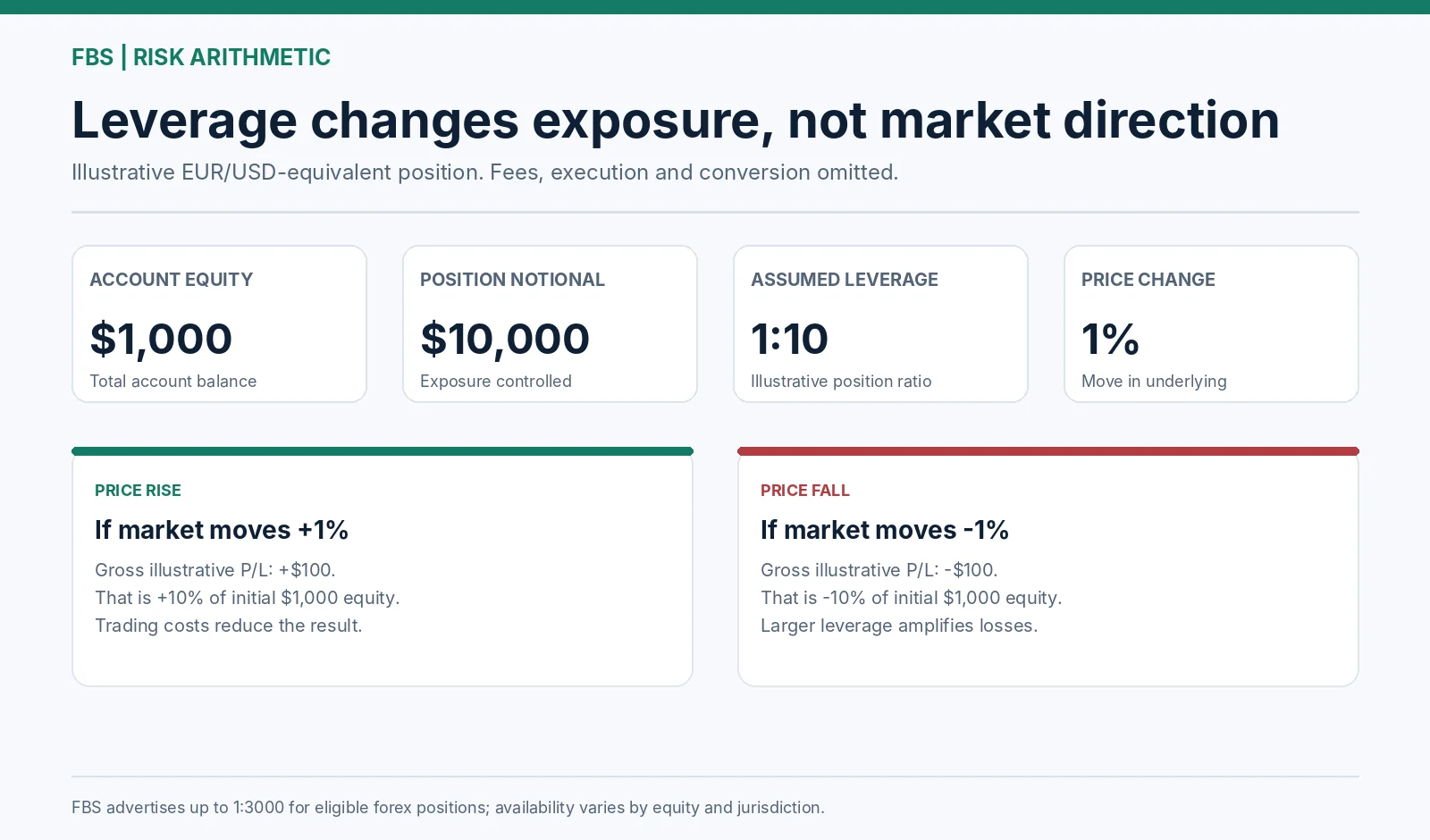
Higher leverage lowers initial margin required for a given exposure; it does not reduce the underlying position’s potential dollar loss. Leverage becomes dangerous when the ability to open a large position is mistaken for an acceptable risk budget. The loss from a price move follows the position notional and contract mechanics, regardless of how little collateral was required initially.
For a restrained hypothetical calculation, suppose a trader has $1,000 of account equity and takes a $10,000 forex-equivalent exposure, or an effective 10:1 position ratio. A 1% favorable move represents approximately $100 of gross gain. A 1% adverse move represents approximately $100 of gross loss. Both are 10% of starting equity, before spreads, commission, swap or currency effects. Use of a higher ratio would amplify the equity effect further.
Margin call and stop-out figures
FBS’s public general conditions page currently lists a 40% margin call level and 20% stop-out level, along with negative balance protection. Those are company-published figures for the advertised offering, not blanket assurance that every regional entity or account operates identically. Check the actual calculation method and liquidation ordering in the client agreement.
Margin level is usually a relationship between current equity and used margin. If the level falls below a specified threshold, the system may restrict positions or close trades. The timing and realized fill depend on market conditions. A stop-out setting is not the same as an insured loss limit: gapping markets and changing quotations can cause a position to close at a substantially different price.
Negative balance protection, where contractually applicable, should be read alongside exclusions and applicable law. It does not protect a trader from losing all deposited trading capital. Protection against owing more than account balance is different from a guarantee of any positive account value after a market shock.
Why regional terms change the comparison
The FBS.com restrictions deserve prominent placement. A US, UK or EU resident who reads a trading comparison cannot simply assume the FBS Markets Inc. product is available to them. Even if an online advertisement appears in their search results, account eligibility is a separate legal question. Nor should the presence of a currency or national flag in a payment selector be treated as proof of regulatory permission.
The correct sequence is to establish residence eligibility, identify the legal company, confirm regulator and license, read the relevant account agreement, then examine the offered product. The apparent convenience of an app should not reorder that list. Terms may also distinguish personal and corporate applicants or impose more extensive documentation on some customers.
This article refers to the current FBS.com documentation. If someone is directed to a materially different entity or website, they should not treat the fee calculations or restrictions here as a replacement for that entity’s contract.
Deposits and withdrawals
FBS advertises extensive payment-method coverage, but availability depends on the user’s country, account currency and provider configuration. Cards, electronic payment methods or banks can have different minimums, verification rules and transaction limits. Before making the first deposit, establish the permitted withdrawal route. Some systems require refunds to the original funding source before other methods can be used. Know-your-customer and anti-money-laundering procedures may restrict transfers to third-party accounts. Check how funds are converted if the trading account and withdrawal method use different currencies.
A withdrawal’s life cycle has more than one stage: request submitted, account checks, broker approval, payment-provider processing and arrival. A promise about one stage cannot be substituted for a measured end-to-end settlement result. This review does not present fabricated withdrawal test timings. Readers should retain reference numbers and ask support which stage a delayed payment has reached.
Read the current legal documentation
FBS Markets Inc.’s recent published trading-conditions document states that it forms part of the client agreement. The listed documents include additional terms, AML procedures, risk disclosures, complaints policy, privacy documentation and the trading platform itself. A trader comparing brokers should read the documents together, because a product specification does not replace conditions governing account suspension, dispute processing or payment operations.
Recent FBS documentation names an external company involved in payment transactions. That separation is another reason to distinguish the broker, payment service and recipient bank when investigating a transfer. It should not be used to allege a problem; it is simply a relevant operational fact.
A realistic cost worksheet
For an intended EUR/USD strategy, enter the lot or contract size first. Then calculate an approximate pip value using the current quote and contract specification. Observe spreads around the actual trading hours, include any explicit commission, apply the swap rate to projected holding nights, and identify conversion charges. Only then compare two providers.
Imagine a position with a $10 pip value and an observed spread of 1.3 pips. The spread component is approximately $13. If a hypothetical overnight charge of $3 applies on four nights, that adds $12. If a hypothetical conversion expense adds $2, the estimated cost becomes $27 before slippage or market price movement. The $3 and $2 figures are examples, not FBS rates.
Running the same worksheet at 0.7 pip gives a $7 spread component and a $21 illustrative total under the same other assumptions. The point is not that either figure describes an actual FBS account. It shows how to evaluate a minimum advertised spread without letting it dominate the entire economic comparison.
Strengths worth considering
FBS’s appeal is understandable for users who value widespread MetaTrader familiarity, the ability to choose between MT4 and MT5, published entry-level trading conditions and broad advertised instrument coverage. A clear margin page is preferable to a broker marketing leverage without describing equity restrictions. For experienced traders willing and eligible to use a leveraged CFD broker, the available documentation supplies material for comparison.
Those positives require context. Features available in a terminal are not proprietary advantages of the broker. Very high leverage is a risk capability, not evidence of superior execution or profitability. The exclusion of major jurisdictions limits relevance for a substantial share of the international audience. A public minimum spread does not replace sampled pricing in live market conditions.
Who may prefer a different service?
An investor primarily interested in unleveraged, directly owned shares may prefer a traditional securities broker with custody arrangements suitable for that objective. A resident of a restricted jurisdiction should not try to bypass eligibility rules. A trader requiring a particular statutory compensation arrangement needs to confirm the actual contracting entity rather than assume any multinational broker brand supplies it.
For automated strategies, the choice may come down to verified EA compatibility, historical data, acceptable execution conditions and reliable operational access. For a discretionary trader, risk controls and realistic position sizing may be more important than hundreds of instruments or impressive maximum leverage figures.
A five-minute pre-account checklist
Confirm the precise legal company and whether the applicant’s country is accepted. Read the relevant license disclosure and client agreement. Choose MT4 or MT5 based on needed tools, not age alone. Verify the exact symbol and contract size. Record realistic spreads and all overnight financing charges. Calculate risk using position notional rather than required margin. Review verification, withdrawals and dispute channels before funding.
FBS can be evaluated fairly only after those steps. A platform comparison built around five promotional numbers and none of the underlying conditions is not a reliable basis for a leveraged trading decision.
FAQ
Is MetaTrader 5 always better than MetaTrader 4 at FBS?
No. MT5 has a richer technical architecture, while MT4 retains a substantial legacy tool ecosystem. Account specifications, execution terms, available instruments and strategy compatibility should drive the choice.
Can every FBS trader use 1:3000 leverage?
No. FBS’s documentation ties maximum forex leverage to equity ranges, and asset, country and account conditions can impose further restrictions. The maximum advertised ratio is not a universal default.
Does ‘no commission’ mean there are no costs?
No. Spreads, swap or other financing adjustments, conversions and execution differences can all change the economics of a position even when an account has no separate trading commission.
Sources and editorial method
Consult the official FBS trading conditions, margin and leverage schedule, MT4 account page, MT5 account page, and published client trading conditions. The company website discloses legal-entity information and jurisdiction exclusions in its footer. Numerical exercises above are explicitly hypothetical and are not represented as actual filled trades.
See the FBS company profile and the site’s ATFX profile for related company information and reader reviews.

Jo Carter is an editor and ecommerce researcher at Ecom Reality, where she covers ecommerce platforms, digital selling tools, online business software, pricing models, and emerging industry trends. She focuses on turning complex platform features and costs into clear, practical information for entrepreneurs and digital sellers. Her work combines detailed research with a balanced editorial approach, helping readers compare services, understand potential limitations, and choose tools that fit their business goals.
Comments
Related Articles


Leave a Reply