
eMercados Review: Trading Education, Signal Quality and Subscription Value
What eMercados is selling: knowledge, alerts and community
At first glance, eMercados sits between a trading school and a market-alert service. Its English website promises educational resources, signals, insights from analysts and access to a community of traders. That combination is attractive because learning and decision support solve different problems. Education helps the customer build a repeatable framework; alerts may draw attention to a market setup at a particular moment. The risk is assuming that joining both automatically produces better trades. A signal is not a trading plan, and a course is not evidence that an alert provider has a profitable historical record. The best evaluation separates the three layers: the quality of education, the quality of the signals and the cost of access.
For people searching for an eMercados review, the most useful questions are practical. What does a learner receive at each skill level? Does a signal include enough information to calculate risk before placing a trade? Can readers independently verify results over a meaningful period? Are package features and renewal terms clearly displayed? Does the service explain the difference between its education business and any execution venue used by a customer? The website provides a public outline of beginner, intermediate and advanced courses, plus a description of trading alerts, community features and market insight. It is less straightforward to establish a universal current subscription price or a complete independently audited signal track record from the open pages. That information gap matters when assigning value.
Education and signals should be judged separately
Education has value even when no individual trade works out. A high-quality beginner course can prevent basic errors: confusing leverage with extra capital, ignoring trading costs, misunderstanding orders or treating every market move as a signal. Intermediate material should introduce analysis methods and help readers recognize when a strategy is not appropriate. Advanced education should build on risk management, market regimes, trade planning and psychological discipline. eMercados organizes its public course description into those three levels, which gives prospective learners a sensible map for progression. It also indicates that the service is not only a feed of buy and sell suggestions.
Signal value is different. An alert can be timely and still lead to a loss, or accurate about direction while being unusable at the price a subscriber can actually obtain. Signal providers should therefore be judged not only by their percentage of winning predictions but by trade definition, stop placement, reward relative to risk, publication timestamps and complete treatment of losing calls. It is possible to learn from a provider even when one does not copy its trades. Conversely, a user who subscribes only to alerts without developing independent risk discipline can become overly dependent on notifications. Buyers should decide which of the two benefits is primary before comparing package prices or choosing the most expensive level.
The public educational curriculum: strengths and gaps
The eMercados website advertises beginner courses covering core concepts and an introduction to how financial markets work. It describes intermediate courses addressing market-analysis tools, trading styles and the development of strategies. Its advanced section references more sophisticated strategies, risk management and the psychology required to trade consistently. This structure is a positive starting point because it recognizes that a learner who cannot size a position should not jump immediately into complex setups. The presentation is also accessible to customers who want a gradual learning path rather than a single intensive seminar with no follow-up.
However, broad course categories are not the same as a full curriculum. A serious buyer should look for the actual lesson list, total hours, instructor credentials, exercises, sample explanations, update frequency and assessment methods. The public description does not on its own establish how thoroughly each topic is taught. A course called "advanced" can range from a detailed statistical treatment to a set of familiar chart patterns with more sophisticated labels. The difference is substantial. Ask whether the material teaches why a method might fail and how to recognize unsuitable conditions. The highest-value trading education explains invalidation as well as entry; otherwise students can memorize rules without understanding the risk they are taking.
What a useful trading signal must contain
A complete signal is more than an asset name and a green or red arrow. At a minimum, the subscriber needs the instrument, direction, a clearly stated entry condition, the invalidation point, a proposed stop, a realistic profit objective and the time at which the signal was published. If the alert is conditional, it should explain what must happen before an order makes sense. If it concerns a market with variable spreads or irregular liquidity, it should explain why the expected entry price may differ from the alert price. Clear timestamps matter because the same setup can change from attractive to unsuitable within minutes.
The format should also answer practical questions about trade management. Does the provider issue updates when an entry expires? Are changes to the stop documented? Are canceled trades separated from losing trades? How are multiple profit objectives counted? Can subscribers find old alerts and their original wording after the event? These are basic standards of transparency, not unreasonable demands for a consumer-facing signals service. eMercados promotes access to reliable alerts and experienced market commentary. To evaluate those claims, buyers should examine the signal feed available at their access level and verify whether the alerts contain enough information to support independent judgment rather than simply encouraging instant trades.
Measuring signal quality without misleading win rates
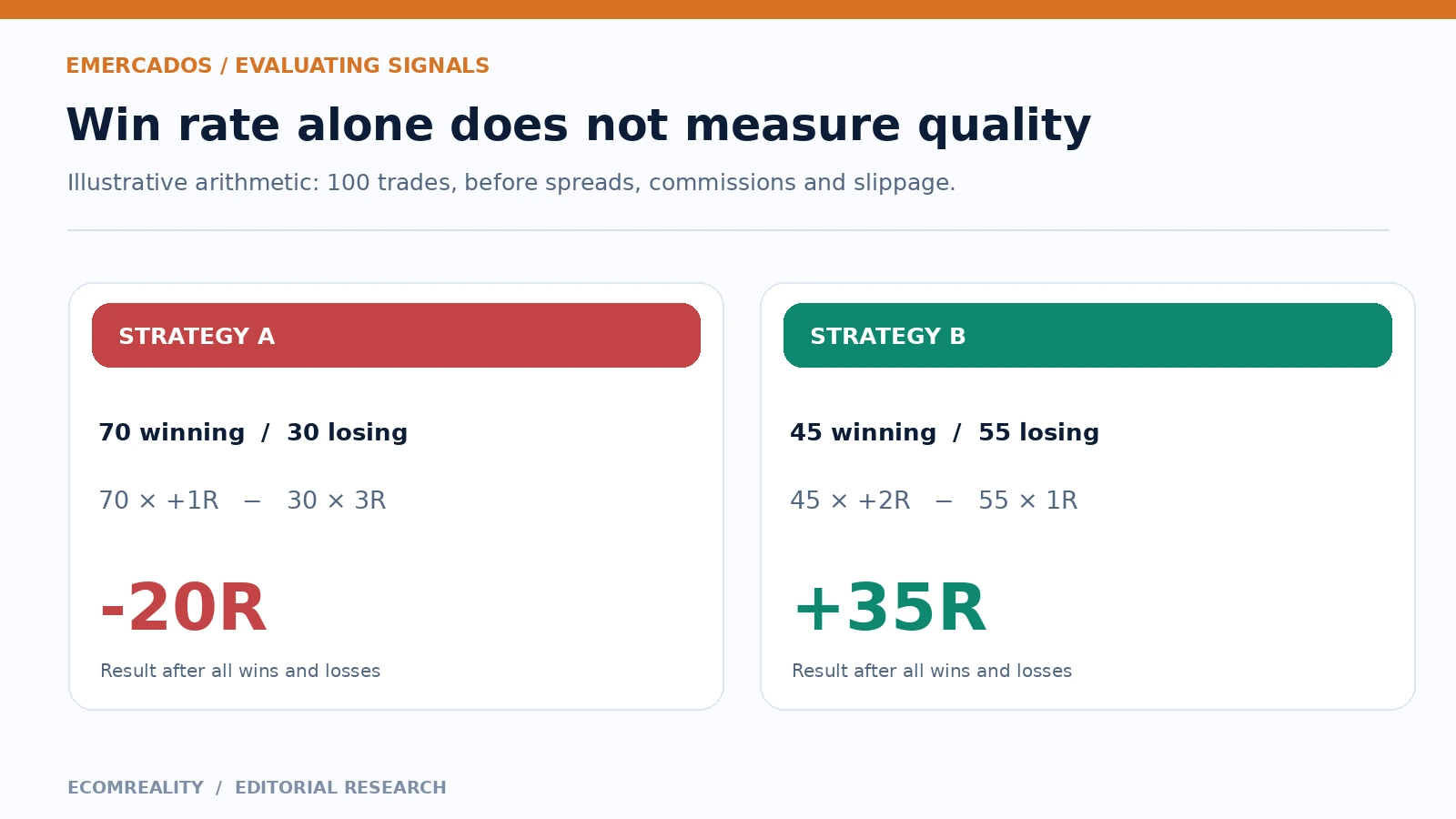
A win rate by itself is an incomplete statistic. Consider two purely illustrative strategies with 100 trades each. Strategy A wins 70 times, making one unit on each winner, but loses three units on each of the remaining 30. Its gross result is 70 minus 90, or minus 20 units. Strategy B wins only 45 times but earns two units per winner and loses one unit on each of 55 losses. Its gross result is 90 minus 55, or plus 35 units. These examples deliberately ignore transaction expenses to isolate the central point: a higher hit rate need not mean a better strategy. Once spreads, commissions and slippage are included, the difference between a marketing statistic and a real outcome can be even larger.
The relevant measure is expectancy: average gain times win probability minus average loss times loss probability, adjusted for execution cost. For a subscription service, this calculation should use the full set of alerts rather than a cherry-picked sample. It should include missed trades, modified entries and periods with unfavorable market conditions. A good signal archive supports independent reconstruction: a buyer can see what was published at the time, check an available market quote and understand what a reasonable fill would have involved. The public eMercados homepage speaks positively about alert quality, but a complete independently verifiable history was not apparent from the open overview pages. That makes methodology and transparency central pre-purchase questions.
Slippage, spreads and execution make alerts harder to copy
Even when a provider identifies the right direction, a subscriber's realized result can differ. A trading alert may arrive several seconds after the analyst identified the setup, the spread may widen during a news release, or a limit order may not execute. The difference between the suggested price and the actual order price is not a minor administrative detail. On a narrow target it can consume a material share of the expected return. A service selling alerts should make that limitation understandable and avoid presenting its model entry as though every customer received it simultaneously.
This is especially important when users subscribe from different regions and trade with different brokers. Liquidity, permitted leverage, market hours, swap rules and available contracts can vary. A subscriber placing a CFD on an index through one broker may not have the exact contract specification used by the analyst. Matching the signal to a real account therefore requires checking the instrument name, point value, margin and expected cost. A useful educational provider should help the subscriber perform those checks. The stronger eMercados becomes at connecting its teaching to realistic signal execution, the more credible its all-in-one model becomes for customers who want informed decisions rather than a stream of notifications.
A practical subscription-value formula
The value of a paid signals-and-education service depends on what a subscriber would otherwise spend to obtain the same learning and research support. A simple monthly worksheet begins with the actual subscription price shown at checkout. Add any required third-party data, charting or broker-related expenses, and the time needed to monitor alerts. Then record actual usage: lessons completed, useful research items reviewed, alerts that met the user's criteria and trades that were skipped because the expected risk was not acceptable. A subscription may be worthwhile for a learner who studies regularly even if no alert is ever copied. It may be poor value for someone who signs up impulsively, misses most alerts and never opens the educational library.
Do not calculate "subscription ROI" by multiplying a marketing win rate by a fixed trade amount. That skips position sizing, losing streaks and personal execution. Also avoid treating the nominal price of separate components as a guaranteed saving. If a course library, analysis feed and signal dashboard are bundled together, the combination matters only if those components are useful to this particular customer. The public pages describe an Our Packages area, but they do not provide sufficient accessible information to establish one universal current monthly fee or precise included feature list for every user. Buyers should rely on the currently displayed checkout terms and a copy of the package description, not on unverified third-party price tables.
The renewal question: what a customer should check
Subscription-based learning products introduce an obligation beyond the first payment. Before joining eMercados, look for the billing interval, renewal timing, cancellation method, refund eligibility, trial conversion rules, currency and any distinction between access to lessons and access to live signals. Ask whether an annual discount comes with an early termination limitation. Some customers want a single month of study; others plan to work through several course levels. Their subscription needs are different. The best choice depends on the duration of the intended learning plan and the portion of the catalog actually available under the selected package.
Another key question is what remains after cancellation. Can the customer continue to view completed lessons, download reference material or review historical alerts? Or does access end with the billing period? Those conditions should be explicit. It is easy to compare subscription prices and ignore the practical cost of losing a collection of notes, saved market studies or personal progress. Retain the package terms and invoices because features and promotional offers can change. Without a clear published price and feature list, it would be misleading for a review to declare that a particular eMercados tier is the cheapest or best. The defensible recommendation is to assess the actual contractual offer alongside the value of the materials the buyer will use.
The role of the community
Community access is one of eMercados' promoted benefits. Discussion with peers can help learners ask questions, compare interpretations of a market setup and develop vocabulary. A community can also reveal how experienced participants handle uncertainty, missed entries and the decision not to trade. That kind of learning is valuable because trading is full of situations where doing nothing is more rational than reacting to every chart movement. A thoughtful community can help normalize patience, process and risk control rather than only celebrating winning screenshots.
There are drawbacks. Group conversations can become noisy, especially when members share different products, time horizons and risk budgets. A post that looks like an urgent opportunity for one trader can be irrelevant or dangerous for another. Communities may also amplify unverified performance claims, pressure users to trade more frequently or reward confident prediction over careful analysis. Subscribers should distinguish statements by instructors or official analysts from unmoderated comments. It is useful to ask how moderators handle incorrect information, whether promotional posts are labeled and whether support questions receive substantive answers. Community size alone does not demonstrate educational quality; clear standards of discussion and accountability matter more.
How eMercados compares with a standalone course
A standalone course usually has a defined beginning and end. It may be easier to budget, review and complete without worrying about a constantly changing feed. A combined education-and-signal platform can offer continuing context: a learner studies a concept and then sees it discussed in live market conditions. That is eMercados' most persuasive potential advantage. The connection between theory and real observations can help users understand why a setup is attractive, why it failed or why an analyst chose to stand aside. The experience is particularly useful for students who already know the basics and want practice in evaluating unfolding situations.
The drawback is divided attention. Students who repeatedly interrupt lessons to chase every new alert may learn less than they expect. A disciplined schedule helps: allocate time to structured study, time to reviewing historical signals, and only then time to observing live markets. Use a trade journal to connect what was learned with actual decisions. Ask the platform whether signals are explained educationally after publication, including the unsuccessful ones. That one feature can make a service more useful than a plain alert feed. If the education and signals remain disconnected, a buyer may be paying for two products without receiving the benefit of integration.
Three tests before treating any signal as reliable
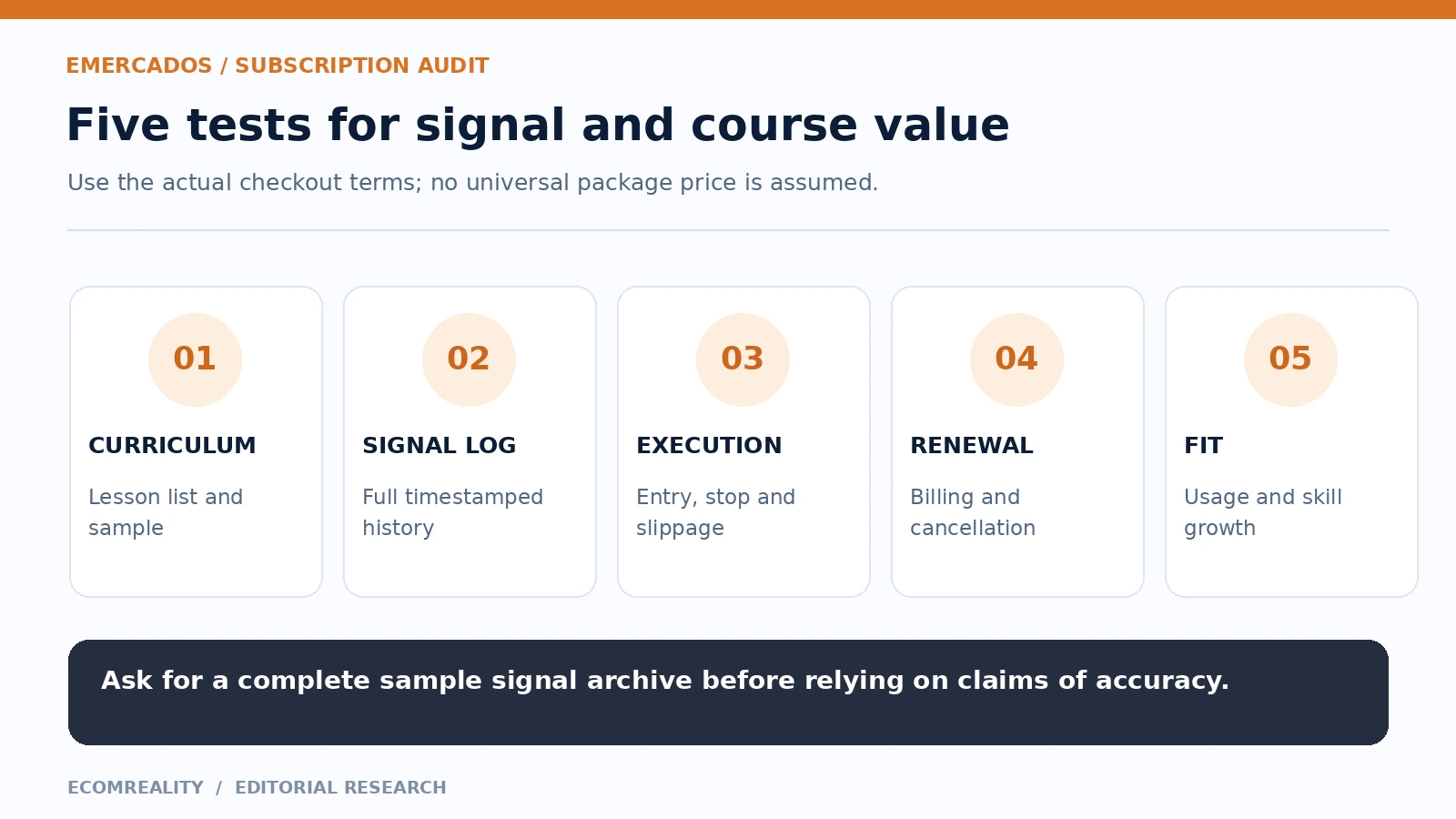
The first test is reproducibility. Can you reconstruct the trade from an archived signal without relying on the provider's later interpretation? The second is completeness. Does the public record include losses, canceled entries, stop changes and time periods when the market was difficult? The third is independence. Can at least some statistics be checked against timestamps and market prices from a separate source? These tests help prevent the common error of accepting a selection of winning examples as if it were representative performance. They also protect the subscriber from unconsciously changing the rules of a strategy after seeing the outcome.
A useful personal test is to track alerts in a journal for several weeks without risking money. Record the publication time, the market price available when the alert was actually received, theoretical transaction costs, whether the trade met the original rule and the final result under a predetermined exit method. The exercise does not prove that future performance will be similar. It shows whether the feed has enough detail to be followed consistently and whether it fits the customer's schedule. A signal service that only works if the subscriber sits at the screen every minute may not be suitable for someone with a full-time job. Frequency, timing and documentation are aspects of product quality as important as accuracy.
What the public site does and does not establish
The official English eMercados homepage establishes the broad product positioning: trading courses for multiple skill levels, market alerts, insights and community participation. It also contains an educational disclaimer, a general leveraged-trading risk warning and a list of restricted jurisdictions including the United States, Cuba, Sudan, Somalia, Iran, Cyprus, Syria and North Korea. These are relevant limitations for someone evaluating account availability. The page also displays several award claims. Such claims can form part of brand presentation, but they do not replace a clearly documented curriculum, verified signal record or transparent subscription terms.
The most important public information gap is not whether the site looks professional. It is the lack of enough open, independently reconstructable data to determine signal expectancy and universal subscription value. We cannot infer those outcomes from claims that alerts are accurate or that courses are world class. Readers should ask for a complete recent signal archive, package terms and example lessons, and should verify what is included at the point of purchase. This is a fair, critical evaluation rather than an assumption that the service has no value. The educational outline is useful, and the concept of combining lessons with ongoing market analysis is sensible. The remaining question is how consistently it is delivered to paying members.
Verdict: when eMercados makes sense
EcomReality's conclusion is that eMercados is most interesting as a combined learning and market-observation product, not as an automated route to profitable trading. Its broad curriculum structure and stated focus on signals and community can appeal to learners who want education reinforced by ongoing examples. Its value will be strongest when lessons are detailed, analysts explain both successful and unsuccessful setups, and subscribers can verify the information they receive. For an experienced trader considering only paid alerts, transparency of historical performance and total cost deserve even greater weight than the brand's educational positioning.
The limitations are substantive: open pages do not establish a universal price, complete audited signal record, or enough details to certify that every package offers attractive value. A sensible customer therefore requests the current package description, checks renewal and cancellation conditions, reviews sample lessons and observes alerts before committing substantial funds to their use. The most useful question is not "Will these signals win?" but "Does the service improve my process and offer evidence I can independently evaluate?" Framed that way, eMercados can be assessed with the same standards that should apply to any subscription promising trading knowledge, research and timely ideas.
Official sources and further reading

Croom Raymond is an ecommerce writer and digital business researcher at Ecom Reality. He covers online selling platforms, SaaS tools, pricing structures, platform features, and practical strategies for building digital businesses. His articles focus on clear, evidence-based analysis that helps readers understand how different services work, compare their advantages and limitations, and make more informed business decisions.
Comments
Related Articles



Leave a Reply