
SabioTrade Review: Prop-Trading Challenges, Drawdown and Reward Rules

SabioTrade is a proprietary-trading evaluation business, not an ordinary brokerage account into which a customer deposits a large balance and starts investing it. The user pays for an assessment, trades within a simulated risk framework and, if every qualification condition is satisfied, may become eligible for a separate reward-stage arrangement. That distinction is central to this SabioTrade review. A simulated account labeled $20,000 represents a rule set and not $20,000 that the participant can withdraw. The meaningful product is access to an evaluation process whose terms determine how difficult it is to reach the stated target and remain eligible for a reward afterward.
The company offers a comparatively simple one-step proposition: reach a profit target without breaching daily or overall drawdown, follow behavioral restrictions and complete the account verification process. But simplicity at headline level is not the same as simplicity in the rulebook. The platform’s public rules describe a 55% consistency threshold, while a published version of its terms describes a different 40% test. Other conditions change for intraday accounts. A careful reader therefore has to examine exactly which program is being purchased, which document controls it and how the firm calculates violations. The sections below unpack those issues with numerical examples and practical questions rather than assuming a successful challenge equals an immediate cash payout.
What the customer actually buys
The entry fee buys participation in a simulated evaluation. The assessment aims to identify traders who can make gains while respecting a restricted risk budget. Once a user purchases a plan, the key economic variables are its simulated balance, fee, profit objective, daily loss allowance, trailing drawdown allowance and reward percentage after qualification. A smaller advertised starting fee is not necessarily the best value: accounts with tight drawdown tolerances may require highly conservative position sizes, and a failed evaluation can mean buying another attempt. The sensible comparison is not just dollars of nominal account size per dollar of entry fee but the amount of realistic risk that the rules permit.
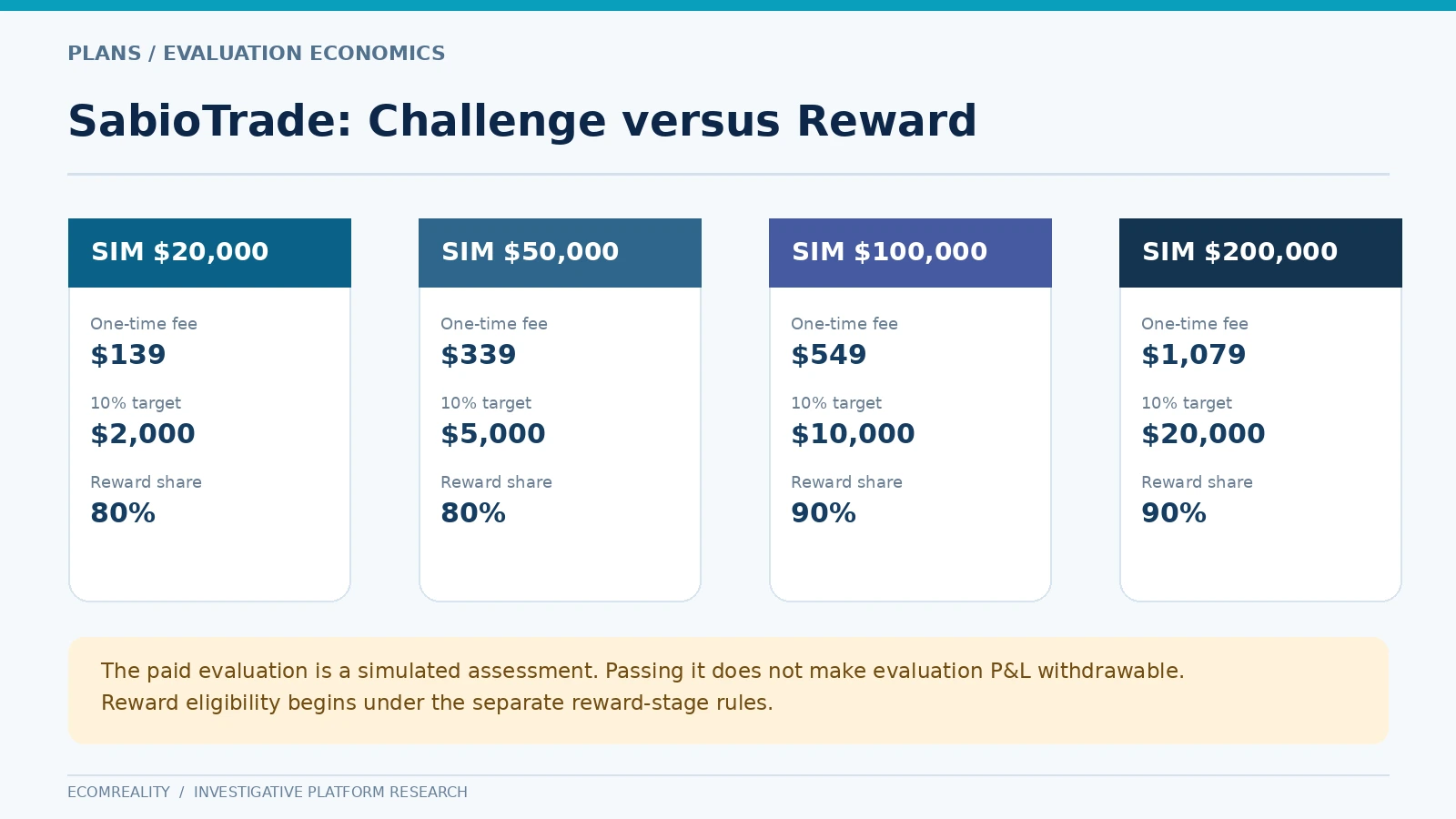
SabioTrade publishes an Essential plan with a $20,000 simulated balance and a $139 evaluation price, a Plus plan at $50,000 and $339, Advanced at $100,000 and $549, and Ultimate at $200,000 and $1,079 on its rules page. The relevant table describes a 10% profit objective and a 6% maximum trailing drawdown for standard single-step accounts, with the first two plans showing an 80% reward percentage and larger plans showing 90%. These are public plan descriptions, not a promise that every region or promotion will always show identical checkout totals. The specific selected plan should always be checked against the order confirmation.
The one-step evaluation: what must happen before qualification
A one-step challenge can look refreshingly direct compared with programs that demand several profit targets on different stages. Here the trader does not ordinarily need to pass a second evaluation merely to start the reward-stage process. However, reaching 10% on a closed-balance basis is not sufficient on its own. Public rules also require compliance with risk thresholds, the consistency calculation, account activity and the restrictions on trading techniques. Qualification also includes identity checks. This means an account that shows an attractive floating gain has not necessarily completed the challenge and an account with the numerical target met may still need additional qualifying sessions.
Consider an Essential account showing $20,000 at opening. A 10% objective is $2,000. If the trader finishes at $22,000 while all limits were respected, that is progress toward the stated target; it is not automatically a $2,000 cash reward. The assessment balance is a simulated measurement. The transition to a reward account and the subsequent rule checks are separate events. The difference can be disappointing to customers who only read an advertisement offering a high profit share. SabioTrade’s reward policy describes the profit split at the reward stage, while the evaluation fee is not refunded after the first reward under the public FAQ. These details should shape the buyer’s decision from the beginning.
Daily drawdown versus trailing drawdown: two separate tests
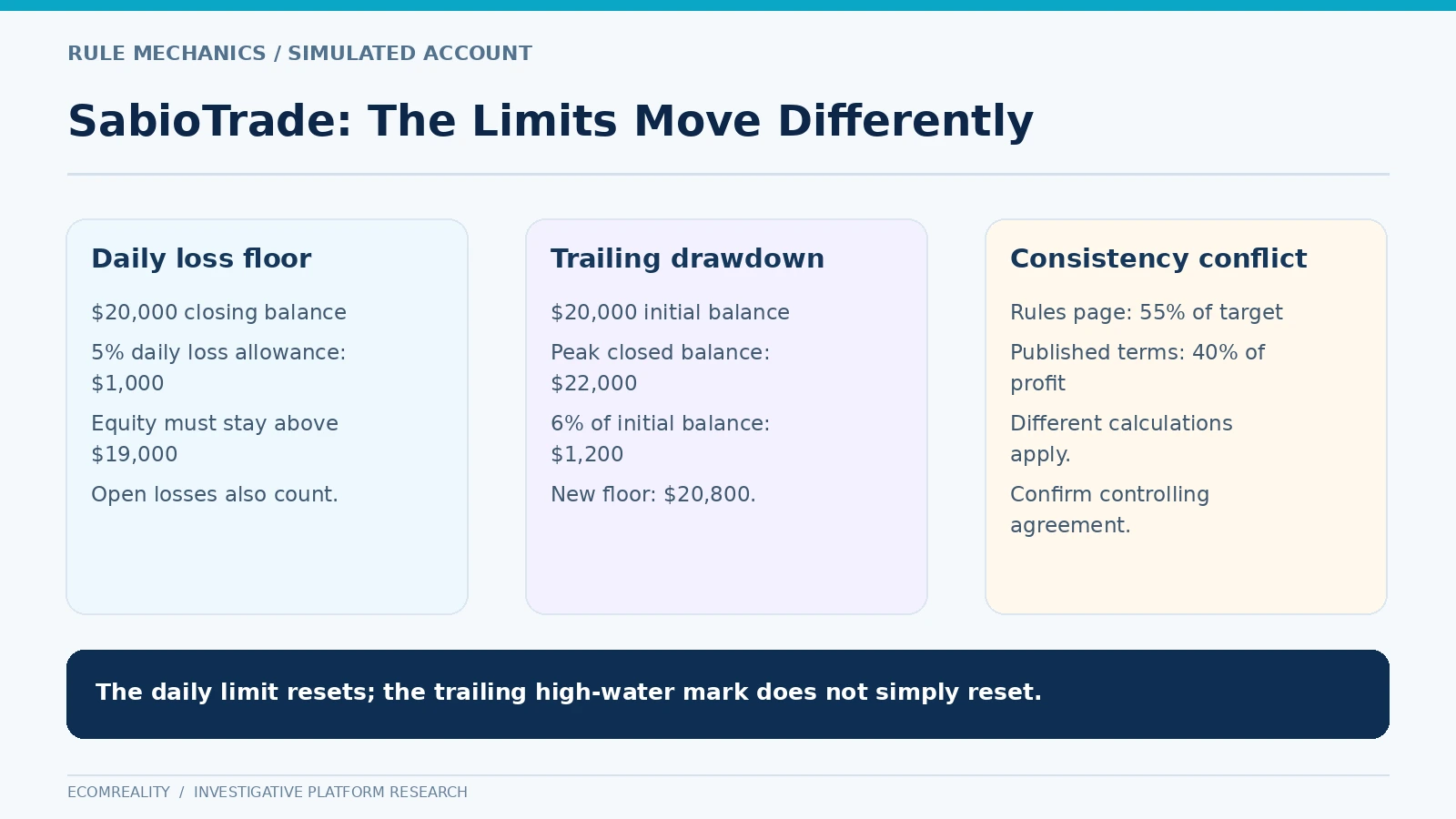
A daily loss limit and a maximum trailing drawdown are often mistakenly treated as the same stop-loss threshold. SabioTrade’s published single-account framework applies a 5% daily loss calculation using the prior day’s closed balance, while the overall trailing allowance is 6% of the initial simulated balance beneath the highest recorded closed balance. Equity, including unrealized losses on open positions, is monitored against the limits. That combination is stricter than simply looking at realized P&L. A position can breach an equity floor during a market dip even if it eventually recovers or closes profitably. Platform automation does not cancel the fact that the risk was exceeded at the time.
Here is a practical calculation. Suppose yesterday’s closed balance was $20,000. The 5% allowance is $1,000 and the daily equity floor is $19,000. Later, suppose the highest closed balance reaches $22,000. On a 6% trailing rule applied to a $20,000 starting balance, the buffer is $1,200 and the trailing floor becomes $20,800. The trader then has to respect both applicable floors, not whichever is more convenient. This is why a trade size that was acceptable on the first day may be unacceptable after a sequence of profitable closes. Risk capacity evolves with the account’s recorded performance.
Why drawdown must be managed on equity, not optimism
The most useful way to trade under these conditions is to establish an internal buffer below the maximum allowed loss. If the firm allows a $1,000 daily loss, risking nearly $1,000 on a single volatile trade leaves no room for spreads, slippage, commission, other open positions or price gaps. There is no operational benefit to staying one dollar above a breach line. Realistic traders set smaller per-trade risk budgets and monitor combined exposure, especially when several correlated assets move together. Correlation can make three apparently separate positions behave like one large bet during a macroeconomic announcement.
Another subtle problem is that the daily rule resets according to the program’s clock, while trailing drawdown can move upward when closed-balance highs are established. A user who understands only the first mechanism can misread the dashboard the next morning. Before purchasing, ask whether the dashboard shows the exact active equity threshold, whether transaction costs are included in the real-time number and what happens during a platform interruption. Screenshots of the current rule panel are useful for resolving later disputes, but an internal spreadsheet that mirrors the threshold calculation is equally valuable for daily risk planning.
The consistency rule conflict that buyers should notice
One of the most consequential information gaps concerns consistency. SabioTrade’s public trading-rules page says that a single day’s closed profit should not exceed 55% of the required profit target, and that a day above this share can increase the target rather than immediately terminate the account. A published terms document, however, describes a 40% test of accumulated simulated profit, including single trades as well as trading days. Those standards are materially different. The correct response is not to quietly select whichever version sounds easier; it is to determine the controlling contractual rule for the exact plan and purchase date.
For a $20,000 account with a $2,000 target, 55% produces a recommended daily profit threshold of $1,100. If one session earns $1,400, the 55% formula would require a recalculated target of about $2,545.45. A 40% consistency rule framed against total accumulated profit can imply still another path to compliance. Without knowing which contract applies, a trader cannot reliably estimate the total profit needed or plan an efficient sequence of qualifying days. This is not a minor footnote: the difference can affect the viability of a strategy built around occasional high-conviction trades. Obtain the rule and its calculation in writing.
Standard and intraday programs should not be mixed
The SabioTrade rules also distinguish standard single accounts from intraday accounts. The standard description uses a 10% target, 5% daily loss, 6% trailing drawdown and a 1:30 leverage ceiling. The intraday framework is described with a 12% profit target, 4% daily loss and 5% trailing drawdown; some public program material advertises different leverage settings and automatic closeout at the end of a trading day. Those are not interchangeable packages. A trader who enjoys holding positions overnight may dislike enforced day-end closing, whereas someone who deliberately avoids overnight financing could value the stricter intraday structure.
The choice should come after a strategy review. Write down expected holding time, typical adverse movement, average win size, win rate, news exposure and how frequently positions remain open during the account’s reset window. Then choose the account whose boundaries fit those behaviors. Selecting a higher leverage allowance because it looks more powerful can undermine the entire purpose of a disciplined assessment. If a strategy requires one unusually large position to achieve the target, the evaluation itself may be a poor fit even when the website permits the instrument or the trading style in general.
Trading restrictions: what can invalidate an otherwise profitable record
The published rules allow several ordinary activities, including news trading and some overnight positions where the account permits them. They also list prohibited strategies. High-frequency trading, cross-account hedging, mirrored or copied trading, certain arbitrage techniques, exploitation of price errors and unauthorized bots or API trading can create breaches. The rules describe excessive concentration or ‘all-in’ behavior using 80% or more of available margin on a single position as a danger threshold. These are not merely lifestyle recommendations. They may affect eligibility even when the numerical profit target has been met.
Users who rely on automated trading deserve special caution. An expert advisor used for signal analysis may be treated differently from a fully automated order-entry system. The distinction between tool-assisted analysis and prohibited automated execution should be confirmed before connecting third-party software. The platform’s FAQ also states that SabioTrade uses its own trading interface rather than MetaTrader 4 or MetaTrader 5. Anyone whose established workflow depends on those terminals, custom indicators or proprietary scripts should factor the adjustment cost into the review, not discover it after paying for a challenge.
Reward-stage economics and the meaning of an 80–90% share
The best-known benefit of a prop evaluation is the opportunity to receive a share of eligible performance after qualification. SabioTrade advertises reward percentages ranging from 80% to 90% on the standard plans described above. But a payout percentage is only one component of expected economics. The user first incurs the entry fee, then must meet every challenge condition, complete checks and generate eligible profit at the subsequent reward stage. A 90% headline applied to simulated challenge gains is the wrong calculation: challenge profits are not inherently withdrawable. The percentage applies under the reward-stage agreement and its specific eligibility rules.
An illustrative $1,000 eligible reward-stage profit at an 80% share means $800 for the trader before any applicable conversion or receipt costs; at 90%, it means $900. These are arithmetic examples, not income forecasts. SabioTrade’s public rules indicate that the first reward request may be available after eligible profit is generated and positions are closed, while subsequent requests require seven days after the last successfully processed reward. Payment routes include bank transfer and cryptocurrency, with processing times varying by method. The reward request may still be reviewed for strategy compliance, account activity and identity, which is why ‘instant reward’ advertising must be read with its conditions attached.
The first reward can change the available risk buffer
Another important condition appears after a reward has been processed. SabioTrade states that equity on the reward account must remain above the initial simulated balance. That post-reward floor can be more restrictive than traders expect if they think only in terms of the usual trailing drawdown line. Imagine a strategy that withdraws nearly all generated gains, then opens several sizeable positions. The account may have very little space for a temporary equity dip. The trader has received money but may have made the next trading session much harder to manage.
A sustainable reward strategy therefore plans account equity and withdrawals together. Before submitting a request, calculate the cushion that will remain when the reward amount is removed and the next day’s limits are set. If the intended position size has routinely created drawdowns greater than the remaining buffer, the trader may need to retain more equity, reduce size or refrain from trading. The highest gross payout percentage is not always the best answer if pursuing it leaves an account one routine fluctuation away from termination.
Cost comparison beyond the evaluation price
There is an appealing feature in the fee structure: the public rules describe a one-time evaluation charge rather than mandatory recurring monthly payments for the standard plans. That makes up-front cost relatively easy to see. Yet repeated attempts change the effective economics dramatically. If a trader fails three $139 assessments before qualifying on a fourth, four purchases would cost $556 unless a separate retry promotion applies. The fee is an expense regardless of whether an account passes. The calculation is simple, but many promotional comparisons never put failure probability into the picture.
Platform usability and its most important limitation
SabioTrade’s proprietary environment is designed to keep evaluation, account metrics and reward requests in one workflow. From a trader’s perspective this can be a strength: fewer services to connect and a single set of account dashboards to monitor. The same design, however, is restrictive for users who have already built a mature MetaTrader-based system. The FAQ explicitly states that MT4 and MT5 are not supported. Proprietary technology should therefore be judged by charting, execution controls, stability, reporting, device compatibility and rule visibility, not simply by how modern the homepage looks.
Regulation, contract rights and buyer protection
The word ‘funded’ can suggest a conventional investment relationship with a broker or asset manager. A prop evaluation arrangement is different. The trader purchases assessment services, and the platform defines eligibility for an incentive or reward structure. The company is not necessarily the custodian of a retail deposit in the way a regulated broker would be. That is why consumer questions about refund rights, cancellation, contracting entity, dispute forum and the meaning of ‘simulated capital’ deserve at least as much attention as profit share. The rules and terms are more important than the size of the headline account.
A useful due-diligence checklist asks which entity issues the invoice, whether the fee is refundable under any circumstances, what evidence is retained when a breach is recorded, what account activities can trigger discretionary review and which terms are incorporated into the order. Where different pages describe 40% versus 55% consistency, save the effective version associated with checkout. An editorial review should not convert an unresolved documentation conflict into reassurance. The responsible conclusion is that buyers need a single, written set of applicable conditions before deciding whether the offer is clear enough.
Who may benefit, and who should be more skeptical
SabioTrade may suit traders who already use controlled position sizing, are comfortable with proprietary interfaces and prefer an assessment with a defined one-step target. The published plans make it possible to compare fee, simulated account size, objective and reward percentage without guessing basic terms. That clarity is a genuine positive. The firm also publishes detailed examples of drawdown and consistency calculations, which give traders a more useful starting point than a vague promise of professional funding.
The principal disadvantages are equally concrete: the trailing risk threshold becomes tighter after profits, a single equity spike downward can end an account, repeated fees accumulate, MetaTrader users cannot simply bring over their standard workflow and the consistency wording differs across official materials. These shortcomings will matter far more to some traders than others. People who favor occasional large wins or high-frequency execution should be particularly careful. A reasonable outcome of researching SabioTrade is deciding that a rule-driven challenge is not compatible with a particular trading style, even if the nominal reward percentage is attractive.
Final assessment
SabioTrade presents a credible concept for measuring discipline under a simulated account framework, but its appeal depends on much more than passing a 10% challenge. The potential user needs to understand daily equity floors, trailing high-water marks, consistency calculations, prohibited automation and what happens to risk limits after the first reward. The company is strongest when its detailed public risk rules are treated seriously. It is weakest where the site and terms leave different impressions of the controlling consistency standard. For a trader with stable risk practices and a verified contract, the format may be worthwhile; for someone relying on large one-off gains or platform portability, the frictions are considerable.
Frequently asked questions
No. The advertised balance represents the scale of a simulated assessment or reward account. Assessment profit is not automatically cash the trader can withdraw.
No. The consistency test, activity requirement, daily and trailing drawdown, prohibited practices and account verification can all affect progression.
The trailing threshold follows the highest closed balance with a buffer based on initial account size; the daily limit uses the prior day’s closed balance. Current equity is checked against both applicable boundaries.
The public rules discuss 55%, while a published terms version describes 40%. The exact contractual conditions of the selected program must be verified at purchase.
The public FAQ says SabioTrade requires its proprietary trading environment and does not support MT4 or MT5.
Original sources and reference pages
https://sabiotrade.us/trading-rules · https://sabiotrade.us/terms · https://sabiotrade.us/lp/sabiotrade-overview

Sylvia Pierce is an editor and ecommerce researcher at Ecom Reality. She specializes in reviewing ecommerce platforms, digital selling tools, pricing models, and online business software. Her work focuses on providing clear, practical, and balanced information that helps entrepreneurs make informed decisions.
Comments
Related Articles



Leave a Reply