
Quick answer: Shopify Payments and third-party gateways are not priced the same way. A merchant using Shopify Payments pays the plan subscription plus applicable payment processing charges. A store using an outside processor may also incur Shopify’s additional third-party transaction fee, which varies by plan. For a US Basic store, Shopify’s October 2026 published comparison lists 2% for eligible third-party transactions, versus 1% on Grow and 0.6% on Advanced. The more useful question is not whether Shopify supports a gateway, but what the complete charge will be on the store’s actual mix of payments, refunds and international orders.
The checkout choice that can change your margins
A store owner choosing a payment processor may compare a card rate of 2.9% plus 30 cents with a rival quote of 2.7% plus 25 cents and conclude that the rival is cheaper. On Shopify, that comparison can be incomplete. Depending on how the processor is configured and the store’s plan, the merchant might owe an additional percentage to Shopify on transactions processed outside Shopify Payments.
At $10,000 in eligible monthly volume, an extra 2% is $200. For a low-margin product line that can be far more important than a difference of a few cents per transaction. But it would also be wrong to suggest that every alternative payment method automatically incurs the charge. Shopify documents exemptions and special cases, including manual payment methods and some PayPal transactions when Shopify Payments is primary.
This analysis looks at the fee layers, checkout differences and country restrictions that determine the real cost. It deliberately avoids repeating a generic Shopify platform review. It also separates confirmed published US prices from numerical assumptions used solely to illustrate a merchant decision.
What Shopify Payments is
Shopify Payments is Shopify’s integrated payment-processing arrangement for eligible merchants in supported countries. It places payment activation and much of the payment operations workflow inside the store admin. The merchant can review transactions, payment status and payouts without operating an entirely separate gateway dashboard for every part of the process.
The integration does not eliminate standard card-processing fees. Shopify’s official US plan table currently shows basic online standard card pricing starting at 2.9% plus 30 cents on Basic, with lower listed starting percentage rates for higher plans. Charges can vary for premium cards, international transactions and other methods. A retailer comparing total costs should use the rate that applies to its actual payment mix, not assume every sale qualifies for the least expensive published tier.
Shopify says there are no additional third-party transaction fees on payments processed through Shopify Payments in the ordinary single-provider arrangement. That is a meaningful difference from using an outside processor where the extra Shopify charge applies. It is not equivalent to saying Shopify Payments itself is free.
What a third-party payment provider does
Shopify supports numerous external card payment integrations. Its Help Center distinguishes direct and external providers. With a direct provider, shoppers complete the payment flow on the online store rather than moving to a separate hosted checkout. With an external provider, the customer is redirected to the provider’s outside payment page to finish paying.
That checkout difference is operational. Redirection may introduce a different screen, language, authentication step or support process. A direct integration may feel more continuous to the shopper, but it still has separate fees, settlement rules and account terms. Neither checkout type should be declared universally higher-converting without measured evidence for a particular merchant.
Third-party providers can be useful when a merchant needs a local method, existing contract, supported business model or regional coverage not available with Shopify Payments. The provider may also offer functions that matter to a business’s payment operations. However, the provider’s own advertised processing rate is only one cost input.
Why there can be two processing-related charges
A merchant using an outside provider generally pays that provider’s processing fee. Shopify may charge its own additional third-party transaction fee on qualifying transactions. They are separate charges for different services. A comparison that adds the provider fee but forgets the Shopify fee understates total cost.
Shopify’s US plan comparison currently lists 2% on Basic, 1% on Grow, 0.6% on Advanced and 0.2% on Plus for the additional third-party transaction rate. These are plan-based figures from its published US page, not a promise that the same rates apply in every country or to every enterprise contract. Shopify’s relevant Help Center also says the calculation basis includes product cost after discounts plus tax and shipping charges for eligible orders.
The effective total therefore depends on the order mix. Order mix, discounts, shipping and tax affect the fee base. Don’t model the extra fee on net profit: Shopify describes a transaction-based calculation, not a share of merchant earnings.
What about manual payments and other exceptions?
Shopify states that manual methods such as cash on delivery, bank deposits and certain orders do not incur additional third-party transaction fees. The help documentation also notes exclusions for eligible Shopify Payments, Shop Pay and Shop Pay Installments transactions. PayPal has special treatment: when Shopify Payments is selected as the primary provider, Shopify says PayPal transactions are exempt from the additional third-party fee.
For newer stores there can also be special fee treatment around gift cards or store credit, depending on their creation date and how the payment is applied. The rules are detailed enough that merchants should use the current Help Center rather than a simplistic internet chart saying ‘all non-Shopify payments cost an extra 2%.’
A side-by-side comparison of payment setups
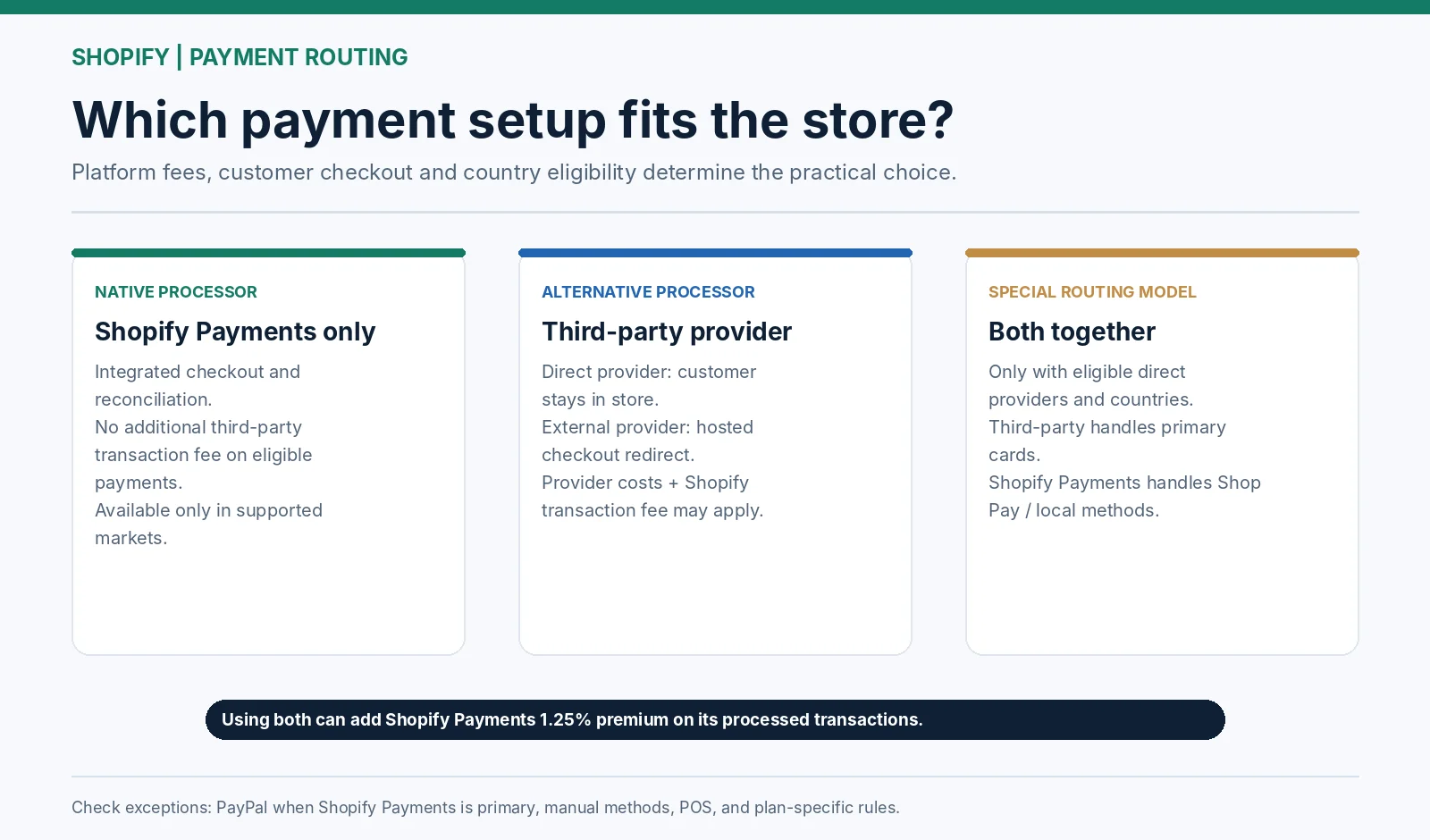
Consider three common structures. First, a store uses Shopify Payments as the primary and only card-processing arrangement. It gets the integrated reporting workflow and standard applicable processing fees without the ordinary additional third-party transaction charge on Shopify Payments orders.
Second, a store uses a third-party provider as its primary processor. It pays that provider’s rates and, on qualifying orders, Shopify’s plan-dependent additional transaction charge. The provider can be direct or external, affecting the customer checkout experience. Merchants should verify how disputes, refunds and payout records appear across the two systems.
Third, Shopify now documents a structure in which an eligible merchant uses Shopify Payments alongside one direct third-party provider. In this arrangement the third-party provider remains the main processor for credit and debit cards, while Shopify Payments can handle certain other methods and serve as a backup for eligible failed card attempts. This is not unrestricted simultaneous use of all processors; Shopify publishes eligibility requirements and routing rules.
Using both providers has its own pricing rule
The current Shopify Help Center explains that, in the combined setup, third-party transaction fees apply to transactions processed by the third-party provider. Shopify Payments transactions such as Shop Pay and supported local methods carry its standard processing rate plus a 1.25% premium in this configuration. Eligible failed card payments recovered through Shopify Payments are also subject to that premium.
The merchant therefore cannot safely assume that turning on Shopify Payments alongside an outside processor makes all outside transactions exempt from Shopify’s third-party charge. It also cannot assume every transaction processed through the native side is priced at the ordinary sole-provider rate. Routing and fee schedules both matter.
Shopify further specifies that the store must be located in a Shopify Payments-supported country and have an active direct third-party provider. It states that certain Shopify Plus contracts and multi-entity configurations are not eligible for the combined feature. A store situated where Shopify Payments is unavailable cannot turn the feature on simply to expand payment coverage. Some promotional diagrams online get this point wrong.
Payment recovery is narrower than it sounds
Shopify describes automatic retry of eligible failed card transactions through Shopify Payments when a third-party processor is primary. This can be operationally helpful, but Shopify specifies that local payment methods and wallet transactions are not routed through the same recovery mechanism. Recurring subscription charges through the third-party provider are not recovered this way either.
The practical implication is to analyze failed-payment types, not simply count all declined attempts as recoverable. A merchant with mostly recurring payments may receive different value from this feature than a merchant selling one-time products. Claims about increased conversion should be tied to observed merchant data, which is not supplied here.
A worked example: $10,000 in monthly sales
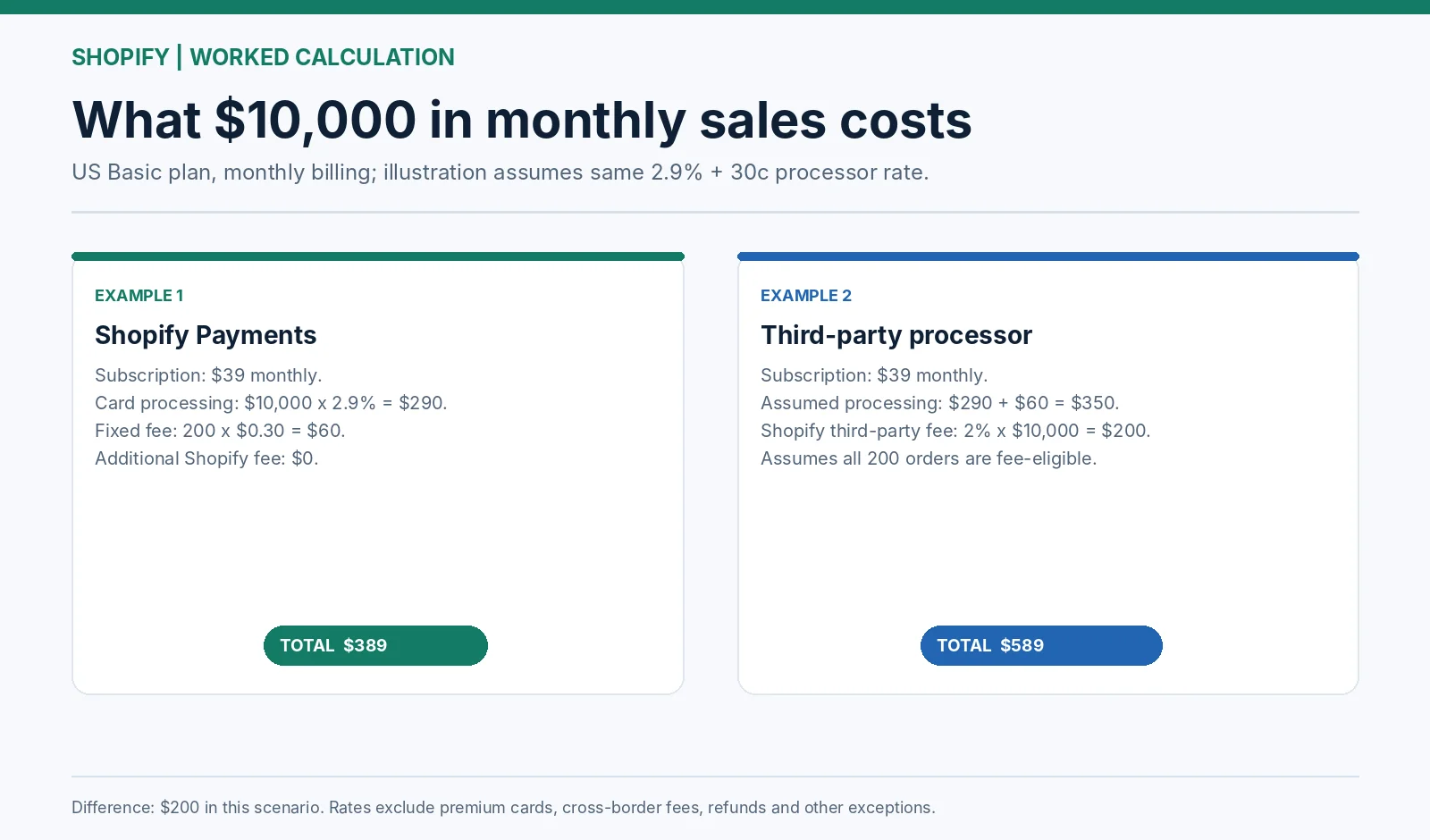
Suppose a US-based store has $10,000 gross monthly sales, 200 successful standard online card transactions and an average order value of $50. Assume a Shopify Basic subscription at the published $39 monthly billing rate, as opposed to $29 per month under annual billing. For the main example, assume all payments qualify for the listed domestic standard rate of 2.9% + $0.30. Assume a third-party processor quotes the same 2.9% + $0.30 rate, solely to isolate the extra Shopify fee.
The processing calculation is $10,000 x 0.029 = $290, plus 200 x $0.30 = $60, or $350 in card processing. The subscription adds $39. When all payments are processed using Shopify Payments in this illustrative scenario, the monthly total of the modeled items is $389.
For the hypothetical third-party processor at that same assumed rate, processing is still $350 and the Shopify subscription remains $39. If the entire $10,000 payment volume is subject to the Basic plan’s 2% additional transaction fee, Shopify adds $200. The modeled total becomes $589. The difference is $200 per month, not because the outside processor was independently priced higher, but because the comparison holds provider charges constant and adds Shopify’s separate fee.
Effective cost as a share of sales
Under those assumptions, $389 divided by $10,000 is 3.89% of gross sales for the modeled subscription and processing charges. $589 divided by $10,000 is 5.89% for the outside-provider scenario. Those figures are not universal Shopify effective rates; they are outputs from explicitly stated example inputs. They exclude many possible expenses such as apps, chargebacks, premium-card processing, foreign exchange and custom contractual rates.
It is useful to keep the subscription as a separate line item. A fixed $39 monthly charge consumes a greater percentage of revenue at $1,000 in sales than at $100,000. A merchant may choose a higher plan for reasons beyond payment processing, such as staff access or reporting, and should avoid attributing every upgrade cost solely to card fees.
Does moving to Grow or Advanced solve the problem?
Higher Shopify plans can carry lower published processing rates and lower additional third-party transaction percentages. That can justify an upgrade at sufficient transaction volume, but only after including the higher subscription. For a simple analysis of third-party fees alone, the Basic rate of 2% versus Grow’s 1% creates an illustrative $100 monthly difference on $10,000 of fully fee-eligible volume. That is not the complete upgrade economics.
Shopify’s current US page shows $39/$105/$399 monthly billing for Basic, Grow and Advanced, while annual billing reduces the effective per-month subscription amounts. The processing rate for standard online cards also differs between plans. A correct break-even calculation must choose either monthly or annual billing consistently, include the applicable processor rate, and account for the merchant’s true mix of orders.
If the shop processes mostly native Shopify Payments transactions, an upgrade’s savings come principally through its lower applicable processing rates and whatever additional plan benefits it provides. If it relies heavily on a third-party provider, lower additional Shopify transaction fees may also matter. The comparative value is different for each business.
Refunds complicate cost comparisons
A refund reverses some or all of the amount the customer paid. It does not necessarily reverse each charge incurred to process the original transaction. Shopify’s help documentation specifically states that its third-party transaction fees are not returned when an order is refunded. The outside payment provider will have its own refund and processing-fee policy.
Suppose a store frequently refunds higher-value orders. An analysis based only on successful gross sales can understate effective fees relative to retained revenue. A merchant should count payment charges associated with orders that were later refunded, and track them separately from ordinary fulfillment or product-return costs.
Chargebacks and disputes create a similar need for careful accounting. They may involve provider fees, administrative effort and temporarily withheld funds. A seemingly lower headline rate is less helpful if the provider’s dispute workflow is difficult for the business to manage. That operational consideration needs actual terms and data, not assumptions.
International cards and currency conversion
Shopify’s US pricing page lists additional charges for some international transactions and different pricing categories for standard and premium cards. A store with substantial cross-border traffic should not apply a US domestic standard rate to all sales. Currency conversion can also involve a separate charge or unfavorable rate relative to a merchant’s reporting currency.
The first step is to separate card origin, customer payment currency, store currency and payout currency. A foreign card paying in USD can create a different fee pattern from a domestic card paying in a converted currency. The merchant’s processor and Shopify market configuration determine the details.
The same issue arises with a third-party provider offering attractive local methods. A provider may reduce checkout friction in a particular region but also introduce settlement currency or bank-transfer arrangements that cost more. A fair comparison includes all stages from checkout to the money arriving in the merchant’s operating account.
Eligibility and restricted businesses
Shopify Payments is available only in supported countries and to eligible businesses. Availability can depend on the merchant’s country, business details, product category and verification status. Shopify’s acceptance of a product on its ecommerce platform does not automatically mean Shopify Payments or any particular outside gateway is permitted to process that product.
Merchants in regulated or higher-risk categories need to review the processor’s prohibited or restricted-business terms. A merchant should not assume an outside processor will be more permissive without obtaining confirmation. Conversely, a business that is ineligible for Shopify Payments may have legitimate third-party options, subject to local law, Shopify’s rules and the provider’s underwriting requirements.
Verification can involve beneficial ownership details, registration records, address information and other documents. Payment holds or reserves, where contractually authorized, can alter working capital. These issues should be compared using the provider’s actual policies rather than generalized claims that one brand ‘never holds payouts.’
Direct checkout versus hosted redirect
A direct provider keeps the customer within the store payment experience. An external provider redirects the checkout to its own hosted page. Which is preferable depends on the brand, customer expectations, payment-method familiarity, security implementation and mobile usability. An external checkout is not automatically unsafe or ineffective; many legitimate providers use hosted payment pages.
A merchant should complete test purchases and inspect confirmation emails, tax display, shipping calculations, abandoned-checkout reporting and refund synchronization. These tests should be performed before a high-volume campaign, especially if an outside provider is being introduced to an established store.
The article’s diagrams illustrate workflows, not actual screenshots of a connected store. Their purpose is to show why payment setup affects reporting, support responsibilities and transaction charges.
How to choose based on your store’s needs
Begin with merchant eligibility. If Shopify Payments is supported and covers the required payment methods, calculate its actual card and international charges for a normal month of transactions. If a third-party processor is necessary, get its complete fee quote in writing and add Shopify’s plan-specific transaction charge wherever applicable. Include failed payments, refunds and currency settlement effects.
Next, investigate where checkout and reconciliation work will take place. Teams managing high order volumes may value an integrated dashboard and fewer support handoffs. Businesses with unusual regional coverage might prioritize an outside processor even when direct costs are higher. Payment approval rates, dispute management and cash-flow timing can be economically meaningful, but none should be assigned invented savings without data.
Finally, model volume scenarios rather than choosing on today’s smallest bill. At $10,000 and $50,000 in monthly sales, an extra percentage fee scales directly, while the subscription component is relatively fixed. A growing retailer may rationally change plans or processors when its transaction mix evolves.
The practical pre-launch checklist
Confirm the store’s supported country and products. Compare official current plan prices for the exact billing term. Obtain processing rates for domestic, premium and international cards. Establish whether the selected provider is direct or external. Review third-party Shopify transaction fees and all documented exceptions. If using both providers, check the extra 1.25% Shopify Payments premium and routing constraints. Test a real checkout flow and reconcile its costs to both the Shopify bill and the processor statement.
A fair decision requires no loyalty to a brand. Shopify Payments is often the simpler economic and operational default for an eligible merchant with standard needs, while a third-party provider can be the right solution where payment coverage or contractual features justify its complete cost.
FAQ
Does Shopify charge 2% on every non-Shopify payment?
No. Two percent is the published US Basic additional third-party rate for applicable transactions. Other plans have different rates, and the Help Center documents exceptions for certain methods and configurations.
Can Shopify Payments and a third-party processor operate together?
Yes, in eligible countries and configurations with a supported direct third-party provider. The routing model has restrictions, and Shopify Payments transactions under that setup carry its standard rate plus a published 1.25% premium.
Is Shopify Payments free if it is built into Shopify?
No. It is integrated, but card processing and other applicable payment charges remain payable. The main fee advantage in a standard sole-provider setup is avoiding the additional Shopify third-party transaction fee on eligible Shopify Payments orders.
Sources and editorial method
Official references: Shopify US pricing, Shopify Payments fees, third-party payment providers, using Shopify Payments alongside another provider and third-party transaction fee billing. The worked example is hypothetical and explicitly identifies its fee assumptions.
Related EcomReality reading: Shopify App Dependency, Shopify Review 2026, and Shopify company profile.

Sylvia Pierce is an editor and ecommerce researcher at Ecom Reality. She specializes in reviewing ecommerce platforms, digital selling tools, pricing models, and online business software. Her work focuses on providing clear, practical, and balanced information that helps entrepreneurs make informed decisions.
Comments
Related Articles



Leave a Reply