
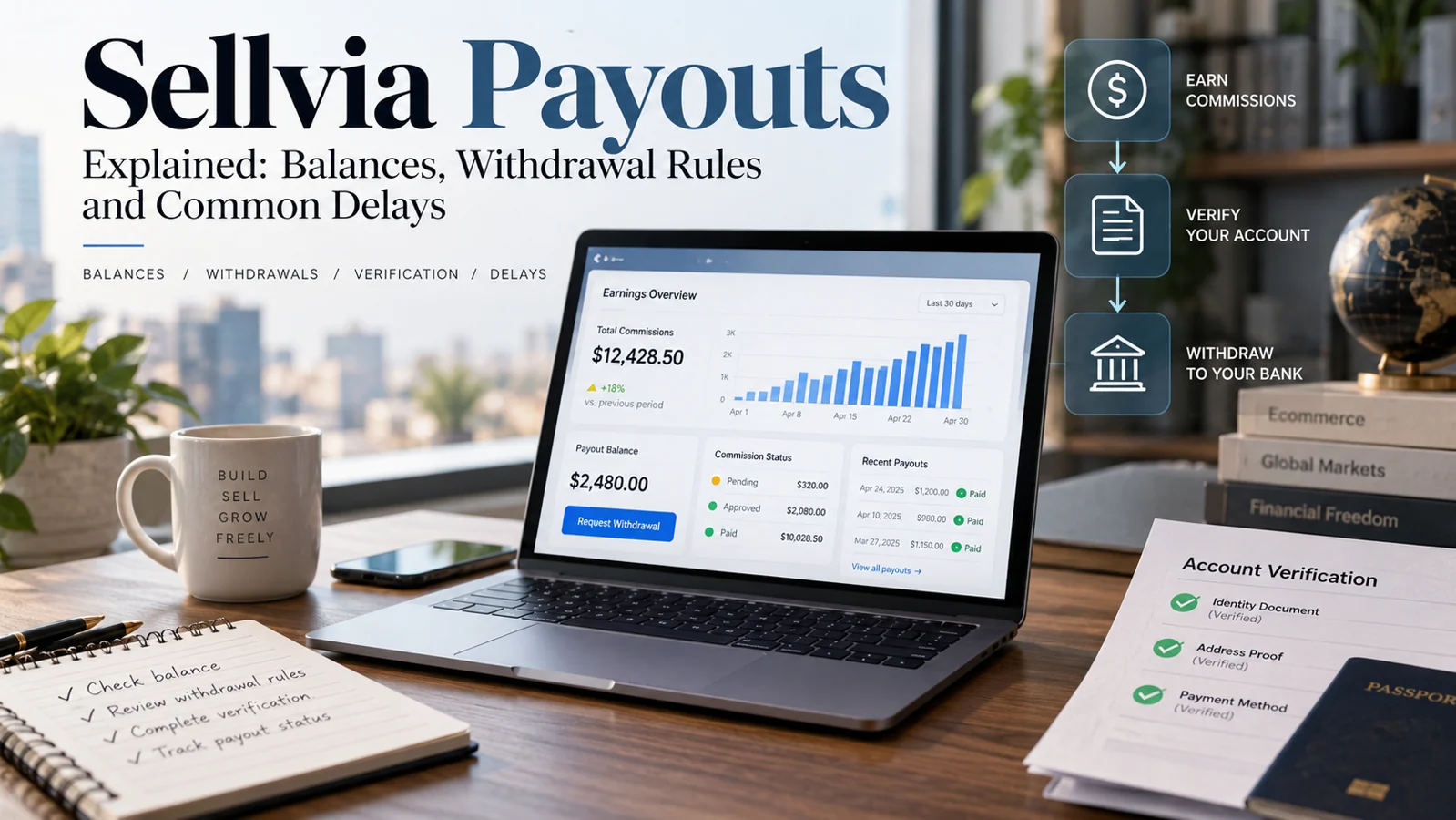
Quick answer: Sellvia’s commission figure is not the same thing as withdrawable cash. Under the current Sellvia Terms of Use, commission is an internal, Sellvia-funded promotional incentive. It can move from Pending to Incoming, and, after eligibility checks, to Available status. The first allocation may be staged, while the remainder can remain subject to a validation period of up to 125 days. Redemption requires an active, fully paid subscription, processed orders, identity verification and approval. Published minimums are $100 for US residents and $300 for residents of other countries, subject to a cancellation-window exception. Different payout routes have different fees.
A number on the dashboard is not necessarily cash ready to withdraw
The easiest way to misunderstand Sellvia’s earnings interface is to read every displayed commission amount as money that can immediately be sent to a bank. The current contractual model is more specific. Sellvia records commission as a promotional incentive linked to qualifying activity in its ecosystem, checks that activity, determines allocation, and permits redemption after its eligibility process is completed.
That distinction is useful when planning a store’s cash needs. If an account shows a large total across multiple statuses, only the portion classed as Available can potentially be submitted for redemption. Even then, approval and verification remain required. A store owner who budgets future expenses against all recorded commission may find a mismatch between expected and available resources.
This article follows the current official Terms of Use rather than relying on older tutorials that may describe different thresholds or treat commission as conventional customer-payment settlement. It is designed to make the process understandable, not to suggest that commission amounts or payment dates are guaranteed.
How Sellvia describes its commission program
Sellvia operates a partnership or promotional program in connection with designated activity and orders in its ecosystem. The Terms define commission as a non-cash promotional incentive funded by Sellvia, rather than an amount segregated from a shopper’s payment. The company says approved payouts are made from its own corporate operating funds. It also states that commission is not a bank balance, wallet, escrow arrangement, wages or settlement of customer sales revenue.
That legal characterization matters to an article about withdrawals. It would be inaccurate to describe Sellvia as a payment processor that holds a merchant’s end-customer revenue in custody until a payout day. The contract instead describes an internal incentive and a redemption process, with Sellvia as the eventual payer when the conditions have been met.
It is also important to distinguish commission-bearing ecosystem or storefront activity from a Customer Store Order in which the customer is the seller and receives the shopper’s payment directly. The official terms specify that commission does not arise for that latter category in the same way. Readers should check which order type is recorded in their own account before drawing conclusions from a sales dashboard.
Stage one: Pending Commission
Pending Commission is associated with orders that have not yet been processed under Sellvia’s procedures. Recording an order does not complete the lifecycle. A user can therefore see activity without having an amount ready to redeem. The pending status answers one narrow question: relevant activity has been associated with the account, but a required processing step remains incomplete.
For planning purposes, treat Pending as a tracked possibility subject to the contract, not a receivable that can be spent. If the status remains unchanged, check the related order processing requirements and any account notices. Support is better equipped to investigate a specific order identifier than a general statement that ‘the earnings are stuck.’
The order’s processing and approval stage also distinguishes the arrangement from instant merchant settlement. A paid customer order, a processed ecosystem order and approved promotional commission can be separate events. The exact path depends on the order category defined by Sellvia.
Stage two: Incoming Commission
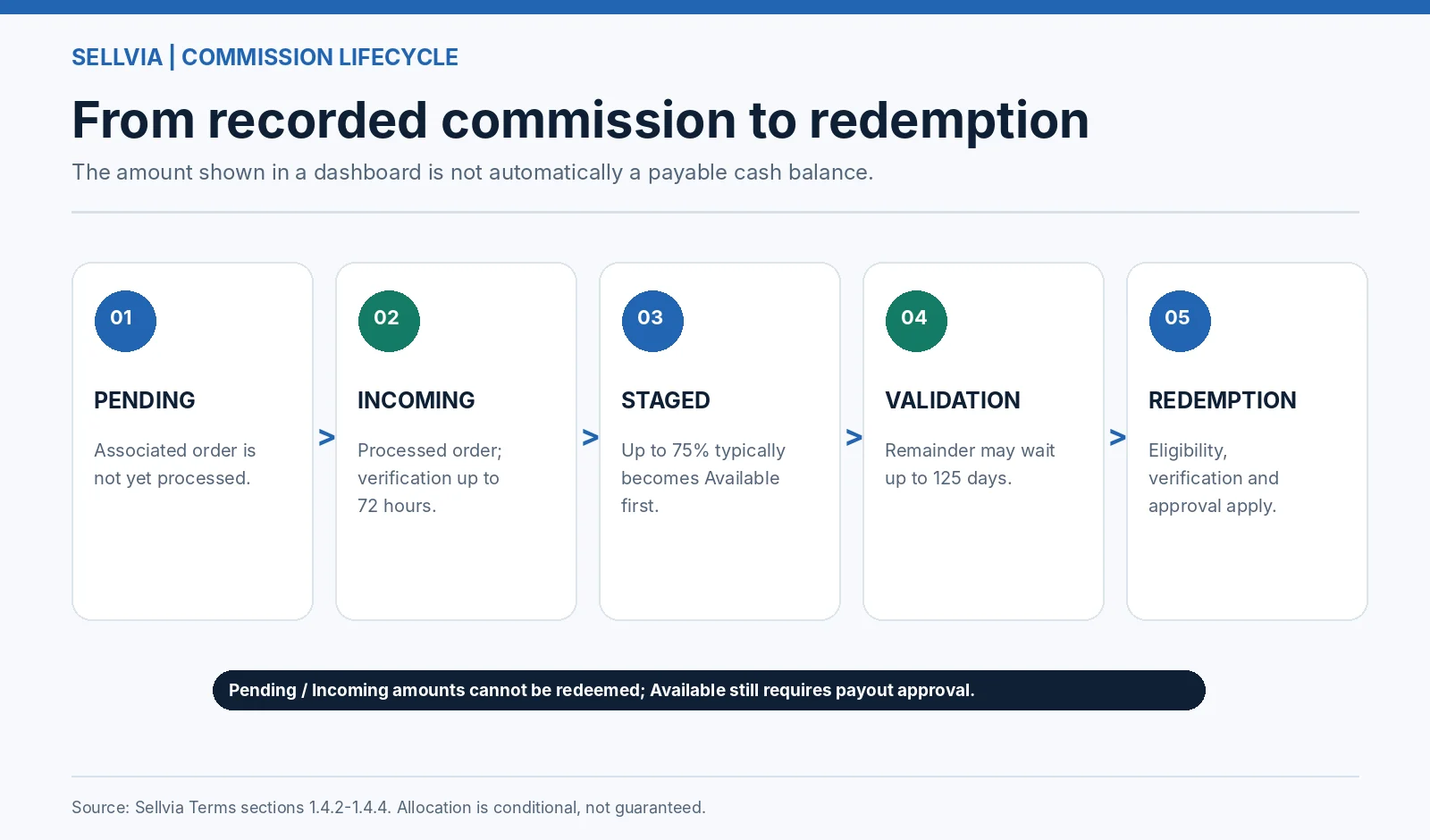
Once the associated order is processed, the commission moves to Incoming for verification. The current Terms describe an Incoming period of up to 72 hours. During that interval Sellvia may confirm order completion, attribution, eligibility and compliance with program rules, including anti-abuse controls.
The 72-hour figure should be read as the documented period for this status, not a guarantee that 100% of the recorded commission becomes redeemable in three days. The same Terms permit staged allocation and a separate validation window for a remaining portion. A dashboard total could include amounts subject to more than one stage.
If an owner expects immediate access based on a previous interface or third-party guide, this is the first point to review the effective contract. A statement about an old payout schedule cannot override the current structure displayed in the authoritative terms.
Stage three: Available Commission and staged allocation
Available Commission represents an incentive portion that has moved through the relevant status conditions and may be eligible for redemption. That word ‘eligible’ is essential. The amount is not automatically payable simply because the label says Available: the user still needs a valid request, account standing and approval.
Section 1.4.2 also describes progressive allocation. It states that typically up to 75% of attributed commission may transition to Available after the Incoming period, with the remainder awaiting allocation over a Commission Validation Window of up to 125 days from the qualifying attribution event. The percentage and duration are discretionary and can change depending on activity, account history, standing and risk indicators. It would therefore be misleading to present 75% as a guaranteed amount or 125 days as a universal fixed schedule.
A $500 example, without pretending the amount is guaranteed
Imagine a purely hypothetical qualifying commission event with an attributed amount of $500. If Sellvia applies the illustrative 75% staged allocation described in its current structure, up to $375 might become Available after the applicable initial verification. The remaining $125 could be held within the longer validation process. The contract allows different allocation outcomes and adjustments, so the figures are an arithmetic illustration rather than a forecast for any real account.
This is why multiplying sales events by a headline percentage can overstate what is available for an immediate request. Owners should monitor the status of each cohort of commission, not just one combined figure. A business plan that assumes all $500 can be paid the same week would not reflect the documented staged-allocation mechanism.
Eligibility for a redemption request
The current contract sets several conditions. The relevant Sellvia subscription must be active and fully paid at the standard plan rate, and orders associated with the Partner Account must have been fully processed according to Sellvia’s operating requirements. The user selects Redeem Commission in the dashboard and follows the on-screen request process.
The published standard minimum is $100 for US residents and $300 for residents of all other countries. Nationality, residence and chosen payment destination should not be casually treated as interchangeable. If the dashboard determines a minimum based on the account’s classification, follow the written policy and resolve any discrepancy before relying on the amount.
A request at the minimum does not mean the bank will receive that exact amount after fees. Redemption charges vary by method, and some have fixed or minimum fees. A reader comparing options needs to calculate the net result before clicking through.
Verification is part of the payout process
Sellvia requires successful phone-number and identity verification before it may approve redemption. The Terms list a $4.50 nonrefundable fee per identity-verification attempt. There is an exception when an attempt cannot be completed for a technical reason attributable to Sellvia or its verification provider, in which case that attempt is not charged under the described rule.
An unsuccessful attempt may mean the user has to submit documents again and incur another attempt fee. Identity mismatches, outdated documents, incomplete account details or a request for additional compliance information can complicate the process. The contract reserves discretion to request material related to fraud prevention, account security, tax reporting and administrative review.
Treat verification as a prerequisite to plan for rather than an emergency step at the end. Ensure legal name, contact information and documents are consistent before initiating redemption. Do not share identity documents with unofficial support accounts or third-party social-media contacts; use the legitimate account process.
The published redemption fee schedule
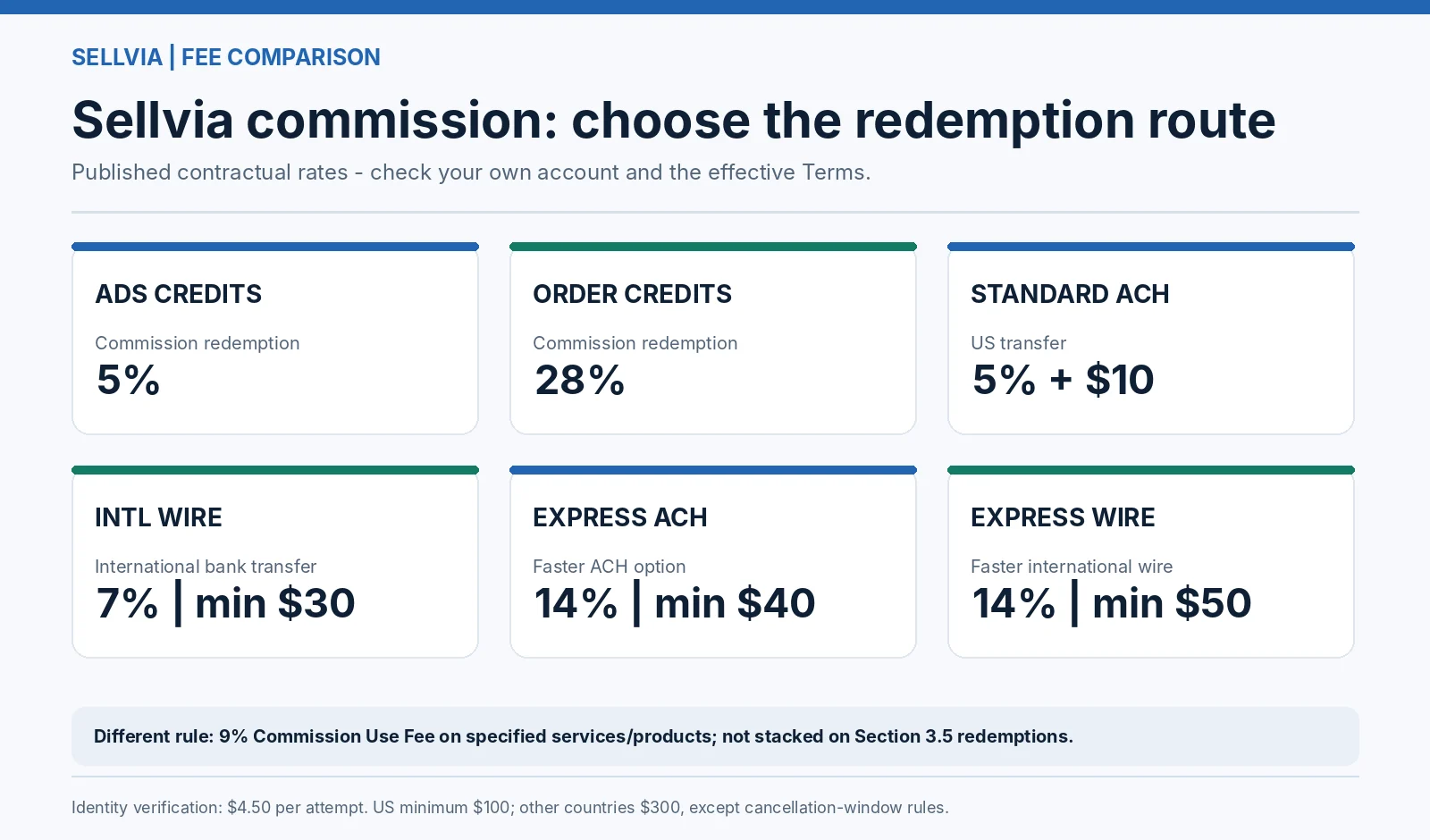
Section 3.5 of the current Terms lists different fee rates depending on how the commission is redeemed. Standard ACH is 5% plus $10, while an international wire is 7% with a $30 minimum. Express ACH is 14% with a $40 minimum; express international wire is 14% with a $50 minimum. The terms also describe redemption toward Ads Credits at 5% and Order Processing Credits at 28%.
These prices matter enough to warrant a full comparison rather than a vague statement that withdrawals may include fees. In particular, the difference between a percentage-plus-fixed charge and a percentage-with-minimum charge can be substantial for a smaller transfer.
A net-amount example for standard ACH
Suppose an eligible US account receives approval to redeem $500 through standard ACH, and the published 5% plus $10 structure applies. The fee is $25 + $10 = $35. The illustrative amount after that stated fee is $465. This example excludes any different provider-specific charges and assumes the user meets the program conditions. The numbers are not a promise that a $500 attributed event will yield $500 of Available Commission.
For $100, the same arithmetic gives a $5 percentage component plus $10 fixed, a $15 fee and $85 after the stated fee. This shows why a payout minimum should not be mistaken for a minimum net receipt. Whether a particular transfer route is offered depends on the user’s actual account and payment details.
An international wire comparison
For a hypothetical $500 approved international wire redemption, 7% is $35, exceeding the published $30 minimum. The resulting amount after the listed fee would be $465 before possible intermediary or conversion charges. For a hypothetical $300 redemption, 7% is $21, so the $30 minimum would govern instead, leaving $270 before other potential banking deductions.
On an express international wire, 14% of $500 is $70, higher than the stated $50 minimum. The comparison illustrates why choosing ‘express’ needs an actual timing benefit relevant to the recipient; it has a higher stated fee and is not a guarantee that every outside bank will settle instantly.
Commission redemption is different from spending commission
Sellvia offers internal credit redemption options and separately describes a 9% Commission Use Fee in Section 3.6 for commission used toward specified services, subscriptions or products. The crucial point is that the Terms explicitly say the Section 3.6 fee does not stack on redemptions covered by Section 3.5, including Ads Credits or Order Processing Credits purchases under that section. An article that adds 9% to every redemption would overstate the published charge.
Store owners comparing an advertising-credit option with an actual bank transfer should think in terms of what is being acquired. Advertising credit is not bank cash. Order-processing credit is not bank cash. Their value depends on intended future activity and the conditions of those credit services. A choice should reflect a genuine operating need rather than assuming every redemption route produces an equivalent financial result.
If an account has outstanding amounts owed to Sellvia, the terms also discuss how commission may be applied under specific provisions. Check the account breakdown and contract.
Why a redemption can take longer than expected
Several documented reasons can affect timing. Commission may still be Pending or Incoming. The allocation window for the remainder may not have finished. The subscription may not be in the required paid, active state. Related orders might still need processing. Identity verification may not be complete, or Sellvia may request further information before approving the request.
The Terms also reserve rights to delay, deny, adjust, suspend or reverse certain requests connected to suspected fraud, traffic manipulation, chargebacks, disputes, policy violations or unresolved account matters. Their dispute and notification wording is relevant to affected customers. None of these provisions proves that a specific account has an issue; they identify contingencies that can affect a payout.
Even after a request is approved and executed, the receiving financial institution may introduce processing time. The contract notes that transfers are executed through third-party payment providers. Therefore, ‘approved by Sellvia’ and ‘credited by the recipient bank’ are separate statuses. Anyone reporting a delay should first establish which stage has occurred.
What happens if the subscription is canceled?
Section 1.4.7 includes an unusually important provision: after subscription cancellation, expiry or termination, Sellvia says it will notify the user at the account email about Available Commission and the time allowed for redemption. A 14-day Redemption Period begins from that notice. During the period the normal $100/$300 minimums do not apply, although verification and other conditions still do.
This does not mean every recorded amount can be cashed out after cancellation. Pending, Incoming and unallocated commission do not become Available automatically. Amounts that fail to qualify and be redeemed within the relevant period can be forfeited under the contract. An already-submitted request may continue under the described conditions, but unresolved customer verification can still matter.
The document also distinguishes a subscription that is temporarily inactive due to an uncollected payment while Sellvia continues collection attempts from a formally canceled subscription. For that state the regular redemption requirement may prevent a request, while the cancellation period has not necessarily begun. Readers should not interpret every billing interruption as automatically starting the 14-day clock.
The practical cancellation checklist
If considering cancellation, export or record the commission status breakdown, check which amounts are actually Available, complete requested verification, note the exact email notification date and contact official support promptly if the timeline is unclear. Review whether any redemption request was already pending. Do not assume a future scheduled validation date extends the contractual redemption period after termination.
A transparent article should disclose these restrictions clearly even while explaining the program’s available redemption options. They are material to someone making a subscription decision.
How to keep a reliable commission ledger
For each meaningful commission event, track an order or attribution reference, recorded amount, processing status, Incoming date, any amount already Available, any remaining validation portion, requested redemption date, approved amount, stated fee, provider reference and final receipt date. A spreadsheet with those columns is more informative than a single total.
Separate recorded, Available, requested, approved and received. They are not synonyms. At the end of each month, reconcile dashboard activity against any bank entries or acquired service credits. This avoids treating gross commission as net cash and makes it easier to identify which stage requires attention.
For an owner buying advertising services, keep that expenditure in a separate operating-cost category. Do not subtract it invisibly from commissions and then call the remaining number profit. Gross incentives, service purchases, subscription costs and real expenses should each be visible in the model.
Does the structure benefit users?
A defined status model can make it easier to understand why a recorded event is not yet available, provided the dashboard labels and contractual disclosures are kept consistent. Sellvia also presents more than one redemption option, enabling eligible users to compare cash transfer routes with supported internal credits. Those operational choices are useful features for anyone actively working within the ecosystem.
The trade-offs are substantial enough to name. The program is discretionary, certain amounts can require a long validation period, fees are not negligible, verification is required, and cancellation can change the timeframe in which Available Commission can be redeemed. No amount or approval is guaranteed. A positive review should not erase those conditions; it should help an informed reader plan around them.
The most practical approach is to treat commission as a conditional incentive until each stage is resolved. Plan advertising and subscription spending with separate resources, and make a payout request based on confirmed eligibility rather than expected future allocations.
Before selecting Redeem Commission
Check that the subscription is active and fully paid. Confirm related orders are processed and the desired amount is actually labeled Available. Verify the correct residence-based minimum and that phone and identity checks are complete. Compare fee schedules using the net amount after the fee, not the gross amount shown in the field. Save the request reference and monitor each subsequent status.
If the dashboard appears inconsistent with the Terms, ask support to reconcile the discrepancy in writing and identify the effective policy. Keep a dated copy of the applicable fee schedule, particularly if a redemption is material to business finances. These are ordinary record-keeping steps, not a sign that a problem is inevitable.
FAQ
Is Available Commission guaranteed money in my bank account?
No. It is an internal promotional incentive eligible for a redemption request, subject to subscription, order, verification and approval conditions. Sellvia’s Terms state that commission is not customer funds held in custody.
Why is only part of the commission available after 72 hours?
The Terms describe staged allocation. Typically up to 75% may be allocated after the initial period, while the remainder can remain in a validation window of up to 125 days. The percentage and timing are discretionary and not guaranteed for every event.
Can I withdraw less than $300 outside the United States?
The normal minimum for residents outside the US is $300. Section 1.4.7 provides a specific exception during the 14-day redemption period following a cancellation-related notice, when standard minimums do not apply but other conditions remain.
Sources and further reading
Primary source: Sellvia Terms of Use, especially Sections 1.4.1 through 1.4.7 and Sections 3.5-3.6. Rates and eligibility rules are reported from the published contract and must be reconfirmed when a request is made. The financial examples are illustrative and do not represent a verified user payout.
Related EcomReality coverage: Sellvia Pricing Explained, Sellvia Product Catalog vs Creating Your Own Digital Products, and the Sellvia company profile.

Jo Carter is an editor and ecommerce researcher at Ecom Reality, where she covers ecommerce platforms, digital selling tools, online business software, pricing models, and emerging industry trends. She focuses on turning complex platform features and costs into clear, practical information for entrepreneurs and digital sellers. Her work combines detailed research with a balanced editorial approach, helping readers compare services, understand potential limitations, and choose tools that fit their business goals.
Comments
Related Articles



Leave a Reply