
When Shopify announced in 2022 that Oberlo – for years the dominant dropshipping tool in the Shopify App Store – was being discontinued, millions of merchants needed a replacement overnight. DSers stepped into that gap and has not looked back. Today it claims over 4.5 million dropshipping users, holds a near-perfect 5.0 rating on Trustpilot from over 5,400 reviews, and advertises itself as the official AliExpress dropshipping solution. For anyone entering the dropshipping space in 2026, DSers is almost impossible to avoid.
But popularity and quality are not the same thing. This review examines DSers honestly: its real capabilities, its structural limitations, where its pricing model creates problems, and what the billing complaints visible in independent reviews reveal about the platform’s actual relationship with its users. The platform is genuinely useful for a specific type of merchant. It is also tightly bound to a single supplier ecosystem, has generated a pattern of unexpected billing incidents, and carries a learning curve that its marketing understates.
We analyzed DSers’s official features and pricing, studied real user complaints across Trustpilot, the Shopify App Store, Reddit, Capterra, and G2, and present here a complete picture of what using DSers actually looks like in 2026.
WHAT DSERS IS AND WHERE IT CAME FROM
DSers was founded in 2018 and positioned itself from the start as an automation tool for AliExpress-based dropshipping. Its core thesis was simple: the biggest operational bottleneck for dropshippers sourcing from AliExpress was order processing. Placing individual orders one by one, copying addresses, selecting shipping options, updating tracking numbers – these tasks consumed hours every day as stores scaled. DSers automated the entire sequence.
The platform became the official AliExpress dropshipping partner, which gave it a formal relationship with AliExpress that competitors lack. When Oberlo shut down, DSers was the natural migration destination – it offered similar functionality, had AliExpress’s endorsement, and crucially, maintained a functional free tier that Oberlo-accustomed merchants could adopt without immediate additional cost.
Today DSers integrates with Shopify, WooCommerce, Wix, Squarespace, BigCommerce, Ecwid, TikTok Shop, and several other platforms. It supports managing up to 50 stores from a single dashboard on its Enterprise plan, handles bulk order placement across hundreds of orders simultaneously, automates tracking number synchronization, and provides a Supplier Optimizer that helps merchants find alternative AliExpress suppliers for their existing products.
The platform is entirely AliExpress-centric. That focus is both its greatest strength and its most significant structural limitation.
PRICING: WHAT THE FREE PLAN ACTUALLY GIVES YOU
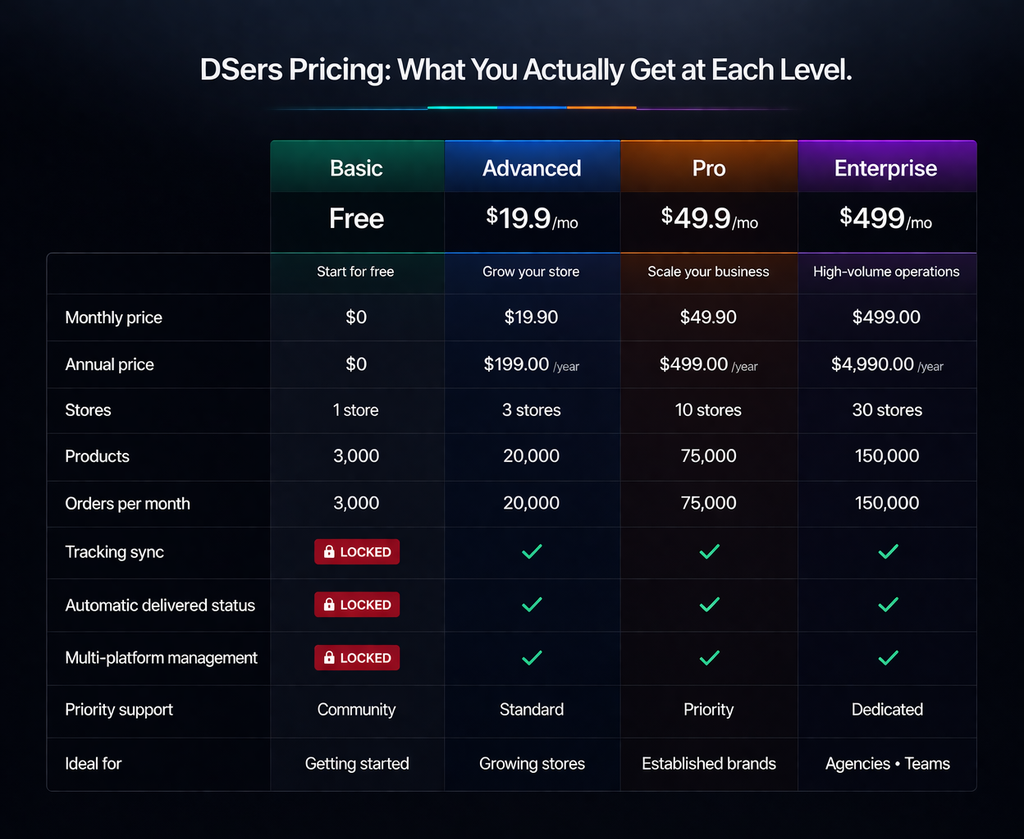
DSers offers four pricing tiers, and the free Basic plan is the platform’s primary acquisition tool.
The Basic plan is genuinely free with no time limit. For a beginner testing the dropshipping model, it provides access to AliExpress product importing, bulk order placement, 24/7 support, and management of up to 3 stores with up to 3,000 products. For many new merchants, this is sufficient to validate whether dropshipping as a business model works for them before committing to ongoing software costs.
The Advanced plan costs $19.9 per month and unlocks order tracking for customers, shipping rate calculations, 10 store management, 20,000 product limits, and a tracking page on your store’s domain. For merchants who have found product-market fit and are starting to handle meaningful order volumes, this is the logical upgrade.
The Pro plan costs $49.9 per month and adds multi-platform management across Shopify, WooCommerce, and Wix simultaneously, AI-assisted product title and description optimization (50 times per month), TikTok hot product research access, and support for 25 stores and 75,000 products.
The Enterprise plan at $499 per month is clearly positioned for high-volume operations managing 50 stores, 100,000 products, and requiring first-priority support with the full feature stack.
The pricing structure is competitive compared to alternatives. Zendrop’s equivalent paid tier runs $79 per month with no free plan worth calling functional. AutoDS charges comparably to DSers’s Pro plan but includes no meaningful free tier. DSers’s free-to-Advanced upgrade path is one of the most reasonable cost escalations in the dropshipping tool category.
However, the gap between the free Basic plan and the Advanced plan contains one feature that many new merchants discover they need almost immediately: order tracking. On the Basic plan, tracking number updates to your store are delayed to only 7 days and there is no automated delivery status synchronization. For merchants trying to provide professional customer service – responding to “where is my order?” inquiries – this limitation becomes apparent within days of receiving the first real orders.
THE ALIEXPRESS DEPENDENCY: A STRUCTURAL RISK
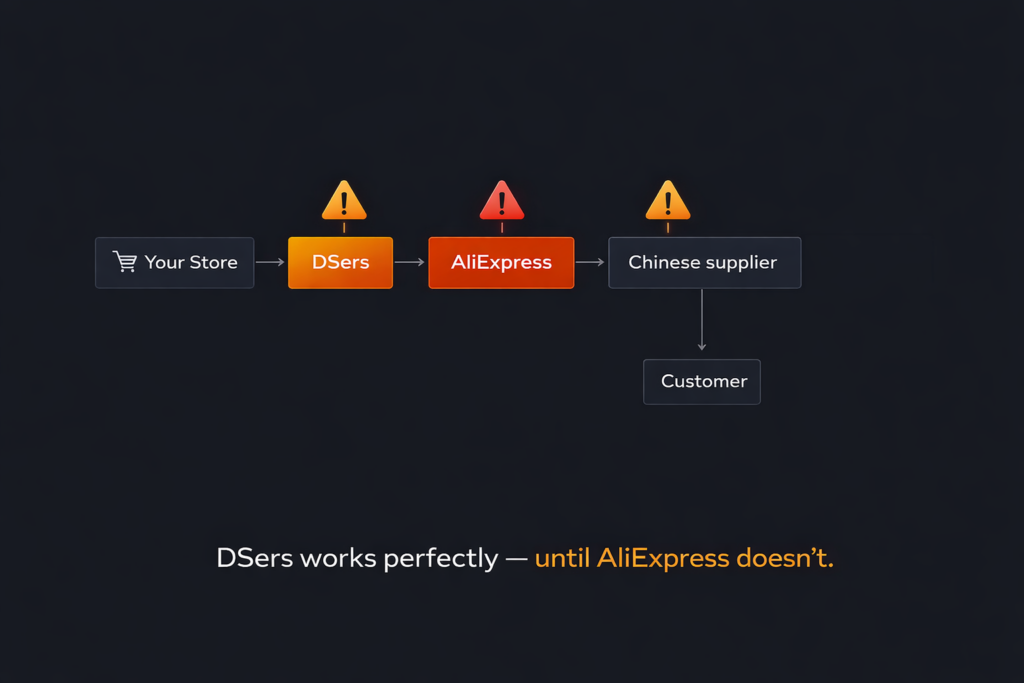
DSers’s most significant limitation is one it cannot change without becoming an entirely different product: it is exclusively tied to AliExpress as a supplier source.
This dependency creates a chain of risk that is easy to underestimate when first starting out. DSers works by connecting your store to AliExpress suppliers. When your customer places an order, DSers routes it to AliExpress, where you must have a valid account, sufficient payment method, and where the supplier must have the product in stock at the price displayed. If any link in that chain breaks, the entire fulfillment process stops.
AliExpress accounts can be restricted or suspended for various reasons: payment disputes, order cancellation rates, account security flags from multiple login locations, or country-based restrictions. DSers itself acknowledges this in its help documentation, maintaining articles about account restrictions for merchants in Russia-adjacent countries and countries with specific phone number format requirements. When an AliExpress account is suspended, DSers becomes non-functional – no orders can be placed regardless of subscription status.
The shipping timeline is a related structural issue. DSers’s shipping times are AliExpress’s shipping times. Standard China-to-US delivery on AliExpress typically runs 15-30 days. DSers offers no warehousing, no fulfillment infrastructure of its own, and no mechanism to accelerate shipping beyond what AliExpress suppliers themselves offer. For merchants whose customers expect Amazon-like delivery windows, this is a fundamental constraint that no amount of automation can solve.
As one independent analyst summarized: “DSers is tightly tethered to AliExpress, and the reliance on default, low-quality product descriptions means more manual editing than some might expect. The search functionality inside DSers replicates AliExpress rather than improving it, which feels like a missed opportunity.”
This is not a criticism of DSers specifically – it is accurate description of what the platform is designed to be. The issue arises when merchants enter expecting a broader dropshipping infrastructure and discover they have signed up for AliExpress automation, which is a narrower tool.
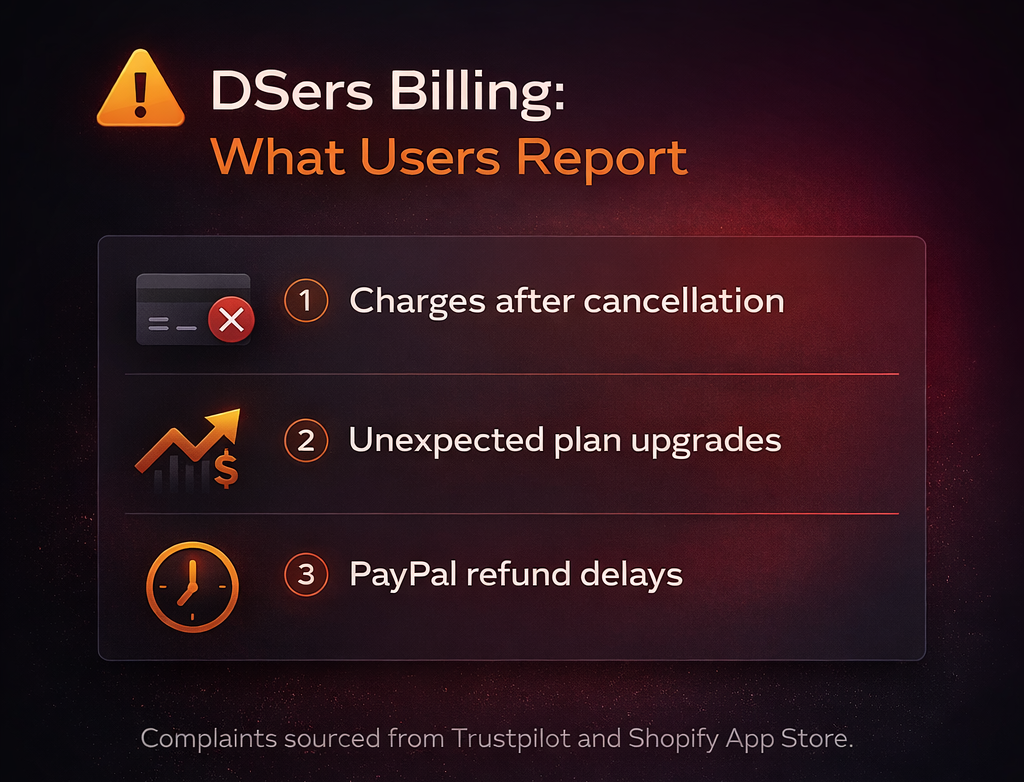
DSers’s near-perfect Trustpilot score obscures a pattern of billing complaints that appears consistently across independent review platforms. These complaints are not the majority experience – but they follow a specific, recurring structure that prospective users should understand before entering payment details.
The most common complaint type involves charges appearing after cancellation. One Shopify App Store reviewer wrote: “I signed up with the basic plan (12/2024) which is ‘forever free’ and cancelled the plan shortly after AND UNINSTALLED the app as I didn’t think this company would be the right fit for the business I’m trying to get into. Today 17/01/2025, my bank account was charged $49.90 for a pro plan that I did not subscribe to. This is absolutely ridiculous. Why would you charge me for a plan I DID NOT subscribe to?”
A similar pattern was documented by a Trustpilot reviewer: “I installed DSers just to test the app during the free plan period. After testing, I realized it wasn’t suitable for my business needs, so I uninstalled it immediately. To my surprise, DSers still charged me $47 USD, even though I never used any paid plan. What’s worse – they admitted it was their mistake, but they told me I must pay first before they could issue a refund.”
A third complaint type involves refund processing failures through PayPal specifically. One Trustpilot reviewer documented a situation where they canceled a trial subscription properly but waited almost a month for a refund. DSers support repeatedly replied that they had forwarded the issue to an internal team, but no refund appeared. The reviewer noted: “What concerns me most is that DSers continues to accept PayPal payments and advertise PayPal as a payment method, while openly admitting they are currently unable to process refunds through PayPal.”
It is important to contextualize these complaints. DSers has over 4.5 million users, and the volume of billing complaints across all platforms represents a very small fraction of that base. DSers also responds to many of these complaints and in several documented cases does issue refunds. The pattern is not evidence of systematic fraud – it appears to reflect a subscription management system that does not always correctly cancel when merchants uninstall the app or cancel through the Shopify interface rather than through DSers’s own account panel.
The practical guidance: always cancel your DSers subscription through DSers’s own account settings, not just by uninstalling from Shopify. Screenshot the cancellation confirmation. Monitor your bank statement for at least two billing cycles after cancellation.
WHERE DSERS GENUINELY EXCELS
Having examined the limitations honestly, the platform’s genuine strengths deserve equal space – because they are real and meaningful for the right user.
Bulk order processing is DSers’s defining feature and it works as advertised. The ability to place hundreds of AliExpress orders simultaneously, with automated address entry, shipping method selection, and payment processing, fundamentally changes the operational reality of running a dropshipping store. Merchants who have manually placed AliExpress orders one by one report that DSers saves several hours per day at meaningful order volumes. This time savings has real dollar value.
The Supplier Optimizer is genuinely useful. The ability to find alternative AliExpress suppliers for any product with a single click – and switch to them without changing anything on your store – provides meaningful protection against supplier disruptions. When a primary supplier runs out of stock, increases prices, or starts receiving poor reviews, DSers allows merchants to migrate to an alternative supplier without creating new product listings or updating store content.
Multi-store management from a single dashboard is a real operational advantage for merchants managing multiple stores or selling across different niches. The ability to switch between stores, import products, and process orders from one interface – rather than logging in and out of multiple Shopify or WooCommerce accounts – saves meaningful time.
The free plan is genuinely functional for testing. Unlike many “free” plans that are effectively non-functional demos, DSers’s Basic tier allows real order processing, real product importing, and real store management for up to 3 stores with 3,000 products. A merchant can validate their entire dropshipping concept without paying anything.
The Shopify App Store rating reflects something real. DSers has maintained a 5.0 rating on Shopify with over 19,000 reviews, and the positive reviews consistently name specific support agents – Holly, Fiona, Blanca, Rapheal, Vivian, Lucy – who resolved specific problems. This level of specific, personal praise is difficult to fabricate at scale and suggests the support team has genuine quality.
THE LEARNING CURVE REALITY
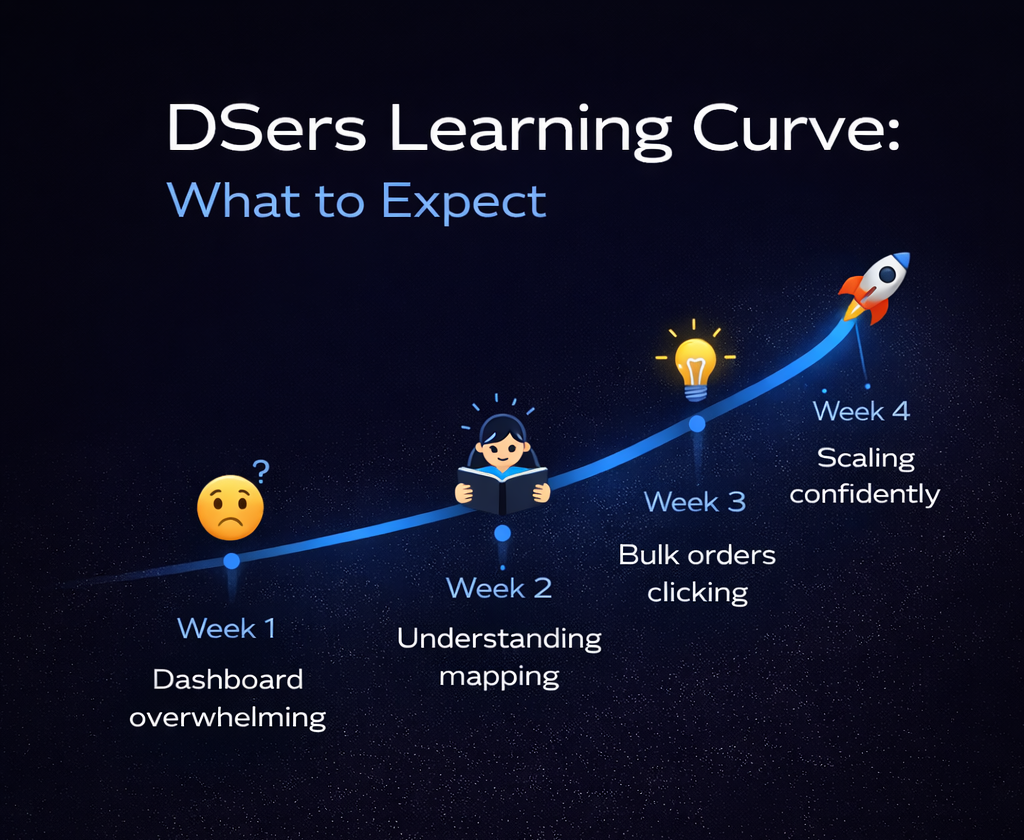
DSers’s marketing emphasizes ease of use, and for experienced dropshippers or those familiar with AliExpress, the learning curve is genuinely manageable. For absolute beginners, the dashboard is more complex than the platform’s promotional materials suggest.
The concept of “mapping” – connecting your store’s product variants to specific AliExpress supplier variants – is not intuitive to newcomers. Getting it wrong results in customers receiving different product variants than what they ordered. Understanding the difference between Basic Mapping, Advanced Mapping, and BOGO Mapping, and knowing when each applies, takes time to internalize.
The Chrome extension, which allows importing products directly from AliExpress to DSers, is a key part of the workflow but requires a specific browser setup that creates friction for users who are not comfortable with browser extensions. Some Capterra reviewers noted login issues that appear intermittently and require troubleshooting that is not always covered in the documentation.
As one Capterra reviewer noted: “DSers has a learning curve, especially for users who are new to dropshipping or using automation tools.” Another noted that the “interface is difficult to manage at the beginning” before becoming intuitive over time.
The support team’s quality partially compensates for this. Many of the positive reviews describe support agents who walked users through setup step-by-step, including screenshots, which suggests the company is aware that its interface is not self-explanatory for new users and compensates with human guidance.
DSERS VS ALTERNATIVES: WHERE IT FITS
Understanding DSers requires placing it in context against the alternatives that merchants most commonly compare it to.
Against Zendrop, DSers wins on price (free vs $49-79/month) and loses on supplier quality and shipping speed. Zendrop offers vetted suppliers, US warehousing, 2-5 day US delivery, and custom branding. DSers offers AliExpress’s supplier network with its full range of quality variability and 15-30 day standard shipping times. For price-sensitive merchants or those still testing products, DSers’s free tier makes it the obvious starting point. For merchants who have validated products and need to build brand reputation around reliable delivery, Zendrop’s premium has a rational justification.
Against AutoDS, DSers wins on price and simplicity. AutoDS supports multiple supplier marketplaces (not just AliExpress), includes price and stock monitoring across those marketplaces, and offers a more sophisticated automation suite – but charges $9.90-$39.90 per month minimum with no meaningful free tier. DSers is the more accessible starting point for pure AliExpress dropshipping.
Against Spocket, the comparison is almost categorical: they serve different markets. Spocket focuses on US and EU suppliers with 2-7 day delivery times and premium pricing. DSers focuses on AliExpress with its cost advantages and shipping time tradeoffs. Merchants targeting customers who expect fast delivery should look at Spocket; merchants optimizing for margin with customers tolerant of longer shipping windows should look at DSers.
Against the legacy of Oberlo, DSers is its natural successor and in most respects an improvement. The features are comparable, the integration is tighter, and the free tier is more functional. Merchants who were comfortable with Oberlo typically adapt to DSers without significant friction.
WHO SHOULD AND SHOULD NOT USE DSERS
DSers works well for:
Beginners testing the dropshipping model. The free plan allows complete validation of a product concept without any software cost. The bulk order processing, product importing, and Shopify integration work on the free tier. There is no financial commitment while learning.
High-volume AliExpress dropshippers. The bulk order capability is genuinely transformative at scale. A merchant processing 200+ orders per day cannot afford to place them manually, and DSers’s automation saves hours of daily operational work.
Multi-store operators. The ability to manage multiple Shopify, WooCommerce, or Wix stores from a single dashboard, with a single product catalog and unified order management, is operationally significant for merchants running several parallel stores.
Price-sensitive operators with patient customers. If your customer base is price-sensitive and tolerant of 2-4 week shipping times, DSers’s cost structure – free or $19.9/month – combined with AliExpress’s vast product catalog and competitive pricing, creates a very low-cost operation.
DSers is not the right choice for:
Merchants who need fast US or EU delivery. DSers has no fulfillment infrastructure. Your shipping speed is AliExpress’s shipping speed. If your customers expect under-10-day delivery, DSers alone cannot deliver that without selecting specific AliExpress suppliers who ship from local warehouses, which represents a small fraction of the catalog.
Merchants wanting supplier diversity. DSers is an AliExpress tool. If you want to source from US suppliers, European suppliers, Alibaba, or other platforms, DSers does not serve those use cases. AutoDS or a multi-platform alternative would be more appropriate.
Merchants building premium branded experiences. DSers has no custom packaging, no private labeling, no thank-you card functionality. If brand presentation is central to your product positioning, a platform like Zendrop or Spocket is better suited.
Merchants uncomfortable with AliExpress account management. Because DSers depends entirely on an active, healthy AliExpress account, any issues with that account – payment problems, geographic restrictions, suspension – immediately halt all order processing regardless of your DSers subscription status.
THE BOTTOM LINE: WHAT DSERS IS AND IS NOT
DSers is a well-built, genuinely useful automation tool for a specific and clearly defined use case: high-volume AliExpress dropshipping through Shopify, WooCommerce, or Wix. Within that use case, it is probably the best available option at its price point, and the free tier is one of the most functional free plans in the entire dropshipping tool category.
The platform’s limitations are structural rather than executional. DSers cannot change the fact that AliExpress shipping takes 15-30 days. It cannot change the fact that AliExpress supplier quality is variable. It cannot solve the account dependency risk that comes with being tethered to a single external platform. These are features of the tool’s design, not bugs.
The billing complaints – unexpected charges after cancellation, refund delays through PayPal, charges after app uninstallation – represent a real pattern that prospective users should take seriously. The frequency is low relative to the user base, but the mechanic is consistent enough to warrant careful subscription management practices.
The 5.0 Trustpilot score should be read as reflecting what DSers does well: the support team is genuinely responsive and the core automation functions work reliably. It should not be read as indicating DSers is without limitations – the structural ones are real and documented.
For someone starting in dropshipping in 2026 with no budget for software, DSers’s free plan is one of the most rational starting points available. For someone who has validated products, is scaling toward meaningful volume, and wants faster shipping and brand differentiation, the calculus shifts toward platforms with fulfillment infrastructure. DSers excels at what it is. Understanding what that is, before committing, is the key to using it well.
This review is based on DSers official website, pricing documentation, and user reviews from Trustpilot, Shopify App Store, Capterra, G2, Reddit, and independent dropshipping review sites. No affiliate relationship exists with DSers or any competing platform.
One response to “DSers Review 2026: The Free AliExpress Tool That 4.5 Million Dropshippers Use – But Is It Enough?”
-
Pretty fair breakdown overall. The AliExpress dependency section is the part most reviews skip over and it’s honestly the most important thing to understand before signing up.
Tried DSers for a few months on the free plan. The bulk ordering works, no complaints there – that part genuinely saves time. But the 15-30 day shipping thing caught up with me fast. Customers don’t read product descriptions, they just expect their stuff in a week, and no automation tool fixes that.
The mapping system is also way more confusing than it needs to be for beginners. Took me a solid week to stop making mistakes with variants. Support was helpful when I reached out but it shouldn’t require support to figure out a core feature.
The billing complaints in this review line up with what I’ve seen others post on Reddit too. The “uninstall doesn’t cancel” thing is a known issue at this point – Spocket has the same problem. You’d think after 4.5 million users they’d just fix it.
Good starting point if you’re testing and have zero budget. The second your customers start asking where their order is, you’ll be looking at other options.


Jo Carter is an editor and ecommerce researcher at Ecom Reality, where she covers ecommerce platforms, digital selling tools, online business software, pricing models, and emerging industry trends. She focuses on turning complex platform features and costs into clear, practical information for entrepreneurs and digital sellers. Her work combines detailed research with a balanced editorial approach, helping readers compare services, understand potential limitations, and choose tools that fit their business goals.
Comments
Leave a Reply
Related Articles



Leave a Reply