
Every dropshipping beginner eventually arrives at the same crossroads: AliExpress is too slow and unpredictable, but what is the alternative? Zendrop positions itself as the answer to that question. Trusted by over 3,000,000 sellers according to its homepage, marketed as “The #1 high margin dropshipping platform,” and backed by a Trustpilot score that most ecommerce companies would envy, Zendrop has become one of the most recommended dropshipping tools in the space.
But the dropshipping industry is also one of the most affiliate-saturated corners of the internet. When the people recommending a platform are earning commissions to recommend it, independent analysis becomes harder to find. This review is not sponsored, we have no affiliate relationship with Zendrop, and our goal is to answer the question that actually matters: is Zendrop worth the money in 2026, or is it a polished middleman charging premium prices for a service that cheaper alternatives can match?
We studied Zendrop’s official pricing and feature claims, analyzed real user complaints from Trustpilot, the Better Business Bureau, Reddit, and the Shopify App Store, and identified the recurring patterns – both positive and negative – that independent reviewers consistently document.
WHAT ZENDROP IS AND HOW IT WORKS
Zendrop is a dropshipping fulfillment platform that connects Shopify store owners with suppliers, primarily based in China and the United States. Founded in 2019 under the name Silkroad by dropshippers who were frustrated with AliExpress’s unreliable shipping and supplier communication, the platform rebranded to Zendrop after early growing pains and has since grown to become one of the largest players in its niche.
The core proposition is simple: instead of manually ordering from AliExpress suppliers, waiting weeks for delivery, and dealing with inconsistent product quality, merchants use Zendrop’s dashboard to import products into their Shopify store, set prices, and let Zendrop handle fulfillment automatically when orders come in. Automated order processing, tracking number updates, and supplier communication all happen within the platform.
Zendrop also offers several features beyond basic fulfillment: a product discovery tool updated weekly with trending items, US-based warehousing for faster domestic shipping, custom branding and packaging options, print-on-demand services, AI-built store creation, and an educational component called Zendrop Academy with weekly coaching calls.
It is a broad platform, and that breadth is both its appeal and one of its complications.
PRICING: WHAT YOU ACTUALLY PAY
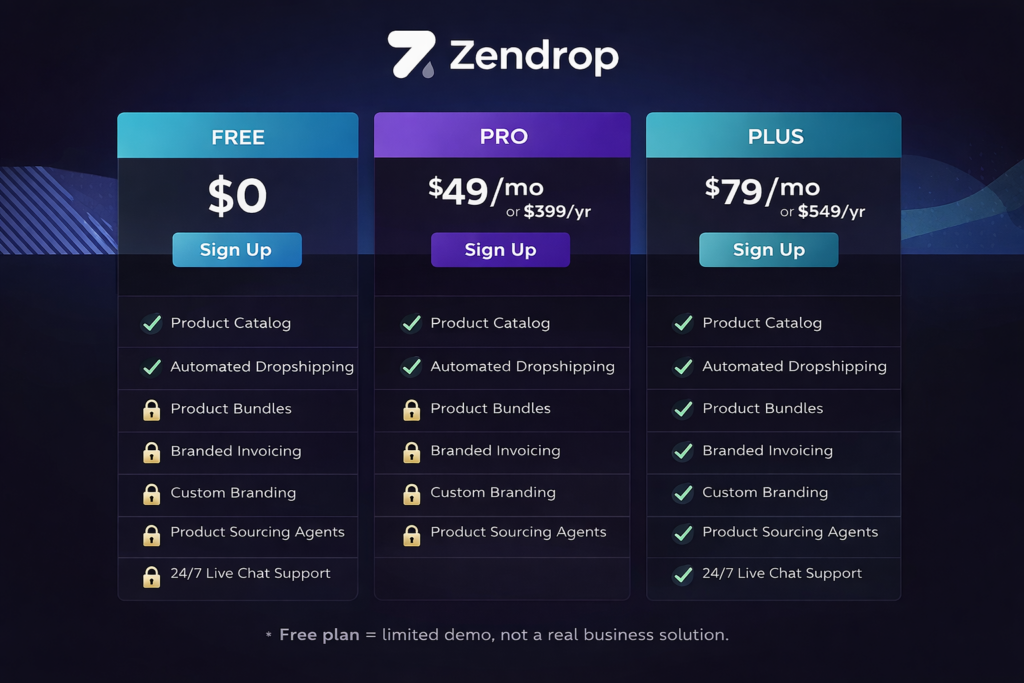
Zendrop operates on a freemium model with three tiers.
The Free plan costs nothing but provides genuinely limited functionality. There is no automated fulfillment on the free plan – every order must be processed manually. Access to US products, top winning products, and key features like Zendrop AI are locked behind paid tiers. The free plan works reasonably well as a way to explore the dashboard and import a product catalog, but it is not a viable long-term solution for a growing store.
The Pro plan costs $49 per month, or $399 billed annually. This unlocks automated fulfillment, US products, access to winning products, live coaching calls, and Zendrop Academy. For most merchants who commit to the platform, this is the entry point to actually using it properly.
The Plus plan costs $79 per month, or $549 billed annually. It adds additional sales tools and is positioned as the premium tier for scaling sellers. Multiple independent reviewers have noted that the difference between Pro and Plus is not significant enough to justify the $30 per month premium for most use cases.
One critical detail that Zendrop’s marketing does not prominently feature: the platform charges separately for order fulfillment itself. The subscription fee buys access to the platform and its features. The actual cost of each product – including product price and shipping – is paid on top of the subscription. A merchant on the Plus plan at $79 per month is still paying per product, per order, on every sale.
This matters because Zendrop’s product pricing is consistently cited as a pain point in independent reviews, which we examine in detail below.
THE PRODUCT PRICING PROBLEM: THE MOST CONSISTENT COMPLAINT
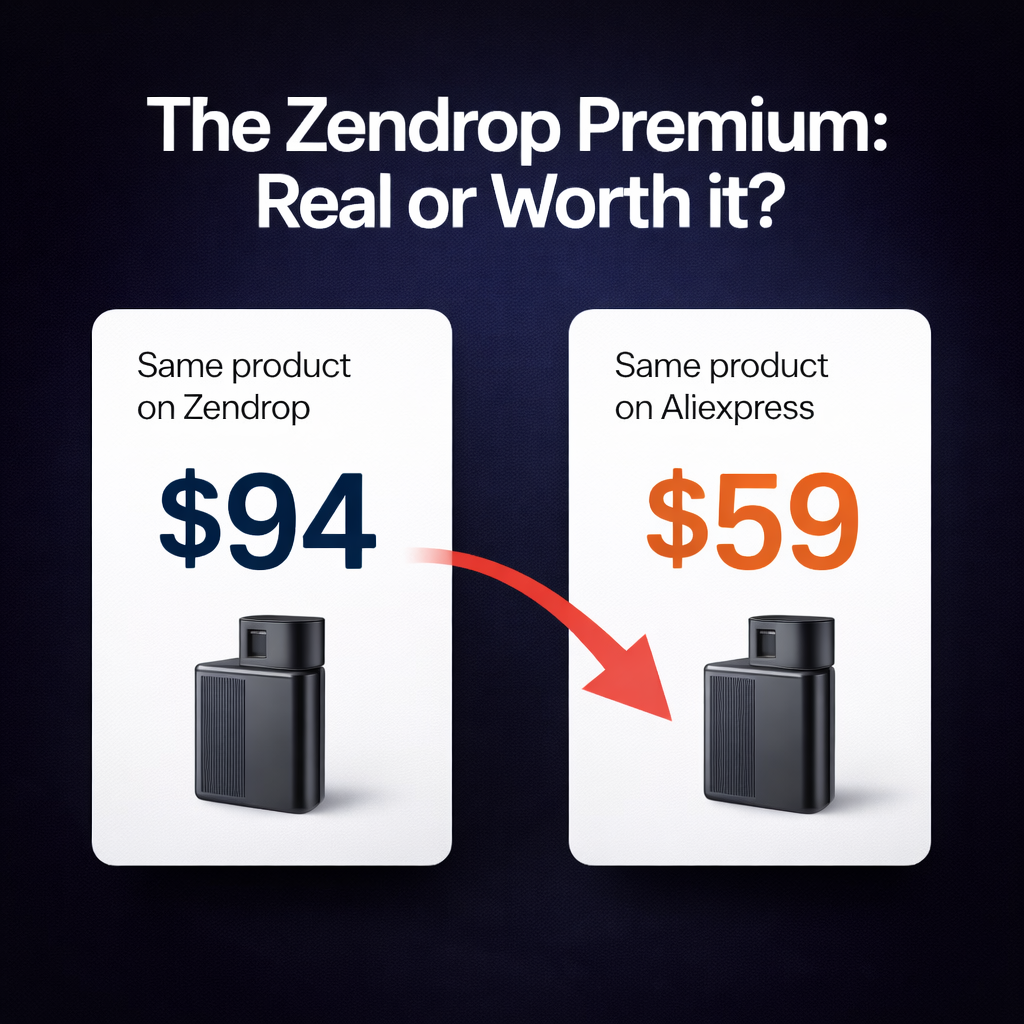
The single most consistent criticism of Zendrop across Reddit, Trustpilot, and independent review sites is that its product prices are significantly higher than what merchants can source directly from AliExpress or through competing platforms.
One Reddit user summarized the experience directly: “Every single product is so expensive you can’t make more than 20 something dollars profit and if you run ads, good luck with your store. You see a product 5-10 dollars and when you go on the page of the product it is like 20-30-15 dollars some crazy number for shipping.”
This is not a fringe complaint. Independent price comparisons consistently find the same pattern. A dog ball launcher on Zendrop, for example, was found to cost $94.38 including shipping, while the identical product on AliExpress with fast US shipping was available for $59.55. That $35 difference on a single product represents the Zendrop premium – the cost of faster shipping, supplier reliability, and the platform’s middleman margin.
A Shopify App Store reviewer put the core issue plainly: “Their prices are heavily marked up, which kills profit margins, and the limit of 20 sourcing requests per month is very restrictive if you’re actively testing products.”
The important counterargument, which some merchants make honestly, is that the comparison is not apples to apples. Zendrop’s sourcing goes through vetted suppliers with quality control, and its shipping times are meaningfully faster than standard AliExpress. One merchant noted: “Honestly, we thought Zendrop products were too expensive and delivery time was relatively long, BUT their customer service is really great and the suppliers are reliable, so it’s really worth it.” For merchants who have lost sales and customers to AliExpress shipping disasters, paying a premium for reliability is a reasonable business decision.
The honest calculation is this: if your product sells for $60 and costs $20 on AliExpress versus $35 on Zendrop, the question is whether faster, more reliable shipping generates enough repeat business and fewer refund requests to justify the $15 per unit margin compression. For some businesses, the answer is yes. For others, especially those with thin margins or in competitive niches, Zendrop’s pricing makes profitable advertising almost impossible.
SHIPPING: FASTER THAN ALIEXPRESS, BUT NOT ALWAYS RELIABLE
Zendrop’s shipping is genuinely better than standard AliExpress in most cases. For China-sourced products, the platform advertises an average of 10-12 days to the US, compared to AliExpress’s 15-30 day range. For products stocked in US warehouses, Zendrop offers 2-5 day delivery – a significant competitive advantage for merchants selling to American customers who expect Amazon-style speed.
However, the shipping reliability complaints in independent reviews reveal a more complicated picture than the marketing suggests.
A Reddit user documented one of the most common failure scenarios: “I had customer orders placed, I upgraded my Zendrop plan, and bought express shipping. I received notifications that all orders were shipped out, and my customers did too. These orders were placed 3 weeks ago, and TODAY Zendrop emailed me saying the supplier doesn’t have the product and that all the orders are on hold. Absolutely awful customer service and completely unacceptable.”
This specific failure mode – orders confirmed as shipped, tracking numbers sent to customers, then orders put on hold due to supplier stock issues – appears with enough frequency in independent reviews to represent a real operational risk rather than isolated bad luck.
A Trustpilot review described a similar experience: Zendrop kept replying with the same generic message about investigating and contacting their China supplier for express shipping, but nothing actually happened. After more than a month, the only resolution offered was a refund of the amount paid to Zendrop – not the full amount the merchant would need to refund their customer.
The structural issue is that Zendrop acts as a middleman between merchants and Chinese factories or trading companies. When a factory runs out of stock, changes pricing, or delays production, Zendrop absorbs that uncertainty and must communicate it upstream to merchants – sometimes too slowly to prevent customer-facing problems.
For US-warehouse products, the reliability is considerably better. Merchants who build their catalog primarily around Zendrop’s US-stocked items report significantly fewer fulfillment issues.
THE BILLING COMPLAINTS: AN UNDERREPORTED PROBLEM
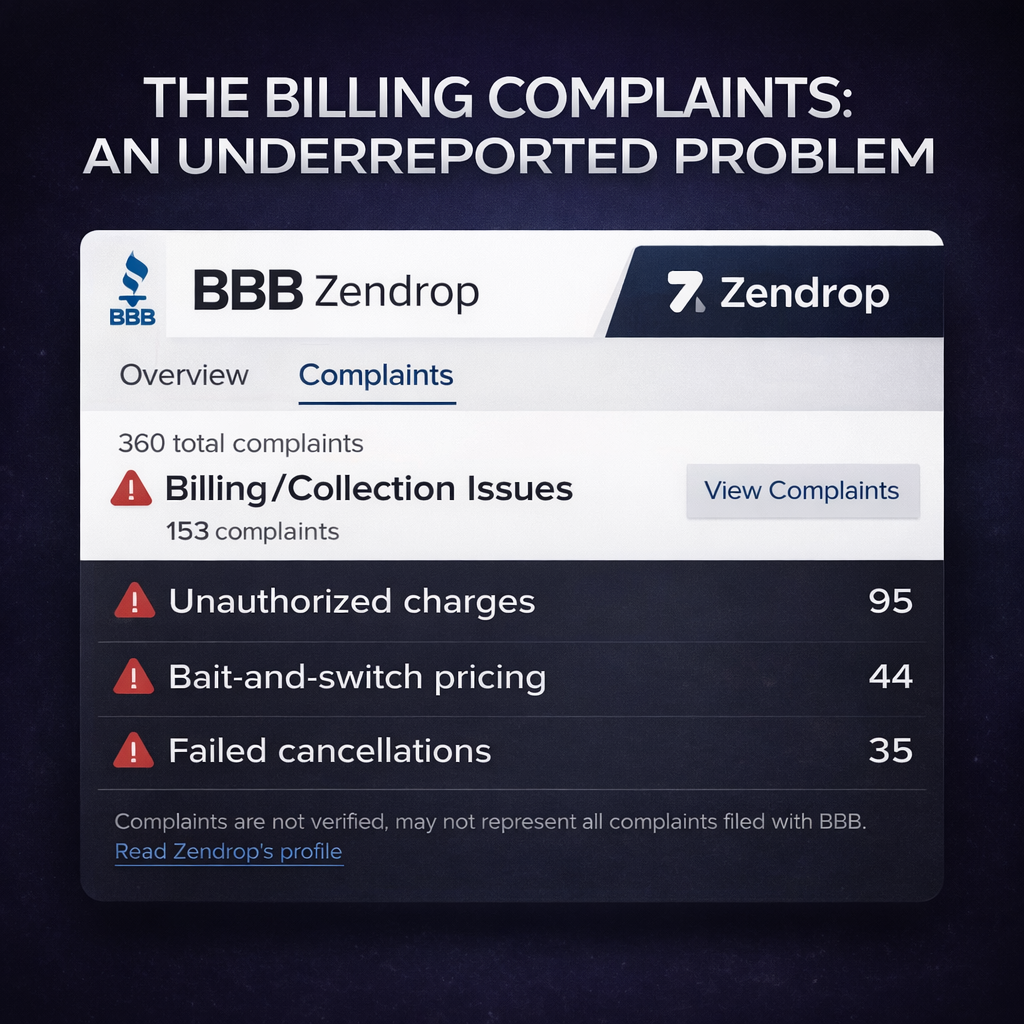
Beyond product pricing and shipping, a pattern of billing-related complaints in BBB filings and Trustpilot reviews deserves attention.
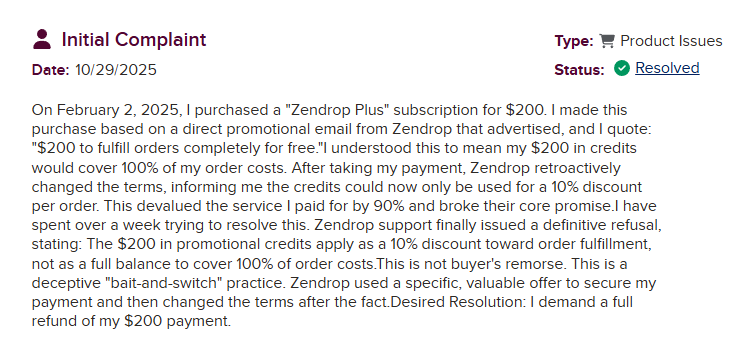
One BBB complaint documented what the merchant characterized as a bait-and-switch: purchasing a Zendrop Plus subscription for $200 based on a promotional email that advertised the credits would “cover 100% of order costs.” After payment, Zendrop changed the terms so the credits only applied as a 10% discount per order – a 90% devaluation of the benefit that originally prompted the purchase. Zendrop’s response acknowledged the policy had changed in May 2026, after the original purchase, but maintained the new terms applied.
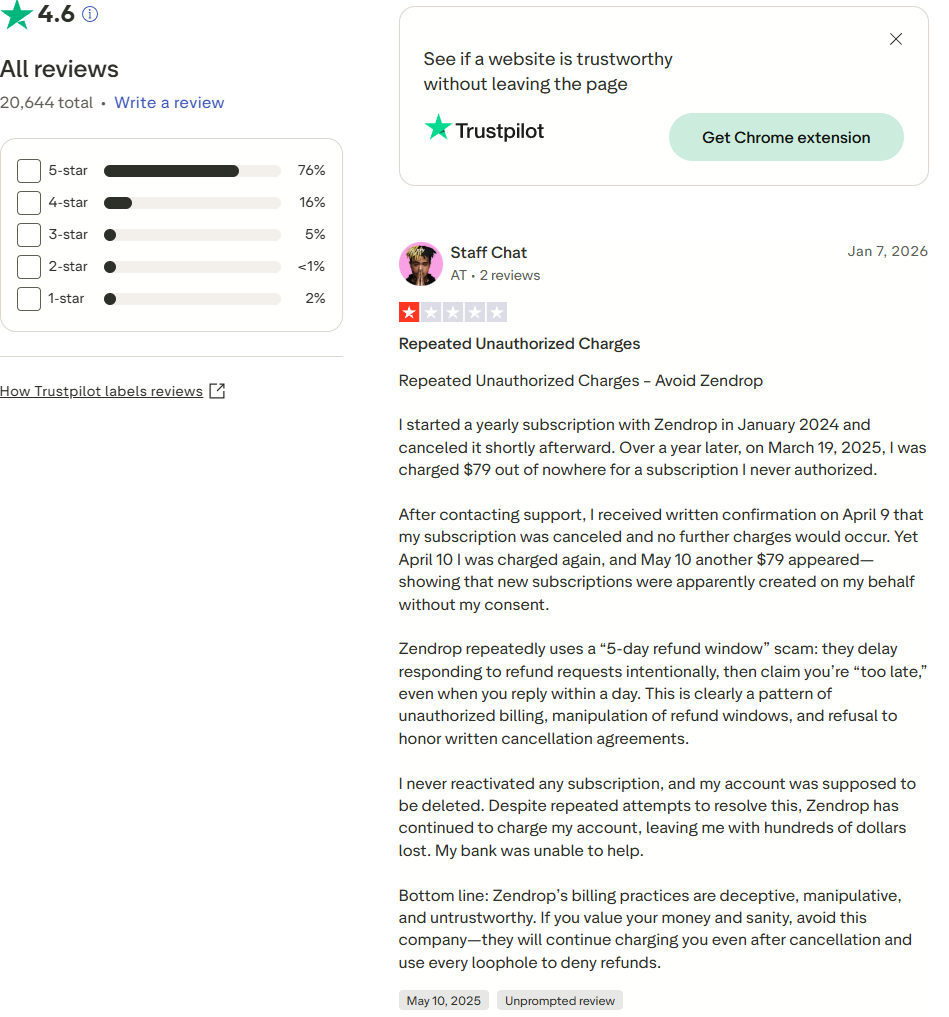
A Trustpilot reviewer documented repeated unauthorized charges: “I started a yearly subscription with Zendrop in January 2024 and canceled it shortly afterward. Over a year later, on March 19, 2026, I was charged $79 out of nowhere for a subscription I never authorized. After contacting support, I received written confirmation on April 9 that my subscription was canceled and no further charges would occur. Yet April 10 I was charged again, and May 10 another $79 appeared.”
A separate BBB complaint described being charged for a subscription on an account that, according to the login page, did not exist – making it impossible to cancel or dispute the charges through the platform’s own interface.
These are not the dominant experience – the majority of Zendrop’s reviews are positive. But the billing complaints follow a recognizable pattern: subscription cancellations that do not take effect, promotional terms that change after payment, and charges that continue after confirmed cancellations. Merchants considering Zendrop should use a credit card that allows easy dispute filing, monitor billing carefully after any plan changes, and screenshot any promotional terms before purchasing.
THE REVIEW ECOSYSTEM: UNDERSTANDING THE 4.6 TRUSTPILOT SCORE
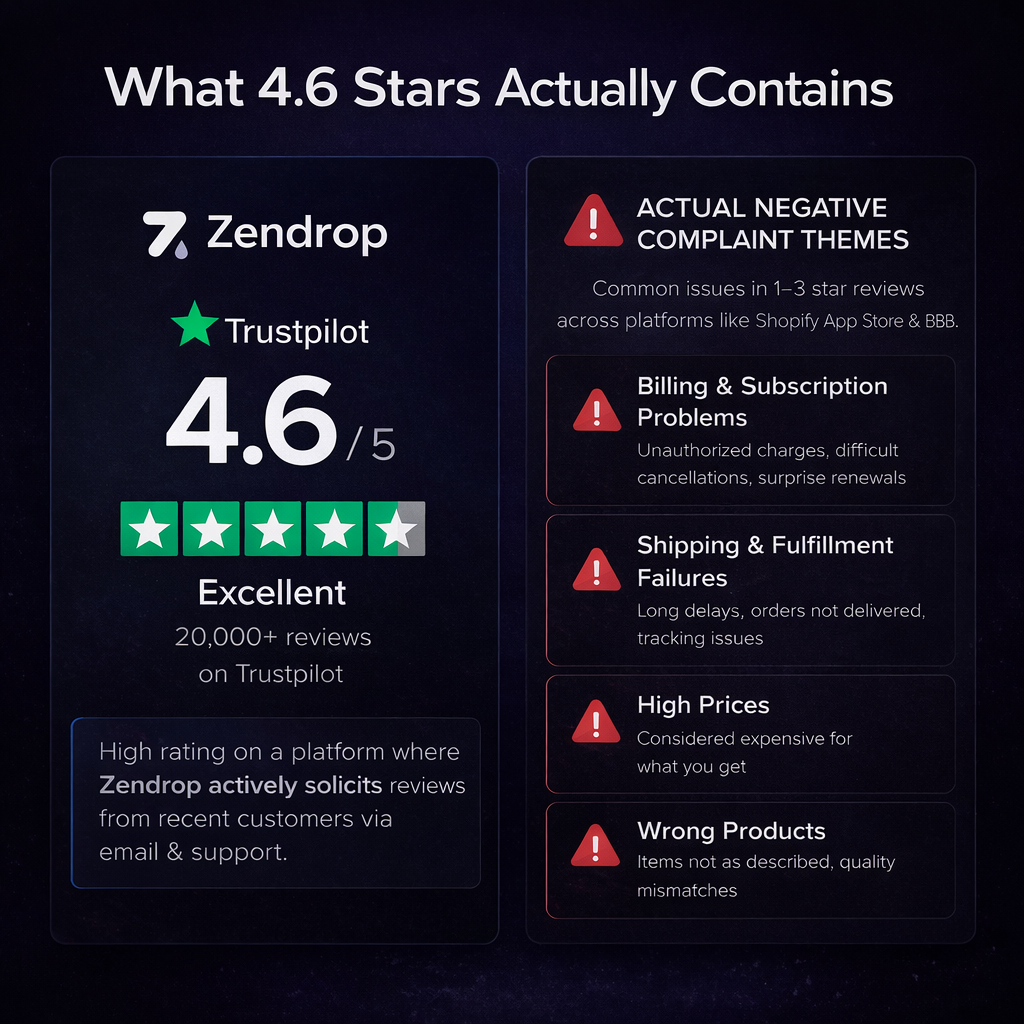
Zendrop’s 4.6 out of 5 rating on Trustpilot from over 20,000 reviews is impressive on its face. But understanding what that score represents requires context.
The dropshipping industry has a documented problem with review manipulation. Platforms in this space actively cultivate positive reviews through automated post-interaction emails, support agents who explicitly ask satisfied customers to leave reviews during chats, and affiliate programs that incentivize positive coverage. The negative reviews that do appear – billing complaints, fulfillment failures, pricing frustrations – represent merchants who were motivated enough by a bad experience to seek out the platform’s Trustpilot page and leave feedback despite no incentive to do so.
One independent reviewer who removed himself from Zendrop’s affiliate program to write an unbiased analysis put the question directly: “Given the notoriously low success rate in dropshipping, the probability of a platform in this space consistently earning so many 5-star ratings is questionable.” He noted that recurring complaints around product quality, long shipping times, unresponsive support, and refund issues appear in the lower-rated reviews, and suggested reading varied ratings for a more rounded perspective.
This does not mean Zendrop’s positive reviews are fake. Many appear genuinely enthusiastic, particularly about the customer support team – specific support agents are named by multiple positive reviewers, which is difficult to fabricate at scale. But a 4.6 score on a platform where the company actively solicits reviews from recently-helped users tells a different story than a 4.6 score accumulated entirely from unprompted customer initiative.
The most accurate read of Zendrop’s actual user satisfaction is probably somewhere between the 4.6 Trustpilot score and the more granular complaints visible in 1-3 star reviews on the Shopify App Store and BBB.
WHERE ZENDROP GENUINELY DELIVERS
Balanced analysis requires acknowledging where the platform earns its positive reviews – and there are real areas where Zendrop outperforms alternatives.
Customer support is consistently cited as a genuine strength. Unlike Shopify or WooCommerce, where support complaints focus on AI chatbots and unreachable humans, Zendrop’s support team receives specific, personal praise across hundreds of independent reviews. Support agents are named individually – Mariane, Darlene, Shiza, Jo – and multiple reviewers describe problems resolved within hours rather than days. For a platform serving beginners who encounter problems constantly, accessible human support has real value.
The US fulfillment option is a legitimate competitive advantage. Merchants who build their product catalog around Zendrop’s US-warehoused inventory can offer 2-5 day shipping to American customers – delivery speeds that make a meaningful difference in customer satisfaction and repeat purchase rates. For store owners targeting US consumers who compare everything to Amazon Prime, this is not a minor feature.
Automation genuinely works. Order processing, tracking number updates, inventory sync, and fulfillment – these function reliably for the majority of users. Merchants who have spent months manually ordering from AliExpress suppliers report that Zendrop’s automation saves significant time. The platform’s integration with Shopify is seamless and well-maintained.
Product discovery has real utility. The weekly updated trending products section, winning products list, and AI-powered recommendations give beginners a starting point that AliExpress’s overwhelming catalog does not. For someone who does not know what to sell, having curated product suggestions reduces the paralysis of infinite options.
Custom branding and thank-you cards allow merchants to build something that feels like a real brand rather than a generic dropshipping operation – a meaningful difference for long-term customer retention.
WHO SHOULD AND SHOULD NOT USE ZENDROP
Zendrop works well for:
Beginners who prioritize learning over margin optimization. The platform removes enough friction that a new dropshipper can focus on marketing and customer service rather than supplier logistics. The educational resources – Zendrop Academy, weekly coaching calls, the product discovery tools – add genuine value for someone starting from zero.
Merchants targeting US customers who need fast shipping. If your customer base expects under-a-week delivery and you can build margins around Zendrop’s US-warehouse pricing, the platform delivers on its core promise.
Sellers who have experienced AliExpress fulfillment disasters. For merchants who have lost customers and money to inconsistent AliExpress suppliers, Zendrop’s vetted network and responsive support represents a meaningful upgrade even at premium pricing.
Businesses building toward brand identity. Custom packaging, private labeling, and print-on-demand under one platform make Zendrop more useful as a brand-building tool than as a pure price-optimization platform.
Zendrop is the wrong choice for:
Price-sensitive merchants in competitive niches. If your product sells for $30 and Zendrop’s cost with shipping is $18 while AliExpress is $9, the math on advertising spend does not work. Zendrop’s premium is sustainable only when it is justified by meaningful differentiation in the customer experience.
Experienced dropshippers who source directly. As one independent reviewer noted, a dropshipper who has supplier relationships and understands logistics can source better products at lower costs with faster shipping than what Zendrop offers – and without paying $49-79 per month for access. Zendrop’s value proposition diminishes as merchants become more sophisticated.
Merchants with diverse, multi-niche catalogs. Zendrop’s catalog is strong in general merchandise categories but thinner in specialized niches. The 20 sourcing request limit per month creates a ceiling for active product testers. Merchants who need to test dozens of products monthly will hit that limit quickly.
THE BOTTOM LINE: IS ZENDROP WORTH IT IN 2026?
endrop is a legitimate, functional dropshipping platform that genuinely solves problems it claims to solve – for the right user. The automation works, the support is better than most alternatives, and the US fulfillment speeds are real. It is not a scam, and the majority of its users report positive experiences.
The honest caveats are equally real. Product prices are higher than direct AliExpress sourcing, often significantly so, which compresses margins in a business model that is already margin-thin. Shipping failures, while not the norm, follow a specific pattern – stock-outs discovered after orders are confirmed – that can damage customer relationships at exactly the wrong moment. Billing practices have generated enough complaints to warrant careful monitoring of charges. And the 4.8 Trustpilot score needs to be interpreted in the context of an industry with a documented review solicitation culture.
The platform makes most sense as a starting point rather than a permanent home. Zendrop reduces the friction of beginning enough that a new dropshipper can validate a product concept and learn the business without getting lost in supplier management. Whether it makes sense long-term depends on whether the margin compression is sustainable in your specific niche and whether you eventually develop the supplier relationships to source independently.
If you are seriously considering Zendrop, start with the free plan. It is limited but gives you access to the dashboard, the product catalog, and a sense of whether the platform’s catalog and pricing will work for your niche. Upgrade to Pro only after a real evaluation – and document any promotional terms before purchasing.
This review is based on Zendrop’s official website, pricing documentation, and analysis of user reviews across Trustpilot, the Shopify App Store, the Better Business Bureau, Reddit, and independent dropshipping review sites. No affiliate relationship exists with Zendrop or any competing platform.
3 responses to “Zendrop Review 2026: Is It Worth $79/Month for Dropshipping?”
-
Been using Zendrop for about 8 months on the Pro plan. This article pretty much nails it – especially the part about product pricing. Margins get squeezed hard compared to sourcing directly from AliExpress, and once you start running paid ads you really feel it.
On the plus side – support is genuinely good. Real humans, fast responses, not some useless chatbot. And the US warehouse is a lifesaver if you’re selling to American customers.
But yeah, I agree with the conclusion here. Zendrop is a solid starting point when you’re just getting into it, but eventually you start looking for ways to source directly. As a long-term solution at scale – it’s just too pricey. -
Really thorough breakdown, appreciated the honesty about the review ecosystem – thats the part most comparisons skip over. The margin compression point is what gets me. If you have to pay $49-79/month AND eat a premium on every product, the math gets brutal fast unless you’re already doing serious volume.
-
[…] fulfillment engine. For a broader examination of its plans, fulfillment model and limitations, see our independent Zendrop review and the Zendrop company […]



Jo Carter is an editor and ecommerce researcher at Ecom Reality, where she covers ecommerce platforms, digital selling tools, online business software, pricing models, and emerging industry trends. She focuses on turning complex platform features and costs into clear, practical information for entrepreneurs and digital sellers. Her work combines detailed research with a balanced editorial approach, helping readers compare services, understand potential limitations, and choose tools that fit their business goals.
Comments
Leave a Reply
Related Articles



Leave a Reply