
Introduction: This Is Not a Tool Comparison
Most comparisons between Zendrop and DSers fail for a simple reason: they treat both platforms as interchangeable utilities.
They are not.
At a superficial level, both platforms help you connect products to a store and fulfill orders. That is where the similarity ends. Underneath, they represent two fundamentally different approaches to handling uncertainty inside a commerce system.
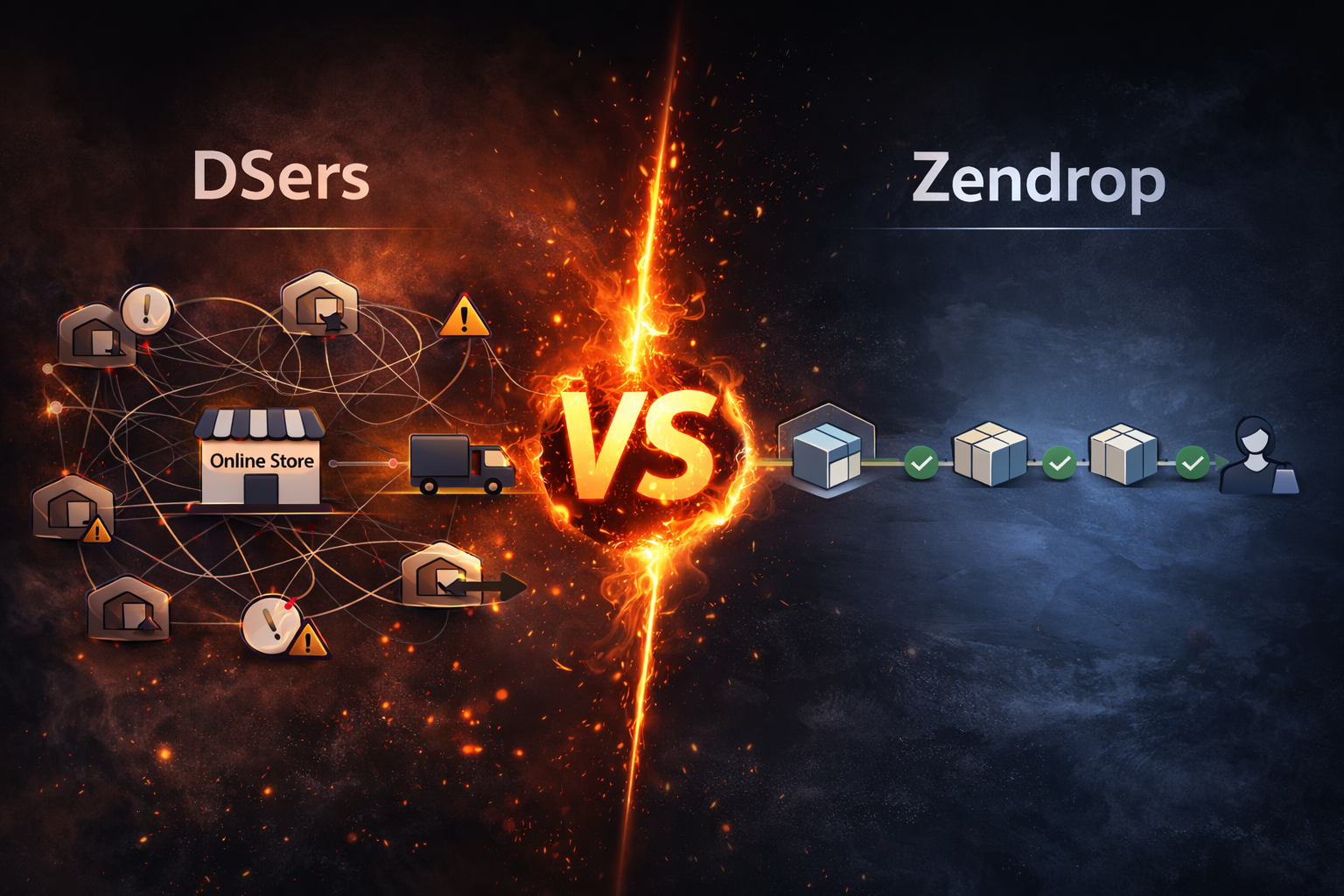
DSers is built on top of an open supplier marketplace. Zendrop is built as a controlled fulfillment environment. One exposes variability and gives you tools to manage it. The other reduces variability but replaces it with dependency.
This distinction is not cosmetic. It affects how margins behave, how risk accumulates, and what happens when something breaks under scale.
Understanding that difference is more important than any feature comparison.
The Architecture Layer: Visibility vs Abstraction
The cleanest way to understand DSers is to stop thinking of it as a fulfillment platform. It is not. DSers is a routing layer that sits between your store and the AliExpress ecosystem. Its job is to translate store orders into supplier orders as efficiently as possible.
What happens after that translation is largely outside of its control.
Every product you sell through DSers is tied to a specific supplier listing. That supplier controls inventory, processing time, packaging quality, and shipping behavior. DSers does not standardize these variables. It only helps you interact with them faster.
This creates a system where visibility is high but control is indirect. You can see which supplier you are using. You can switch suppliers. You can compare listings. But you cannot enforce consistency across them.
Zendrop approaches the same problem from the opposite direction. Instead of exposing the supplier layer, it compresses it into a managed pipeline. Orders enter the Zendrop system and are routed internally through its network. The supplier layer still exists, but it is abstracted away from the user.
This changes the nature of the system. You lose direct visibility into sourcing, but you gain a more standardized operational flow. Shipping times become more predictable. Tracking behavior is more consistent. The system behaves less like a marketplace and more like a controlled service.
This is the first real tradeoff: DSers gives you access to a fragmented ecosystem. Zendrop gives you a simplified version of that ecosystem, but on its own terms.
What Actually Happens After a Sale
The moment a customer places an order is where theoretical differences turn into operational reality.
With DSers, the order does not go into a unified system. It enters a chain of dependencies. The product must be mapped to a supplier. That supplier must accept and process the order. The shipping method must be selected, often based on incomplete or inconsistent information. Tracking must be generated, sometimes with delays or gaps.
Each of these steps introduces latency and uncertainty. Not catastrophic uncertainty, but cumulative friction. One supplier might process orders within hours, another within days. One might provide stable tracking, another might not update for several days. The system works, but it does not behave uniformly.
Zendrop reduces the number of visible steps. Orders are routed into its internal process, where supplier coordination, processing, and shipping are handled behind the interface. From the user’s perspective, the workflow is compressed. There are fewer decisions to make and fewer points where something can go wrong visibly.
However, the reduction in visible steps does not eliminate complexity. It relocates it. Instead of dealing with multiple independent suppliers, you are now dependent on how efficiently Zendrop’s internal system handles volume, inventory synchronization, and routing.
This is an important distinction. DSers distributes complexity across many small interactions. Zendrop centralizes it into one system.
When DSers has issues, they tend to be isolated. A single supplier underperforms, and you replace it. When Zendrop has issues, they tend to propagate across all orders because the system is unified.
Cost Structure: Why Subscription Price Is Misleading
One of the most persistent misconceptions in this comparison is the focus on subscription pricing. DSers is often framed as “cheap” because it offers a free tier, while Zendrop is framed as “expensive” because of its paid plans.
This framing ignores where money is actually lost.
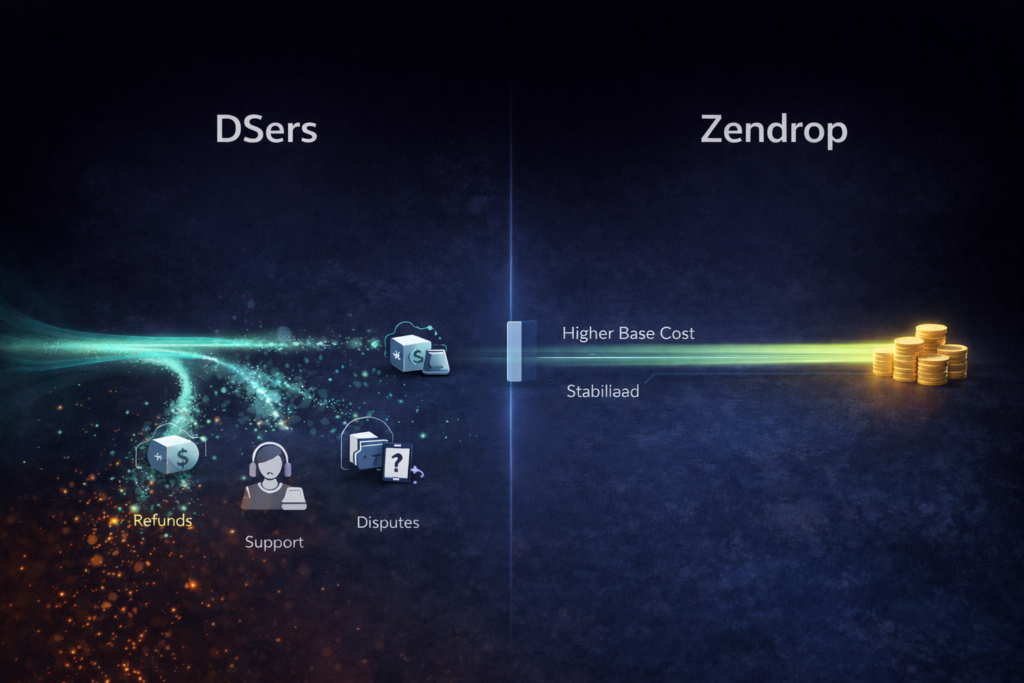
In a DSers-based workflow, the largest costs are not visible on the dashboard. They emerge from inconsistency. When shipping times stretch beyond expectations, refund requests increase. When product quality varies between suppliers, customer support load increases. When tracking is unreliable, dispute rates increase.
These costs are not line items. They are leakage. They erode margins gradually and unpredictably.
Zendrop addresses part of this leakage by standardizing fulfillment. Faster and more predictable shipping reduces refund pressure. More consistent processing reduces customer complaints. The system is designed to remove variability that translates into downstream cost.
But that stability is not free. It is embedded into product pricing. Zendrop products are typically priced higher at the base level, which reduces the maximum possible margin per order.
The result is a shift in where cost appears. DSers externalizes cost into operational friction. Zendrop internalizes cost into pricing.
This leads to a non-obvious outcome. DSers can appear highly profitable at low volume, because you are not yet experiencing the full impact of inconsistency. Zendrop can appear less profitable per order, but more stable as volume increases.
Margin Behavior Under Real Conditions
Margins are not static. They change depending on how a system behaves under pressure.
With DSers, margins are theoretically higher because product costs are lower and supplier competition drives pricing down. However, these margins are sensitive to disruption. A delay in shipping or a batch of low-quality products can convert a profitable campaign into a loss through refunds and chargebacks.
Zendrop reduces that sensitivity. By compressing fulfillment variability, it stabilizes the relationship between cost and delivery outcome. Customers receive products faster and more consistently, which reduces refund rates and improves retention.
But this stability comes with a ceiling. Because product costs are higher and less flexible, there is less room to absorb rising ad costs or aggressive discounting.
This creates two different margin profiles. DSers offers higher potential but higher variance. Zendrop offers lower potential but tighter control.
Neither is inherently better. They simply respond differently to the same pressures.
Supplier Layer: Flexibility vs Standardization
The supplier layer is where the philosophical difference between the two platforms becomes most visible.
In DSers, the supplier is an explicit part of your workflow. You choose it, evaluate it, and replace it when necessary. This gives you leverage. If one supplier raises prices or slows down, you can switch to another. If you find a better version of the same product, you can update your mapping.
This flexibility is powerful, but it comes at the cost of constant monitoring. The system does not enforce consistency, so you have to.
Zendrop removes most of that responsibility. Suppliers are integrated into its network, and the platform handles coordination. From the user’s perspective, this reduces decision fatigue. You do not need to evaluate multiple suppliers for the same product or worry about switching between them.
But the tradeoff is reduced agency. You are no longer negotiating with a market. You are operating within a predefined system.
This matters more as you scale. In DSers, scaling requires better supplier management. In Zendrop, scaling increases dependence on the platform’s internal efficiency.
Speed vs Margin: The Core Economic Tradeoff
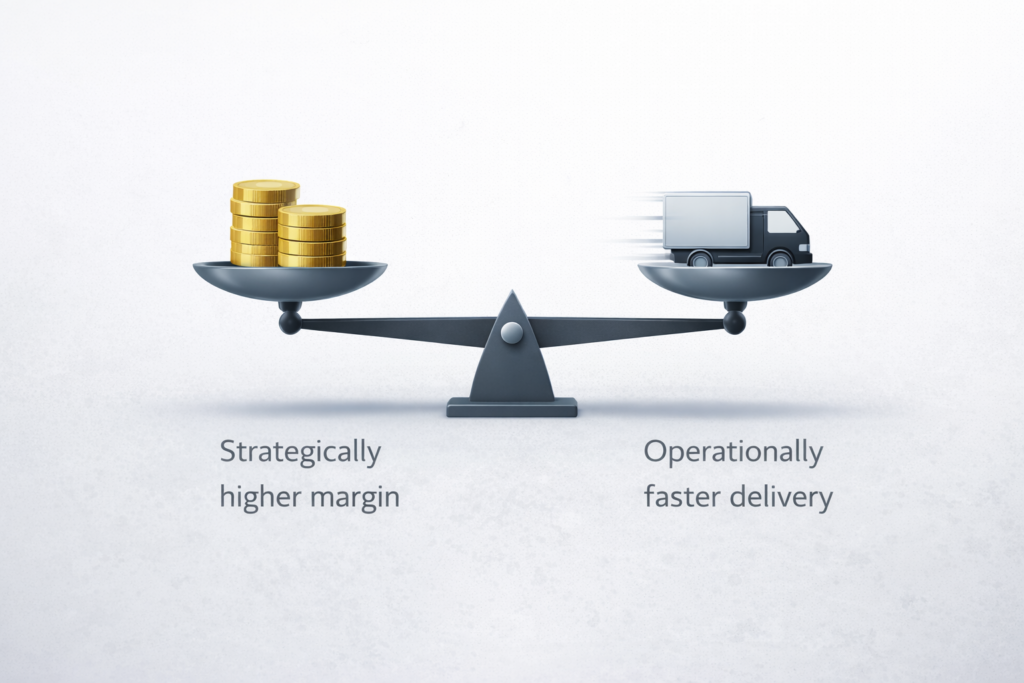
At the center of this comparison is a simple but critical tension: speed versus margin.
DSers leans toward lower product costs, which allows for higher markups. However, this often comes with longer or less predictable delivery times. Customers tolerate this to a point, but beyond that point, refund rates increase and trust declines.
Zendrop moves in the opposite direction. It prioritizes faster and more predictable delivery, which improves customer experience and conversion rates. But because costs are higher, the available margin per order is reduced.
This is not just a pricing issue. It is a strategic decision about what type of business you are building.
If your model depends on aggressive margins and rapid product testing, DSers aligns with that approach. If your model depends on consistency and customer experience, Zendrop aligns better.
Most users try to optimize both simultaneously and end up with neither.
How Each System Breaks
Every system eventually encounters failure. The difference lies in how that failure manifests.
In a DSers-based setup, problems tend to appear as small, distributed issues. A supplier may delay orders. Another may ship inconsistent products. Tracking updates may lag. These issues are frequent, but they are usually contained. You can replace a supplier, remap a product, or adjust your workflow.
The system feels unstable, but it is adaptable.
In a Zendrop-based setup, problems are less frequent but more concentrated. Because fulfillment is centralized, delays or bottlenecks affect multiple orders simultaneously. You cannot simply switch suppliers to bypass the issue. You are tied to the platform’s internal processes.
The system feels stable until it encounters stress, and then the impact is broader.
This difference is not about which system fails more. It is about how failure propagates.
Product Strategy Constraints
Both platforms are often marketed as shortcuts to finding winning products. In reality, they do not solve the product problem at all.
DSers gives you access to a massive catalog of products, but it provides no guidance on which ones have sustainable demand. This leads to a pattern of rapid testing, where users cycle through products hoping to find something that converts.
Zendrop reduces the number of choices through curation. This makes it easier to start, but it also increases overlap between users. When many stores are pulling from the same catalog, differentiation becomes harder.
In both cases, the platform handles logistics, not demand. The responsibility for identifying what to sell remains entirely with the operator.
The Automation Misconception
Automation is one of the most overused terms in ecommerce.
DSers automates the mechanical process of placing orders with suppliers. Zendrop automates the coordination of fulfillment and shipping. Both reduce the amount of manual work required to process transactions.
Neither automates the core drivers of profitability.
Product selection, positioning, pricing, and traffic acquisition remain manual, iterative processes. Automation can make a system more efficient, but it cannot make it profitable on its own.
This is where many users miscalculate. They interpret automation as a substitute for strategy, when in reality it only optimizes execution.
Scaling Is Where Systems Stop Looking Similar
At the entry level, both Zendrop and DSers appear to solve the same problem with roughly comparable efficiency. Orders flow, customers receive products, and the operational layer feels manageable. This is precisely where most evaluations stop, and also where most misunderstandings begin.
The structural difference only becomes visible when order flow stops being occasional and becomes continuous. Scaling is not simply an increase in volume. It is a change in system behavior under sustained load. What worked at ten orders per day is not the same system at one hundred. Latency, inconsistency, and failure modes do not scale linearly; they compound, overlap, and begin to interact with each other.
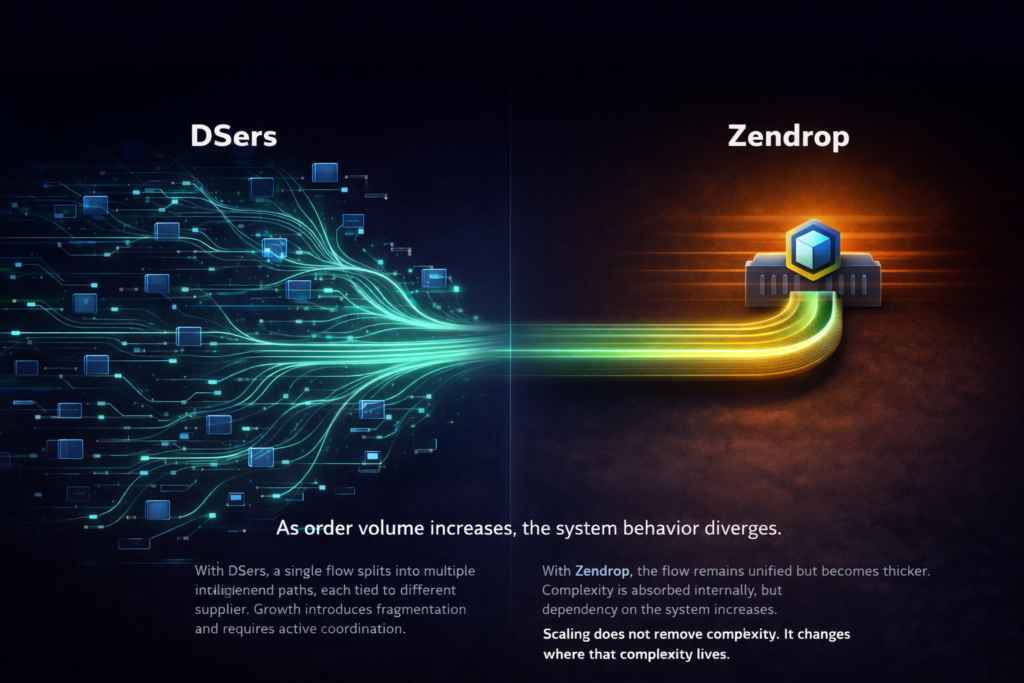
In a DSers-based system, each order is effectively an independent interaction with a supplier-defined reality. That independence is an advantage at low scale, because it gives flexibility. At higher scale, it creates fragmentation. Orders that were once isolated events now form patterns. Supplier delays begin to cluster, tracking inconsistencies begin to overlap, and customer expectations begin to collide with operational variability. The system does not break in a single point; it degrades across many small points simultaneously.
Zendrop eliminates most of that visible fragmentation by collapsing the supply layer into a controlled pipeline. Orders do not branch into multiple independent supplier interactions. They pass through a unified system that standardizes processing and delivery. At moderate scale, this creates a noticeable difference in perceived stability. Fewer unexpected delays, fewer inconsistent outcomes, fewer customer-facing issues. The system appears more mature, even if the underlying demand conditions are identical.
The key distinction is not that one system scales better in absolute terms. It is that they scale differently. DSers scales by expanding complexity across multiple external components. Zendrop scales by intensifying reliance on a centralized internal system.
When Growth Starts Creating Friction
The moment scaling becomes real, the cost of inconsistency becomes measurable. In DSers, the system does not enforce uniform behavior across suppliers, which means variability is not an exception but a baseline condition. At low volume, this is manageable because problems are sparse. At higher volume, those same problems become statistically inevitable.
A delay from one supplier is no longer an isolated issue. It overlaps with delays from others. A tracking inconsistency is no longer a minor inconvenience; it becomes a repeated customer support trigger. Small inefficiencies begin to align in time, and what was previously noise becomes operational drag.
This is the point where DSers transitions from a tool into a system that requires active management. Growth does not remove friction; it amplifies it. Maintaining the same level of customer experience requires disproportionately more intervention. The system remains flexible, but that flexibility demands continuous input.
Zendrop approaches the same scaling phase differently. Because fulfillment is standardized, the system absorbs much of the variability before it reaches the user. Delays still exist, but they are more uniform. Tracking behavior is more consistent. Customer expectations align more closely with actual delivery outcomes. The system appears smoother because it reduces the number of independent variables.
However, this smoothness masks a structural shift. The source of complexity has not disappeared; it has been internalized. Instead of managing multiple suppliers, you are relying on a single system to manage them for you. Instead of solving many small problems, you are trusting one system to prevent large ones.
Dependency Is Not Visible Until You Need Flexibility
At early stages, reduced decision-making feels like efficiency. The absence of supplier selection, routing decisions, and fulfillment variability simplifies execution. The system becomes easier to operate because there are fewer variables exposed to the user.
The limitation appears only when flexibility becomes necessary.
In a DSers-based system, suppliers are explicit components. They can be replaced, optimized, or removed. The system is loosely coupled. Each part can be modified without breaking the whole, even if doing so requires effort. This makes the system adaptable. It may not be stable, but it can be reshaped.
Zendrop operates as a tightly coupled system. The supplier layer is abstracted, which means it is no longer directly accessible. This reduces operational overhead, but it also removes the ability to reconfigure the system at the same level. If performance needs to be optimized or if conditions change, the range of possible actions is narrower.
This is not a short-term issue. It becomes relevant when the business reaches a point where optimization matters more than simplicity. At that stage, the inability to intervene at the supplier level is no longer a convenience. It is a constraint.
Margin Is a System Outcome, Not a Fixed Number
At the surface level, DSers appears to offer higher margins because product sourcing is flexible and often cheaper. Zendrop appears to offer lower margins because pricing includes built-in operational efficiency. This comparison is incomplete because it treats margin as static.
Margin is not determined at the point of sale. It is determined by how the system behaves after the sale.
In a DSers workflow, margin is exposed to variability. A delayed shipment can trigger a refund. A quality inconsistency can trigger a dispute. A lack of tracking clarity can increase support overhead. These events do not happen in isolation. They interact. A single problematic batch of orders can affect multiple cost layers simultaneously.
The result is that margin becomes unstable. It fluctuates based on operational noise rather than purely on pricing strategy. At low volume, this instability is less visible. At higher volume, it becomes a defining characteristic.
Zendrop reduces that instability by standardizing fulfillment. Fewer unexpected delays mean fewer refunds. More consistent delivery reduces customer dissatisfaction. The system narrows the range of possible negative outcomes. This stabilizes margin behavior, even if the absolute margin per order is lower.
The tradeoff is structural. DSers allows margin expansion but exposes it to degradation. Zendrop limits margin expansion but protects it from volatility.
The Real Constraint Is Not the Platform – It’s the Operator Fit
At this stage, the comparison stops being technical and becomes behavioral. The same system can produce different outcomes depending on the operator using it. Some operators are comfortable managing variability, making rapid adjustments, and optimizing across multiple moving parts. Others perform better in structured environments where the system absorbs complexity.
DSers rewards operators who can tolerate inconsistency and respond to it quickly. It provides the tools to optimize, but it does not simplify the environment. Zendrop rewards operators who prefer predictability and are willing to accept structural limitations in exchange for stability.
The mismatch between operator and system is where most failures occur. Users who seek simplicity but choose DSers are overwhelmed by operational noise. Users who seek control but choose Zendrop are constrained by the system’s boundaries.
The platform does not determine success. It determines the type of problems the operator must solve.
Where the Problem Lives Defines the Business
The most accurate way to understand the difference between Zendrop and DSers is to identify where each system places its problems.
In DSers, problems exist outside the system, in suppliers, logistics, and variability. You have visibility and the ability to intervene, but you are responsible for managing instability.
In Zendrop, problems exist inside the system, within the platform’s internal processes. You are shielded from variability, but you are also limited in how you can respond to it.
Neither approach removes complexity. It redistributes it.
This redistribution defines how the business behaves over time. It determines how margins respond to pressure, how scaling affects operations, and how adaptable the system is when conditions change.
Conclusion
Zendrop and DSers are often positioned as competing tools, but they are better understood as different system architectures.
DSers distributes risk across multiple independent components, creating flexibility at the cost of stability. Zendrop centralizes risk within a controlled pipeline, creating stability at the cost of flexibility.
At low scale, this difference is easy to ignore. At higher scale, it becomes decisive.
The correct choice is not about features or pricing. It is about alignment between the system and the operator. It is about understanding where complexity exists, how it behaves under pressure, and whether you are equipped to manage it.
Choosing the wrong system does not fail immediately. It fails later, when scale exposes what the system was designed to optimize all along.
One response to “Zendrop vs DSers (2026): The Structural Difference Most Reviews Miss”
-
I still lean slightly toward DSers, but mostly for one reason: I like seeing where the problems actually are. Zendrop feels cleaner on the surface, sure, but that also means you’re trusting a black box. With DSers, the mess is real, but at least it’s visible. That’s annoying operationally, yet for some people it’s still better than being locked into a system you can’t really inspect or rework. Not saying DSers is “better” overall – just more honest about the tradeoff.

Related Articles
Leave a Reply