

Shopify currently powers more than 4.8 million active stores worldwide and holds roughly 10% of total global e-commerce market share. For many entrepreneurs, it is the default first choice: a polished brand, a familiar checkout experience, and an enormous ecosystem of apps and integrations. Yet beneath the marketing veneer, a substantial and consistent body of complaints has been accumulating across review platforms, community forums, Reddit threads, and developer communities. These are not isolated edge cases. They form identifiable patterns that any prospective or current merchant should understand before committing to the platform.
This article examines the most significant and recurring Shopify problems reported by real users – from hidden cost structures and arbitrary account suspensions to deteriorating customer support and dangerous over-dependence on third-party apps. The goal is not to condemn a platform that genuinely works well for many businesses, but to offer an honest analytical view of where it fails and why those failures matter.
1. The True Cost of Shopify: A Fee Structure Built to Extract
The most persistent category of Shopify complaints is financial. On the surface, Shopify’s pricing looks straightforward: a Basic plan at $39/month, a standard Shopify plan at $105/month, and an Advanced plan at $399/month. The reality merchants encounter is considerably more complicated.
The Third-Party Payment Penalty
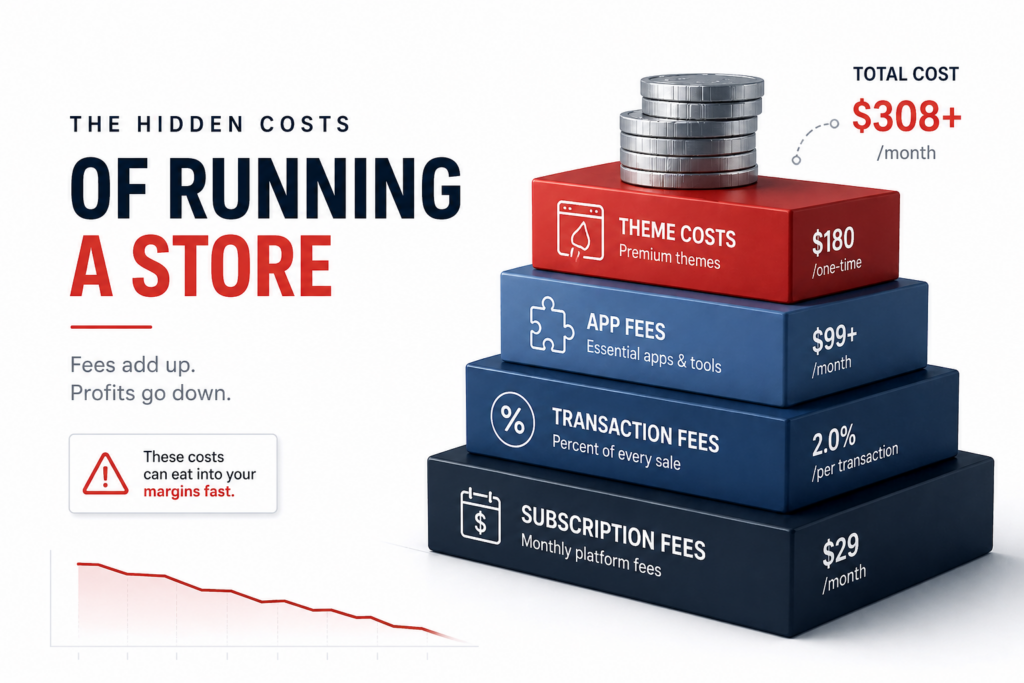
The most criticized element of Shopify’s pricing is its transaction fee policy for merchants who use payment processors other than Shopify Payments. On the Basic plan, Shopify charges an additional 2% on every transaction processed through a third-party gateway. That fee drops to 1% on the standard plan and 0.5% on Advanced – but it never disappears entirely unless merchants use Shopify’s own payment system.
For businesses that cannot access Shopify Payments – which is unavailable in dozens of countries and restricted for certain product categories – this penalty is inescapable. A merchant processing $50,000 per month through a third-party processor on the Basic plan faces $1,000 in extra fees monthly, or $12,000 annually, simply for not using Shopify’s preferred gateway. As one analyst put it bluntly: merchants are effectively penalized for choosing their own payment method.
Even for those using Shopify Payments, the processing rates themselves are not especially competitive. The Basic plan charges 2.9% + $0.30 per online transaction regardless of sales volume – meaning a merchant doing $500,000 a year gets the exact same rate as someone doing $10,000. There is no volume discount negotiation, no interchange-plus pricing, no flexibility. For high-volume sellers, this rigidity can cost significantly more than a dedicated merchant account where rates as low as 1.8% + $0.20 per transaction are achievable.
The App Stack: Subscription Creep
Shopify’s base platform is deliberately lean. Many features that merchants expect to be standard – advanced filtering, subscription management, loyalty programs, custom product fields, B2B pricing tiers, review systems, upsells – require paid third-party apps. The Shopify App Store contains over 10,000 apps, many of which charge $10–$100 or more per month individually.
The cumulative effect on costs is striking. A merchant who starts on the $39/month Basic plan and installs a reasonable selection of apps to run a functional store – email marketing, reviews, upsells, subscriptions, returns management, advanced SEO – can easily find themselves paying $150–$300+ per month before a single transaction fee is counted. One common complaint found across Trustpilot and Reddit is the experience of a merchant who builds their entire stack, only to realize months later that their actual monthly platform cost has tripled from what they originally budgeted.
This “subscription creep” is not accidental. It reflects a deliberate platform architecture where Shopify monetizes its ecosystem partly by enabling third-party developers to sell solutions to gaps it leaves in the core product.
Theme Costs and One-Time Fees
Premium Shopify themes – which often provide the visual differentiation merchants need to look professional- cost between $180 and $350 as a one-time purchase. For new merchants building a brand on a tight budget, this is a meaningful upfront expense that is often not mentioned prominently in Shopify’s marketing materials. Free themes exist, but they are limited in design flexibility, and most serious stores eventually require a paid option.
2. Account Suspensions and Payment Holds: An Operational Nightmare
One of the most alarming categories of Shopify complaints involves unexpected account suspensions and payment holds. The combination of opaque enforcement, slow response times, and Shopify’s contractual right to terminate “for any reason, without notice and at any time” creates a high-risk environment for merchants whose entire revenue depends on the platform.
Sudden Suspensions Without Warning
Across the Shopify Community forums, Reddit, and Trustpilot, hundreds of accounts describe the same pattern: a store is built, products are listed, and then – without warning – the store is taken offline. No prior email, no grace period, no clear explanation. Merchants are left unable to serve customers, fulfill orders, or even access their own product data.
Shopify’s Terms of Service, specifically Section 14.3, grants the platform the right to suspend any account at any time for any suspected violation. While this clause is legally common among SaaS providers, the practical application – particularly the absence of communication and the length of time before resolution – consistently draws criticism.
One documented case in the Shopify Community forums describes a new merchant whose store was taken offline after just seven days of operation, with no reason provided. Despite reaching out to support, the merchant waited 14+ days with no meaningful response, estimating losses of over $10,000. Shopify’s resolution? An offer of one free month of their service plan.
Shopify Payments Account Holds and the 120-Day Reserve Problem
Separate from full account suspension is the issue of payment holds under Shopify Payments. Merchants whose Shopify Payments accounts are flagged – for chargeback rates above 1%, unusual sales spikes, or perceived fraud risk – can have their funds placed in a reserve for up to 120 days. During this period, they continue operating their store, fulfilling orders, and incurring costs – but cannot access their revenue.
Multiple Trustpilot reviews describe merchants with suspended Shopify Payments access who then lose visibility into their reserve balances, chargeback decisions, and release timelines because they no longer have admin access. One merchant stated that after opening five support tickets over two months, every response promised escalation to a “dedicated team” – and that team never responded. Thousands of euros remained held with no clarity on when or whether they would be released.
This dynamic is particularly damaging for small businesses where cash flow is fragile. A 120-day freeze on receivables, combined with inaccessible admin panels and unresponsive support, can be commercially catastrophic.

The GMC Ban Problem for New Stores
A specific and growing concern in forums is the rate at which new Shopify stores get banned from Google Merchant Center (GMC) within days of launch. New accounts reportedly face alarming ban rates, with merchants citing misrepresentation flags even when their stores fully comply with Google’s policies. This creates a double-bind: a new merchant loses their primary paid acquisition channel at the exact moment they need it most, and both Google and Shopify offer limited help in resolving the issue.
3. Customer Support: The Decline of a Once-Respected Reputation
Shopify’s customer support was once considered a genuine differentiator. Among merchants who have been on the platform for five or more years, a consistent narrative emerges: support used to be fast, human, and effective. Something changed.
The AI Support Transition
In its effort to scale support across millions of merchants, Shopify has heavily invested in AI-powered chat assistants. The result, according to merchants, has been a dramatic deterioration in the quality of support interactions. Forum users describe support bots that respond to complex technical issues with generic links to help articles already tried, or with prompts to clear browser cache. The shift has been described by community members as making things “dramatically worse.”
The escalation path is no longer a resolution path. Merchants report being told their issues will be escalated to a technical team – and then receiving no follow-up for days or weeks. For time-sensitive issues like payment holds or store downtime during peak sales periods, this response lag is commercially damaging.
Shopify Plus: Premium Price, Diminished Support
Perhaps the most stinging criticism in recent months comes from long-term Shopify Plus merchants. Shopify Plus costs $2,000+ per month and is marketed partly on the promise of superior support and dedicated merchant success management. Multiple recent Trustpilot reviews from Plus merchants tell a very different story.
One merchant, an eight-year Shopify customer, described reaching out in early 2025 to discuss downgrading their Plus contract as their business faced a revenue decline. Over the following 14 months, they were passed between eight different “Merchant Success Specialists,” none of whom had authority to adjust the contract. When they requested a phone call to discuss options, they were quoted a $50 charge to speak with a “Growth Specialist.” A Shopify agent eventually acknowledged on a recorded chat that the merchant did not even have an assigned Customer Success Manager – despite paying over $24,000 annually for a plan that explicitly implies dedicated support.
This pattern – premium pricing without premium accountability – represents one of the most serious trust failures on the platform.

4. App Dependency and Platform Fragility
Shopify’s architecture deliberately offloads much of its functionality to the App Store ecosystem. This creates flexibility – but it also creates serious fragility.
Performance Degradation from App Bloat
Data from performance analytics specialists reveals that third-party apps are responsible for approximately 75% of page load time on the average Shopify store. The average Shopify store runs nearly 60 third-party apps, creating complex interdependencies that progressively slow site performance. A store that launches with a clean, fast-loading theme can see its PageSpeed score drop from 95 to 60 after installing a handful of apps – each individually justified, but collectively damaging.
Slower page speeds have direct, quantifiable revenue impact. Studies consistently show that every additional second of load time reduces conversion rates. For Shopify merchants, the irony is that the apps they install to improve revenue (upsells, personalization, reviews, email capture) may simultaneously be undermining it through performance degradation.
App Conflicts and the Support Gap
When apps conflict with each other or break theme functionality, merchants are left in a support vacuum. Shopify only provides support for apps built by Shopify itself. For the vast majority of App Store apps – built by thousands of independent developers – merchants must contact each developer separately. When a bug cannot be attributed to a single app and appears to emerge from an interaction between two or more apps, there is no clear owner of the problem, and merchants can spend days or weeks troubleshooting without resolution.
API Changes and Integration Instability
Shopify maintains a quarterly API versioning cycle that has caused significant integration problems for merchants relying on custom-built solutions. In early 2025, the deprecation of REST API endpoints for product data broke integrations across thousands of stores and third-party services that had not updated to Shopify’s GraphQL APIs. In late 2025, Shopify announced the deprecation of the custom app creation flow with only two months’ notice – a timeline developers described as “ridiculously rushed” compared to industry norms of a full year.
For merchants whose business operations depend on stable integrations – inventory sync, ERP connections, multi-channel fulfillment – these unilateral changes introduce operational risk that is difficult to anticipate and expensive to remediate.
5. Fraud, Scams, and Platform Accountability
A dimension of Shopify complaints that affects buyers more than merchants – but which reflects on the platform’s overall governance – is the prevalence of fraudulent stores operating on Shopify infrastructure.
Trustpilot reviews for Shopify are replete with consumer accounts of non-delivery, counterfeit goods, and outright scam operations. The common thread in these reports is Shopify’s position: it is a platform provider, not a retailer, and therefore not responsible for transactions between consumers and merchants. Shopify’s official response typically directs buyers to contact the merchant directly – a resolution path that, by definition, fails when the merchant is fraudulent.
Critics argue that Shopify’s fee-based model creates a perverse incentive structure. As long as a scam store is paying Shopify’s monthly subscription and generating transaction volume, Shopify receives revenue from it. The platform does take action when abuse is reported, but the threshold and speed of enforcement are contested. UK Trustpilot reviewers have described Shopify as appearing “complicit” by continuing to host stores already known to be fraudulent to other affected buyers.
For legitimate merchants, this dynamic creates a brand association risk. When buyers have negative experiences with fraudulent Shopify-hosted stores, their distrust can extend to the platform brand itself, affecting consumer confidence in legitimate stores operating on the same infrastructure.

6. SEO Limitations and URL Structure Issues
For merchants who depend on organic search as a significant acquisition channel, Shopify’s approach to URL architecture has been a long-standing source of frustration.
Shopify forces a rigid URL structure: products always live under /products/, collections under /collections/, and blog posts under /blogs/. There is no native option to customize this structure. For merchants migrating from other platforms where their product pages had different URL formats, this creates unavoidable redirect chains that can erode hard-won search rankings.
The more persistent issue is the duplicate content created by Shopify’s collection-product URL pattern. When a product appears in multiple collections, Shopify generates multiple URLs for the same product – the canonical product URL and a collection-scoped variant. While Shopify does add canonical tags to address this, the implementation is not always clean, and SEO practitioners continue to report crawl budget inefficiencies and indexation issues in larger stores.
Advanced SEO capabilities – structured data injection, comprehensive log file analysis, bulk meta tag editing – require paid third-party apps, adding once again to total cost of ownership.
7. B2B and Wholesale: A Platform Not Built for Complexity
Shopify was architected around direct-to-consumer retail. Merchants in the B2B or wholesale space consistently encounter fundamental limitations that the platform’s standard plans do not address.
Tiered pricing by customer group, purchase order workflows, credit terms, net payment options, and complex product variant configurations (beyond the 100-variant limit) all require either Shopify Plus (minimum $2,000/month) or expensive custom development. For mid-market B2B businesses, this creates a difficult calculus: either absorb significantly higher platform costs or compromise on operational capabilities.
The 100-variant limit – Shopify’s cap on the number of variants a product can have – is a particular pain point for businesses with complex SKU structures (configurable products, multiple size/color/material combinations). While workarounds exist, they introduce UX compromises and technical debt.
8. Lock-In and Data Portability
A concern that becomes most acute when a merchant wants to leave Shopify is the degree of platform lock-in the ecosystem creates.
Shopify’s custom Liquid templating language means that any theme customization work is not transferable to another platform. The Shopify Payments history does not export in formats compatible with other payment processors. Apps built for Shopify do not function elsewhere. Customer accounts, while exportable as CSV files, lose loyalty program integrations, purchase history tags, and any custom metafields.
For large merchants who have invested years building a Shopify ecosystem, migration to another platform represents not just a technical project but a potential rebuild of significant portions of their technology stack. This switching cost is Shopify’s most effective retention mechanism – and it is one that some long-term users feel was not fully transparent at the outset.
A Balanced Assessment: Why Shopify’s Problems Don’t Define It
Recognizing these problems is not the same as recommending against Shopify. For most small to medium direct-to-consumer merchants, the platform remains one of the most capable and well-supported options on the market. Its checkout conversion rates are strong, its hosting infrastructure is reliable, and the breadth of its app ecosystem – despite the problems it creates – is genuinely unmatched.
The issues described above affect specific merchant profiles most acutely: high-volume merchants with tight margins who face compound fee structures; merchants in restricted payment geographies; businesses with complex B2B workflows; and any merchant who encounters an enforcement action and needs rapid, human support.
What makes these problems analytically significant is their persistence. Many of the complaints documented here are not new – they have appeared consistently across forums and reviews for several years. The fee structure, the app dependency model, the support quality decline, and the account suspension opacity represent structural characteristics of the platform, not bugs that will be patched in the next update. Merchants who understand this are better positioned to build a resilient business on Shopify – or to make an informed decision that a different platform is a better fit for their specific needs.
Key Takeaways for Prospective Merchants
Before committing to Shopify, merchants should honestly evaluate the following:
On costs: Calculate your actual monthly cost including apps, themes, transaction fees at expected sales volume, and payment processing fees – not just the headline plan price. Model scenarios where your sales volume triples: will the fee structure scale favorably?
On payments: If you are outside a Shopify Payments-supported country, or sell products in restricted categories, factor in the transaction fee penalty from day one. It does not get negotiated away.
On support: If your business cannot tolerate even 48-72 hours of downtime or account issues without significant financial harm, build a contingency plan. Do not rely on Shopify’s support response times for time-critical resolutions.
On apps: Every app you install is a dependency. Audit your stack regularly. Understand that Shopify does not support third-party apps, and that conflicts between apps can create problems that nobody officially owns.
On lock-in: Build with migration in mind. Export your customer data regularly. Document your customizations. The switching cost from Shopify is high – but merchants who are surprised by it typically did not plan for it.
Shopify is a powerful platform. It is also one that demands informed, clear-eyed engagement. The complaints documented across forums, review platforms, and community discussions are not the grievances of incompetent merchants – they are the feedback of real businesses encountering real structural limitations. Taking that feedback seriously is the first step to using the platform well.
EcomReality is an independent publication and is not affiliated with, sponsored by, or endorsed by Shopify or any other platform mentioned in this article. Content is based on publicly available sources and is intended for informational purposes only.Share

Croom Raymond is an ecommerce writer and digital business researcher at Ecom Reality. He covers online selling platforms, SaaS tools, pricing structures, platform features, and practical strategies for building digital businesses. His articles focus on clear, evidence-based analysis that helps readers understand how different services work, compare their advantages and limitations, and make more informed business decisions.
Comments
Leave a Reply
Related Articles



Leave a Reply